
When Arguments Feel Endless, It’s Time to Find Help Close to Home
Marital counseling near me is one of the most searched phrases by couples who have finally decided that something needs to change.
If you need a quick answer, here’s what to know right away:
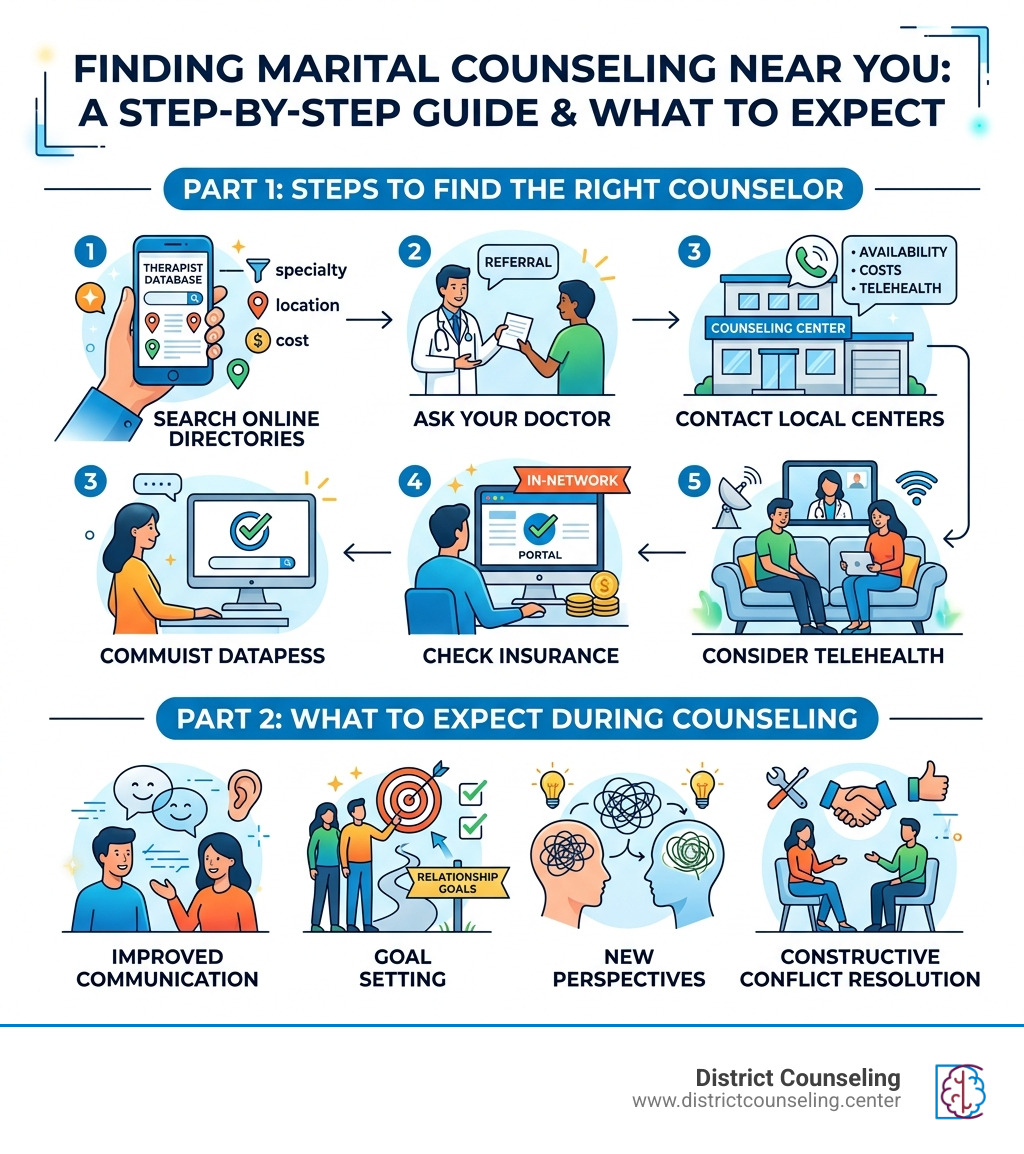
How to find marital counseling near you:
- Search online directories like Psychology Today to filter therapists by location, specialty, and cost
- Ask your primary care doctor for a referral to a licensed marriage and family therapist (LMFT)
- Contact a local counseling center directly and ask about availability, session costs, and telehealth options
- Check your insurance portal for in-network couples therapists in your area
- Look for telehealth options if in-person appointments are hard to fit into a busy schedule
Marriages hit rough patches. That is not a sign of failure. In fact, research shows that over 50% of marriages in developed countries end in divorce — often because couples wait too long to get help.
The good news? Counseling works. Many couples notice real improvement within just 8 to 12 sessions.
Whether you are dealing with repeated arguments, growing distance, or a serious breach of trust, a trained therapist can help you and your partner find a path forward — together or separately, with clarity either way.
I’m Francisco Ortiz, a Licensed Professional Counselor-Supervisor with extensive experience providing counseling and psychotherapy to couples and families facing relationship conflicts, trauma, and mood challenges — the exact issues that bring most people searching for marital counseling near me. As the founder of AdventMind by District Counseling, I’ve worked with individuals and couples across Texas and understand what it takes to move from stuck to supported.
Understanding the Basics: Marital Counseling vs. Couples Therapy
When you start your search for marital counseling near me, you might notice that the terms “marital counseling” and “couples therapy” are used interchangeably. While they share the same goal—helping partners improve their relationship—there are subtle differences in their historical focus and duration.
Marital counseling is often viewed as a shorter-term form of therapy. In many cases, the process may last between four and eight sessions. It typically focuses on specific, present-day issues such as improving communication, resolving a particular conflict, or preparing for a life transition.
On the other hand, couples therapy often dives deeper into the relational dynamics and history. These sessions can last 12 weeks or much longer. The focus here is frequently on identifying unhealthy interaction patterns that have developed over years. Whether you are legally married or in a committed partnership, both approaches treat the relationship itself as the “client.” At District Counseling, we offer Relationship Marital Counseling in Houston and across Texas to help you navigate these nuances.
Signs You Might Need Marital Counseling
It is a common myth that you only need a therapist when you are on the brink of divorce. In reality, the most successful outcomes often happen when couples seek help proactively. If you find yourself searching for marital counseling near me, you likely already feel that something is “off.”
Here are common signs that it is time to reach out:
- Repetitive Arguments: You find yourselves having the same fight over and over again without any resolution.
- Communication Breakdowns: You feel like you are speaking different languages, or you have stopped talking about anything deeper than the grocery list.
- Emotional Distance: You feel more like roommates than romantic partners.
- Trust Issues: Whether due to infidelity or smaller, consistent broken promises, the foundation of trust feels shaky.
- Life Transitions: Major changes like a new baby, a career shift, or becoming empty nesters have created friction.
- The “Mental Load”: One partner feels overwhelmed by the domestic and emotional responsibilities, leading to deep resentment.
How Marital Counseling Works: What to Expect
Walking into a therapist’s office for the first time can feel intimidating. You might worry the therapist will “take sides” or that you’ll spend the whole hour being blamed. At District Counseling, our approach is sincere and compassionate; we are here to support the health of the relationship, not to act as a judge.
The First Session
In your initial meeting, the therapist will gather a detailed history of your relationship. You will discuss your current concerns, your strengths as a couple, and what you hope to achieve. This is a time for assessment and education. The therapist will help you identify the “invisible patterns” that lead to your conflicts.
The Process
After the assessment, sessions become more active. We don’t just ask, “How does that make you feel?” We work to interrupt conflict cycles in real-time. You might be asked to practice new communication skills during the session so you can take those tools home. Many couples experience noticeable improvement within 8–12 sessions of focused work.
Effective Methods in Marital Counseling
Not all counseling is the same. Science has given us highly effective, evidence-based methods to help couples reconnect.
- The Gottman Method: This approach is based on decades of research. It focuses on building the “Sound Relationship House” by increasing intimacy, respect, and affection. It provides practical tools to disarm conflict and create shared meaning.
- Emotionally Focused Therapy (EFT): EFT looks at the attachment bonds between partners. It helps couples understand the deep emotional needs—like the need to feel safe and valued—that often drive heated arguments.
- Solution-Focused Therapy: This is a shorter-term approach that focuses on your strengths and finding immediate, practical solutions to current problems.
We utilize these methods across our locations, including Relationship Marital Counseling in Austin and Relationship Marital Counseling in Fort Worth.
Duration and Success Rates: Is It Worth It?
One of the most frequent questions we hear is, “How long will this take?” The duration of counseling depends on the complexity of the issues and the level of commitment from both partners. While some see shifts in 4 to 8 sessions, deeper issues like trauma or betrayal may require longer care.
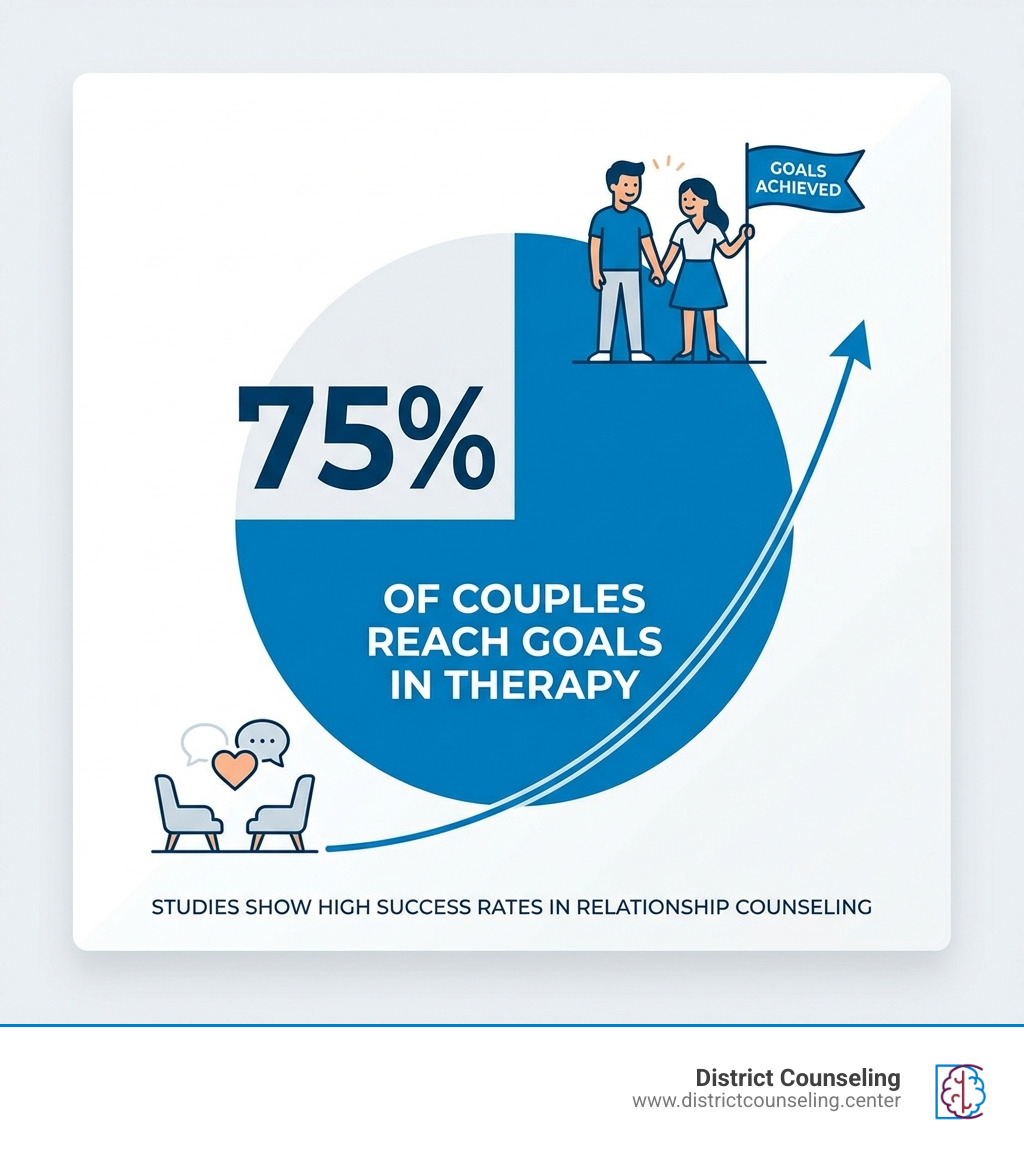
Is it effective? Absolutely. Statistics show that over 75% of clients in specialized relationship centers reach or exceed their goals. Seeking help is a sign of resiliency, not failure. It is an investment in your personal wholeness and relational peace.
Specialized Services: Infidelity, Premarital, and More
Marital counseling isn’t a one-size-fits-all service. Different stages of a relationship require different types of support.
- Infidelity Recovery: Rebuilding trust after an affair requires a structured process of accountability and transparency. We help couples cope with the trauma caused by infidelity and decide how to move forward.
- Premarital Counseling: This is for couples who want to build a strong foundation before saying “I do.” It covers topics like finances, parenting styles, and conflict resolution.
- Discernment Counseling: Sometimes one partner wants to save the marriage while the other is leaning toward divorce. This specialized process helps couples gain clarity and confidence in their next steps.
- Intensive Counseling: For couples in crisis, intensive sessions (sometimes lasting several hours over a few days) can provide a “jumpstart” to healing that weekly sessions might not achieve.
The Cost of Counseling and Insurance Considerations
Cost is a valid concern for many families. In the Texas market, session rates can vary based on the therapist’s experience and location. While some insurance plans cover behavioral health, many do not cover “marriage counseling” specifically unless it is part of treating a diagnosed mental health condition for an “identified client.”
At District Counseling, we aim for transparency. Many couples find that the cost of counseling is a vital investment compared to the emotional and financial toll of a divorce. We provide Services across a wide range of needs to ensure you get the specific care you require.
Choosing the Right Marital Counselor Near You
Finding a therapist is like finding a good pair of shoes—the fit matters most. When searching for marital counseling near me, consider the following:
- Credentials: Look for a Licensed Professional Counselor (LPC) or a Licensed Marriage and Family Therapist (LMFT).
- Specialization: Ensure they have specific training in couples work, such as the Gottman Method or EFT.
- Location and Convenience: We have offices throughout the Houston area, including Relationship Marital Counseling in Katy, Relationship Marital Counseling in Cypress, and Relationship Marital Counseling in Sugar Land.
- Comfort Level: Most therapists offer a brief consultation. Use this to see if you feel heard and respected.
Finding Local Support in Texas
If you are in the Lone Star State, District Counseling provides extensive coverage. Whether you are in the heart of the city or the suburbs, we have a location near you:
- North Houston: Relationship Marital Counseling in Spring, Relationship Marital Counseling in Tomball, and The Woodlands.
- West Houston: Relationship Marital Counseling in Copperfield, Katy, and Relationship Marital Counseling in Spring Branch.
- South Houston: Relationship Marital Counseling in Pearland and Relationship Marital Counseling in Missouri City.
- Central and Beyond: CityCentre, Memorial, Greater Heights, Pasadena, and our offices in Austin and Fort Worth.
Online vs. In-Person Counseling: Which is Better?
In April 2026, the flexibility of therapy has never been greater.
- In-Person Counseling: Offers a neutral, physical space away from the distractions of home. It can make it easier for the therapist to read body language and for partners to feel fully present.
- Online Counseling: Telehealth Counseling is incredibly effective and convenient. It eliminates commute time and allows you to attend sessions from the comfort of your own home. For many busy Texas couples, this is the key to maintaining consistency in therapy.
What If My Partner is Reluctant?
It is common for one partner to be more “ready” for therapy than the other. If your spouse is hesitant, don’t force them. Instead:
- Express your own needs: Focus on how you are feeling and why you want the relationship to improve.
- Start individually: You can begin your own journey with Individual Counseling. Improving your own communication and coping skills can often shift the relationship dynamic, sometimes encouraging the other partner to join later.
- Suggest a trial: Ask for a commitment to just three sessions to see how it feels.
Real Outcomes: What Growth Looks Like
Successful counseling doesn’t mean you will never argue again. It means you will have the tools to improve communication with your spouse so that arguments don’t turn into “wars.”
Couples who complete the process often report:
- Feeling like a team again.
- Understanding their partner’s “triggers” and how to avoid them.
- Rebuilding physical and emotional intimacy.
- Having a clear plan for the future.

Next Steps: Start Your Healing Journey Today
If you have been searching for marital counseling near me, the most important step is the first one. You don’t have to stay stuck in a cycle of frustration and silence.
At District Counseling, we are dedicated to helping Texas couples find their way back to each other. Our Therapists are ready to provide the compassionate, expert guidance you need.
Take the next step now:
- Browse our locations to find an office near you.
- Read our blog for tips on how to build trust and what makes love last.
- Reach out to schedule a consultation and begin making the change you long for.
Your relationship is worth the effort. Let’s start the conversation.
Book Your Session at District Counseling
Visited 5 times, 1 visit(s) today



Similar Posts

Francisco Ortiz
October 19, 2026
Why therapy for caregiver exhaustion is a necessity not a luxury
Back-to-School Mental Health: Tips for a Smooth Transition – Discover practical tips to ease back-to-school anxiety for kids, teens, and parents. Build healthy routines, manage stress, and foster emotional… …...

Francisco Ortiz
October 16, 2026
Navigating Neuropsychological Evaluations from Katy to Pasadena
Learn how an ADHD evaluation for Houston teens works, from medication management to school accommodations and 504 plans....

Francisco Ortiz
October 14, 2026
How Texas caregivers can beat exhaustion with virtual therapy
Beat caregiver exhaustion therapy Texas caregivers trust—virtual sessions for stress, boundaries, and recovery. Start today....

Francisco Ortiz
October 12, 2026
Find Local Youth Counselor: How They Can Help Your Teen Thrive (52 characters)
Find a qualified youth counselor near me to help your teen thrive with evidence-based support for anxiety, trauma, and more....

Francisco Ortiz
October 9, 2026
Faith-Based Pastoral Counseling: A Comprehensive Guide
Discover how pastoral counseling integrates faith and psychology for holistic healing, grief, trauma, and marital support....

Francisco Ortiz
October 7, 2026
Houston Counseling Options: Find Local Help Nearby
Find affirming counseling in Houston for trauma, LGBTQ+ care, couples, and more. Explore local options and start your healing today....

Francisco Ortiz
October 5, 2026
Why every teacher needs a burnout therapy game plan
Why every teacher needs a burnout therapy game plan – Learn about burnout therapy for teachers...

Francisco Ortiz
October 2, 2026
Child Therapist Near Me? Here is How to Spot a Great One
Find a child therapist near me who fits your child’s needs. Learn signs, costs, and effective therapy options....

Adalid Blandin
September 30, 2026
Mental Health and Miracles: Finding Local Christian Care
Find pastoral counselling near me for faith-based emotional and spiritual support in Texas....

Adalid Blandin
September 28, 2026
Missouri City and Houston Couples Therapy 101
Explore relationship counseling in Houston options, from couples therapy to intensives, with costs, insurance, and therapist tips for Missouri City families....


