
Demystifying the Court-Ordered Mental Health Evaluation Process
What Is a Court-Ordered Mental Health Evaluation?
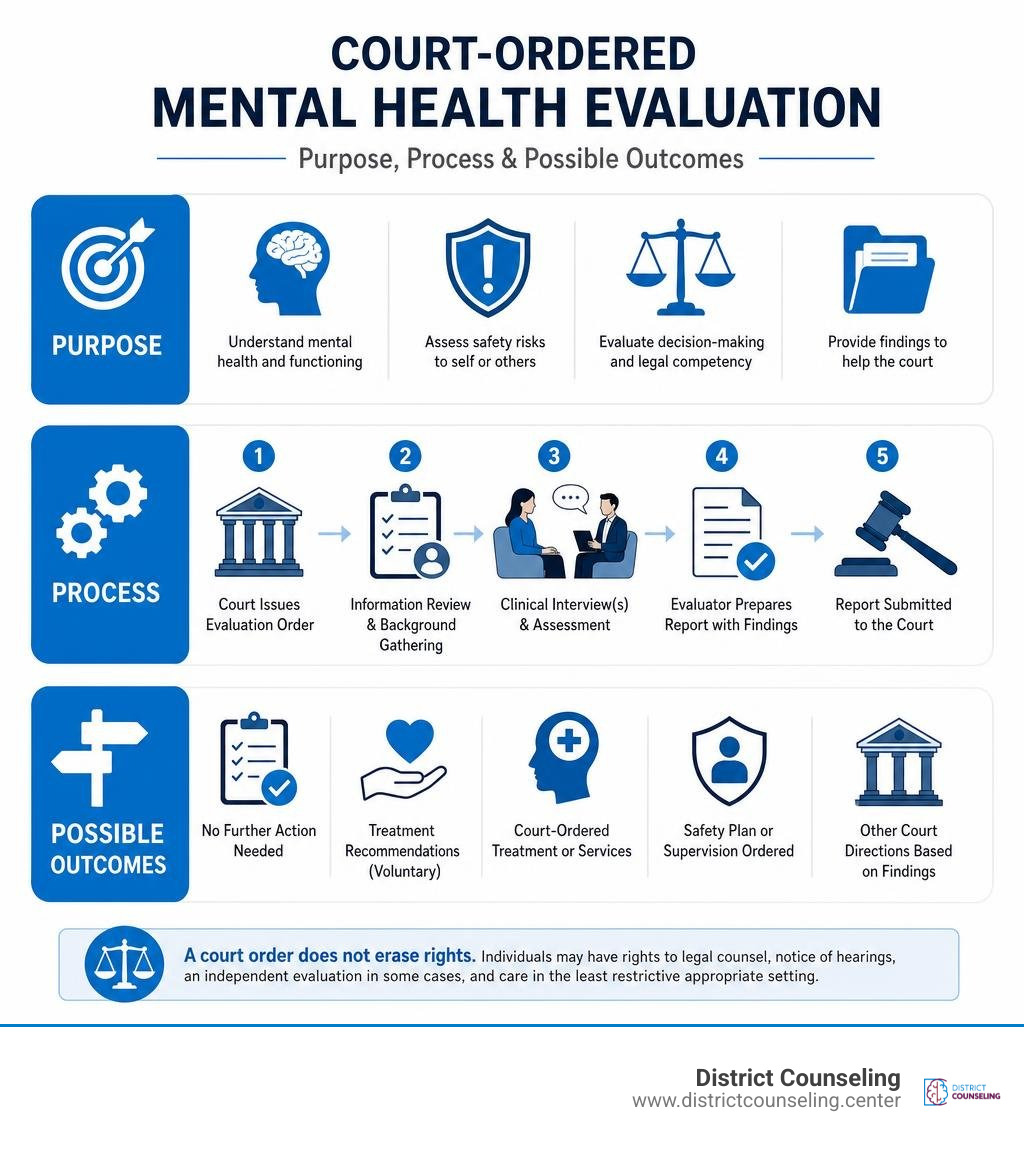
A court ordered mental health evaluation is a formal assessment requested or required by a judge to help the court understand a person’s mental health, safety risks, decision-making ability, or legal competency. A qualified mental health professional reviews relevant information and provides findings to the court; it is not the same thing as a treatment order or a diagnosis by itself.
These evaluations can arise in criminal cases, child custody disputes, civil commitment matters, sentencing, and other legal proceedings. The exact rules depend on the state and the reason for the order. For example, Texas requires specific medical certificates before many hearings for court-ordered mental health services, while Florida generally limits an involuntary examination period to up to 72 hours.
A court order does not erase a person’s rights. The person may have rights to legal counsel, notice of hearings, an independent evaluation in some cases, and care in the least restrictive appropriate setting. Still, refusing a valid order can lead to serious legal consequences.
I am Francisco Ortiz, a Licensed Professional Counselor-Supervisor and Certified Forensic Mental Health Evaluator with experience conducting forensic assessments for complex legal proceedings, including competency and child custody matters. In this guide, I will explain what a court ordered mental health evaluation involves, why courts request one, and what may happen next.
Legal Criteria and State Variances for Mental Health Assessments
Courts do not issue orders for psychological testing on a whim. For a court to order an evaluation, specific statutory criteria must be satisfied. Generally, the court must see clear evidence that an individual’s mental health condition is directly relevant to a legal determination—such as their capacity to stand trial, risk of danger to self or others, ability to care for personal safety, or fitness to parent.
In civil commitment cases, the legal threshold usually centers on whether the person presents an immediate danger to self or others, or is so gravely disabled that they cannot meet their basic human needs. In criminal proceedings, the focus shifts to whether a mental disorder prevents the defendant from understanding the nature of the charges or assisting their defense attorney.
State-Specific Regulations: Texas, Florida, Arizona, Ohio, and Idaho
Because mental health laws are primarily established at the state level, the rules and timelines for evaluations vary significantly across state lines:
- Texas: Under Texas Health and Safety Code Section 574.009, a court cannot hold a hearing on an application for court-ordered mental health services unless at least two certificates of medical examination for mental illness are filed with the court. These examinations must be completed by two different physicians within the preceding 30 days, and at least one examiner must be a psychiatrist if one is available in the county.
- Florida: Under Chapter 394 (the Baker Act), a person can be taken for an involuntary examination if there is reason to believe they have a mental illness and face substantial risk of self-neglect or serious bodily harm. The hold period lasts up to 72 hours, though for minors, the examination process must be initiated within 12 hours of arrival at the receiving facility.
- Arizona: A court-ordered evaluation (COE) involves holding an individual in a behavioral health facility for up to 72 hours. During this period, two independent behavioral health medical professionals conduct evaluations to assess if the person is a danger to self, a danger to others, persistently or acutely disabled, or gravely disabled.
- Ohio: In criminal cases governed by Section 2919.271 of the Ohio Revised Code, an evaluation of a defendant’s mental condition must be completed and a written report submitted to the court no later than 30 days from the date the order is entered.
- Idaho: Pursuant to Idaho Code Section 19-2522, if there is reason to believe a criminal defendant’s mental condition will be a significant factor at sentencing, the court appoints a psychiatrist or licensed psychologist to examine the defendant and submit a detailed report covering functional impairment, public safety risk, and treatment availability.
Federal vs. State Procedures Under 18 U.S.C. §§ 4241 and 4246
When a mental health evaluation occurs in federal court, federal statutory procedures take precedence over state rules. Under 18 U.S.C. § 4241, if a federal judge suspects a criminal defendant is incompetent to stand trial, the court can commit the defendant to the custody of the Attorney General for placement in a suitable facility (such as a Federal Medical Center). This initial evaluation period cannot exceed 30 days, though extensions are permitted.
If the defendant is found incompetent, 18 U.S.C. § 4241(d) allows for temporary hospitalization—not to exceed four months—to determine if there is a substantial probability the person will regain competency in the foreseeable future. If competency cannot be restored, the defendant transitions to proceedings under 18 U.S.C. § 4246 to assess whether their release would create a substantial risk of bodily injury to another person or serious damage to property. As highlighted in a notable Federal Court Opinion on Competency Evaluations, federal courts possess inherent authority to order temporary evaluations for dangerousness, though formal § 4246 certification reports must be ordered by the federal court in the district where the medical facility is located.
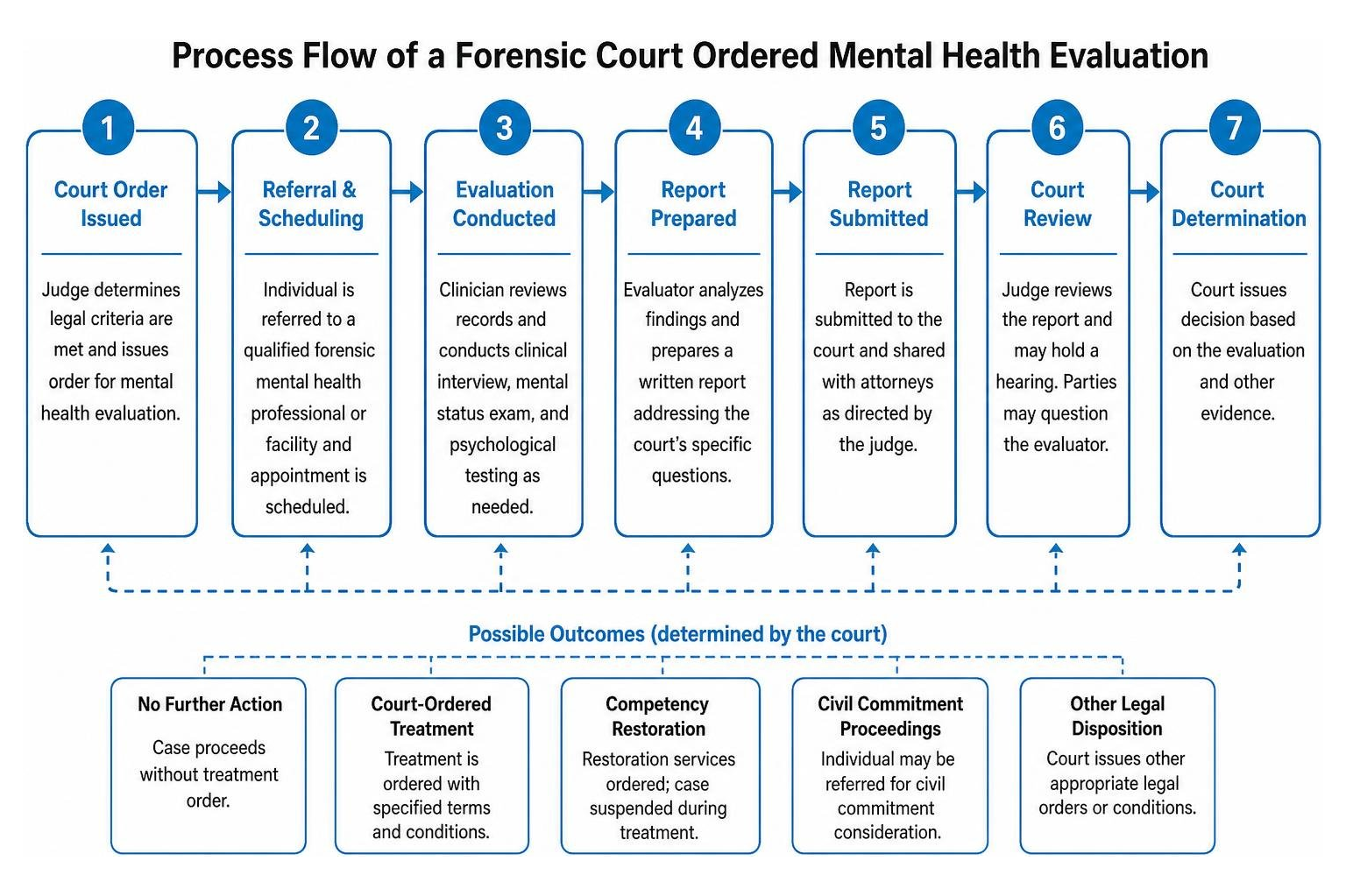
What to Expect During a Court Ordered Mental Health Evaluation

Undergoing a court ordered mental health evaluation can feel intimidating, but understanding the steps helps demystify the experience. At District Counseling, we regularly conduct thorough Forensic Mental Health Evaluations across our Texas locations—including Houston, Austin, Fort Worth, Cypress, Katy, Sugar Land, and The Woodlands—ensuring objective assessments that respect patient rights while satisfying judicial standards.
Key Differences Between Court-Ordered Evaluation (COE) and Court-Ordered Treatment (COT)
It is crucial to distinguish between an evaluation order and a treatment order. They serve distinct functions in the legal system:
| Feature | Court-Ordered Evaluation (COE) | Court-Ordered Treatment (COT) |
|---|---|---|
| Primary Purpose | To assess, diagnose, and evaluate mental status and legal competency. | To mandate compliance with a specific therapeutic or psychiatric care plan. |
| Duration | Short-term (e.g., 72 hours to 30 days depending on statutory jurisdiction). | Medium to long-term (e.g., 90 days, 180 days, or ongoing outpatient care). |
| Focus | Data gathering, clinical interviewing, and objective reporting to the court. | Active intervention, medication management, and symptom stabilization. |
| Care Setting | Evaluation facility, forensic center, or outpatient clinical office. | Least restrictive setting available (inpatient facility or structured outpatient). |
| Trigger | Suspected impairment, dangerousness, or legal competency doubts. | Judicial finding after evaluation that the person meets commitment criteria. |
Information Gathered and Assessment Components
A forensic evaluation is far more comprehensive than a standard counseling session. Evaluators utilize a multi-source approach to ensure accuracy:
- Clinical Interview: In-depth questioning covering current psychological symptoms, emotional state, life history, developmental background, and personal perceptions of the legal matter.
- Psychological and Diagnostic Testing: Standardized instruments designed to assess cognitive functioning, personality traits, diagnostic conditions, and potential symptom exaggeration or malingering.
- Medical and Psychiatric Records: Reviewing past hospitalization records, psychiatric treatment histories, prescribed medications, and physician notes.
- Collateral Information: Interviewing family members, friends, law enforcement personnel, or clinical providers, and reviewing police reports or court transcripts to verify historical details.
- Behavioral Observation: Direct observation of motor activity, speech patterns, thought organization, affect, and overall orientation during clinical contact.
How the Evaluation Process Works: Initiation, Payment, and Consequences

Navigating the mechanics of court-ordered assessments requires understanding how petitions begin, who covers the financial obligations, and what happens if someone refuses to participate.
Initiating a Court Ordered Mental Health Evaluation: Emergent vs. Non-Emergent Approaches
The pathway to a court evaluation depends heavily on whether the situation involves an immediate safety crisis:
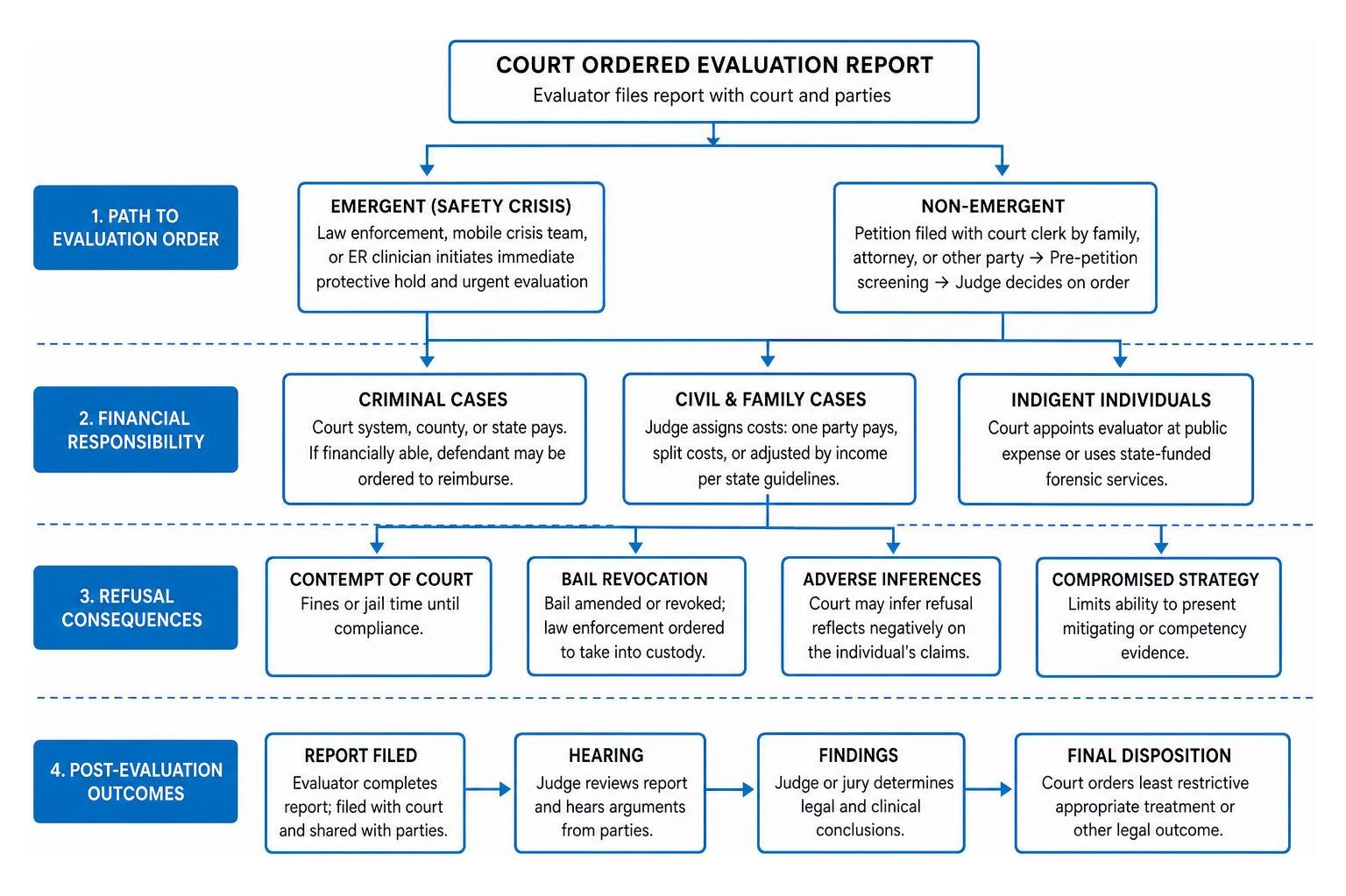
- Emergent Approach: When an individual exhibits severe crisis behaviors presenting an immediate danger to self or others, emergency channels are activated. Law enforcement officers, mobile crisis response teams, or hospital emergency clinicians can initiate an immediate protective hold (such as a 72-hour emergency hold under state public health laws) to ensure safety while an urgent evaluation takes place.
- Non-Emergent Approach: In non-crisis situations, family members, legal guardians, district attorneys, or defense counsel file a formal application or petition with the court clerk. In many states, this initiates a pre-petition screening process where a designated screening agency reviews facts, interviews witnesses, and advises the judge on whether a formal evaluation order is legally warranted.
Financial Responsibility for a Court Ordered Mental Health Evaluation
Determining who pays for an evaluation depends on the legal context, state statutes, and the individual’s financial standing:
- Criminal Cases: When a court orders a competency evaluation or pre-sentencing examination in a criminal case, costs are typically covered by the court system, county funds, or state forensic budgets. However, as noted in Idaho statutory guidelines, if a defendant is financially capable, the court may order them to reimburse examination expenses.
- Civil and Family Law Cases: In civil litigation or custody disputes, the judge assigns costs based on state guidelines, judicial discretion, or party agreement. The court may require one party to pay, split costs between both parties, or adjust fees based on income.
- Indigent Individuals: If an individual is financially indigent, courts appoint qualified evaluators at public expense or utilize state-funded forensic centers to ensure equal access to justice.
Legal Consequences of Refusing a Psychological Evaluation
Refusing to comply with a court order for a psychological assessment carries severe legal ramifications. Unlike voluntary therapy, a court order carries the force of law:
- Contempt of Court: The judge can find the non-compliant individual in civil or criminal contempt, resulting in financial fines or jail time until compliance is achieved.
- Bail Revocation: In criminal proceedings, if a defendant on bail refuses a court-ordered evaluation, the court can amend bail conditions, revoke release, and direct law enforcement to take the defendant into custody for the examination (as authorized under Ohio law).
- Adverse Inferences: In family court matters, such as Child Custody Evaluations, a judge may draw adverse inferences from a parent’s refusal, assuming that the missing evaluation results would have been unfavorable to their claim.
- Compromised Legal Strategy: In criminal matters involving a Criminal Recidivism Evaluation or competency review, refusing to speak with the evaluator prevents defense attorneys from presenting mitigating mental health evidence or establishing legal incompetency.
Post-Evaluation Outcomes: Certification, Hearings, and Final Disposition
Once the evaluator completes their assessment, they draft a written report outlining clinical findings, diagnostic impressions, legal competency conclusions, and risk analyses. This report is filed with the court and provided to both defense and prosecution (or counsel for both sides in civil cases).
In Texas civil commitment proceedings under Texas Code Section 574.036, after a judge or jury determines that a person meets the statutory criteria for court-ordered mental health services, the court must order care provided in the least restrictive appropriate setting available. The judge reviews official treatment recommendations and hears evidence on alternative settings before issuing a final order for inpatient hospitalization or structured outpatient care.
Frequently Asked Questions About Mental Health Evaluations
How long does a court-ordered evaluation take?
The timeframe depends on the legal setting. Emergency evaluations under state hold laws (like Florida or Arizona) typically last up to 72 hours. Comprehensive forensic evaluations in criminal cases, such as competency or sentencing assessments in Ohio or Texas, generally require a 30-day reporting window to gather records, perform testing, and write the formal court report.
Who is qualified to perform a court-ordered evaluation?
Evaluations must be performed by qualified professionals designated by state statute. These typically include board-certified psychiatrists, licensed clinical psychologists, or licensed mental health professionals (such as LPCs or LCSWs) who possess specialized training in forensic mental health and are affiliated with recognized forensic facilities.
Can evaluation findings be used in civil and criminal proceedings?
Yes. Evaluation findings are submitted directly to the court and can be introduced as expert evidence in competency hearings, sentencing proceedings, civil commitments, and family law disputes. However, statements made during forensic evaluations are generally restricted to addressing the legal questions at hand and cannot be used as an unexpected confession for unrelated charges.
Conclusion
A court ordered mental health evaluation serves as a bridge between the legal system and professional psychological science, ensuring that legal decisions regarding freedom, competency, sentencing, and family structures are guided by clear clinical facts. While navigating court-ordered mandates can feel overwhelming, understanding your legal rights, statutory timelines, and procedural steps empowers you to handle the process with confidence.
At District Counseling, our team of compassionate clinicians and certified forensic evaluators provides expert, objective assessment services aligned with state and federal legal standards across our Texas locations. Whether you need clarity on psychological testing, forensic reporting, or individual care, Learn more about professional evaluations with District Counseling to see how we support individuals and families through complex legal transitions.
Visited 1 times, 1 visit(s) today



Similar Posts

Francisco Ortiz
October 23, 2026
Demystifying the Court-Ordered Mental Health Evaluation Process
Learn what to expect in a court ordered mental health evaluation, including legal criteria, costs, and outcomes....

Francisco Ortiz
October 21, 2026
Finding the Right EMDR Specialist in Cypress Texas for Real Healing
Find a qualified EMDR specialist in Cypress Texas for real trauma healing and lasting anxiety relief....

Francisco Ortiz
October 19, 2026
Why therapy for caregiver exhaustion is a necessity not a luxury
Find relief with exhaustion therapy for caregivers. Learn how clinical support heals burnout and restores your well-being....

Francisco Ortiz
October 16, 2026
Navigating Neuropsychological Evaluations from Katy to Pasadena
Learn how an ADHD evaluation for Houston teens works, from medication management to school accommodations and 504 plans....

Francisco Ortiz
October 14, 2026
How Texas caregivers can beat exhaustion with virtual therapy
Beat caregiver exhaustion therapy Texas caregivers trust—virtual sessions for stress, boundaries, and recovery. Start today....

Francisco Ortiz
October 12, 2026
Find Local Youth Counselor: How They Can Help Your Teen Thrive (52 characters)
Find a qualified youth counselor near me to help your teen thrive with evidence-based support for anxiety, trauma, and more....

Francisco Ortiz
October 9, 2026
Faith-Based Pastoral Counseling: A Comprehensive Guide
Discover how pastoral counseling integrates faith and psychology for holistic healing, grief, trauma, and marital support....

Francisco Ortiz
October 7, 2026
Houston Counseling Options: Find Local Help Nearby
Find affirming counseling in Houston for trauma, LGBTQ+ care, couples, and more. Explore local options and start your healing today....

Francisco Ortiz
October 5, 2026
Why every teacher needs a burnout therapy game plan
Why every teacher needs a burnout therapy game plan – Learn about burnout therapy for teachers...

Francisco Ortiz
October 2, 2026
Child Therapist Near Me? Here is How to Spot a Great One
Find a child therapist near me who fits your child’s needs. Learn signs, costs, and effective therapy options....


