
Riding Out the Storm: The Four Horsemen of Couples Therapy and Their Antidotes
Mastering Four Horsemen Couples Therapy: Quick Antidotes for Conflict
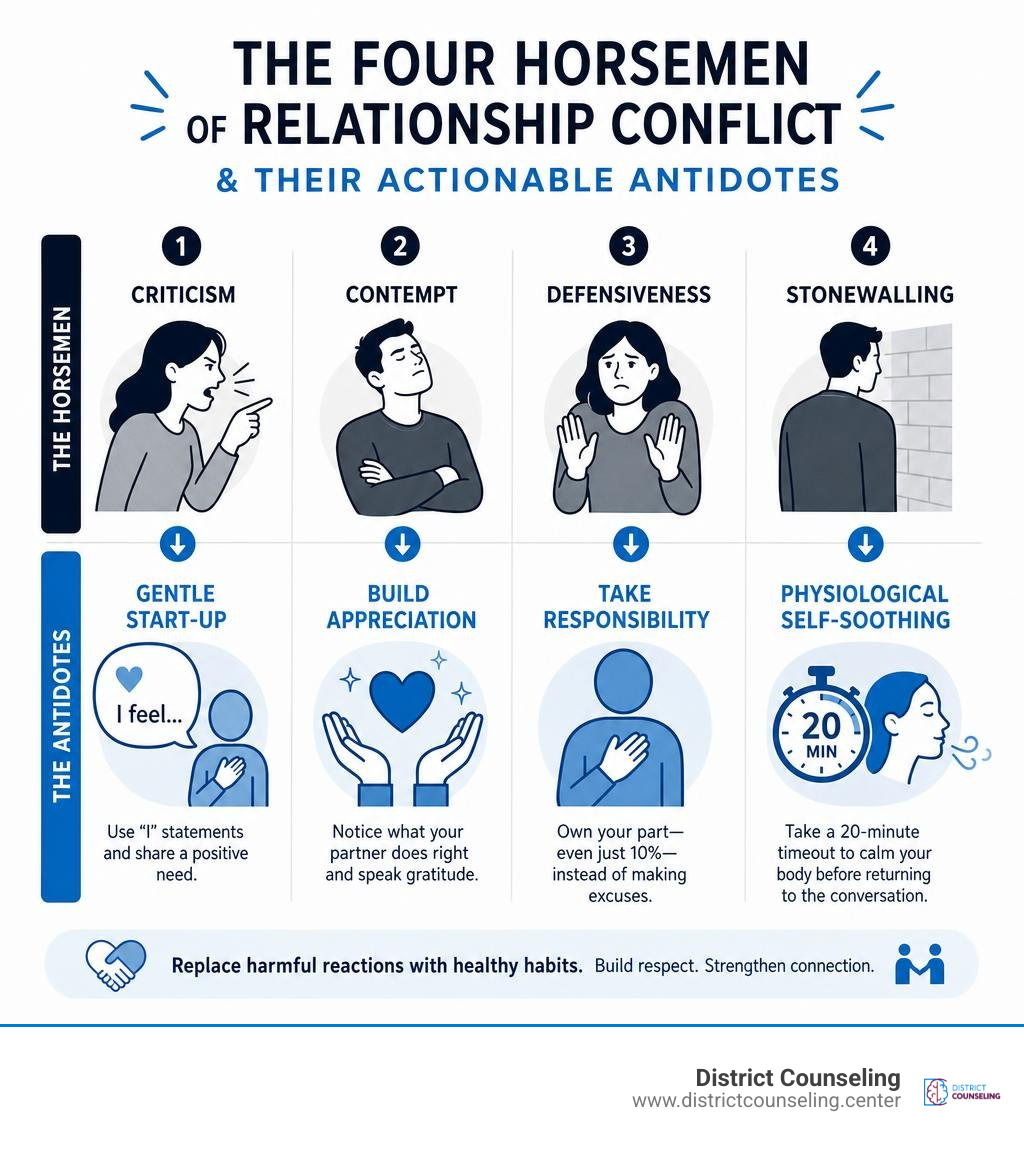
In relationship science, the “Four Horsemen” represent four toxic communication habits that predict breakups: criticism, contempt, defensiveness, and stonewalling. In four horsemen couples therapy, partners learn to immediately defuse arguments by replacing each harmful reaction with a direct behavioral antidote:
- Criticism $\rightarrow$ Gentle Start-Up: Talk about your feelings using “I” statements and state a positive need without attacking your partner’s character.
- Contempt $\rightarrow$ Build Appreciation: Actively notice what your partner does right and speak gratitude aloud to rebuild mutual respect.
- Defensiveness $\rightarrow$ Take Responsibility: Own your part of the issue—even just 10%—instead of making excuses or counter-attacking.
- Stonewalling $\rightarrow$ Physiological Self-Soothing: Call a structured 20-minute timeout to lower your heart rate before resuming the discussion.
I’m Francisco Ortiz, a Licensed Professional Counselor-Supervisor (LPC-S) and founder of AdventMind by District Counseling. From my clinical background in trauma-informed care and marital counseling, I regularly guide couples through four horsemen couples therapy to replace reactive fighting cycles with genuine emotional intimacy.
Four horsemen couples therapy word roundup:
- gottman method couples therapy houston
- relationship therapy for couples
- relationship therapy exercises
Understanding the Four Horsemen Couples Therapy Framework
Every relationship encounters storms. Whether you are arguing over spending habits, household chores, or parenting decisions, conflict is an inescapable reality when two unique lives merge. However, over five decades of empirical research reveal that it is not whether you fight that matters—it is how you fight.
When arguments devolve into relational warfare, specific destructive habits tend to rear their heads. In clinical practice, we look to the landmark research on The Gottman Four Horsemen developed by Dr. John Gottman and Dr. Julie Schwartz Gottman. Borrowing imagery from the New Testament metaphor of the Four Horsemen of the Apocalypse, this framework identifies four specific relational habits—criticism, contempt, defensiveness, and stonewalling—that signal the rapid deterioration of intimacy and partnership.
Understanding The Gottman Four Horsemen and How to Defeat Them allows us to step outside reactive blaming and inspect the actual mechanisms undermining connection.
The Origins of Four Horsemen Couples Therapy in Gottman Research
The foundation of modern marital therapy changed drastically when Dr. John Gottman established the famous “Love Lab” at the University of Washington. By hooking couples up to physiological sensors, tracking heart rates, observing facial expressions, and analyzing videotaped conflicts frame by frame, Gottman conducted extensive longitudinal studies across thousands of couples.
The data yielded staggering conclusions: researchers could observe a couple arguing for just a few minutes and predict whether they would divorce with 94% accuracy. This prediction was not based on the topic being debated—couples fight about money, intimacy, work, and in-laws across both happy and unhappy marriages. Instead, the prediction was rooted entirely in the presence of specific communication patterns that predict breakups.
Research consistently demonstrates that discussions overwhelmingly end the exact way they begin. A harsh, accusatory startup in the first three minutes of a conversation predicts a failed interaction with nearly 96% certainty. When these patterns harden into standard operating procedure, relationships cross into dangerous territory.
The Cumulative Impact on Emotional and Physical Health
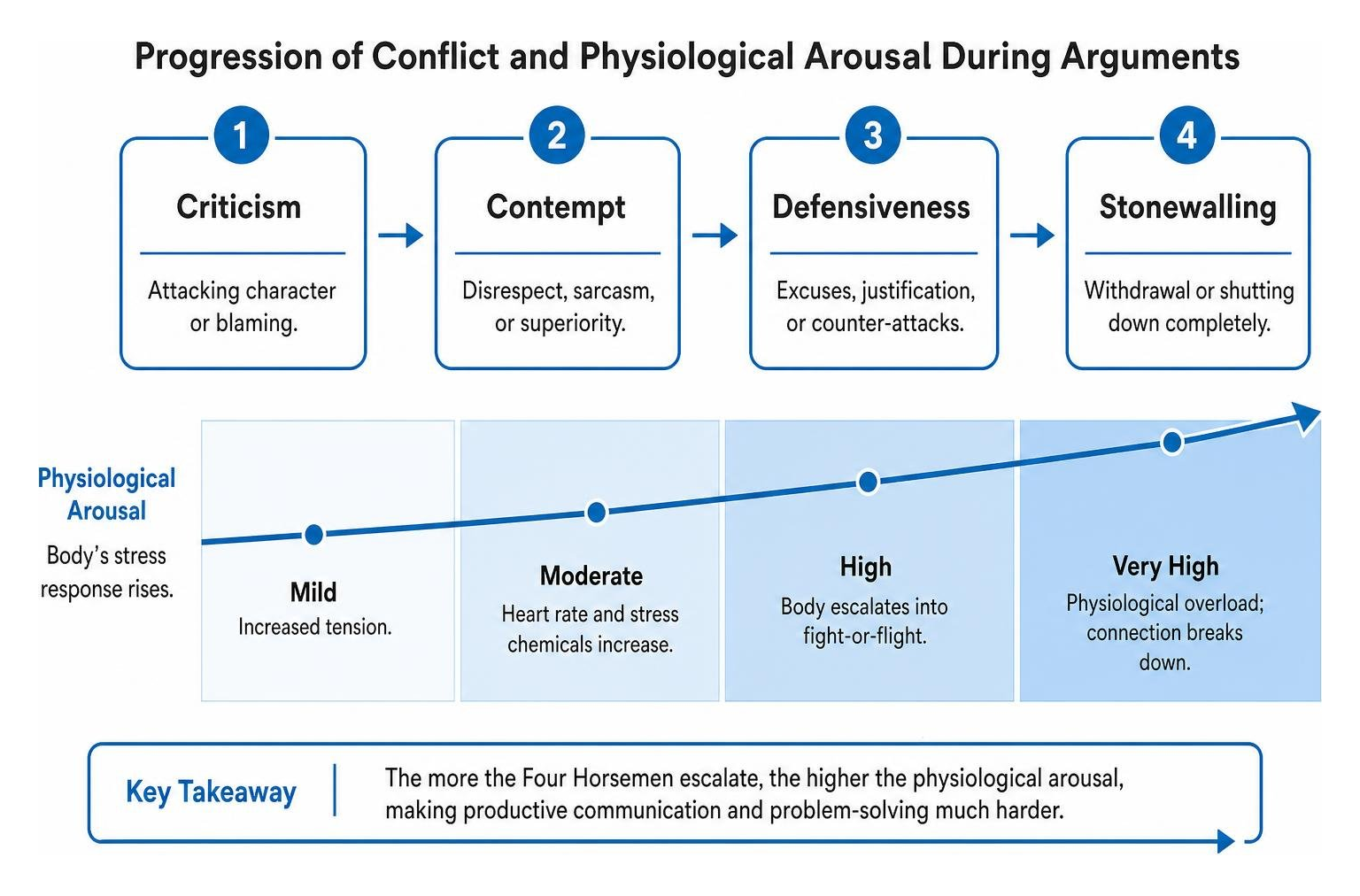
The fallout of unmanaged conflict extends far beyond hurt feelings. Chronic relational stress keeps the body’s autonomic nervous system in an extended state of alarm, causing systemic wear and tear.
When contempt and hostility become ambient in a home, the body stays flooded with cortisol and adrenaline. Longitudinal research reveals that partners trapped in contemptuous dynamics experience measurable immunosuppression. In fact, individuals in highly contemptuous relationships suffer from significantly higher rates of infectious illnesses, such as chronic colds and the flu, compared to their peers in emotionally safe environments.
Living in a permanent state of emotional vigilance drains psychological resilience, leaving partners exhausted, disconnected, and burnt out.
Deconstructing the Four Conflict Behaviors and Their Proven Antidotes
Breaking these cycles requires replacing instinctive, defensive reactions with intentional, evidence-based habits. For every destructive horseman, relationship science offers an exact behavioral solution.
Couples can dramatically improve conflict outcomes by learning to stop arguing and start searching for underlying feelings and needs. Below, we break down each horseman and explain how to apply The Four Horsemen: The Antidotes in everyday discussions.
| The Destructive Horseman | Core Problem | Therapeutic Antidote | Constructive Replacement |
|---|---|---|---|
| Criticism | Attacking character and personality | Gentle Start-Up | Express feelings with “I” statements & name positive needs |
| Contempt | Acting from moral superiority & disgust | Culture of Appreciation | Regularly express gratitude, fondness, and respect |
| Defensiveness | Denying fault, counter-attacking | Taking Responsibility | Own your part of the issue (even 10%) & validate partner |
| Stonewalling | Shutting down, withdrawing | Physiological Self-Soothing | Call a structured 20-30 min break to calm your nervous system |
1. Criticism vs. Gentle Start-Up
It is completely normal to have complaints in a relationship. A complaint addresses a specific action, event, or failure: “I was worried when you didn’t text me that you’d be running an hour late.”
Criticism, on the other hand, is an ad hominem attack on your partner’s core personality, character, or integrity. It often incorporates sweeping, globalized language like “always” or “never”: “You never think about anyone but yourself. You are completely selfish and irresponsible.”
When partners feel their character is being assassinated, their nervous system perceives a threat, triggering immediate defensiveness.
The Antidote: Gentle Start-Up
The antidote to criticism is initiating conversations using a Gentle Start-Up. A gentle startup focuses on what you feel and what you need, rather than what is wrong with your partner:
- Describe the situation factually without judgment: “When dinner was getting cold and I hadn’t heard from you…”
- State your actual feeling using “I” statements: “…I felt anxious and unconsidered.”
- State a concrete, positive need: “…Next time, could you please send me a quick text if you’re running late?”
2. Contempt vs. Building a Culture of Appreciation
Gottman’s research identifies contempt as the single greatest predictor of divorce. If criticism is a spark, contempt is sulfuric acid.
Contempt operates from a platform of moral superiority. It conveys disgust, disrespect, and disdain through eye-rolling, sneering, mocking, hostile sarcasm, and name-calling: “Oh, you’re tired? Must be exhausting doing the bare minimum while I run this entire household.”
Contempt makes productive conflict repair nearly impossible because it places one partner on a pedestal while dehumanizing the other.
The Antidote: Build a Culture of Appreciation and Respect
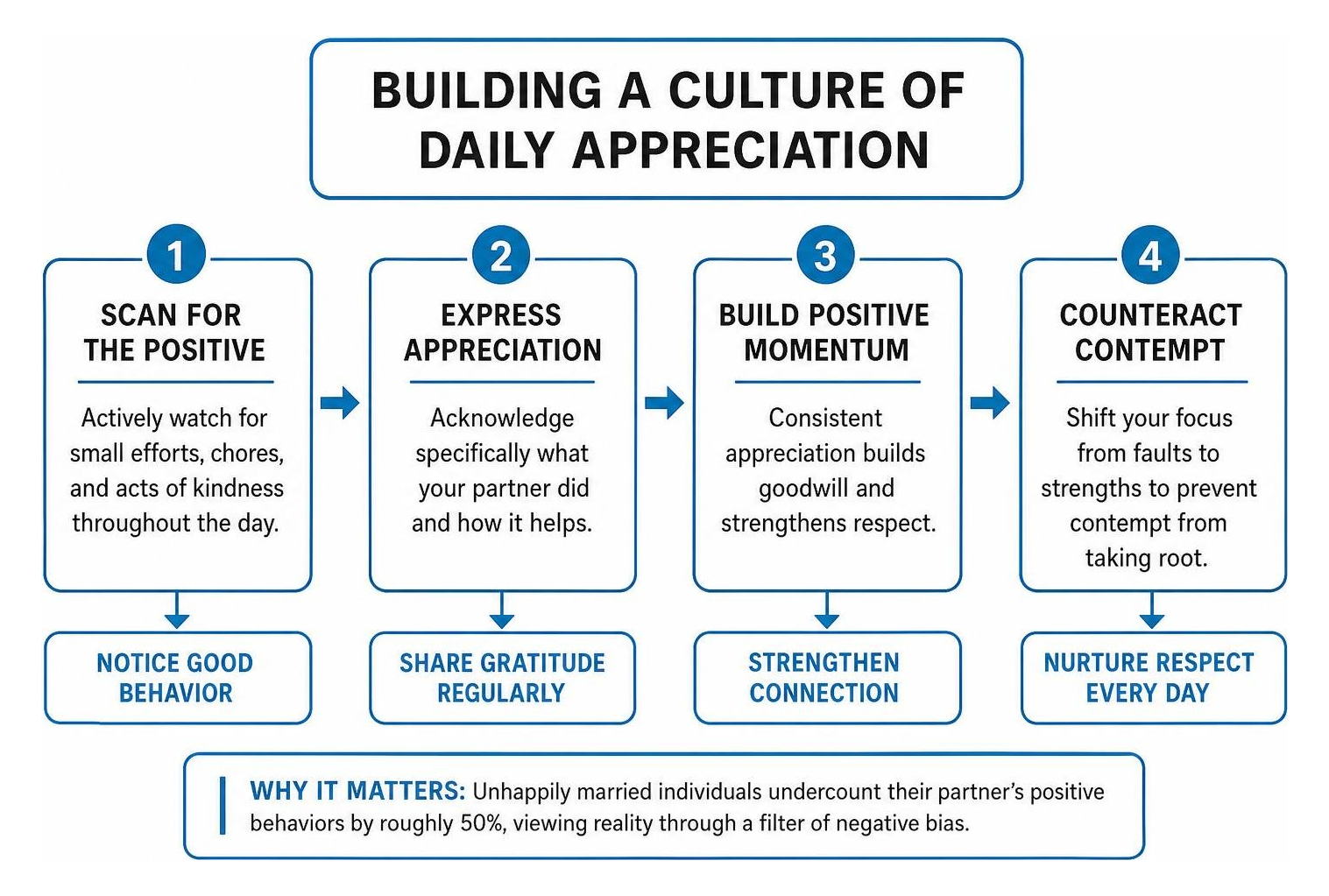
Contempt festers when partners constantly scan their environment for their spouse’s mistakes. Research indicates that unhappily married individuals undercount their partner’s positive behaviors by roughly 50%, viewing reality through a filter of negative bias.
To counteract contempt, you must intentionally reverse this habit:
- Scan for the positive: Actively watch for small efforts, chores, and acts of kindness your partner completes throughout the day.
- Voice appreciation immediately: Move beyond thinking a compliment—say it out loud: “Thank you for packing the lunches this morning, it made my day so much easier.”
- Cultivate mutual fondness: Regularly remind yourself of the qualities and shared values that drew you to your partner in the first place.
3. Defensiveness vs. Taking Responsibility
Defensiveness is an almost universal human response when we feel attacked. However, in relationship conflicts, it escalates tension rather than diffusing it.
Defensiveness typically takes two forms:
- Playing the innocent victim: “You’re always picking on me! Nothing I do is ever good enough for you!”
- Counter-complaining (Yes-butting): “Well, the only reason I forgot to call the plumber is because you didn’t give me the number like you promised!”
Defensiveness signals to your partner that their concerns do not matter to you and that you refuse to be accountable for your actions.
The Antidote: Taking Responsibility
The antidote to defensiveness is taking ownership of your portion of the problem, even if it is just a 10% slice of the issue.
Acknowledging your role immediately defuses the conflict and validates your partner’s experience.
4. Stonewalling vs. Physiological Self-Soothing

When arguments become overwhelming, one partner may abruptly shut down, go silent, avoid eye contact, and act completely unresponsive. This behavior is known as stonewalling.
While stonewalling can feel like cold indifference or passive-aggressive rejection, clinical research shows it is usually a biological response called Diffuse Physiological Arousal (DPA), or emotional flooding. When a person’s heart rate climbs over 100 beats per minute, the sympathetic nervous system activates fight-or-flight mode. In this state, the prefrontal cortex shuts down, making rational listening and problem-solving biologically impossible.
In heterosexual relationships, approximately 85% of stonewallers are men, largely because male physiology tends to flood more quickly during conflict and takes longer to return to baseline.
The Antidote: Physiological Self-Soothing
When flooding occurs, continuing the argument will only escalate the damage. The antidote is taking a structured, somatic timeout:
- Call the break clearly: State out loud that you are flooded without placing blame: “I am feeling overwhelmed right now and want to hear you clearly. Can we take a 20-minute break and finish this?”
- Commit to a specific return time: Never walk away without agreeing when to reconnect. Unannounced withdrawal is abandonment; an agreed pause is self-regulation.
- Soothe your nervous system for 20 to 30 minutes: Step away and engage in calming activities—take a walk, practice deep breathing, stretch, or listen to music. Avoid ruminating or replaying angry arguments in your head.
The Power of Mid-Conflict Repair and Daily Emotional Connection
A critical finding from decades of couples research is that lasting couples still experience conflict and occasionally exhibit the Four Horsemen. What separates thriving relationships from struggling ones is the speed, effectiveness, and reception of mid-conflict repair attempts.
A repair attempt is any statement, gesture, or behavioral bid designed to de-escalate tension and steer the conversation back to safety. Exploring everything you need to know about couples therapy highlights how clinicians coach partners to spot and accept these micro-repairs in real time.
Applying Four Horsemen Couples Therapy Exercises to Conflict Repair
During therapy, couples practice structured de-escalation tools to halt negative escalation:
- Naming the dynamic: “I realize I just got defensive. Let me back up and try that again.”
- Offering physical or emotional softening: Reaching out to hold a hand, softening vocal tone, or using gentle, shared humor to break the tension.
- Validating emotional state: “I can see how frustrating this has been for you. Tell me more about what you need.”
Preserving the 5:1 Positive-to-Negative Interaction Ratio
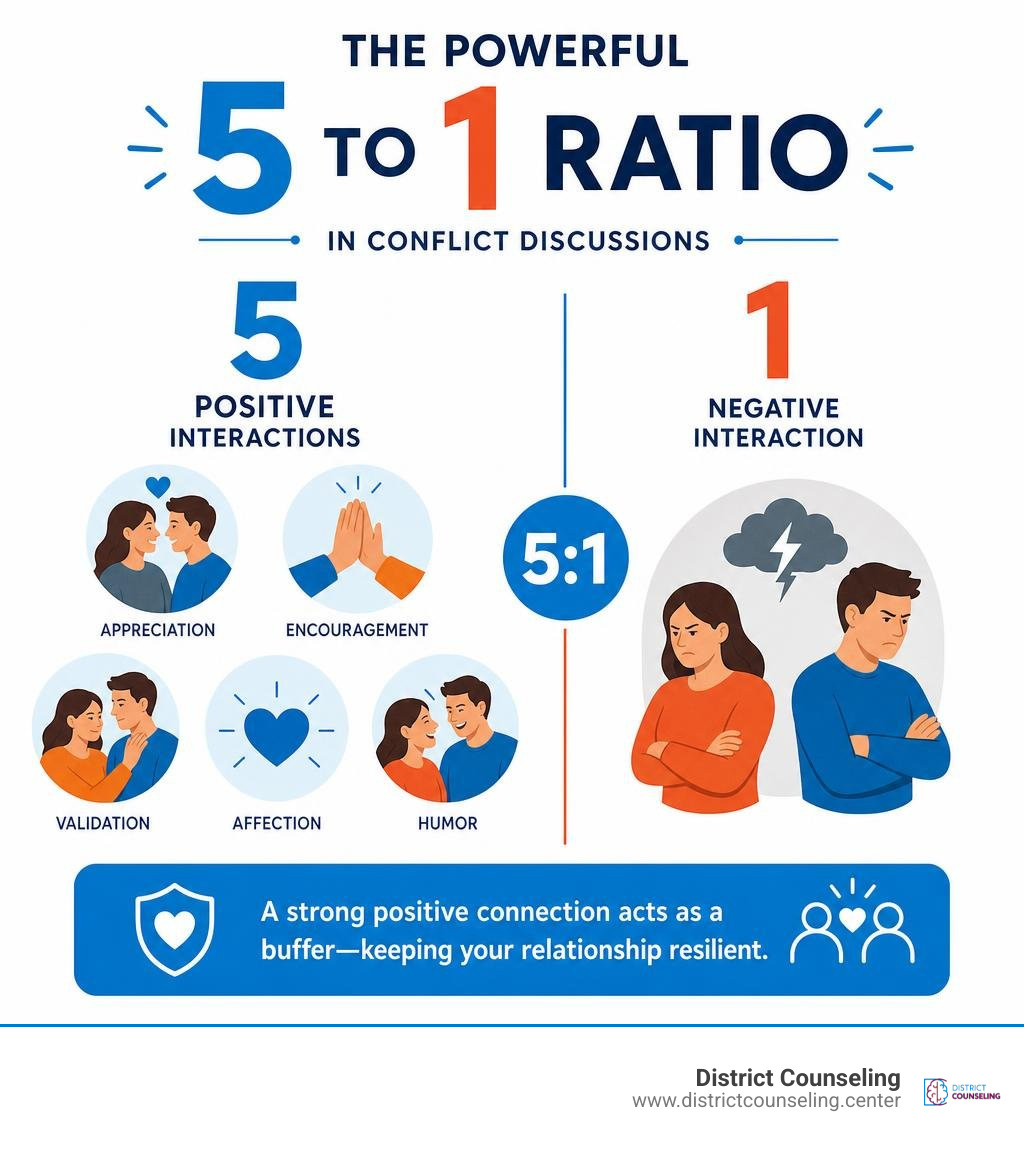
Stable, happy couples maintain a 5:1 ratio of positive to negative interactions during conflict discussions (and a 20:1 ratio during daily life). This positive emotional buffer acts as a shock absorber when tensions run high.
To build and maintain this emotional bank account, practice these daily appreciation rituals:
- Express gratitude daily: Verbalize at least two specific things you appreciate about your partner every day.
- Engage in intentional check-ins: Spend 15 minutes each evening asking open-ended questions about your partner’s day and feelings.
- Maintain physical affection: Share a six-second kiss or a warm 20-second hug before parting ways in the morning and when reuniting in the evening.
- Schedule weekly relationship alignment meetings: Dedicate 30 minutes every week to discuss logistics, celebrate wins, and address small points of friction before they fester.
When to Seek Professional Relationship Support

While self-help communication frameworks are invaluable, entrenched relational habits often require objective, professional guidance. Knowing when to seek couples counseling before chronic resentment takes root can save years of distress.
Many couples wait an average of six years from the onset of relationship problems before seeking professional support. By that time, contempt and stonewalling may have caused significant emotional erosion. In cases involving deep-seated hurt or infidelity, specialized interventions like couples therapy after betrayal provide the structured safety needed to rebuild broken trust.
Reviewing our ultimate guide to marital counseling can help you and your partner choose the right therapeutic path for your specific needs.
Frequently Asked Questions About the Four Horsemen in Relationships
Can a relationship recover once contempt has become common?
Yes, but it requires intentional, sustained effort from both partners. Contempt develops when complaints go unaddressed and turn into festering resentment over months or years. Recovery requires establishing psychological safety, eliminating hostile communication, practicing daily appreciation rituals, and often working with a licensed relationship therapist to untangle underlying gridlocked issues.
How does stonewalling differ from a constructive timeout?
Stonewalling involves abrupt emotional or physical withdrawal without acknowledging the partner’s bid for connection, leaving the other person feeling dismissed, abandoned, or unheard. A constructive timeout is mutually agreed upon, communicates a clear intention to return (e.g., “I need 20 minutes to calm down, and then I want to finish this conversation”), and includes active self-soothing rather than angry rumination.
Do healthy and lasting couples ever use the Four Horsemen?
Yes. Even the happiest, most emotionally intelligent couples occasionally slip into criticism or defensiveness when stressed, exhausted, or overwhelmed. The difference lies in their self-awareness and repair speed: healthy couples quickly recognize these behaviors, apologize, and accept their partner’s de-escalation bids before lasting damage occurs.
Conclusion
The presence of criticism, contempt, defensiveness, and stonewalling does not mean your relationship is doomed—it simply means your current communication strategies are failing you. By identifying these destructive patterns and consistently practicing their therapeutic antidotes, you can transform moments of conflict into opportunities for deeper emotional intimacy and trust.
At District Counseling, we provide compassionate, evidence-based therapy for couples across Texas, including Houston, Greater Heights, Memorial, CityCentre, Katy, Cypress, Sugar Land, The Woodlands, Austin, and Fort Worth. If you are ready to stop destructive conflict cycles and build a resilient, fulfilling partnership, reach out to explore our specialized relationship and marital counseling services today.
Visited 21 times, 1 visit(s) today
Similar Posts

Francisco Ortiz
October 16, 2026
Navigating Neuropsychological Evaluations from Katy to Pasadena
Learn how an ADHD evaluation for Houston teens works, from medication management to school accommodations and 504 plans....

Francisco Ortiz
October 14, 2026
How Texas caregivers can beat exhaustion with virtual therapy
Back-to-School Mental Health: Tips for a Smooth Transition – Discover practical tips to ease back-to-school anxiety for kids, teens, and parents. Build healthy routines, manage stress, and foster emotional… …...

Francisco Ortiz
October 12, 2026
Find Local Youth Counselor: How They Can Help Your Teen Thrive (52 characters)
Find a qualified youth counselor near me to help your teen thrive with evidence-based support for anxiety, trauma, and more....

Francisco Ortiz
October 9, 2026
Faith-Based Pastoral Counseling: A Comprehensive Guide
Discover how pastoral counseling integrates faith and psychology for holistic healing, grief, trauma, and marital support....

Francisco Ortiz
October 7, 2026
Houston Counseling Options: Find Local Help Nearby
Find affirming counseling in Houston for trauma, LGBTQ+ care, couples, and more. Explore local options and start your healing today....

Francisco Ortiz
October 5, 2026
Why every teacher needs a burnout therapy game plan
Why every teacher needs a burnout therapy game plan – Learn about burnout therapy for teachers...

Francisco Ortiz
October 2, 2026
Child Therapist Near Me? Here is How to Spot a Great One
Find a child therapist near me who fits your child’s needs. Learn signs, costs, and effective therapy options....

Adalid Blandin
September 30, 2026
Mental Health and Miracles: Finding Local Christian Care
Find pastoral counselling near me for faith-based emotional and spiritual support in Texas....

Adalid Blandin
September 28, 2026
Missouri City and Houston Couples Therapy 101
Explore relationship counseling in Houston options, from couples therapy to intensives, with costs, insurance, and therapist tips for Missouri City families....

Adalid Blandin
September 25, 2026
How to find authentic therapy for emotional exhaustion in Houston
Find emotional exhaustion therapy Houston that helps professionals and caregivers move from burnout to renewed energy and balance....


