
What a DOT SAP Evaluation Means for Returning to Work
A DOT SAP evaluation is a required assessment for a safety-sensitive transportation worker who has violated DOT drug or alcohol rules. A qualified Substance Abuse Professional (SAP) assesses the worker, recommends education or treatment, and later checks whether those steps were completed. To return to safety-sensitive work, the worker must also pass a return-to-duty test. Completing the SAP evaluation alone does not clear someone to work.
The process can feel urgent when your job is on hold. This guide explains what happens at each step, what may affect the cost and timeline, and how the FMCSA Clearinghouse applies to commercial drivers.
I’m Francisco Ortiz, a licensed professional counselor-supervisor and certified forensic mental health evaluator with experience in clinical and forensic assessments. That background informs how I explain the DOT SAP evaluation process; return-to-duty decisions must be made by a qualified SAP.
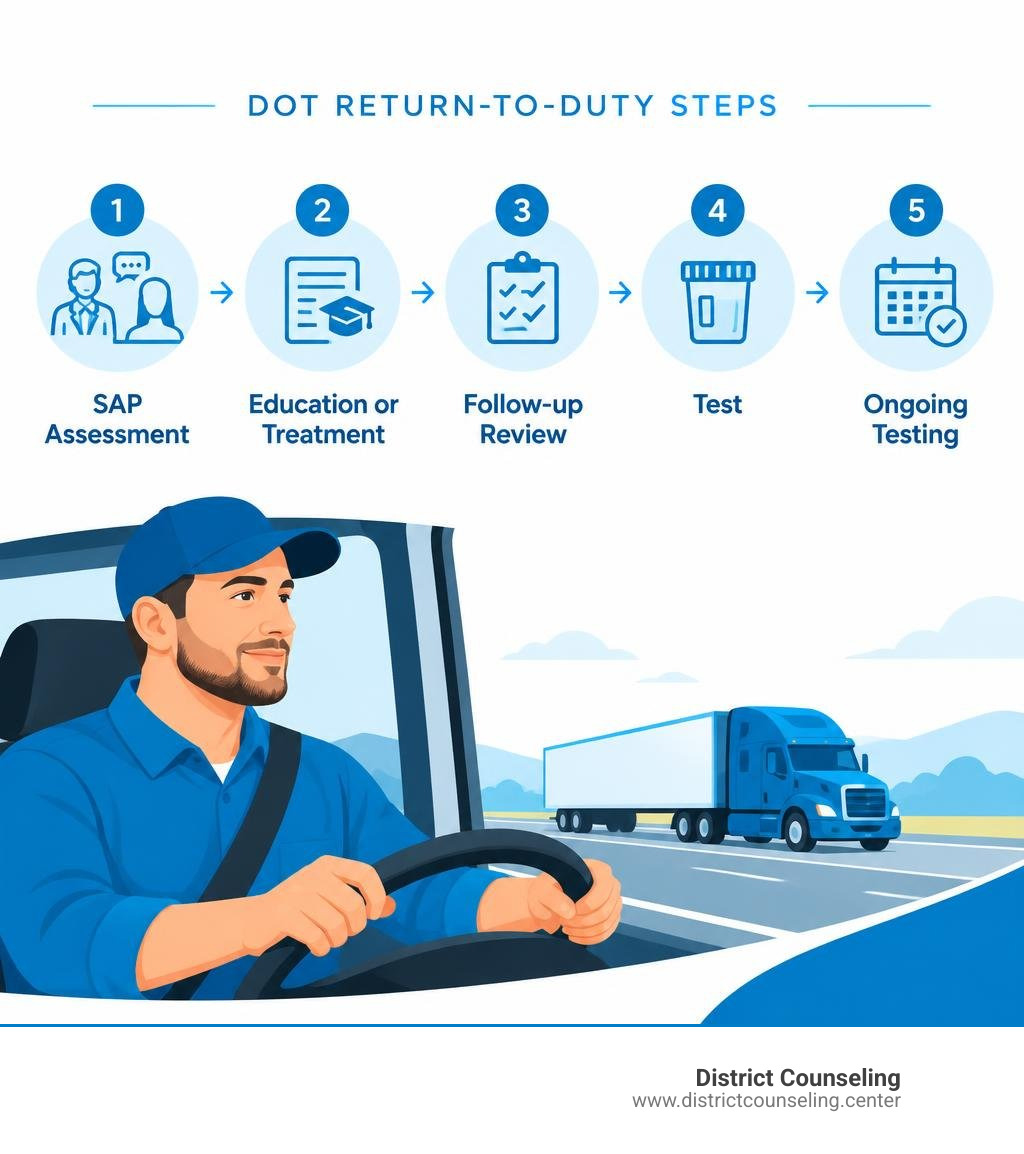
What Is a DOT SAP Evaluation and Who Needs One?
When a transportation worker tests positive for a prohibited substance or refuses a mandatory test, federal law requires immediate removal from safety-sensitive duties. Getting back behind the wheel, into the cockpit, or onto the rails is not as simple as waiting for a suspension period to pass or providing a clean screen to an employer. Federal regulations require that you first undergo a formal evaluation with a credentialed Substance Abuse Professional.
A Substance Abuse Professional (SAP) acts as an independent gatekeeper for the traveling public. Under official DOT SAP guidelines established by the Department of Transportation and codified in 49 CFR Part 40, the SAP’s primary legal duty is not to advocate for the employee or appease the employer. Instead, their role is to protect public safety by thoroughly evaluating the employee, determining the specific level of assistance needed, and ensuring that adequate rehabilitation or education occurs before anyone is cleared for testing.
The legal foundation for this entire framework dates back to the Omnibus Transportation Employee Testing Act of 1991. This federal statute mandated workplace drug and alcohol testing across all safety-sensitive transportation sectors. Whether you operate a commercial motor vehicle across Texas or manage gas pipelines in Houston, these federal rules apply uniformly across safety-sensitive employment categories.

Safety-Sensitive Roles and Violation Triggers
Safety-sensitive positions span multiple federal agencies, each operating under specific operating administrations overseen by the Department of Transportation:
- Federal Motor Carrier Safety Administration (FMCSA): Commercial driver’s license (CDL) and commercial learner’s permit (CLP) holders operating heavy trucks, interstate haulers, and passenger buses.
- Federal Aviation Administration (FAA): Commercial pilots, flight attendants, flight dispatchers, and aircraft maintenance personnel.
- Federal Railroad Administration (FRA): Locomotive engineers, conductors, dispatchers, and signal maintenance crews.
- Federal Transit Administration (FTA): City bus operators, subway and light-rail drivers, and armed transit security personnel.
- Pipeline and Hazardous Materials Safety Administration (PHMSA): Technicians handling emergency operations, maintenance, and hazardous liquid or gas pipeline monitoring.
- United States Coast Guard (USCG): Crewmembers and captains operating commercial marine vessels.
A violation occurs whenever an individual tests positive for prohibited substances or fails a blood or breath alcohol screen showing a concentration of 0.04 or greater. It is worth noting that marijuana remains the single most common substance violation, accounting for roughly 60% of all positive drug tests reported to federal tracking systems.
Violations are not limited to failed screens. A refusal to test carries the exact same weight as a positive result. Under federal rules, test refusals account for 14.7% of all recorded drug violations, making them the third most common cause of violation behind marijuana and cocaine. Refusals include failing to appear for a scheduled screening, leaving the collection facility before completion, providing an adulterated or substituted specimen, or failing to cooperate with collection personnel.
When a violation takes place, the employer must immediately remove the employee from safety-sensitive functions and provide them with a list of qualified SAPs. For commercial drivers, state licensing agencies automatically downgrade their CDL to a standard driver’s license once a violation is registered, making immediate action essential to preserve career credentials.
DOT SAP vs. Regular Therapist: Key Differences
It is common to assume that any licensed counselor, psychologist, or clinical therapist can provide return-to-duty clearance. However, standard therapy credentials alone do not satisfy federal Department of Transportation mandates. Federal law requires specialized qualification under 49 CFR Part 40 Subpart O.
| Role Characteristic | Qualified DOT Substance Abuse Professional (SAP) | General Mental Health Counselor / Therapist |
|---|---|---|
| Regulatory Authority | Governed strictly by 49 CFR Part 40 Subpart O | Governed by state behavioral health licensing boards |
| Primary Mandate | Public safety gatekeeper; independent evaluator | Client advocate; individualized therapeutic support |
| Specialized Training | Must pass a 100-question qualification exam and complete 12 CEUs every 3 years | Standard clinical graduate education and general state continuing education |
| Reporting Capabilities | Authorized to update and log compliance in federal databases (e.g., FMCSA Clearinghouse) | Cannot submit official federal return-to-duty clearance records |
| Treatment Independence | Federally prohibited from profiting directly from prescribed treatment programs | Can deliver direct, ongoing counseling and bill for treatment sessions |
| Assessment Focus | Specific determination of safety risk, compliance, and required follow-up drug testing plans | General mental wellness, stress, relational issues, and personal growth |
A qualified SAP must hold an active national substance abuse credential (such as NAADAC, IC&RC, or NBCC MAC) or specific state-level clinical licensure, undergo dedicated DOT testing training, and demonstrate extensive knowledge of federal drug testing rules.
The Step-by-Step DOT Return-to-Duty Process
Navigating the return-to-duty sequence can feel overwhelming, but it follows a clear, structured framework. Once a violation occurs, the worker enters prohibited status and cannot perform safety-sensitive tasks until every component of the return-to-duty path is fulfilled.
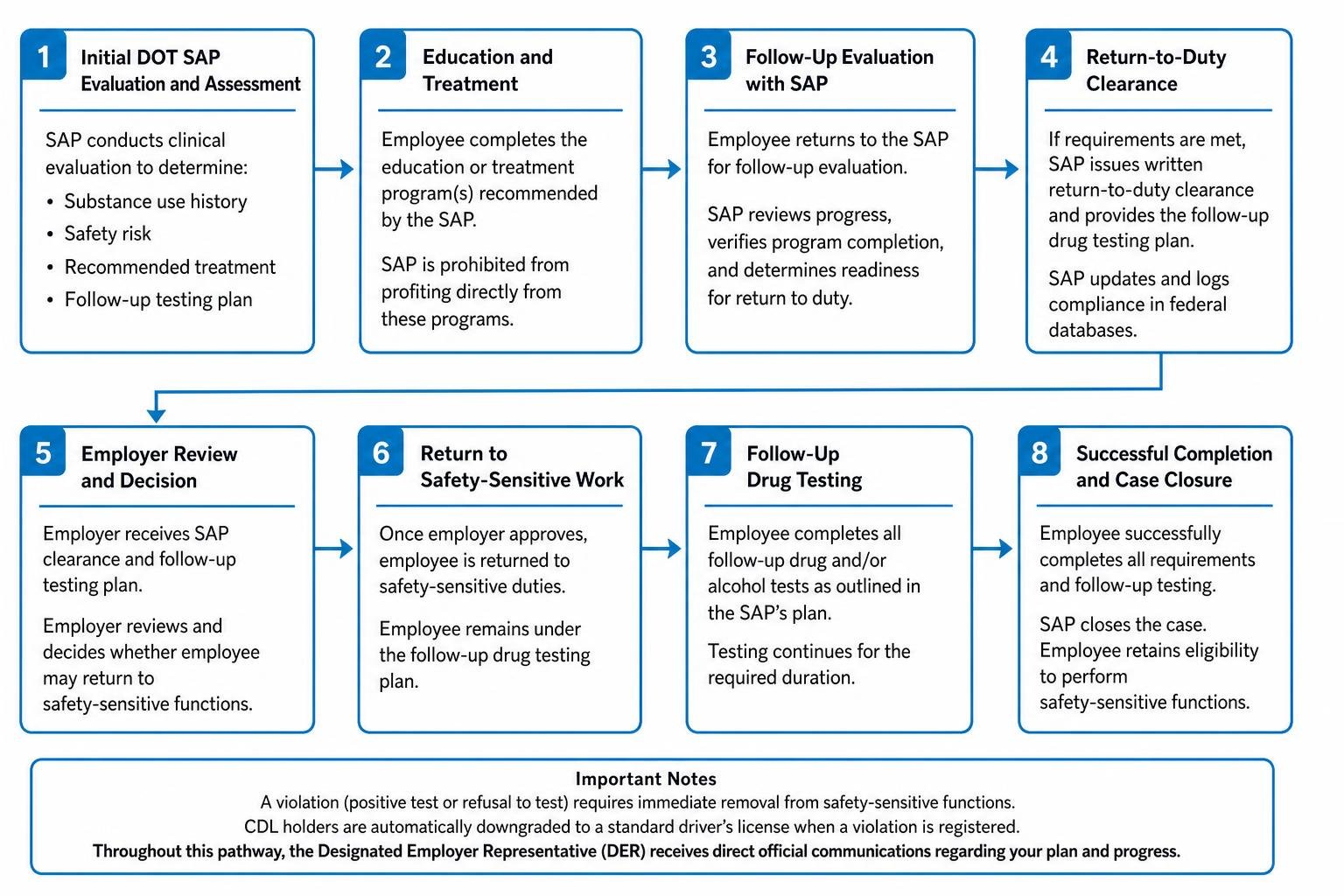
Throughout this pathway, your designated employer representative (DER) receives direct official communications regarding your clinical plan and compliance progress.

Step 1: Initial DOT SAP Evaluation and Assessment
The journey begins by scheduling an initial intake with a qualified Substance Abuse Professional. During this session, the clinician conducts a comprehensive clinical interview and standard diagnostic screening to assess the worker’s history of substance use, the circumstances surrounding the violation, and any underlying behavioral health patterns.
Because federal regulations demand accuracy and transparency, choosing experienced evaluators makes a tremendous difference. If you are dealing with a federal violation in our service communities across the Houston area, you can schedule an initial review through our professional DOT SAP evaluation services to begin resolving your employment status without unnecessary delays.
Following this intake, the clinician crafts a formal, written initial assessment report detailing mandatory education or treatment directives that must be completed before moving forward.
Step 2: Prescribed Education or Treatment Program
Federal regulations strictly forbid SAPs from referring clients to their own private treatment practices or financial partners. This financial independence mandate guarantees that recommendations are rooted entirely in public safety and clinical necessity rather than financial self-interest.
Depending on the assessment findings, recommendations generally fall into two primary categories:
- Psychoeducational Programs: Intended for first-time or low-risk violations where chronic dependency is not present. This may involve structured, multi-hour drug and alcohol education courses.
- Clinical Treatment Programs: Designed for individuals demonstrating deeper substance use patterns. This can range from outpatient therapy and Intensive Outpatient Programs (IOP) to inpatient residential rehabilitation.
During this phase, the employee must actively attend, participate in, and complete the prescribed program while the SAP monitors compliance directly with the education or treatment facility.
Step 3: Follow-Up Evaluation and Return-to-Duty Testing
Once the treatment or education provider confirms successful completion, the employee attends a follow-up clinical evaluation with the original SAP. The evaluator reviews discharge summaries, conducts a clinical reassessment, and verifies that the individual has complied with all recommendations.
If satisfied with the client’s progress, the SAP generates an official return-to-duty clearance letter and logs the completion notice with the employer and the federal Clearinghouse.
At this stage, the employer (or prospective employer) orders a formal Return-to-Duty (RTD) drug test under direct observation. A verified negative test result officially restores the employee to “not prohibited” status, clearing them to work.
Finally, the SAP issues a mandatory, unannounced follow-up testing schedule. Federal law requires a minimum of 6 unannounced tests within the first 12 months after returning to work, with the authority to extend unannounced testing for up to 60 months (5 full years).
FMCSA Clearinghouse, Costs, and Process Timelines
For commercial truck drivers and motor carriers, compliance revolves around the Federal Motor Carrier Safety Administration (FMCSA) Commercial Driver’s License Drug and Alcohol Clearinghouse. This online database tracks all drug and alcohol violations, test refusals, and return-to-duty milestones in real time.
National data highlights a massive bottleneck: approximately 70% of CDL and CLP holders with a violation are actively listed in prohibited status, representing nearly 150,000 drivers unable to work. Strikingly, 79.5% of drivers in prohibited status—about 174,000 individuals since tracking began—have not even started the return-to-duty process. Many drivers assume the mark on their record will fade over time or that switching carriers will bypass the check. However, with 3.67 million driver queries conducted in 2025 and nearly half of all annual queries driven by pre-employment background checks, an unaddressed violation completely halts transportation careers.
For those who take action, the system works. As of October 1, 2026, Clearinghouse data shows that 141,782 drivers with past violations have successfully returned to “not prohibited” status. Among them, 93,442 passed their initial return-to-duty test and resumed driving, while 48,340 have completely finished their entire multi-year follow-up testing schedule.
On average, completing the evaluation, education, and follow-up review takes between 2 to 6 weeks, depending largely on the length of the prescribed educational or clinical program.
Regarding financial investment, standard market rates for a full evaluation package (which includes both initial and follow-up evaluations plus all federal reporting) generally run between $400 and $800. Standard private health insurance rarely covers the administrative cost of the SAP evaluations themselves, though insurance policies often offset the costs of prescribed clinical outpatient or residential treatment programs.
Completing a Virtual DOT SAP Evaluation via Telehealth
Under updated federal transportation regulations, SAPs are permitted to conduct both initial and follow-up clinical evaluations remotely through live, secure two-way audiovisual telehealth platforms.
Virtual evaluations eliminate geographic hurdles, travel costs, and scheduling delays. Commercial drivers working through regional transitions or managing personal schedules in areas like Austin, Fort Worth, Katy, or Greater Heights can complete clinical appointments from home via secure video. It is important to note that while clinical interviews can take place over video, the actual return-to-duty drug screen must still be conducted in person at a certified laboratory collection site under direct observation protocols.
Frequently Asked Questions About DOT SAP Evaluations
What happens if an employee fails a return-to-duty drug test?
If an employee tests positive on or refuses a return-to-duty drug test, it constitutes a brand-new federal violation. The employer must immediately remove the individual from all safety-sensitive responsibilities, report the new violation to the FMCSA Clearinghouse, and reset the entire process. The employee is placed back into prohibited status and must complete a new evaluation with a qualified SAP from step one.
How much does a DOT SAP evaluation cost and does insurance cover it?
A comprehensive evaluation program typically costs between $400 and $800 out of pocket. Whether the employer or employee covers this fee depends on employment agreements and company policies; however, independent contractors and terminated employees almost always pay directly. Health insurance plans generally classify the evaluation as an administrative regulatory assessment rather than medical care, meaning the evaluation fee is not covered. However, major medical insurance may cover subsequent clinical counseling or rehabilitation services.
How long does a violation remain on an FMCSA Clearinghouse record?
A drug or alcohol violation remains recorded in the FMCSA Clearinghouse for five years from the date the violation occurred, or until the driver has successfully completed the entire return-to-duty process—including all unannounced follow-up testing plans determined by the SAP—whichever is later. Once both criteria are met, the violation record is closed and is no longer visible to employers conducting standard pre-employment queries.
Conclusion
Facing a positive drug test or test refusal can feel like a devastating blow to your career, but it does not have to be a permanent roadblock. Federal return-to-duty rules exist to ensure that transportation professionals have a clear, safe, and structured pathway to rehabilitate, demonstrate compliance, and return to work with confidence.
Whether you are an independent driver or an employer seeking guidance for your team across Texas, we are here to provide compassionate, authentic, and grounded clinical care. If you need clarity on your next steps or require an in-depth clinical evaluation, reach out to our team at District Counseling to schedule a comprehensive substance abuse evaluation and take the first decisive step toward restoring your career today.
Visited 1 times, 1 visit(s) today

Similar Posts

Francisco Ortiz
November 11, 2026
The Ultimate Guide to the DOT SAP Evaluation Process
Learn the complete DOT SAP evaluation process for return-to-duty compliance, from initial assessment to Clearinghouse clearance....

Francisco Ortiz
November 9, 2026
The Complete Guide to Finding an Immigration Evaluator
Find expert immigration evaluation for asylum, VAWA, hardship waivers, and N-648 with this complete guide to forensic assessments....

Francisco Ortiz
November 6, 2026
An Essential Guide to the Psychological Evaluation Process
Learn how a psychological evaluation provides diagnostic clarity and a roadmap for mental health treatment....

Francisco Ortiz
November 4, 2026
Best Counseling Services in Cypress: Find Local Support Now
Find compassionate counseling in Cypress for individuals, couples, teens, and families. Start your wellness journey with expert local support today....

Francisco Ortiz
November 2, 2026
A Comprehensive Guide to Finding a Houston Therapist
Find a Houston therapist for anxiety, trauma, or couples counseling. Compare costs, insurance, and specialized care in this local guide....

Francisco Ortiz
October 30, 2026
How to Become a Substance Abuse Professional and Help Save Careers
Learn how to become a substance abuse professional and help save careers with this step-by-step guide to DOT SAP qualification and certification....

Francisco Ortiz
October 28, 2026
Demystifying the Evaluation for Immigration Process
Learn how a professional evaluation for immigration supports asylum, waivers, and visa cases with expert forensic assessments....

Francisco Ortiz
October 26, 2026
The Complete Guide to Emotional Exhaustion
Learn the signs, causes, and recovery paths for emotional exhaustion—plus proven strategies to reclaim your energy and well-being....

Francisco Ortiz
October 23, 2026
Demystifying the Court-Ordered Mental Health Evaluation Process
Learn what to expect in a court ordered mental health evaluation, including legal criteria, costs, and outcomes....

Francisco Ortiz
October 21, 2026
Finding the Right EMDR Specialist in Cypress Texas for Real Healing
Find a qualified EMDR specialist in Cypress Texas for real trauma healing and lasting anxiety relief....


