When “We Need Help” Feels Hard to Say: Finding Marriage Counseling Nearby
If you’ve been searching for marriage counseling nearby, here’s a quick answer to help you get started:
How to find quality marriage counseling near you:
- Search for licensed therapists (LMFT or LMHC) in your area who specialize in couples work
- Look for evidence-based approaches like the Gottman Method or Emotionally Focused Therapy (EFT)
- Check whether they offer in-person sessions, telehealth, or both
- Ask about a free consultation before committing to sessions
- Verify insurance coverage or ask about self-pay rates upfront
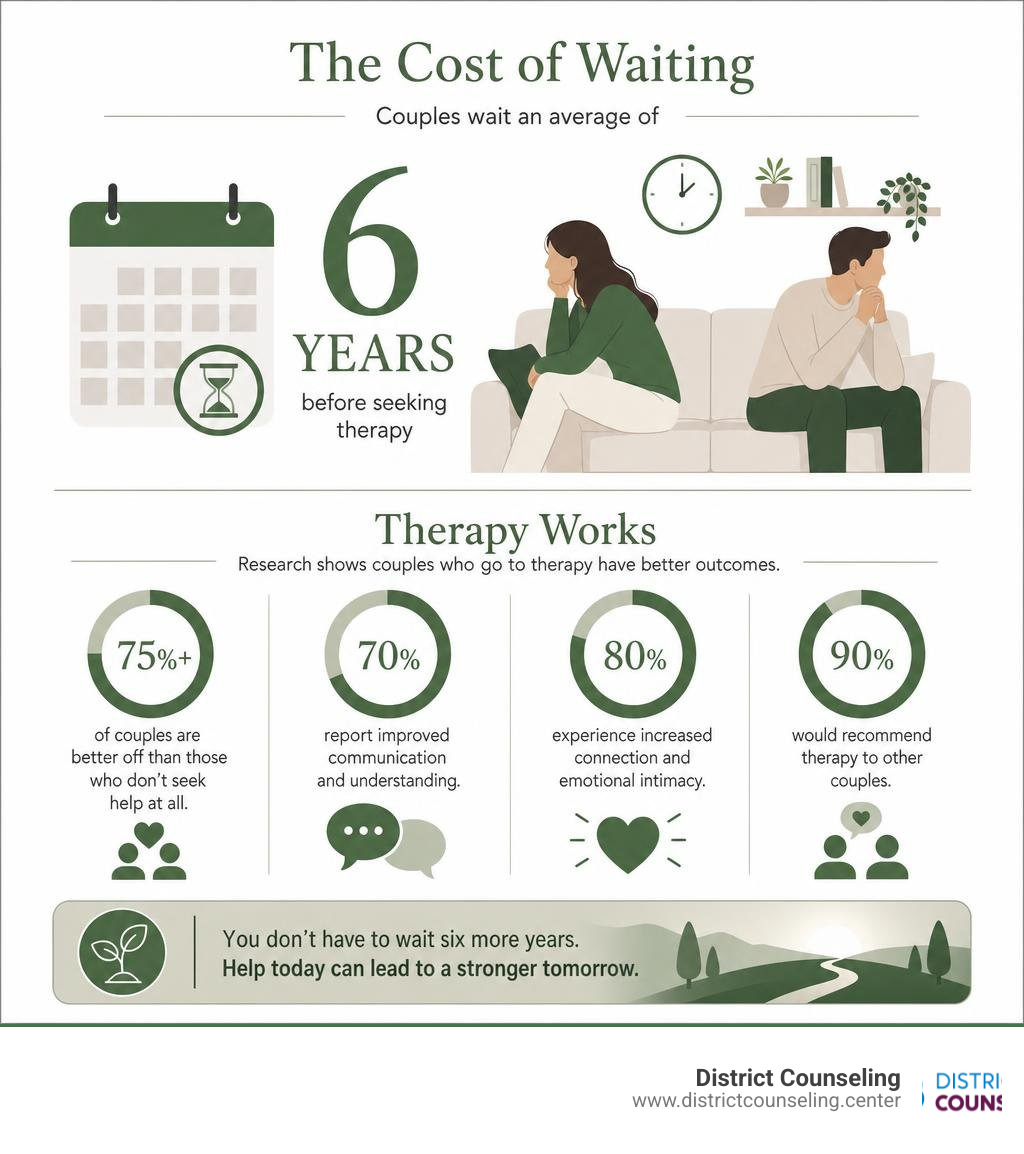
Most couples don’t walk into a therapist’s office at the first sign of trouble. Research shows the average couple waits six years of unhappiness before seeking help. Six years of unresolved arguments, growing distance, and silent car rides home.
That’s a long time to carry something that doesn’t have to be carried alone.
Whether you’re dealing with a communication breakdown, recovering from a breach of trust, or simply feeling more like roommates than partners — the fact that you’re looking for help right now puts you ahead of the curve.
The good news? It’s not too late. Studies show that more than 75% of couples who attend therapy are better off than those who don’t seek help at all.
I’m Francisco Ortiz, a Licensed Professional Counselor-Supervisor with extensive experience providing counseling and psychotherapy to couples and families navigating relationship conflict, trauma, and mood challenges — including helping clients find the right marriage counseling nearby for their specific needs. In this guide, I’ll walk you through everything you need to know to take that next step with confidence.
Recognizing the Signs: When to Search for Marriage Counseling Nearby
How do you know when a relationship has crossed the line from a “rough patch” into needing professional support? Many couples struggle to identify the exact moment things shifted. You might wake up one day and realize you cannot remember the last time you laughed together, or you might find yourselves arguing over the division of household chores with an intensity that seems completely disproportionate to the dirty dishes in the sink.
Recognizing the warning signs early is essential to preventing long-term damage. When couples wait too long, resentment builds like static electricity, ready to spark a major blowup over the smallest inconvenience.
If you are wondering When to Seek Couples Counseling, here are the most common signs that it is time to look for professional support:
1. The Roommate Dynamic
You share a mortgage, a refrigerator, and perhaps a parenting schedule, but your emotional connection is virtually nonexistent. You live parallel lives under the same roof, speaking only about logistics (who is picking up the groceries, when the utility bill is due) rather than sharing your inner worlds. This emotional distance often replaces active conflict, making it feel “peaceful” on the surface, but deeply lonely underneath.
2. Repeated, Unresolved Arguments
Do you find yourselves having the exact same fight year after year? Whether it is about finances, in-laws, intimacy, or how to raise the kids, the topic doesn’t seem to matter—the script remains identical. If your discussions quickly devolve into yelling, texting instead of talking, or complete emotional withdrawal, you are stuck in a toxic loop. Working with a professional can help you break these cycles by focusing on Improving Communication with Spouse.
3. Intimacy Shifts and Physical Disconnection
A drop in physical intimacy or sexual connection is a common indicator of underlying emotional injuries. When partners feel unsafe, unappreciated, or criticized, physical closeness is often the first thing to go. Over time, this lack of touch breeds further insecurity and distance, driving partners further apart.
4. Infidelity and Betrayal Recovery
Whether it is an emotional affair, a physical betrayal, or a breach of financial trust, recovering from infidelity is one of the most challenging hurdles a couple can face. Trying to navigate this pain without a roadmap often leads to further trauma. Specialized therapy helps couples process the betrayal, rebuild trust from the ground up, and write a new, more honest story for their partnership.
5. Resentment Buildup and the Silent Treatment
When arguments go unresolved, they don’t just disappear; they curdle into resentment. If you find yourself keeping score, holding onto past mistakes, or resorting to the silent treatment to punish your partner, your relationship is running on fumes.

At District Counseling, we serve couples across Texas—including Houston, Greater Heights, Cypress, Katy, Sugar Land, Fort Worth, and Austin—who are facing these exact challenges. We understand that taking the step to look for a therapist can feel daunting. If you are ready to find support, you can Find a Therapist in for Couples Relationship Issues who understands how to help you navigate these complex dynamics.
Seeking therapy is not a sign of failure; it is an act of extreme courage. It shows that you still care enough about your partnership to fight for its restoration.
What to Expect: Duration, Costs, and Your First Session
One of the biggest hurdles keeping couples from booking their first appointment is the fear of the unknown. What actually happens behind those closed doors? Will the therapist take sides? How much is this going to cost us, and how long will we have to go?
Let’s demystify the process so you and your partner can walk in feeling prepared.
Your Very First Session: The Intake Evaluation
Your initial session is primarily about assessment and establishing safety. The therapist will not expect you to resolve your deepest conflicts in the first hour. Instead, the focus is on gathering your relationship history, identifying the main patterns of distress, and setting clear goals.
A skilled therapist will establish ground rules for communication, ensuring that both partners feel heard without the session turning into a shouting match. Many practitioners will also schedule brief individual sessions with each of you following the initial joint session to understand your personal backgrounds and family-of-origin dynamics.
How Long Does Marriage Counseling Last?
While some couples experience a noticeable shift within the first few weeks, deep, lasting change takes time. On average, standard couples therapy runs between 12 to 25 sessions, typically spread over 6 to 9 months.
Initially, sessions are scheduled weekly to build momentum and practice new skills. As you begin to break old loops and rebuild trust, sessions may taper to bi-weekly and eventually monthly check-ins. If you want a deeper dive into what this journey looks like, check out The Ultimate Guide to Marital Counseling.
Cost and Financial Considerations
The cost of couples therapy varies depending on the therapist’s credentials, experience, and location. In Texas, session fees typically range from $150 to $250 per hour.
Because relationship counseling focuses on the shared bond rather than diagnosing an individual with a mental health disorder, it is usually a private-pay service. However, some couples are able to use Health Savings Accounts (HSA) or Flexible Spending Accounts (FSA) to cover these costs, or request a “superbill” to submit to their insurance for potential out-of-network reimbursement.
In-Person vs. Online Couples Therapy
In 2026, couples have more flexibility than ever before. Many choose virtual therapy (telehealth) to skip the cross-town commute and fit sessions into busy work schedules. But is virtual therapy as effective as sitting on a therapist’s couch? Let’s compare the two options:
| Feature | In-Person Couples Therapy | Online Couples Therapy (Telehealth) |
|---|---|---|
| Convenience | Requires travel time and navigating traffic. | No commute; log in from your home or office. |
| Environment | Neutral, professional office space free of home distractions. | Comfortable, familiar setting (requires a private room). |
| Therapist Sensing | Easier for the therapist to read subtle body language and physical tension. | High-quality video allows for strong emotional connection, though physical cues are slightly limited. |
| Scheduling | Limited to office hours and physical availability. | Often offers greater flexibility, including evening slots. |
| Effectiveness | Highly effective; traditional gold standard. | Clinically proven to be just as effective for most relationship issues. |
Whether you prefer the face-to-face connection of an office visit or the convenience of virtual sessions, the key is consistency and commitment from both partners.
Evidence-Based Approaches Used by Couples Therapists
When searching for marriage counseling nearby, it is helpful to understand the specific therapeutic methods your counselor might use. Gone are the days when a therapist simply sat back, nodded, and asked, “And how does that make you feel?” Modern couples therapy relies on structured, research-backed modalities designed to interrupt negative patterns and build secure emotional bonds.
Here are the primary evidence-based approaches used by top couples therapists today:
1. The Gottman Method Couples Therapy
Developed by Drs. John and Julie Gottman over decades of relationship research, the Gottman Method is highly structured and practical. It focuses on identifying and dismantling the “Four Horsemen of the Apocalypse” in relationships: criticism, contempt, defensiveness, and stonewalling.
Using tools like the Gottman Relationship Checkup, therapists help couples build “Love Maps,” foster fondness and admiration, and learn how to manage conflict constructively. John Gottman’s research famously demonstrated that by analyzing how a couple argues, observers can predict divorce with over 90% accuracy. The Gottman Method provides concrete tools to change those odds.
2. Emotionally Focused Therapy (EFT)
Based on attachment theory, Emotionally Focused Therapy (EFT) views relationship distress as a threat to emotional security. When we feel disconnected from our partner, our biological “alarm system” goes off, leading to repeated fights or emotional shutting down.
EFT helps couples identify their negative cycle (often a “pursuer-distancer” dynamic) and understand the underlying attachment fears driving it. Instead of just teaching communication tips, EFT focuses on creating moments of deep vulnerability that reshape the emotional bond. Research shows that EFT achieves its therapy goals in about 70-73% of cases, helping couples move from constant defensiveness to secure connection.
3. Imago Relationship Therapy
Imago therapy explores how childhood experiences and early attachment styles influence our adult relationship choices and conflict patterns. Partners learn to use a structured dialogue protocol—mirroring, validating, and empathizing—to slow down conversations and truly hear each other’s pain without getting defensive.
4. Christian Counseling
For couples who want to integrate their faith into the healing process, Christian counseling combines traditional, evidence-based psychological tools with biblical principles. This approach emphasizes commitment, forgiveness, and spiritual alignment as foundational pillars for a healthy, lifelong marriage.
5. Pre-Marital Counseling
You don’t have to wait until your relationship is in crisis to seek help. Pre-marital counseling—often utilizing programs like Prepare-Enrich—helps dating or engaged couples explore value differences, align on hot-button topics (like finances, parenting, and in-laws), and build strong communication habits before saying “I do.” Investing in your relationship early is one of the best ways to ensure a stable, satisfying marriage.

At District Counseling, we believe that Healthy Marriages: Regular Couples Counseling is the Key to a Healthy Marriage. We don’t believe in a one-size-fits-all approach. Whether we are drawing from the Gottman Method, utilizing EFT to heal deep emotional wounds, or helping you navigate attachment styles, our goal is to tailor the therapy to your unique relationship dynamic.
Frequently Asked Questions About Couples Therapy
Starting therapy brings up plenty of questions. Here are clear, straightforward answers to the most common queries couples have when seeking professional help.
Can we receive effective marriage counseling nearby online?
Yes, absolutely. Telehealth has revolutionized mental health care, and couples therapy is no exception. Secure, HIPAA-compliant video platforms allow couples to meet with their therapist from the comfort of their own couch.
This option is incredibly convenient for busy partners who find it hard to coordinate schedules for a physical drive to an office. The clinical effectiveness of online couples therapy has been shown to match that of in-person sessions, provided you have a quiet, private space free of distractions. That due to state licensing laws, your therapist must be licensed in the state where you are physically located during the session.
How do we choose the best marriage counseling nearby for our specific issues?
The most important factor in therapy success is the “therapeutic alliance”—the comfort, trust, and connection both of you feel with your counselor. When evaluating providers, keep these tips in mind:
- Look for Specialized Credentials: Ensure the therapist is a Licensed Marriage and Family Therapist (LMFT), Licensed Professional Counselor (LPC), or Licensed Clinical Social Worker (LCSW) with dedicated postgraduate training in couples therapy (such as Gottman or EFT certification).
- Schedule an Initial Consultation: Many practices offer a free 15-minute phone consultation. Use this time to ask about their approach, their experience with your specific issues (like infidelity or blended families), and how they handle conflict in sessions.
- Assess for Neutrality: A good couples therapist should not take sides or make one partner feel like the “villain.” They should focus on helping you understand the negative cycle itself as the common enemy.
If you are looking for specialized care in your local Texas community, we invite you to explore our dedicated local services:
- Houston Relationship & Marital Counseling
- Katy Relationship & Marital Counseling
- Cypress Relationship & Marital Counseling
- Sugar Land Relationship & Marital Counseling
- Pearland Relationship & Marital Counseling
- Austin Relationship & Marital Counseling
- Fort Worth Relationship & Marital Counseling
We also serve surrounding areas with tailored care, including Copperfield Relationship & Marital Counseling, Tomball Relationship & Marital Counseling, Spring Relationship & Marital Counseling, Missouri City Relationship & Marital Counseling, and Spring Branch Relationship & Marital Counseling.
Is couples therapy covered by health insurance?
Generally, health insurance does not cover standard couples or marriage counseling. Insurance plans require a licensed professional to diagnose an individual client with a mental health condition (such as Major Depressive Disorder or Generalized Anxiety Disorder) and prove that the treatment is “medically necessary” to treat that specific diagnosis.
Because couples therapy focuses on the relationship dynamic rather than treating an individual illness, it typically does not qualify. However, some couples pay out-of-pocket and use their HSA/FSA cards, or find that working with a private-pay therapist provides a higher level of privacy, flexibility, and specialized care without the constraints of insurance mandates.
If you are currently facing tight budget constraints but want to start working on your relationship immediately, you can read our practical guide on How to Save Your Marriage for Free for steps you can take at home today.
Conclusion
Every marriage experiences seasons of distance, doubt, and disconnection. But staying stuck in the silent treatment or repeating the same painful arguments doesn’t have to be your permanent reality. Relationships don’t usually end because of one massive, dramatic fight; they drift apart due to accumulated, unaddressed disconnections over time.
Taking a proactive approach to your relationship health is one of the most loving things you can do for your partner, your children, and yourself. Whether you are recovering from a major crisis or simply want to learn how to keep your connection strong when the world feels unstable, professional support can give you the practical tools you need to build a resilient, joyful partnership.
If you are ready to move beyond date night and craft a deeper connection, we invite you to explore:
- Beyond Date Night: Crafting a Year of Deeper Connection in Your Relationship
- Navigating the Summit of Your Relationship: What Global Politics Can Teach Us About Communication
- Is Your Relationship Ready for a Revitalization? Lessons from a City’s Renewal
- Navigating the Static: How to Keep Your Relationship Strong When the World Feels Unstable
At District Counseling, we provide sincere, authentic, and compassionate therapy tailored to what matters most to you. With convenient locations across Texas—including Houston, Austin, Fort Worth, Katy, Cypress, Sugar Land, and Pearland—our experienced team is here to help you restore and strengthen your relationship.
Don’t wait another six years to get the support your relationship deserves. Reach out to us today to schedule your consultation and take the first step toward lasting healing.
To learn more about our specialized approach or to book your session, visit our Relationship & Marital Counseling page. We look forward to walking alongside you on this journey.
Visited 7 times, 1 visit(s) today
Similar Posts

Francisco Ortiz
October 9, 2026
Faith-Based Pastoral Counseling: A Comprehensive Guide
Back-to-School Mental Health: Tips for a Smooth Transition – Discover practical tips to ease back-to-school anxiety for kids, teens, and parents. Build healthy routines, manage stress, and foster emotional… …...

Francisco Ortiz
October 7, 2026
Houston Counseling Options: Find Local Help Nearby
Find affirming counseling in Houston for trauma, LGBTQ+ care, couples, and more. Explore local options and start your healing today....

Francisco Ortiz
October 5, 2026
Why every teacher needs a burnout therapy game plan
Why every teacher needs a burnout therapy game plan – Learn about burnout therapy for teachers...

Francisco Ortiz
October 2, 2026
Child Therapist Near Me? Here is How to Spot a Great One
Find a child therapist near me who fits your child’s needs. Learn signs, costs, and effective therapy options....

Adalid Blandin
September 30, 2026
Mental Health and Miracles: Finding Local Christian Care
Find pastoral counselling near me for faith-based emotional and spiritual support in Texas....

Adalid Blandin
September 28, 2026
Missouri City and Houston Couples Therapy 101
Explore relationship counseling in Houston options, from couples therapy to intensives, with costs, insurance, and therapist tips for Missouri City families....

Adalid Blandin
September 25, 2026
How to find authentic therapy for emotional exhaustion in Houston
Find emotional exhaustion therapy Houston that helps professionals and caregivers move from burnout to renewed energy and balance....

Francisco Ortiz
September 23, 2026
A Practical Guide to Finding Licensed Telehealth Counselors in Texas
Find licensed telehealth counseling in Texas with this guide to legal standards, privacy, insurance, and best practices for virtual care....

Adalid Blandin
September 21, 2026
All About Psychiatric Weight Loss Options and Treatments
Explore psychiatric weight loss options, including medications, therapy, and bariatric support for holistic wellness....

Francisco Ortiz
September 18, 2026
No Traffic, No Waiting Rooms: Your Guide to Telehealth Counseling in Texas
Learn the rules, rights, and benefits of telehealth counseling in Texas with this complete guide to virtual therapy....


