
What Psychiatric Medication Management Really Means (And Why It Matters)
Psychiatric medication management is the ongoing, supervised process of prescribing, monitoring, and adjusting medications used to treat mental health conditions.
Here’s a quick breakdown:
| Element | What It Means |
|---|---|
| Who provides it | Psychiatrists, psychiatric nurse practitioners, or other licensed prescribers |
| What it involves | Evaluation, prescription, dosage adjustment, side effect monitoring |
| Common conditions treated | Depression, anxiety, ADHD, bipolar disorder, schizophrenia, PTSD |
| How long it takes | Medications typically take 4–8 weeks to show full effect |
| Is it a one-time thing? | No — it’s an ongoing process, not a single prescription |
| Best used with | Psychotherapy, lifestyle changes, and coordinated care |
Think of it less like a prescription refill and more like an evolving clinical partnership — one that changes as you change.
Many people feel overwhelmed, anxious, or emotionally stuck for months before they realize medication might help. Others worry about side effects, dependency, or losing their sense of self. These are real concerns — and they deserve real answers.
I’m Francisco Ortiz, a Licensed Professional Counselor-Supervisor with experience in mental health treatment, including working alongside prescribers to coordinate psychiatric medication management as part of comprehensive, integrated care. In this guide, I’ll walk you through everything you need to know — clearly and without the jargon.
Defining Psychiatric Medication Management
At its core, psychiatric medication management (sometimes called psychopharmacology) is the clinical use of medication to improve mental health symptoms. While many people think of it as simply “getting a script,” it is actually a highly specialized medical service. In Texas, this service is provided by medical doctors (psychiatrists) or psychiatric-mental health nurse practitioners (PMHNPs) who have spent years studying how chemicals interact with the human brain.
If you are looking for Psychiatric Medication Management in Austin, you are essentially looking for a partner to help balance your brain’s internal chemistry. Our brains rely on neurotransmitters—chemical messengers like serotonin, dopamine, and norepinephrine—to regulate mood, focus, and energy. When these chemicals are out of balance, it can feel like you’re trying to run a marathon through waist-deep mud.
Evidence-based clinical care uses medication to “level the playing field.” It isn’t about changing who you are; it’s about restoring function. Think of it like insulin for a diabetic. A person with diabetes doesn’t lack willpower; their body simply isn’t producing or using insulin correctly. Similarly, someone with clinical depression or bipolar disorder may have a biological “chemical imbalance” that requires medical oversight to correct.
The Process: From Evaluation to Optimization
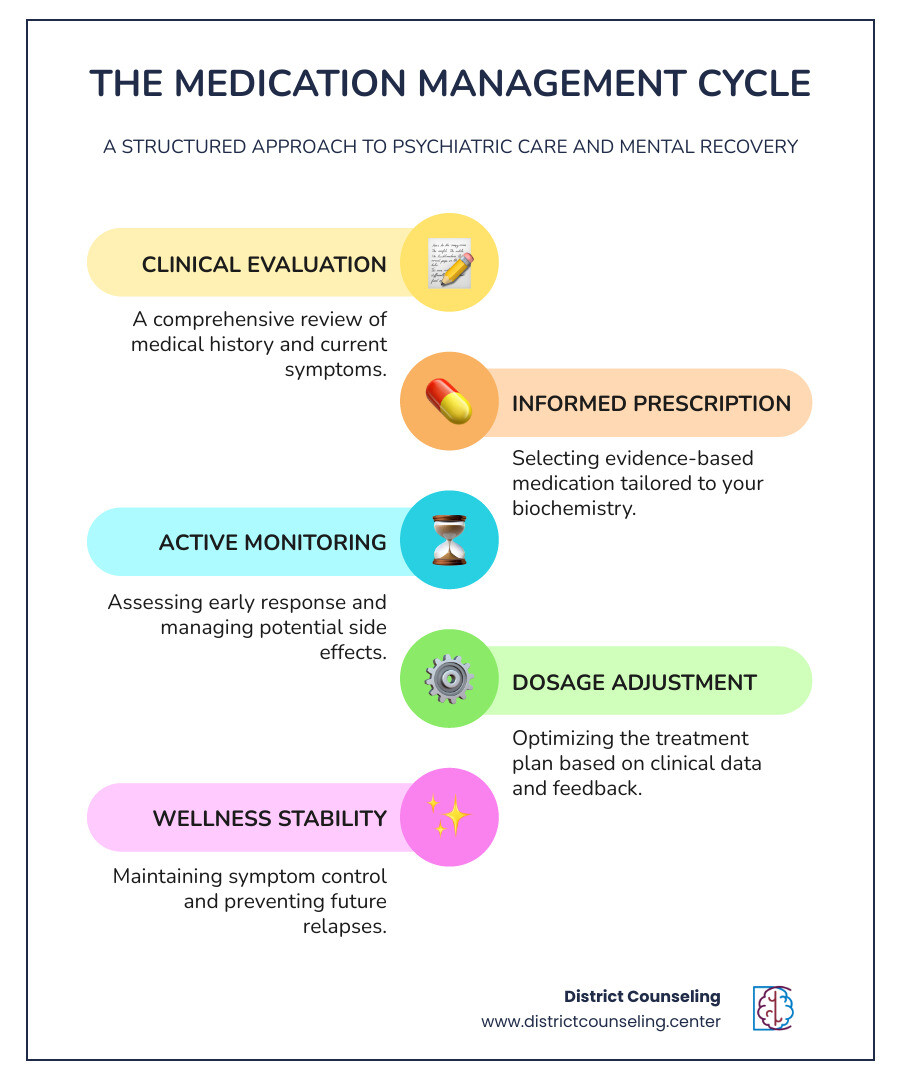
The journey of psychiatric medication management isn’t a straight line—it’s a cycle of listening, testing, and refining. We don’t just hand over a bottle and say, “Good luck!” We work with you through a structured clinical process.

The Initial Evaluation
Everything starts with a comprehensive initial evaluation. This isn’t a five-minute chat. Typically, an intake session lasts about 60 minutes. During this time, the provider reviews your full medical history, current symptoms, lifestyle factors (like sleep and stress), and any past experiences with medication. If you are seeking Psychiatric Medication Management in Houston, this first meeting is where we establish the foundation of your treatment plan.
Follow-Up Visits and Dosage Adjustment
Once a medication is prescribed, the “management” part begins. Follow-up visits are shorter—usually 20 to 30 minutes—and occur more frequently at the start of treatment (often every 2–4 weeks). These sessions are crucial for dosage adjustment. We aim for the “lowest effective dose”—enough to manage symptoms, but not so much that you feel like a “zombie.” This measurement-based care ensures that we are making decisions based on your actual progress rather than guesswork.
Monitoring Psychiatric Medication Management Effectiveness
How do we know if it’s working? We use validated symptom tracking scales to measure your response. It is important to remember that most psychiatric medications take time. While some anti-anxiety meds work within hours, antidepressants often require a 4-to-8-week window to reach their full impact.
In areas like Katy, our providers emphasize that sleep, appetite, and energy often improve before your mood lifts. We also monitor your physical health through lab work. For example, medications like lithium require regular blood tests to ensure levels stay within a safe, therapeutic range.
Safety and Risks in Psychiatric Medication Management
No medication is without risk, which is why professional oversight is mandatory. We take safety seriously, particularly regarding FDA “black box warnings.”
- Suicidal Ideation: In youth and young adults, certain antidepressants can initially increase the risk of suicidal thinking (about 4% in those taking the med vs. 2% in those on a placebo). Close monitoring is essential during the first few weeks.
- Side Effect Management: We watch for physical side effects like weight gain, tremors, or tardive dyskinesia (involuntary movements).
- Drug Interactions: We review every supplement and over-the-counter pill you take to prevent dangerous interactions like Serotonin Syndrome.
Whether you are receiving Psychiatric Medication Management in Pearland or elsewhere in Texas, our goal is to ensure the benefits of the medication always outweigh the risks. For more detailed safety data, you can always consult the FDA Overview of Psychiatric Medications.
Common Medications and Conditions Treated
There is no “one-size-fits-all” pill. Different conditions require different chemical approaches. Below is a general guide to the classes of medications we often manage.
| Medication Class | Common Examples | Primary Conditions |
|---|---|---|
| SSRIs/SNRIs | Prozac, Zoloft, Cymbalta | Depression, Anxiety, OCD, PTSD |
| Mood Stabilizers | Lithium, Lamictal | Bipolar Disorder, Impulse Control |
| Antipsychotics | Abilify, Seroquel | Schizophrenia, Bipolar, Augmentation for Depression |
| Stimulants | Adderall, Ritalin | ADHD, Narcolepsy |
| Anxiolytics | Buspar, Lexapro | Generalized Anxiety Disorder |
If you are looking for Psychiatric Medication Management in Fort Worth, you will find that we treat a wide spectrum of needs. This includes everything from common anxiety to complex Treatment-Resistant Depression (TRD), where traditional meds haven’t provided enough relief.
The Power of Integrated Care: Medication and Therapy
One of the biggest myths in mental health is that you have to choose between “pills or talk.” In reality, the most effective treatment for almost every mental health condition is a combination of both.

We call this the “synergistic effect.” Medication works on the neurochemical level to stabilize your mood and reduce the “noise” in your head. Once you feel more stable, you are better equipped to engage in psychotherapy. Therapy then helps you address the root causes, build coping mechanisms, and change cognitive patterns.
For our clients in Spring and Sugar Land, we find that integrated care significantly reduces the risk of relapse. Medication provides the “protective barrier” (like a seatbelt), while therapy teaches you how to drive more safely through life’s stressors.
Modern Access via Telehealth in 2026
As of May 2026, the way we access care has changed for the better. Psychiatric medication management is now more accessible than ever through telehealth.
Virtual care allows you to meet with your psychiatrist or nurse practitioner from the comfort of your home in Missouri City or any of our other Texas locations. These sessions are conducted via HIPAA-compliant digital health platforms, ensuring your privacy is protected.
Telehealth has removed geographic barriers, making it easier to maintain continuity of care. You don’t have to fight Houston traffic to make your 30-minute follow-up! We also utilize digital prescription monitoring programs to ensure your refills are handled safely and efficiently.
Frequently Asked Questions about Medication Management
How long does it take for psychiatric medications to work?
Patience is the hardest part of this process. Most people do not see major benefits for three to six weeks. While sleep and appetite might improve in the first few days, the full therapeutic impact on mood and anxiety usually takes 4–8 weeks. If you are in Tomball, we will check in with you regularly during this “waiting period” to support you.
Will I have to take medication forever?
Not necessarily. For a first episode of depression, we typically recommend 9–12 months of stability before we discuss tapering off. However, for chronic conditions like Bipolar Disorder or Schizophrenia, long-term maintenance treatment is often the safest path to prevent relapse. We view this as a collaboration—we decide together when it’s time to stay the course or try a supervised “deprescribing” plan. If you are in Spring Branch, we can discuss a timeline that fits your specific history.
Are there special considerations for children or the elderly?
Absolutely. Children and adolescents respond differently to medications, particularly stimulants for ADHD (where about 75% show significant improvement). However, they require closer pediatric monitoring for mood changes. For the elderly, especially those with dementia, certain antipsychotics carry higher risks, requiring a very “low and slow” approach to dosing. Our Copperfield TX providers are specifically trained to handle these delicate developmental factors.
Conclusion
At District Counseling, we believe that mental health care should be as unique as the people of Texas. Whether you are in Houston, Austin, or the surrounding suburbs, our goal is to provide psychiatric medication management that is sincere, authentic, and compassionately aligned with what matters most to you.
Medication isn’t a “cure-all,” and it isn’t a sign of weakness. It is a tool—a powerful one—that can help you reclaim your life. If you’re ready to explore how a personalized treatment plan can help you thrive, we are here to walk that path with you.
Ready to take the next step? Explore our Medication Management Services today. Your mental wellness is worth the investment.
Visited 14 times, 1 visit(s) today


Similar Posts

Francisco Ortiz
October 21, 2026
Finding the Right EMDR Specialist in Cypress Texas for Real Healing
Find a qualified EMDR specialist in Cypress Texas for real trauma healing and lasting anxiety relief....

Francisco Ortiz
October 19, 2026
Why therapy for caregiver exhaustion is a necessity not a luxury
Find relief with exhaustion therapy for caregivers. Learn how clinical support heals burnout and restores your well-being....

Francisco Ortiz
October 16, 2026
Navigating Neuropsychological Evaluations from Katy to Pasadena
Learn how an ADHD evaluation for Houston teens works, from medication management to school accommodations and 504 plans....

Francisco Ortiz
October 14, 2026
How Texas caregivers can beat exhaustion with virtual therapy
Beat caregiver exhaustion therapy Texas caregivers trust—virtual sessions for stress, boundaries, and recovery. Start today....

Francisco Ortiz
October 12, 2026
Find Local Youth Counselor: How They Can Help Your Teen Thrive (52 characters)
Find a qualified youth counselor near me to help your teen thrive with evidence-based support for anxiety, trauma, and more....

Francisco Ortiz
October 9, 2026
Faith-Based Pastoral Counseling: A Comprehensive Guide
Discover how pastoral counseling integrates faith and psychology for holistic healing, grief, trauma, and marital support....

Francisco Ortiz
October 7, 2026
Houston Counseling Options: Find Local Help Nearby
Find affirming counseling in Houston for trauma, LGBTQ+ care, couples, and more. Explore local options and start your healing today....

Francisco Ortiz
October 5, 2026
Why every teacher needs a burnout therapy game plan
Why every teacher needs a burnout therapy game plan – Learn about burnout therapy for teachers...

Francisco Ortiz
October 2, 2026
Child Therapist Near Me? Here is How to Spot a Great One
Find a child therapist near me who fits your child’s needs. Learn signs, costs, and effective therapy options....

Adalid Blandin
September 30, 2026
Mental Health and Miracles: Finding Local Christian Care
Find pastoral counselling near me for faith-based emotional and spiritual support in Texas....


