
Faith-Based Pastoral Counseling: A Comprehensive Guide
What Is Pastoral Counseling?
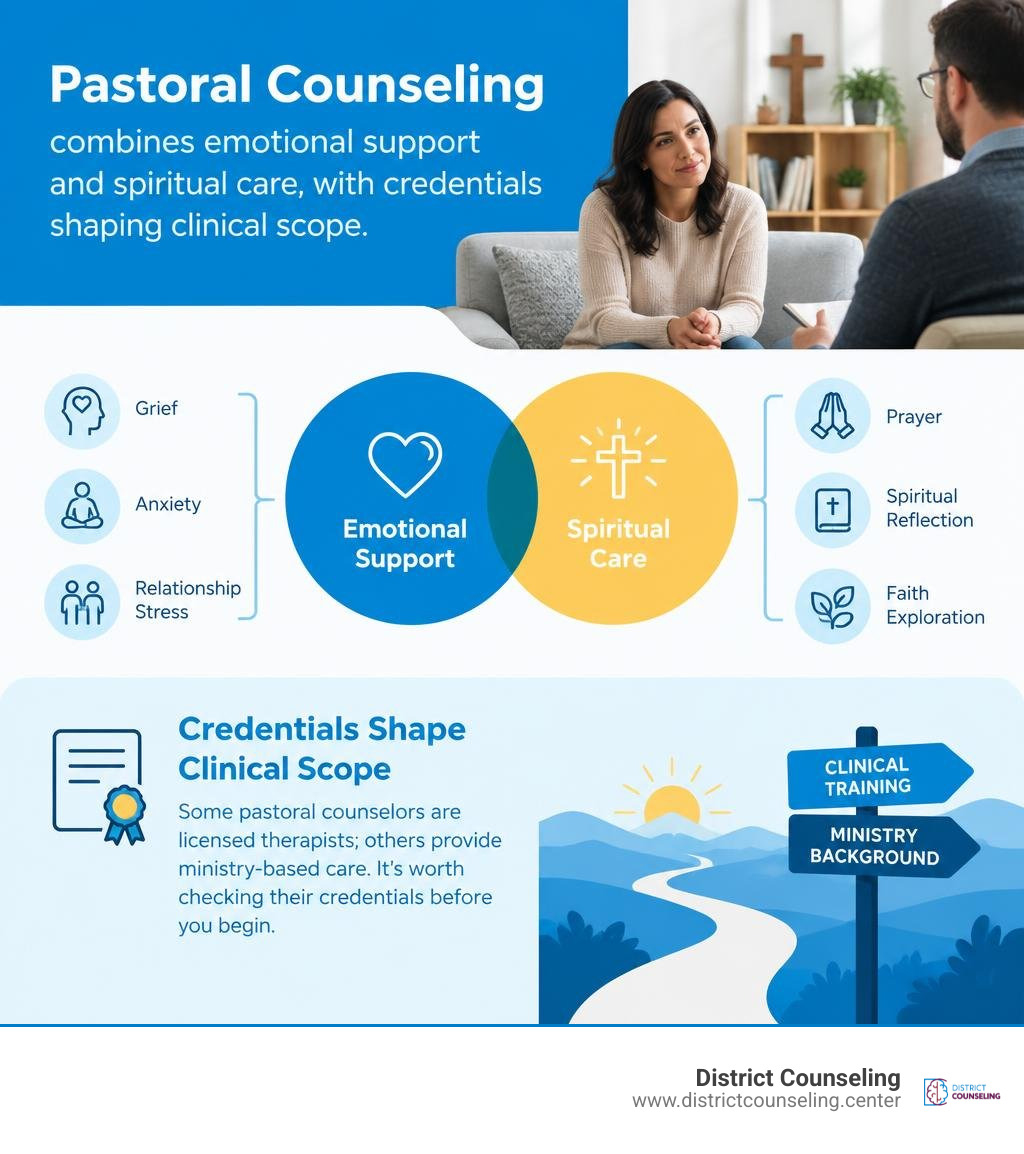
Pastoral counseling combines emotional support with spiritual care. A counselor may help you work through grief, anxiety, or relationship stress while making room for your beliefs and questions about faith. Unlike standard therapy, it can include prayer or spiritual reflection if you want that. Some pastoral counselors are licensed therapists; others provide ministry-based care, so it is worth checking their credentials before you begin.
I’m Francisco Ortiz, a Licensed Professional Counselor-Supervisor and founder of AdventMind by District Counseling, a ministry that offers pro bono psychotherapy. My work with individuals, couples, and families informs this guide to pastoral counseling and how to choose the support that fits your needs.
Understanding Pastoral Counseling: Origins and Dual Integration
When life hits hard, mental health and spiritual questions rarely stay neatly separated. For decades, individuals feeling overwhelmed had to make a tough choice: talk to a secular therapist who might ignore their faith, or visit a pastor who might lack clinical training in psychological distress.
Pastoral counseling bridges that gap by merging rigorous clinical psychology with deep theological understanding. The movement took root in early 20th-century North America through pioneers like Anton Boisen, a minister who survived severe psychiatric crises and realized mental suffering required both medical insight and spiritual empathy. Alongside physician Richard Cabot, Boisen established hospital-based training that evolved into modern clinical pastoral training programs. Later, institutions like the Blanton-Peale Institute brought psychiatry and religion under one roof, establishing that science and faith can work in tandem.
In 1963, the American Association of Pastoral Counselors (AAPC) formed to set unified clinical standards for faith-based practitioners. AAPC later joined forces with the Association for Clinical Pastoral Education (ACPE) to establish cohesive accreditation for clinical training. Exploring the intellectual foundation of pastoral counseling illustrates how the field matured from informal advice into an evidence-informed discipline held accountable to both mental health standards and spiritual communities.
Clinical Techniques in Faith-Based Care
Far from being just a casual chat or an unguided prayer session, structured pastoral counseling utilizes proven psychological models adapted to honor a client’s spiritual framework. Practitioners frequently integrate Cognitive Behavioral Therapy (CBT), Acceptance and Commitment Therapy (ACT), and narrative approaches with spiritual disciplines like contemplative prayer, scriptural reflection, and values assessment.
This dual framework helps clients confront moral distress, unresolved guilt, and existential grief without dismissing psychological factors. Research shows that matching clinical care with a client’s religious or spiritual preferences is demonstrably effective. A meta-analysis of nearly 100 clinical studies demonstrated that integrating faith into evidence-based models produces outcomes comparable to secular treatments—with traditional CBT for depression achieving an effect size (Hedge’s g) around 1.0 to 1.2, and faith-adapted protocols showing similar improvements in symptom reduction and overall well-being.
| Feature / Dimension | Traditional Secular Psychotherapy | Pastoral Counseling |
|---|---|---|
| Primary Framework | Psychological and behavioral science | Integrated psychological science and theology |
| Spiritual Interventions | Excluded or addressed strictly as cultural context | Intentionally integrated (prayer, scripture, meditation) |
| Accountability | State licensing boards and professional ethics | Professional licensing boards and/or faith communities |
| Core Goal | Symptom reduction, psychological wellness, and coping | Psychological healing, symptom relief, and soul care |
| Practitioner Background | Clinical psychology, counseling, or social work | Dual training in behavioral health and theological ministry |
How Pastoral Counseling Integrates Spirituality and Psychology
Pastoral counseling approaches a person as a whole: mind, body, and spirit. When someone endures severe distress, questions like “Why is this happening?” or “Where is God in my suffering?” frequently surface. In a secular environment, these questions might be treated as peripheral, but in pastoral counseling, they are recognized as central to the healing process.
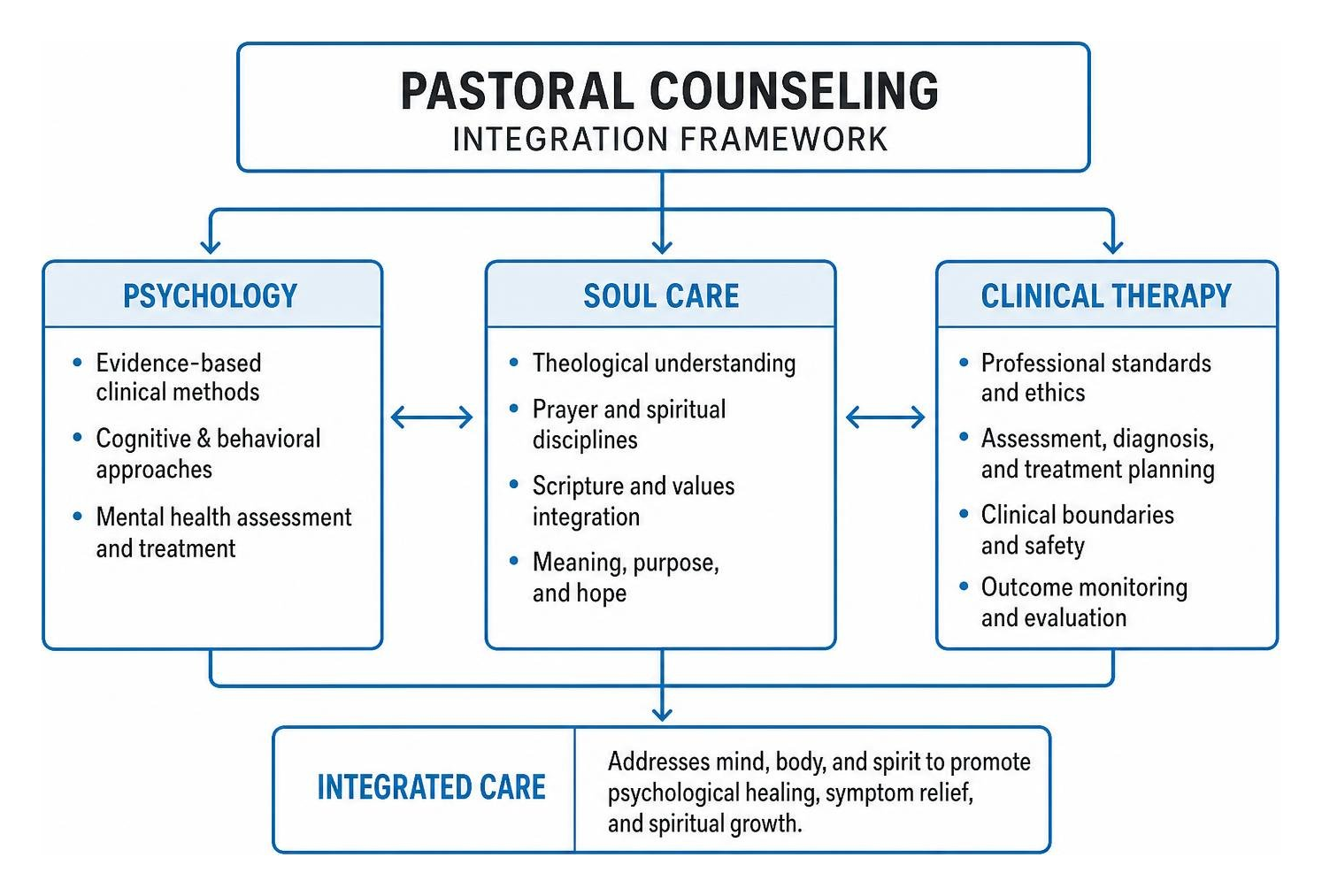
Through cognitive reframing, a counselor helps individuals identify harmful thought patterns while drawing upon spiritual truths that foster resilience, peace, and hope. This balanced perspective of mental health and miracles in local Christian care ensures that emotional struggles are met with sound clinical interventions alongside genuine spiritual support.
Core Applications and Clinical Scope
Because certified pastoral counselors are trained in both human behavior and spiritual dynamics, they handle a wide spectrum of life challenges. Faith-integrated care helps individuals navigate acute crises, chronic distress, and complex transitions:
- Grief and Loss: Coping with the death of a loved one while wrestling with bereavement, anger, and spiritual confusion.
- Trauma and Moral Injury: Processing deep wounds, systemic trauma, or events that shook your core moral beliefs.
- Anxiety and Depression: Managing psychological symptoms using evidence-based tools without feeling that your struggle is a sign of “weak faith.”
- Addiction Recovery: Partnering with medical care to address underlying emotional trauma while renewing spiritual purpose.
- Chronic Illness and End-of-Life: Finding emotional peace, meaning, and coping mechanisms during severe medical challenges.

Scholarly reviews on pastoral counseling research and clinical applications highlight its unique role for clients who view their mental health through the lens of faith, creating an inviting space for emotional repair.
Navigating Premarital and Marital Challenges Through Faith
Relationship distress is one of the most common reasons couples seek counseling. When spiritual worldviews shape family life, marital counseling must address both practical communication tools and shared spiritual values.
Pastoral counselors work with couples to untangle conflict patterns, navigate financial stress, and establish healthy emotional boundaries. In premarital contexts, structured guidance helps partners build a shared foundation. Couples seeking structured Christian support can utilize Christian premarital counseling guidance to explore expectations, roles, and communication. Similarly, couples preparing for marriage within Islamic traditions can turn to Islamic premarital counseling principles to align religious commitments with marital harmony.
Training Pathways, Credentials, and Licensure
Becoming a professional pastoral counselor requires an extensive educational foundation. On average, it takes 6 to 8 years of post-secondary study and supervised training to enter the field.
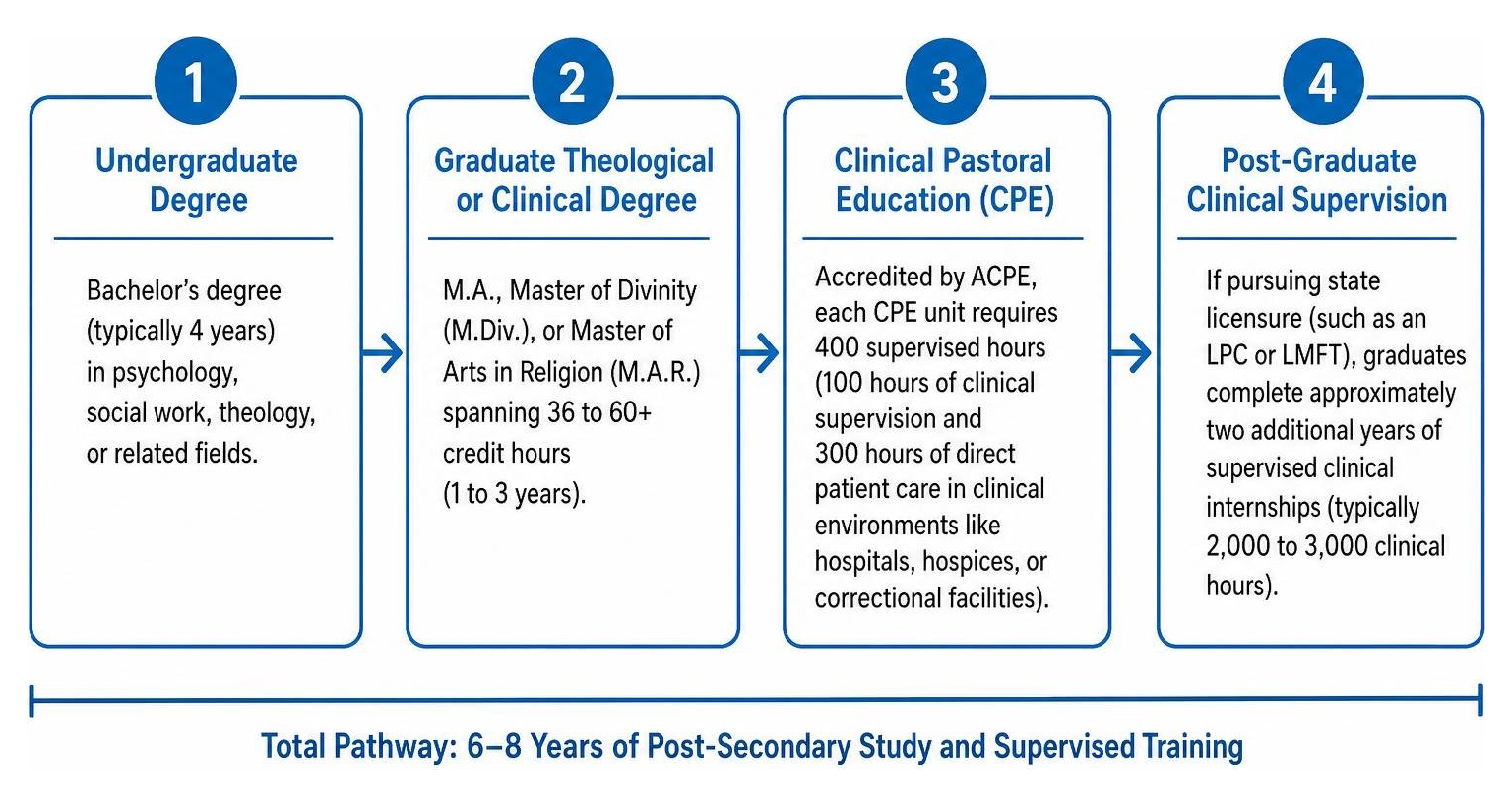
- Undergraduate Degree: Students complete a bachelor’s degree (typically 4 years) in psychology, social work, theology, or related fields.
- Graduate Theological or Clinical Degree: Prospective counselors complete an M.A., Master of Divinity (M.Div.), or Master of Arts in Religion (M.A.R.) spanning 36 to 60+ credit hours (1 to 3 years).
- Clinical Pastoral Education (CPE): Accredited by ACPE, each CPE unit requires 400 supervised hours (100 hours of clinical supervision and 300 hours of direct patient care in clinical environments like hospitals, hospices, or correctional facilities).
- Post-Graduate Clinical Supervision: If pursuing state licensure (such as an LPC or LMFT), graduates complete approximately two additional years of supervised clinical internships (typically 2,000 to 3,000 clinical hours).
According to industry data, pastoral counselors earn an average annual salary of $55,470, with entry-level ministry counselors earning approximately $31,000 annually and experienced licensed clinical practitioners earning substantially more.
Educational Degrees for Pastoral Counseling Careers
Graduate degrees for this profession are evaluated under standards set by the Association of Theological Schools (ATS) or secular mental health accreditation bodies. Curriculum options vary depending on career goals:
- Non-Licensure Ministry Degrees: Focused on soul care, conflict mediation, and discipleship within church congregations or nonprofit ministries. A representative M.A. in pastoral counseling curriculum requires 36 credit hours focusing on small group ministries, church administration, and biblical counseling models.
- Theological Master of Arts: Broader 60-credit-hour programs (such as an M.A. in Religion with pastoral counseling concentrations) that merge comprehensive biblical theology with short-term counseling frameworks.
- Cost Structures: Graduate theological programs often provide structured tuition options, such as block rates (e.g., $2,850 per semester for full-time enrollment) or per-credit rates (e.g., $410 per credit hour, with discounted rates around $310 for military personnel). Specialized private programs may range around $685 per credit hour.
Clinical Licensure vs. Ordained Ministry Scope
Understanding the legal scope of practice is essential when choosing a provider. In most states, ordained ministers, pastors, and church counselors operate under clergy exemption laws, allowing them to provide non-clinical spiritual guidance without state licenses.
However, diagnosing psychiatric conditions or conducting formal psychotherapy requires state licensure (such as Licensed Professional Counselor [LPC] or Licensed Marriage and Family Therapist [LMFT]). While five states (Arkansas, Kentucky, Maine, New Hampshire, and North Carolina) provide specific pastoral counselor licenses and Tennessee offers a clinical pastoral therapist license, most states regulate pastoral counseling through standard behavioral health boards.
| Feature / Criterion | Licensed Clinical Pastoral Counselor (LPC/LMFT) | Ministry-Based Pastoral Counselor |
|---|---|---|
| Education Level | Master’s or Doctorate in Counseling/Psychology | Master’s in Ministry/Theology or lay training |
| State Board Licensure | Yes (Regulated by state behavioral health boards) | No (Practicing under clergy exemption laws) |
| Clinical Diagnosis | Diagnoses DSM-5 mental health conditions | Does not diagnose clinical mental health disorders |
| Evidence-Based Therapy | Clinical psychotherapy, EMDR, CBT, trauma care | Biblical counseling, spiritual mentorship, prayer |
| Insurance Billing | Eligible for insurance reimbursement / Superbills | Out-of-pocket, donation, or church-sponsored |
Frequently Asked Questions About Faith-Based Therapy
What is the primary difference between a secular therapist and a pastoral counselor?
A secular therapist utilizes behavioral and psychological interventions without incorporating religious elements unless the client explicitly brings them up. A pastoral counselor is formally equipped to explore spiritual themes, utilizing theology, prayer, and scripture alongside psychological science to help clients heal emotionally and spiritually.
Is pastoral counseling covered by health insurance?
Insurance reimbursement depends on your counselor’s licensure. When services are provided by a state-licensed mental health professional (such as an LPC, LMFT, or LCSW) who integrates pastoral care, sessions are typically eligible for insurance coverage, in-network benefits, or out-of-network superbills. Ministry-based or non-licensed clergy counseling is not covered by insurance.
Do you have to be religious to benefit from faith-integrated counseling?
No. Qualified pastoral counselors provide compassionate, client-centered care for individuals from all religious backgrounds, as well as those who identify as spiritual or non-religious. Sessions always move at your comfort level, focusing on your values, goals, and personal worldview without judgment or pressure.
Conclusion
Navigating life’s emotional storms does not mean you have to leave your faith at the therapy room door. By blending clinical expertise with spiritual understanding, faith-based counseling helps you find clarity, process deep pain, and rebuild resilience.
At District Counseling, we serve individuals, couples, and families across Texas—including our offices in Houston, Austin, Greater Heights, Memorial, Katy, Sugar Land, The Woodlands, Fort Worth, West Lake Hills, and surrounding areas. Our compassionate, licensed clinicians provide trauma care, EMDR, premarital counseling, and psychotherapy tailored to your values.
If you are looking for guidance that respects your spiritual journey while providing advanced clinical support, connect with our team today to explore our pastoral counseling services and take your next step toward lasting healing.
Visited 1 times, 1 visit(s) today
Similar Posts

Francisco Ortiz
October 9, 2026
Faith-Based Pastoral Counseling: A Comprehensive Guide
Discover how pastoral counseling integrates faith and psychology for holistic healing, grief, trauma, and marital support....

Francisco Ortiz
October 7, 2026
Houston Counseling Options: Find Local Help Nearby
Find affirming counseling in Houston for trauma, LGBTQ+ care, couples, and more. Explore local options and start your healing today....

Francisco Ortiz
October 5, 2026
Why every teacher needs a burnout therapy game plan
Why every teacher needs a burnout therapy game plan – Learn about burnout therapy for teachers...

Francisco Ortiz
October 2, 2026
Child Therapist Near Me? Here is How to Spot a Great One
Find a child therapist near me who fits your child’s needs. Learn signs, costs, and effective therapy options....

Adalid Blandin
September 30, 2026
Mental Health and Miracles: Finding Local Christian Care
Find pastoral counselling near me for faith-based emotional and spiritual support in Texas....

Adalid Blandin
September 28, 2026
Missouri City and Houston Couples Therapy 101
Explore relationship counseling in Houston options, from couples therapy to intensives, with costs, insurance, and therapist tips for Missouri City families....

Adalid Blandin
September 25, 2026
How to find authentic therapy for emotional exhaustion in Houston
Find emotional exhaustion therapy Houston that helps professionals and caregivers move from burnout to renewed energy and balance....

Francisco Ortiz
September 23, 2026
A Practical Guide to Finding Licensed Telehealth Counselors in Texas
Find licensed telehealth counseling in Texas with this guide to legal standards, privacy, insurance, and best practices for virtual care....

Adalid Blandin
September 21, 2026
All About Psychiatric Weight Loss Options and Treatments
Explore psychiatric weight loss options, including medications, therapy, and bariatric support for holistic wellness....

Francisco Ortiz
September 18, 2026
No Traffic, No Waiting Rooms: Your Guide to Telehealth Counseling in Texas
Learn the rules, rights, and benefits of telehealth counseling in Texas with this complete guide to virtual therapy....


