
Why Your Mitochondria Might Be Depressed
When Your Brain Runs Low on Energy, Your Mood Pays the Price
Metabolic mental health is an emerging field that examines how your body’s energy systems — especially in the brain — directly shape your risk for depression, bipolar disorder, schizophrenia, and other psychiatric conditions.
Quick answer: What is metabolic mental health?
| Concept | What it means |
|---|---|
| Metabolic mental health | The study of how metabolism, insulin resistance, mitochondrial function, and inflammation affect brain health and psychiatric symptoms |
| Key metabolic factors | Insulin resistance, mitochondrial dysfunction, chronic inflammation, lipid dysregulation |
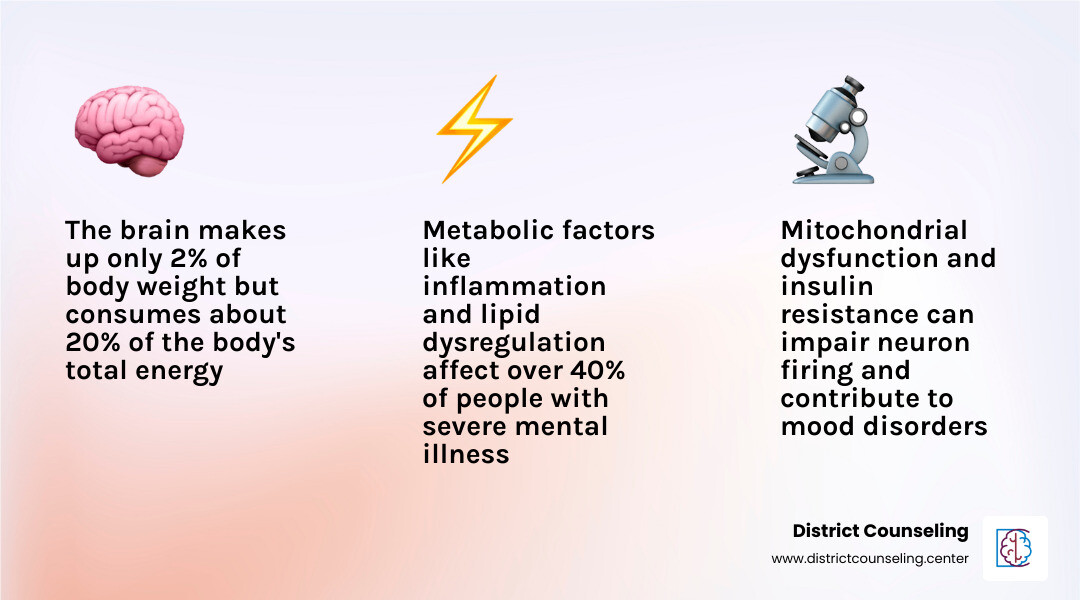
| Who it affects | Over 40% of people with severe mental illness also have metabolic syndrome |
| Why it matters | Metabolic dysfunction may drive psychiatric symptoms — not just accompany them |
| What can help | Ketogenic diet, metformin, GLP-1 agonists, exercise, intermittent fasting, and integrated psychiatric care |
Most people think of mental illness as a brain chemistry problem — too little serotonin, too much dopamine. That framing isn’t wrong, but it’s incomplete.
A growing body of research suggests that how well your brain produces and uses energy may be just as important as any neurotransmitter. When that energy system breaks down — through insulin resistance, mitochondrial damage, or chronic inflammation — your mood, cognition, and behavior can all suffer.
The brain makes up only 2% of your body weight but consumes roughly 20% of your total energy. That makes it extraordinarily vulnerable to metabolic disruption.
This isn’t a fringe idea. Research connecting brain metabolism to psychiatric illness dates back to the 1950s, and today clinical programs at institutions like McLean Hospital and Stanford are building on that foundation with funded trials and dedicated programs.
I’m Francisco Ortiz, a Licensed Professional Counselor-Supervisor and Certified Forensic Mental Health Evaluator with deep experience treating mood disorders, trauma, and complex mental health conditions at the intersection of mind and body. My work in metabolic mental health is grounded in helping real people — not just managing symptoms, but understanding the biological and lifestyle factors that shape long-term recovery. In this guide, I’ll walk you through what the science actually says and what it means for your care.
Metabolic mental health starts with brain energy
When we talk about “brain energy,” we aren’t talking about how much coffee you drank this morning. We are talking about the fundamental biological process of converting food and oxygen into the fuel your neurons need to fire. This process, known as bioenergetics, is the cornerstone of metabolic mental health.
For decades, psychiatry focused almost exclusively on neurotransmitters—the chemical messengers like serotonin and dopamine. But researchers like Seymour Kety in the 1950s and more recently Bruce Cohen at McLean Hospital have pointed out that these messengers can’t do their jobs if the “power plant” of the cell is failing. If your brain cells can’t use glucose efficiently or if they lack the flexibility to switch to ketones when needed, the entire system begins to stutter.
What metabolic psychiatry means and why it differs from traditional psychiatry
Traditional psychiatry often views mental health through a diagnostic lens, focusing on symptom reduction. If you are depressed, we try to lift the mood; if you are anxious, we try to calm the nerves. While this is essential, metabolic mental health takes a more “root cause” approach.
Metabolic psychiatry is a nascent field that examines the overlap between metabolism and mental health. It suggests that many psychiatric conditions are not just “in the head” but are systemic issues. By addressing insulin resistance, inflammation, and energy pathways, we aim for more than just symptom management—we aim for remission and full functional recovery. This field prioritizes key research goals that bridge the gap between your physical health and your psychological well-being.
Why mitochondria matter in depression, bipolar disorder, and psychosis
Mitochondria are often called the “powerhouses of the cell,” but they are much more than that. They regulate cell signaling, gene expression, and even cell death. In the brain, neurons require a massive amount of ATP (energy) to maintain the electrical gradients necessary for firing.
When mitochondria are dysfunctional, several things happen:
- Oxidative Stress: The “exhaust” from energy production becomes toxic, damaging cell structures.
- Neuronal Firing Issues: Cells may become overactive (leading to mania or anxiety) or underactive (leading to depression or cognitive fog).
- Glial Cell Dysfunction: These support cells, which manage glucose storage and brain metabolism, stop protecting neurons effectively.
In conditions like bipolar disorder and schizophrenia, researchers have found evidence of “cerebral hypometabolism”—essentially, certain parts of the brain are starving for energy even when blood sugar is high.
How the brain can be metabolically underpowered before diagnosis
One of the most startling findings in recent years is that metabolic issues often show up years before a psychiatric diagnosis. Longitudinal studies have shown that high childhood insulin levels and rising BMI trajectories are associated with an increased risk of developing psychosis or depression in young adulthood.
This suggests that abnormal glycemic control is not just a side effect of being unwell; it may be a “prodromal” or early warning sign. By the time a first episode of psychosis occurs, many patients already show signs of insulin resistance, even before they take their first dose of medication.
What the evidence says about metabolic dysfunction in mental illness
The link between metabolic syndrome and severe mental illness (SMI) is well-documented and, frankly, quite sobering. People living with SMI—such as schizophrenia or bipolar disorder—die on average 10 to 20 years earlier than the general population. The primary cause isn’t suicide; it’s cardiovascular disease driven by metabolic dysfunction.
Metabolic mental health and insulin resistance in depression and psychosis
Insulin resistance is a state where your body’s cells stop responding properly to insulin, leading to higher blood sugar and inflammation. In major depression, large meta-analyses show that measures like HOMA-IR (a calculation of insulin resistance) are significantly higher than in healthy individuals.
In one Dutch cohort study, three different measures of insulin resistance were found to predict the onset of major depressive disorder. This tells us that metabolic health isn’t just a physical concern; it is a primary driver of mood stability.
Why schizophrenia and bipolar disorder often come with metabolic syndrome
The prevalence of metabolic syndrome—a cluster of conditions including abdominal obesity, high blood pressure, and high blood sugar—is over 40% in individuals with schizophrenia or bipolar disorder. Some studies place this number as high as 48.6%.
This is 58% higher than the general population. While lifestyle factors and medications play a role, there is also evidence of a shared genetic vulnerability. The same biological pathways that make a person susceptible to mood instability may also make them prone to weight gain and diabetes. For a deeper look at these connections, you can explore updates on prevalence and treatment options.
Inflammation, mitochondria, and the shared biology behind psychiatric symptoms
Chronic inflammation acts like a “slow fire” in the body and brain. High levels of cytokines (inflammatory markers) can disrupt the gut-brain axis, interfere with circadian rhythms, and damage mitochondria. This creates an “allostatic load”—the cumulative wear and tear on the body—that eventually breaks down mental resilience.
Can metabolic treatments improve psychiatric symptoms?
If metabolic dysfunction is a driver of mental illness, then fixing the metabolism should, in theory, help the mind. We are seeing exciting evidence that this is exactly what happens.
What clinical trials and case reports show about ketogenic therapy
The ketogenic diet was originally developed a century ago to treat epilepsy. Because the brain can use ketones (made from fat) more efficiently than glucose when the system is compromised, it has become a primary interest in metabolic mental health.
Key findings include:
- Treatment-Resistant Cases: Case studies have shown patients with long-standing schizoaffective disorder achieving remission after switching to a ketogenic diet.
- Symptom Reduction: In a Stanford trial of 23 patients with schizophrenia and bipolar disorder, participants experienced fewer symptoms and a reduced need for medication.
- McLean Hospital Trials: Multimillion-dollar gifts have recently funded trials to study how a 12-week ketogenic intervention impacts brain energy metabolism in early-stage psychotic disorders.
What we know about metformin, GLP-1 agonists, and pioglitazone in psychiatric care
While diet is a powerful tool, pharmacological interventions are also being used to “rescue” brain metabolism.
| Medication | Primary Use in Psychiatry | Evidence |
|---|---|---|
| Metformin | Offsetting antipsychotic weight gain | First-line treatment; can reduce weight by ~3kg and improve insulin sensitivity |
| GLP-1 Agonists | Weight loss and appetite regulation | Significant reduction in metabolic risk; being studied for neuroprotective effects |
| Pioglitazone | Improving insulin sensitivity | Some evidence for reducing depressive symptoms in patients with insulin resistance |
Where intermittent fasting and exercise may fit in
Intermittent fasting (or time-restricted eating) can improve mitochondrial flexibility—the brain’s ability to switch between fuel sources. Meanwhile, exercise is one of the most effective ways to lower inflammation and improve insulin signaling. In Houston, we often encourage clients to find “mindful” ways to move, such as team sports or even a walk in one of our local parks, which provides both social connection and metabolic benefits.
Who may be a candidate for psychiatric weight-focused support
Not everyone needs a specialized metabolic intervention, but it is highly recommended for those who:
- Have experienced significant weight gain on antipsychotics.
- Have a family history of diabetes or cardiovascular disease.
- Are struggling with “treatment-resistant” symptoms that haven’t responded to standard therapy.
We offer specialized support through our Psychiatric Weight Loss Program and can coordinate this with your Medication Management to ensure your physical and mental health are moving in the same direction.
When psychiatric medications help the mind but harm metabolism
It is a frustrating reality in psychiatry: the medications that help stabilize a person’s mind can sometimes wreak havoc on their body. Second-generation antipsychotics (like clozapine, olanzapine, and even Vraylar) are life-saving for many, but they are also associated with weight gain in up to 72% of patients.
Why antipsychotics and other psychotropics can cause metabolic side effects
These medications don’t just “make you hungry.” They can directly interfere with insulin signaling and glucose intolerance. Interestingly, metabolic changes can occur even without significant weight gain, meaning a person might look the same on the outside while their internal chemistry is shifting toward diabetes.
How clinicians can reduce the metabolic burden without destabilizing symptoms
We believe in a “proactive monitoring” approach. This means getting baseline labs and checking them regularly.
Recommended Metabolic Labs for Psychiatric Patients:
- HbA1c and Fasting Glucose: To track blood sugar trends.
- Lipid Panel: To monitor cholesterol and triglycerides.
- Blood Pressure and Waist Circumference: Simple but vital markers of metabolic syndrome.
- HOMA-IR: A more sensitive measure of insulin resistance.
If weight gain becomes an issue, we work with patients on “antipsychotic switching”—moving to a lower-risk medication like aripiprazole—or adding metformin as a protective measure.
Safety limits, contraindications, and practical concerns with metabolic therapies
Metabolic therapies are powerful, which means they must be used carefully. A ketogenic diet, for example, is not appropriate for someone with an active eating disorder or certain rare metabolic conditions. There is also the “keto flu”—a period of dehydration and electrolyte imbalance that can happen early on. Supervision is key to preventing a relapse of psychiatric symptoms during dietary transitions.
How brain scans are changing the future of metabolic mental health
We no longer have to guess what’s happening with brain energy; we can see it.
What MRS and PET reveal about fuel use in the brain
- PET Scans: These can show “glucose hypometabolism,” where certain brain regions appear dark because they aren’t taking up sugar.
- MRS (Magnetic Resonance Spectroscopy): This allows researchers to measure levels of ATP (energy) and lactate in the brain in real-time.

How modern imaging connects old theories to new treatment ideas
These modern tools are proving what researchers like Seymour Kety suspected decades ago: that metabolic dysfunction may be a core driver of psychiatric disease. We are moving from a world of “subjective” diagnosis to one where biomarkers can help guide treatment.
Why metabolite research could personalize future care
Recent Mendelian randomization studies have identified specific metabolites—like tryptophan and certain acylcarnitines—that are causally related to schizophrenia, PTSD, and bipolar disorder. In the future, a simple blood test might tell us exactly which metabolic pathway is “broken” in your brain, allowing for truly personalized care.
What metabolic mental health care looks like in real life
At District Counseling, we serve areas from Cypress to Sugar Land and Pearland to The Woodlands. We know that “living healthy” in Texas looks different for everyone. Metabolic mental health care isn’t just about a diet; it’s about an integrated lifestyle.
How to combine metabolic strategies with therapy and medication management
Metabolic changes are hard. They require significant behavior change, which is why psychotherapy is so important. We help clients address the trauma or stress that might lead to “emotional eating” or sedentary behavior. By combining counseling services with metabolic awareness, we create a safety net for the whole person.
Questions to ask before trying keto or another metabolic intervention
- What are my goals? (Weight loss, symptom reduction, or both?)
- What are my current labs? (Do I already have insulin resistance?)
- Is this sustainable? (Can I maintain this lifestyle long-term?)
- Who is on my team? (Do I have a doctor and a therapist who understand this approach?)
What recovery could mean beyond symptom control
Recovery in metabolic mental health means more than just “not feeling sad.” It means having the energy to return to work, the cognitive clarity to enjoy your family, and the physical health to live a long, full life.

Frequently Asked Questions about Metabolic mental health
Is metabolic psychiatry replacing therapy or psychiatric medication?
No. It is an adjunctive or “add-on” care model. For many, it makes their existing medications work better or allows them to slowly lower their doses under medical supervision.
Can a ketogenic diet really help treatment-resistant schizophrenia or bipolar disorder?
The evidence is very promising. While we need more large-scale clinical trials, the existing case reports and small trials (like those at Stanford) show that some people achieve significant symptom reduction or even remission when their brain switches to burning ketones.
What should be checked before starting a metabolic mental health plan?
You should always start with a full physical. Check your HbA1c, fasting insulin, lipids, and blood pressure. A review of your current medications is also essential to ensure a new diet or supplement won’t cause an adverse reaction.
Conclusion
The “powerhouse” of your brain—the mitochondria—may hold the key to your mental well-being. By screening for metabolic issues and using targeted interventions like the ketogenic diet, exercise, or insulin-sensitizing medications, we can offer new hope for those who haven’t found relief through traditional means.
If you’re in the Houston area and ready to explore a more integrated approach to your care, we are here to help. Whether you’re interested in our Psychiatric Weight Loss Program in Texas or looking for compassionate counseling that understands the mind-body connection, District Counseling is your partner in recovery. Reach out to us today at one of our many locations across the Greater Houston area.
Visited 1 times, 1 visit(s) today



Similar Posts

Francisco Ortiz
November 26, 2026
Austin Christian Counseling: Merging Faith and Mental Wellness
Find hope and healing with Christian counseling in Austin, blending faith and clinical care for your mental wellness....

Francisco Ortiz
November 25, 2026
10 Common Signs of Exhaustion You Shouldn’t Ignore
Learn to recognize the 10 common signs of exhaustion, from physical fatigue to emotional burnout, and discover when to seek medical help....

Francisco Ortiz
November 24, 2026
The Ultimate Guide to Children’s Play Therapy Basics
Discover how children’s play therapy helps kids heal, grow, and communicate through evidence-based clinical play techniques....

Francisco Ortiz
November 23, 2026
A Quick Start Guide to Comparing ADHD Testing Costs
Learn how much it costs to get tested for ADHD in 2027, from $150 telehealth screenings to $5,000+ comprehensive evaluations....

Francisco Ortiz
November 19, 2026
Best Depression Therapists Near Me: Local Care Compared
Find the best depression therapist near me with our guide to local care, credentials, and evidence-based treatment options....

Francisco Ortiz
November 17, 2026
How to Tell When You Are Way Past the Point of Exhaustion
Learn the key signs of being over tired, from brain fog to physical exhaustion, and discover how to reset your sleep and energy....

Francisco Ortiz
November 16, 2026
Healing Through Play: Why Play Therapy Works for Adjustment Disorder
Discover how play therapy for adjustment disorder helps children heal from stress, divorce, and grief through proven therapeutic techniques....

Francisco Ortiz
November 13, 2026
All About Marital Aids: A Quick Start Guide
Discover how a marital aid can enhance intimacy, communication, and wellness with this guide on types, safety, and relationship support....

Francisco Ortiz
November 11, 2026
The Ultimate Guide to the DOT SAP Evaluation Process
Learn the complete DOT SAP evaluation process for return-to-duty compliance, from initial assessment to Clearinghouse clearance....

Francisco Ortiz
November 9, 2026
The Complete Guide to Finding an Immigration Evaluator
Find expert immigration evaluation for asylum, VAWA, hardship waivers, and N-648 with this complete guide to forensic assessments....


