
Understanding ADHD: Symptoms, Masking, and the Gender Gap
Attention-Deficit/Hyperactivity Disorder (ADHD) is a neurodevelopmental condition that affects how the brain processes information, manages attention, and regulates impulses. While many people still associate ADHD with a hyperactive child bouncing off the walls, the reality for adults—especially women—is often much quieter, more internal, and deeply exhausting.

In adults, hyperactivity rarely looks like physical running around. Instead, it manifests as an internal restlessness, a mind that refuses to shut down at night, or chronic executive dysfunction that makes starting simple tasks feel like climbing a mountain. According to resources like Understood.org’s guide on ADHD diagnosis in women, these differences in symptom presentation have created a significant gender gap in diagnosis.
How ADHD Presents Differently in Adults and Women
For decades, ADHD diagnostic guidelines were based on research primarily conducted on young boys. Because boys tend to display more externalized, hyperactive behaviors, girls and women who presented with the inattentive subtype were consistently overlooked.
In women and high-masking adults, ADHD often looks like:
- Internal Restlessness: Feeling a constant, invisible buzz of tension or anxiety rather than physical hyperactivity.
- Rejection Sensitive Dysphoria (RSD): An intense emotional pain triggered by the perception—real or imagined—of being rejected, criticized, or falling short of expectations.
- Exhausting Masking Behaviors: Developing rigid, perfectionist coping mechanisms to hide symptoms. You might show up an hour early to appointments out of fear of being late, or spend double the energy of your peers just to keep your desk organized.
- Late-Stage Burnout: Many women manage to hold things together through school, but find themselves completely overwhelmed in adulthood when the demands of managing a career, household, and relationships exceed their ability to cope.
If you suspect your daily struggles might be linked to these patterns, reading our Adult ADHD Symptoms Test Guide can help you identify how these traits show up in day-to-day life.
Why ADHD is Frequently Missed or Misdiagnosed
Because adult ADHD symptoms can be quiet, they are frequently misidentified. It is incredibly common for women to spend years in therapy treating generalized anxiety or major depressive disorder, only to realize later that their emotional struggles are actually a byproduct of untreated, lifelong ADHD.
In fact, clinical studies show that up to 85% of the items on standard anxiety and depression screening tools (like the GAD-7 and PHQ-9) overlap with core ADHD symptoms. When you are constantly struggling with memory, focus, and chronic disorganization, it is only natural to feel anxious and depressed. As noted in the Decoding ADHD Adult Diagnosis Guide, a specialist who understands adult neurodivergence is essential to untangling these overlapping symptoms and ensuring you receive the correct support.
Who Can Conduct an ADHD Evaluation?
If you are researching adhd how to get tested, one of the most important decisions you will make is choosing the right professional. There is no single “ADHD test” like a blood draw or an MRI; instead, a diagnosis relies on the clinical judgment of a licensed professional.

Several types of healthcare providers can legally evaluate and diagnose ADHD, but they have different areas of focus:
- Clinical Psychologists (Psy.D. or Ph.D.): These specialists are extensively trained in psychological testing, cognitive assessments, and differential diagnosis. They provide comprehensive evaluations that look at your overall cognitive profile.
- Psychiatrists (M.D. or D.O.): As medical doctors specializing in mental health, psychiatrists can diagnose ADHD and are uniquely qualified to prescribe and manage ADHD medications.
- Neurologists: While less common for standard cases, neurologists can evaluate brain function and help rule out other neurological conditions.
- Primary Care Physicians (PCPs): Your family doctor or nurse practitioner can diagnose ADHD and prescribe medication in many cases. However, they may have limited time during a standard office visit to perform a deep, comprehensive evaluation and often refer complex cases to specialists.
For more details on who to contact, you can review the Medical News Today ADHD Testing Guide.
Choosing the Right Specialist for Your Needs
The right specialist depends on your age, your goals, and whether you suspect other conditions are at play. While pediatricians specialize in childhood development, adults need evaluators who understand how ADHD impacts careers, marriages, and adult executive functioning.
Licensed Clinical Social Workers (LCSWs) and Licensed Professional Counselors (LPCs) can provide therapeutic screenings and behavioral therapy, but they often partner with psychologists or psychiatrists if a formal diagnostic report or medication is required. If you are looking for a deep dive into your cognitive strengths and weaknesses, a formal ADHD Psychological Evaluation is often the gold standard.
adhd how to get tested: The 7-Step Diagnostic Guide
Embarking on a diagnostic journey can feel overwhelming, but breaking it down into structured steps makes the process manageable. Below is the step-by-step path to seeking clinical validation, modeled after the trusted ADD.org Adult ADHD Diagnosis Steps.
Step 1: Recognize the Signs and Track Your Symptoms
Start by keeping a symptom diary for one to two weeks. Write down specific instances where focus, forgetfulness, impulsivity, or emotional regulation impacted your day. Note how these challenges affect your work, school, or relationships. Because ADHD is a neurodevelopmental condition, write down any memories of these struggles from your childhood as well.
Step 2: Take an Initial Screening (But Don’t Self-Diagnose)
Online screeners are helpful tools to validate your experiences, but they cannot replace a professional. The Adult ADHD Self-Report Scale (ASRS v1.1) is a widely respected 18-question screening tool developed in conjunction with the World Health Organization. You can learn more about how different tools compare by reading our ADHD Symptoms Test Comparison.
Step 3: Research Your Testing Options and Costs
Determine whether you prefer an in-person evaluation or a virtual assessment. Telehealth evaluations conducted by licensed psychologists are highly accurate and clinically valid, and programs like PSYPACT allow psychologists to practice virtually across state lines. Be sure to check with your insurance provider to see if psychological testing is covered, or ask potential clinics for their out-of-pocket self-pay rates.
Step 4: Find a Qualified Professional for adhd how to get tested
Look for a provider who specializes specifically in adult ADHD or neurodivergence. You can ask your primary care physician for a referral or search local directories. If you live in Texas, we offer comprehensive, compassionate ADHD Evaluations in Texas tailored to both children and adults.
Step 5: Prepare Your History and Documentation
To get the most out of your evaluation, gather supporting evidence. This can include:
- Childhood report cards (especially comments about “not living up to potential” or “daydreaming”)
- Work performance reviews
- A list of current medications and medical history
- Your symptom diary and a list of questions you want to ask the evaluator
Step 6: Complete the Comprehensive Evaluation
Your actual appointment will typically involve a clinical interview where you discuss your developmental, academic, and medical history. The provider will use standardized behavioral rating scales and may include objective, computerized testing—such as the QbTest—to measure attention and physical movement patterns.
Step 7: Review Your Results and Create a Treatment Plan
After the evaluation, your provider will compile a comprehensive diagnostic report. If you receive a diagnosis, you will collaborate on a personalized management plan. This may include a referral for medication management, specialized cognitive behavioral therapy (CBT), or targeted ADHD coaching. For a closer look at what personalized care looks like, check out our guide on ADHD Treatment and Interventions in Cypress.
What To Expect During a Professional ADHD Evaluation
A professional ADHD evaluation is not a standardized test you can pass or fail. It is a collaborative investigation. Typically, an evaluation takes between 1 to 3 hours of direct testing and interviewing, though the clinician may spend additional time reviewing your records and scoring questionnaires.
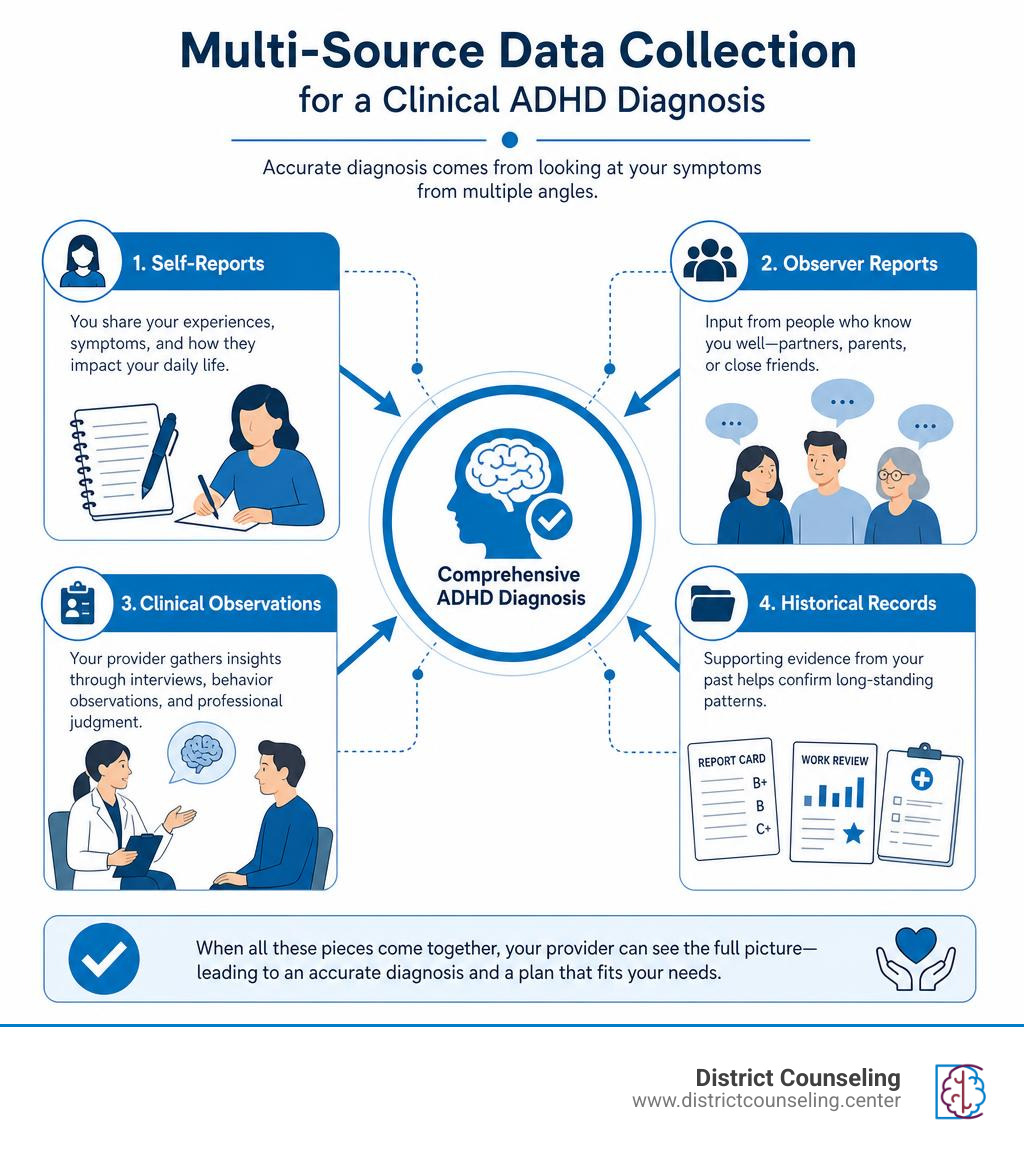
To make an accurate diagnosis, a clinician must gather multi-source information. This means looking at your symptoms from multiple angles: self-reports, observer reports (from a partner, parent, or close friend), clinical observations during the interview, and historical records.
DSM-5 Diagnostic Criteria and Age Requirements
Healthcare providers use the guidelines established in the American Psychiatric Association’s Diagnostic and Statistical Manual of Mental Disorders (DSM-5) to diagnose ADHD. The criteria differ slightly depending on your age group:
| Diagnostic Requirement | Children (Up to Age 16) | Adults & Teens (Ages 17+) |
|---|---|---|
| Symptoms Required | 6 or more symptoms of inattention and/or hyperactivity-impulsivity | 5 or more symptoms of inattention and/or hyperactivity-impulsivity |
| Duration of Symptoms | Must be present for at least 6 consecutive months | Must be present for at least 6 consecutive months |
| Age of Onset | Several symptoms must have been present before age 12 | Several symptoms must have been present before age 12 |
| Settings | Symptoms must be present in 2 or more settings (e.g., home & school) | Symptoms must be present in 2 or more settings (e.g., home & work) |
| Impact | Clear evidence that symptoms interfere with social or academic functioning | Clear evidence that symptoms interfere with social, academic, or occupational functioning |
For a full breakdown of these clinical standards, you can read the official CDC ADHD Diagnosis Guidelines.
Ruling Out Mimics and Co-Occurring Conditions
An essential part of the evaluation is the differential diagnosis—ruling out other conditions that mimic ADHD or identifying co-occurring disorders. Because the human brain is complex, many conditions share overlapping symptoms:
- Anxiety & Depression: Can cause poor concentration, restlessness, and sleep issues.
- Learning Disabilities: Dyslexia or auditory processing disorders can look like inattention in school or work environments.
- Autism Spectrum Disorder (ASD): Shares executive dysfunction traits with ADHD, though the underlying social and sensory processing profiles differ.
- Oppositional Defiant Disorder (ODD): Often co-occurs with ADHD in children and requires careful, distinct intervention strategies.
Frequently Asked Questions About ADHD Testing
How do online screeners compare to professional evaluations when researching adhd how to get tested?
Online screeners and self-assessments are excellent starting points to help you organize your thoughts and decide if professional testing is worth pursuing. However, they lack clinical validity on their own. They cannot perform a differential diagnosis to rule out anxiety, depression, or trauma, nor can they provide the objective attention tests required for a formal, legally recognized diagnostic report.
What is the difference between a school assessment and a clinical evaluation?
A school-based assessment is conducted by educational specialists to determine if a child qualifies for special education services or classroom accommodations (like a 504 Plan or IEP) under federal law. While highly valuable, school assessments do not provide a formal medical or clinical diagnosis. A clinical evaluation, conducted by a private licensed psychologist or psychiatrist, provides a formal diagnosis that can be used for medical treatment, medication, and accommodations both in school and in the workplace. For more details on childhood testing, refer to the CHADD Evaluating Childhood ADHD Guide.
Can I get tested for both ADHD and Autism (AuDHD) at the same time?
Yes. It is incredibly common for ADHD and Autism Spectrum Disorder to co-occur (often referred to in neurodivergent communities as “AuDHD”). A comprehensive neuropsychological evaluation can assess both profiles simultaneously. Evaluating both at once is highly recommended, as it saves time and helps paint a complete, integrated picture of your unique cognitive and sensory needs.
Conclusion
Understanding adhd how to get tested is the first step toward reclaiming control over your focus, your career, and your self-esteem. A formal diagnosis is not a label that limits you; rather, it is a key that unlocks the right accommodations, strategies, and self-compassion.
At District Counseling, we believe in a warm, compassionate, and neurodiversity-affirming approach to mental health. We provide advanced psychological evaluations, counseling, and personalized therapy across our Texas locations—including Houston, Cypress, Katy, Sugar Land, Fort Worth, Austin, and surrounding areas.
If you are ready to take the next step on your journey toward clarity, we are here to support you. Reach out to book a session or schedule a professional District Counseling ADHD Evaluation today.
Visited 23 times, 1 visit(s) today
Similar Posts

Francisco Ortiz
October 7, 2026
Houston Counseling Options: Find Local Help Nearby
Find affirming counseling in Houston for trauma, LGBTQ+ care, couples, and more. Explore local options and start your healing today....

Francisco Ortiz
October 5, 2026
Why every teacher needs a burnout therapy game plan
Why every teacher needs a burnout therapy game plan – Learn about burnout therapy for teachers...

Francisco Ortiz
October 2, 2026
Child Therapist Near Me? Here is How to Spot a Great One
Find a child therapist near me who fits your child’s needs. Learn signs, costs, and effective therapy options....

Adalid Blandin
September 30, 2026
Mental Health and Miracles: Finding Local Christian Care
Find pastoral counselling near me for faith-based emotional and spiritual support in Texas....

Adalid Blandin
September 28, 2026
Missouri City and Houston Couples Therapy 101
Explore relationship counseling in Houston options, from couples therapy to intensives, with costs, insurance, and therapist tips for Missouri City families....

Adalid Blandin
September 25, 2026
How to find authentic therapy for emotional exhaustion in Houston
Find emotional exhaustion therapy Houston that helps professionals and caregivers move from burnout to renewed energy and balance....

Francisco Ortiz
September 23, 2026
A Practical Guide to Finding Licensed Telehealth Counselors in Texas
Find licensed telehealth counseling in Texas with this guide to legal standards, privacy, insurance, and best practices for virtual care....

Adalid Blandin
September 21, 2026
All About Psychiatric Weight Loss Options and Treatments
Explore psychiatric weight loss options, including medications, therapy, and bariatric support for holistic wellness....

Francisco Ortiz
September 18, 2026
No Traffic, No Waiting Rooms: Your Guide to Telehealth Counseling in Texas
Learn the rules, rights, and benefits of telehealth counseling in Texas with this complete guide to virtual therapy....

Adalid Blandin
September 16, 2026
Why Your Mitochondria Might Be Depressed
Explore metabolic mental health to boost brain energy, ease mood disorders, and support recovery through mitochondria-focused strategies....


