
From Eye Contact to Intimacy: Relationship Therapy Exercises That Actually Work
Why Relationship Therapy Exercises Are Worth Your Time
Relationship therapy exercises are structured activities couples use to improve communication, rebuild trust, and deepen emotional intimacy — and you don’t always need a therapist’s office to start.
Here are the most effective exercises to try:
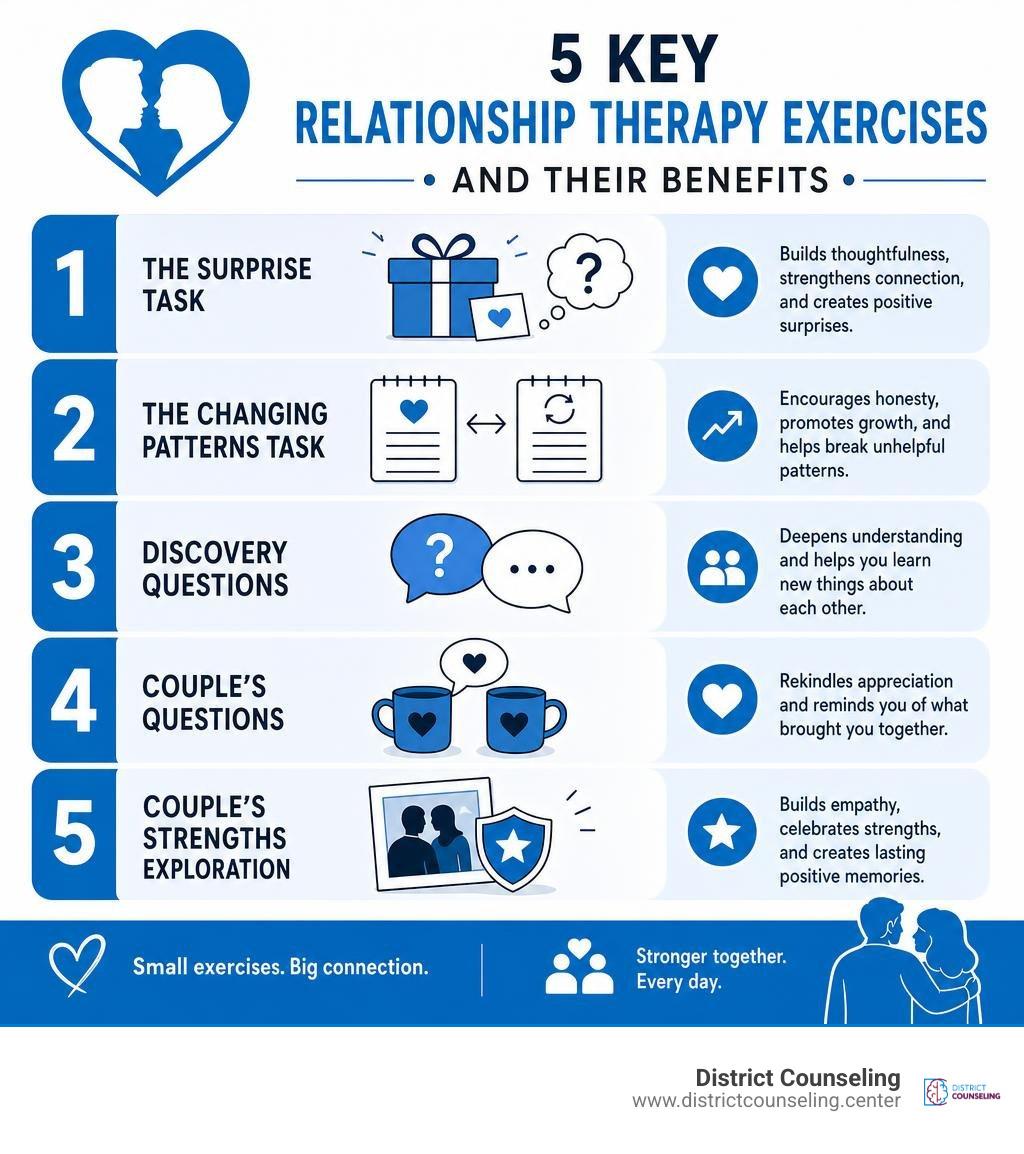
- The Surprise Task – Secretly do one small, meaningful thing for your partner, then guess each other’s change after a week
- The Changing Patterns Task – Exchange written lists of what you love and what you’d like to change, then each commit to one behavior shift
- Discovery Questions – Take turns answering questions across six life categories (fun, hopes, work, emotions, and more)
- Couple’s Questions – Use guided prompts to revisit what drew you to each other and what you still appreciate
- Couple’s Strengths Exploration – Identify your partner’s top strengths and connect each one to a specific memory
Most couples don’t lack love — they lack a structure for expressing it. Small habits quietly erode connection over time. Phones at dinner. Dishes in the sink. Needs left unspoken. These things add up. The good news is that small, intentional changes can reverse that drift just as steadily.
I’m Francisco Ortiz, a Licensed Professional Counselor-Supervisor with extensive experience providing psychotherapy to individuals, couples, and families — including guiding partners through relationship therapy exercises that create real, lasting change. In the sections ahead, I’ll walk you through each exercise step by step so you can start strengthening your relationship today.
Must-know relationship therapy exercises terms:
The Power of Structured Relationship Therapy Exercises
When stress hits, our relationships are often the first things to suffer. Research shows that 77% of people experience stress that affects their physical health, and 73% report stress that impacts their mental health. When you are carrying that kind of pressure, it is incredibly easy to let frustration overflow onto your partner.

This is where structured relationship therapy exercises come in. Rather than waiting for a major crisis to hit, proactive maintenance allows you to address friction points early. By dedicating structured time to your relationship, you create a buffer against the daily grind.
Structured exercises remove the guesswork. Instead of sitting down and saying, “We need to talk about our relationship” (a phrase guaranteed to make anyone’s stomach drop), these activities give you a clear, low-pressure roadmap. They help reduce defensiveness, lower anxiety, and build a sense of collaborative partnership.
Working through these exercises helps build a solid foundation of relationship satisfaction. It shifts your dynamic from reactive firefighting to proactive, intentional growth. To learn more about how structured therapy helps couples navigate these dynamics, check out Blog: The Ultimate Guide to Relationship Therapy.
5 Effective Relationship Therapy Exercises to Try at Home
You do not have to wait until your relationship is in jeopardy to start working on it. In fact, the best time to practice behavior modification and active listening is when things are relatively calm.
The following five exercises are designed to foster emotional safety, encourage positive reinforcement, and guide you toward long-term relationship growth. They require no special equipment—just an open mind, a bit of vulnerability, and a willingness to try something new.
1. The Surprise Task: A Relationship Therapy Exercise for Boosting Intimacy
Originally developed in 1982 by Steve de Shazer at the Brief Family Therapy Center, the “surprise task” is a classic tool rooted in solution-focused brief therapy. It relies on what we call “relational heroism”—the willingness to override comfortable, lazy habits to offer a genuine behavioral gift to your partner.
The beauty of this exercise lies in its specificity. Anyone can buy a generic bouquet of roses, but the surprise task requires you to use your deep, unique knowledge of your partner to do something truly meaningful for them.
How to Complete the Surprise Task:
- Identify a behavior: Think of a small, specific behavior you can do more of (or less of) that you know will ease your partner’s anxiety or bring them joy.
- Execute secretly: Implement this behavior change over the course of one week. Do not tell your partner what you are doing.
- Observe and guess: At the end of the week, sit down together. Each partner tries to guess what the other’s “surprise task” was.
Real-World Examples:
- Addressing Anxiety: If a partner historically dismisses their spouse’s home security anxieties, their surprise task might be quietly locking all doors and setting the alarm every night without being asked.
- Supporting Social Connections: A partner who typically shows discomfort with their spouse’s social life might actively and enthusiastically support them in planning a night out with friends.
- Non-Sexual Affection: A partner who struggled with physical boundaries might offer physical affection (like holding hands or cuddling on the couch) without expecting or initiating sexual intimacy.
If you are interested in trying this, you can read more about how it works at Boost Your Intimacy | Psychology Today . It serves as both an intimacy builder and an excellent diagnostic tool; if a partner refuses to participate or fails to notice a genuine effort, it may point to deeper resentments that require professional help. For more tips on building a foundation of safety, read Blog: How to Build Trust Between a Couple.
2. The Changing Patterns Task for Better Communication
We all have habits that drive our partners crazy. Unfortunately, wishing your partner would “just notice” what bothers you and fix it on their own almost never works. The Changing Patterns task is a structured, weekly relationship challenge designed to change annoying habits and reinforce positive behaviors without triggering a massive argument.
This exercise is highly effective because it balances positive reinforcement with constructive requests. It also preserves personal agency: each partner gets to choose which behavior they are willing to work on, which significantly reduces resistance.
Step-by-Step Guide:
- Set aside dedicated time: Find 30 to 60 minutes when you are both relaxed (e.g., Saturday morning). Avoid doing this right before bed or when you are already stressed.
- Write two lists independently:
- List 1: Specific, concrete things your partner does that you love and appreciate (e.g., “I love when you make coffee for me in the morning”).
- List 2: Specific, observable behaviors you wish would change (e.g., “I wish you wouldn’t leave dishes in the sink” instead of “You are a slob”). Focus on small behaviors that can realistically change in 7 days.
- Exchange lists and read silently: Swap papers and read them completely in silence. This quiet buffer prevents immediate defensive reactions.
- Discuss openly and honestly: Talk through the lists, starting with the positives. Ask clarifying questions without launching counter-attacks.
- Commit to keeping one positive: Each person chooses one appreciated behavior from List 1 to actively maintain.
- Commit to changing one pattern: Each person selects one specific behavior from List 2 that they are willing to work on for the coming week.
- Schedule a check-in: Set a time exactly 7 days later to review your progress.
For a deeper dive into this weekly challenge, check out Love Task #2: Changing Patterns- Weekly Relationship Challenge – Salty Vixen Lifestyle Magazine . For additional communication strategies, take a look at Blog: Improving Communication with Spouse.
3. Structured Question-Based Activities as Relationship Therapy Exercises
Sometimes, couples want to connect but simply do not know what to talk about anymore. Structured discovery questions help you bypass communication blocks by giving you a clear, low-pressure focus.
These activities are excellent for couples who are motivated to grow but need a structured “push” to get the conversation flowing. They are also highly adaptable, making them a great option for long-distance relationships.
Using the Relationship Growth Activity
This exercise involves asking and answering questions across six distinct life domains. By discussing areas outside of your immediate relationship issues, you build a broader foundation of emotional intimacy. The categories include:
- The Fun Things (rebuilding playfulness)
- About Us (reflecting on your bond)
- Hopes & Dreams (looking toward the future)
- Work Life (understanding daily stressors)
- Emotions (sharing deeper feelings)
- Other Relationships (navigating family and friendships)
You can find a structured worksheet for this exercise at Relationship Growth Activity | Worksheet | Therapist Aid .
Interactive Digital Exploration
For a more modern, gamified approach, couples can use interactive digital tools on their phones or tablets. The Couple’s Questions: Relationship exploration activity | Interactive | Therapist Aid allows partners to take turns answering playful and serious questions. It is designed to highlight your relationship’s strengths and help you recall the qualities that made you fall in love in the first place.
Note: These lighthearted, self-guided question activities are designed for couples with a baseline of healthy communication. If your relationship is currently experiencing deep conflict, anger, or contempt, these exercises may feel frustrating and are best saved for a therapist’s office.
If you and your partner are physically apart, you can still use these digital tools to stay connected. Learn more about making long-distance work at Blog: Long Distance Marriage Counseling.
4. Couple’s Strengths Exploration
In the early stages of a relationship, it is easy to see the absolute best in your partner. But as time goes on, those once-amazing qualities can start to feel normal. We begin to take them for granted.
The Couple’s Strengths Exploration exercise uses positive psychology to combat this complacency. It shifts your focus away from what is “wrong” in the relationship and redirects it toward what is “right.”
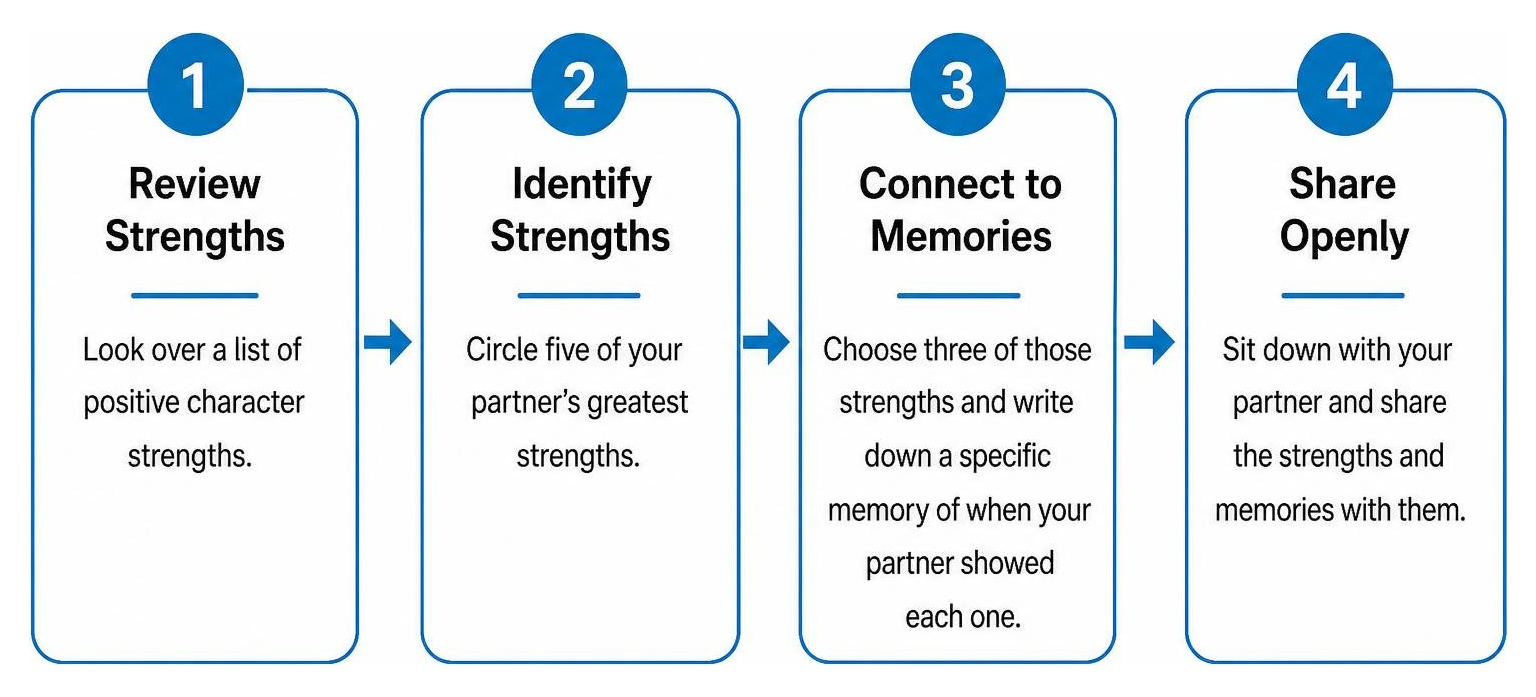
How to Practice Strengths Exploration:
- Review a list of character strengths: Look over a list of positive traits (e.g., bravery, humor, kindness, curiosity, persistence).
- Identify your partner’s strengths: Circle five of your partner’s greatest strengths. If you get stuck, think back to what initially attracted you to them.
- Connect to memories: Select three of those strengths and write down a specific, concrete memory of a time your partner clearly displayed each quality. For example, you might recall how they showed bravery during a family emergency, or humor during a highly stressful travel delay.
- Share openly: Sit down with your partner and share these strengths and memories with them.
Hearing your partner recall a specific moment they admired you is incredibly powerful. It fosters deep gratitude and reminds both of you of the solid foundation you’ve built. You can download a guided worksheet for this activity at Couple’s Strengths Exploration .
How to Create a Safe Space and Overcome Roadblocks
Even the best relationship therapy exercises will fail if you do not have a safe environment to practice them. If one or both partners feel judged, criticized, or attacked, they will naturally pull back or get defensive.

Common Roadblocks to Successful Exercises:
- The “Right Time” Trap: Trying to do an exercise when you are tired, hungry, or in the middle of an argument.
- Vague Requests: Asking for abstract changes (e.g., “I need you to respect me more”) instead of specific, actionable behaviors (e.g., “I would appreciate it if we put our phones away during dinner”).
- Scorekeeping: Using an exercise to point out your partner’s past failures rather than focusing on future growth.
- Immediate Defensiveness: Interrupting your partner to explain why they are wrong before they can finish expressing their thoughts.
To keep your communication constructive, try comparing your typical responses to this feedback guide:
| Action / Feedback | Healthy, Constructive Response | Defensive, Destructive Reaction |
|---|---|---|
| Hearing a Complaint | “I hear that you feel overwhelmed. What is one small thing I can do to help?” | “Well, I wouldn’t have to do that if you actually helped around here!” |
| Receiving a Request | “I understand why that is important to you. Let’s work on it.” | “You are always finding something wrong with what I do.” |
| Sharing a Concern | Uses “I” statements to express personal feelings and specific needs. | Uses “You” statements to attack the partner’s character or personality. |
When to Transition from DIY Exercises to Professional Support
While self-guided exercises are fantastic for relationship maintenance, they have limits. Sometimes, the emotional weight of a relationship is too heavy to navigate without an objective, professional guide.
Mental health challenges can also complicate relationship dynamics. For example, depression can affect work performance by 20% and cognitive abilities by about 35%. When one or both partners are quietly struggling with mental health issues—such as anxiety, depression, or burnout—it can place an immense strain on the relationship.
Signs It Is Time to Seek Professional Help:
- High Conflict or Contempt: Your conversations consistently devolve into yelling, name-calling, or cold silence.
- Repeatedly Broken Commitments: You try exercises like the Changing Patterns task, but one or both partners consistently fail to follow through.
- The “Roommate” Phase: You have completely stopped arguing, but you also have no emotional or physical intimacy left.
- Gridlock: You keep having the exact same argument over and over again without ever finding a resolution.
If you recognize these patterns in your relationship, seeking professional support is not a sign of failure—it is a courageous step toward healing. At District Counseling, we provide compassionate, authentic therapy tailored to your unique needs across Texas, including Houston, Austin, Cypress, Katy, Sugar Land, and surrounding areas.
To explore whether professional counseling is the right next step for you, read Blog: When to Seek Couples Counseling or learn about specialized options in Blog: Discernment Counseling for Couples.
Frequently Asked Questions about Relationship Exercises
How often should couples practice relationship therapy exercises to see lasting improvement?
Consistency is far more important than intensity. Spending 15 minutes a week on a structured check-in is much more effective than doing a three-hour marathon session once a year. Think of relationship maintenance as a habit, much like going to the gym.
We recommend setting aside a dedicated, recurring time each week to check in, practice an exercise, and review your progress. To learn more about why regular maintenance is so vital, check out Blog: Healthy Marriages Regular Couples Counseling.
What are the key signs that a relationship exercise is working or failing?
An exercise is working when you notice small, positive behavioral changes, a reduction in daily tension, and a general feeling of emotional safety. You might find yourselves laughing more, recovering from minor disagreements faster, or simply feeling more connected.
An exercise may be failing (or proving too difficult for DIY methods) if it consistently triggers arguments, breeds resentment, or if one partner feels forced to participate. If trying these activities only leaves you feeling more distant, it is a clear sign that you need a professional therapist to help de-escalate and guide the conversation. For a deeper look at what to expect from professional sessions, read Blog: Everything You Need to Know About Couples Therapy.
What should we do if one partner refuses to participate in the exercises?
It is common for one partner to feel hesitant, anxious, or skeptical about starting relationship exercises. If you experience resistance, avoid pushing, criticizing, or demanding participation. Instead, focus on creating emotional safety.
Sit down and ask your partner about their concerns. Frame the exercises as a collaborative experiment rather than a test. You might say, “I really value our connection, and I want to try this small exercise for just one week to see if it helps us communicate better. Would you be open to trying it with me?” If the resistance continues, it may be helpful to consult a professional counselor to help address the underlying barriers.
Conclusion
Relationships do not stay strong on autopilot. They require intentional care, regular maintenance, and a willingness to step outside of your comfort zone. Whether you start with the quiet surprise task, a structured weekly challenge, or a simple strengths exploration, the small steps you take today can completely transform your connection tomorrow.
At District Counseling, we are dedicated to helping couples across Texas rebuild trust, improve communication, and find their way back to each other. We offer advanced counseling, psychotherapy, and convenient telehealth services with a sincere, compassionate alignment to what matters most to you.
Whether you are looking for support in Houston, Austin, Cypress, Katy, Sugar Land, Pasadena, Pearland, or online anywhere in Texas, we are here to help.
Ready to take the next step in your relationship journey?
- Learn more about our approach: Blog: The Ultimate Guide to Marital Counseling
- Schedule a session for relationship marital counseling with District Counseling today
Visited 26 times, 1 visit(s) today
Similar Posts

Francisco Ortiz
October 9, 2026
Faith-Based Pastoral Counseling: A Comprehensive Guide
Discover how pastoral counseling integrates faith and psychology for holistic healing, grief, trauma, and marital support....

Francisco Ortiz
October 7, 2026
Houston Counseling Options: Find Local Help Nearby
Find affirming counseling in Houston for trauma, LGBTQ+ care, couples, and more. Explore local options and start your healing today....

Francisco Ortiz
October 5, 2026
Why every teacher needs a burnout therapy game plan
Why every teacher needs a burnout therapy game plan – Learn about burnout therapy for teachers...

Francisco Ortiz
October 2, 2026
Child Therapist Near Me? Here is How to Spot a Great One
Find a child therapist near me who fits your child’s needs. Learn signs, costs, and effective therapy options....

Adalid Blandin
September 30, 2026
Mental Health and Miracles: Finding Local Christian Care
Find pastoral counselling near me for faith-based emotional and spiritual support in Texas....

Adalid Blandin
September 28, 2026
Missouri City and Houston Couples Therapy 101
Explore relationship counseling in Houston options, from couples therapy to intensives, with costs, insurance, and therapist tips for Missouri City families....

Adalid Blandin
September 25, 2026
How to find authentic therapy for emotional exhaustion in Houston
Find emotional exhaustion therapy Houston that helps professionals and caregivers move from burnout to renewed energy and balance....

Francisco Ortiz
September 23, 2026
A Practical Guide to Finding Licensed Telehealth Counselors in Texas
Find licensed telehealth counseling in Texas with this guide to legal standards, privacy, insurance, and best practices for virtual care....

Adalid Blandin
September 21, 2026
All About Psychiatric Weight Loss Options and Treatments
Explore psychiatric weight loss options, including medications, therapy, and bariatric support for holistic wellness....

Francisco Ortiz
September 18, 2026
No Traffic, No Waiting Rooms: Your Guide to Telehealth Counseling in Texas
Learn the rules, rights, and benefits of telehealth counseling in Texas with this complete guide to virtual therapy....


