Why every teacher needs a burnout therapy game plan
Why Every Teacher Needs a Burnout Therapy Game Plan Before the Next School Year
Burnout therapy for teachers is one of the most important — and most overlooked — tools available to educators today. Between 25% and 49% of teachers are currently affected by burnout, and nearly 28% of secondary school teachers are experiencing severe emotional exhaustion right now. Those aren’t just statistics. They represent real classrooms, real students, and real educators running on empty.
Here is a quick overview of the most effective burnout therapy options for teachers:
| Treatment Option | Best For | Evidence Strength |
|---|---|---|
| Cognitive-Behavioral Therapy (CBT) | Emotional exhaustion, negative thought patterns | Strong (g = 0.876 for emotional exhaustion) |
| Mindfulness-Based Cognitive Therapy (MBCT) | Depersonalization, stress reduction | Moderate-Strong |
| Inquiry-Based Stress Reduction (IBSR) | Self-guided cognitive reframing | Moderate (90% adherence rate) |
| Peer Support / Co-Regulation | Workload sharing, emotional support | Moderate |
| Boundary-Setting & Workload Management | Preventing burnout before it starts | Practical / Foundational |
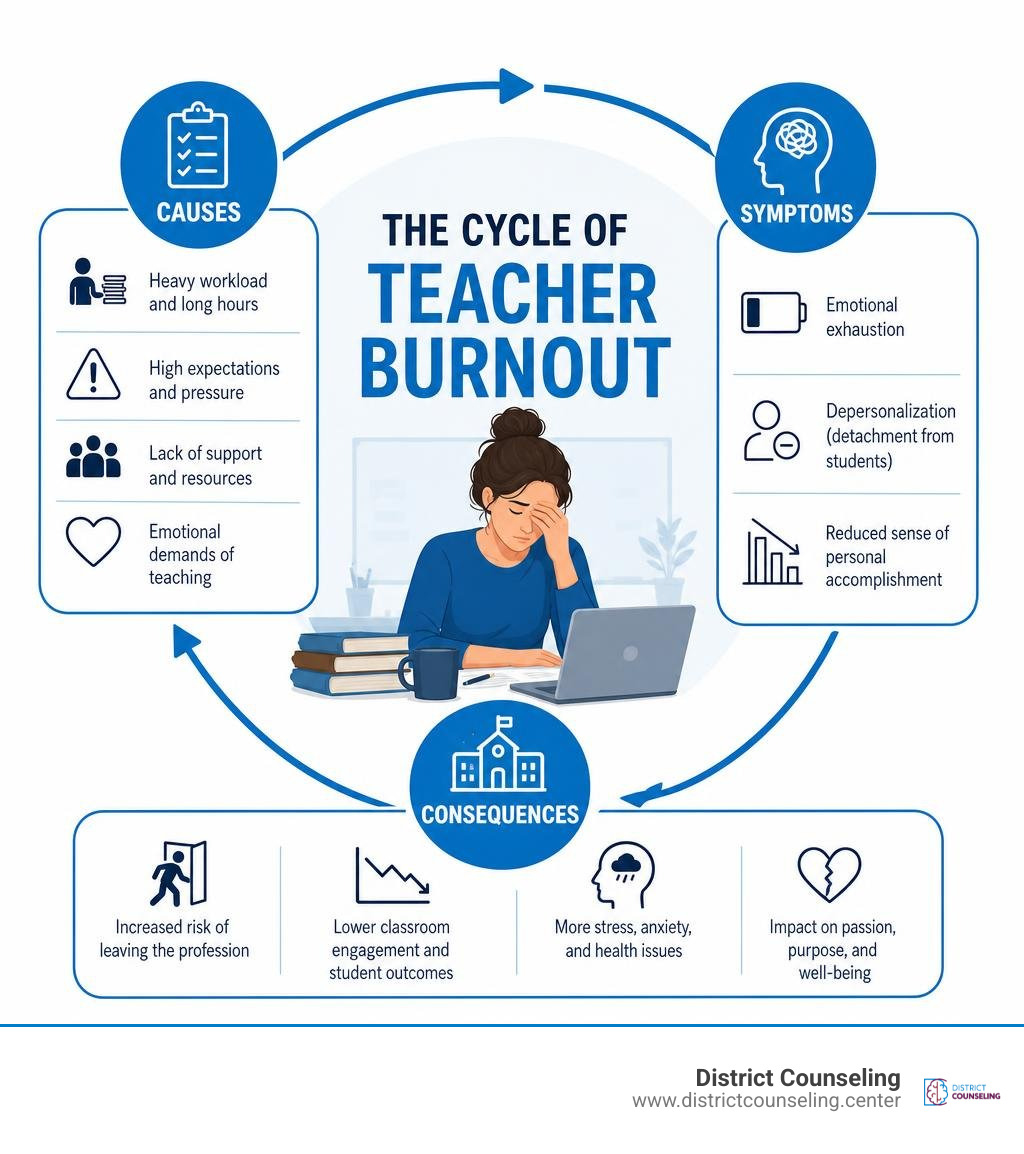
Teacher burnout is not just “being tired at the end of the school year.” It is a chronic, progressive condition with three distinct clinical dimensions: emotional exhaustion, depersonalization (feeling detached from your students), and a reduced sense of personal accomplishment. Left unaddressed, it drives good teachers out of the profession entirely — and research confirms that high work-related stress significantly increases the likelihood of leaving teaching within five years.
The good news? Structured psychological interventions do work. Randomized controlled trials show large effects on stress reduction and meaningful improvements in anxiety, depression, and professional burnout. But not every treatment works the same way — and knowing which approach fits your situation can make all the difference.
I’m Francisco Ortiz, a Licensed Professional Counselor-Supervisor and Director of School-based Clinical Mental Health Services, with hands-on experience providing evidence-based burnout therapy for teachers and other education professionals across Texas. In this guide, I’ll walk you through the clinical options, practical strategies, and real-world tools you can start using today.
Know your burnout therapy for teachers terms:
Understanding the Anatomy of Educator Exhaustion
To build an effective recovery plan, we first have to understand what we are fighting. In our clinical work across Texas — from Houston to Fort Worth — we often see educators who believe they are simply “stressed.” But stress and burnout are two entirely different beasts.
Stress is characterized by over-engagement; you are doing too much, feeling too much, and running on high adrenaline. Burnout, on the other hand, is characterized by disengagement. It is a state of physical, mental, and emotional depletion where you feel you have nothing left to give.
The clinical gold standard for measuring this condition is the Maslach Burnout Inventory (MBI), which breaks educator burnout down into three distinct dimensions:
- Emotional Exhaustion: The feeling of being completely drained of emotional resources. You wake up on a Tuesday morning in July 2026, look at your lesson plans, and feel a deep sense of dread.
- Depersonalization (Cynicism): This is where you begin to distance yourself from your students, parents, and colleagues. Instead of seeing a struggling student as a child who needs help, you might start viewing them as an annoying obstacle or a “problem case.”
- Low Personal Accomplishment: The nagging belief that your work doesn’t matter anymore, that you aren’t a good teacher, and that nothing you do will change the outcomes for your students.
If you are noticing these patterns in your own life, you are not alone. Recognizing these signs is the first step toward reclaiming your passion for teaching. To understand where you fall on this spectrum, read our detailed guide on 10 Signs You’re Emotionally Exhausted and What to Do About It.
Recognizing the Signs That You Need Burnout Therapy for Teachers
Burnout does not happen overnight. It is a slow, quiet process that builds over months of carrying heavy workloads, managing difficult classroom behaviors, and navigating school politics.
Some of the most common physical and psychological signs that it is time to seek professional burnout therapy for teachers include:
- Physical Complaints: Chronic headaches, muscle tension, frequent illnesses (because your immune system is compromised by stress), and persistent sleep disturbances.
- Irritability and Cynicism: Finding yourself snapped at family members, feeling unusually angry at minor administrative requests, or losing your patience with students much faster than usual.
- Cognitive Fatigue: Difficulty concentrating, forgetfulness, and feeling like your brain is constantly “in a fog.”
- Compassion Fatigue: Feeling unable to empathize with your students’ struggles because your own emotional cup is completely empty.
If you are experiencing these symptoms, it is vital to intervene before they develop into more severe mental health challenges. Learn more about how to catch these warning signs early in our article on Workplace Stress Burnout Recognizing It Before It Overwhelms You.
Comparing the Best Clinical Treatment Options for Educator Stress
When you decide to seek professional help, you shouldn’t just look for general talk therapy. Teachers face highly specific, role-related stressors that require evidence-based, clinical approaches.

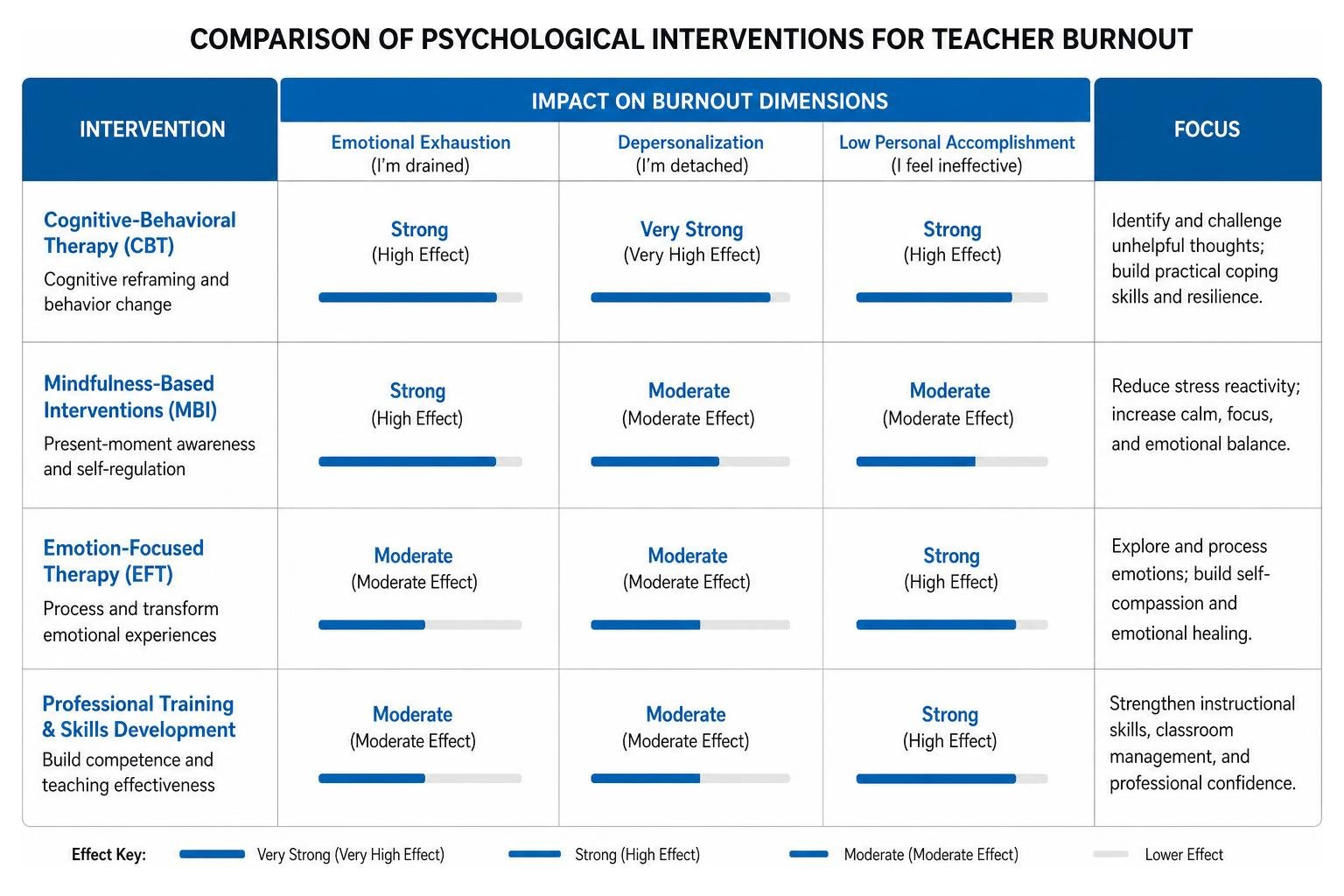
A landmark systematic review and meta-analysis published in Investigating the Effect of Cognitive–Behavioral, Mindful-Based, Emotional-Based Intervention and Professional Training on Teachers’ Job Burnout: A Meta-Analysis evaluated decades of research on what actually works to reduce teacher burnout. The clinical evidence is clear: structured psychological interventions have a massive positive impact on teacher well-being.
Let’s look at how the primary clinical modalities compare when treating the three dimensions of burnout:
Cognitive-Behavioral Therapy (CBT) for Cognitive Reframing
If you are struggling with severe emotional exhaustion and depersonalization, Cognitive-Behavioral Therapy (CBT) is the clinical gold standard. According to the meta-analysis published in Investigating the Effect of Cognitive–Behavioral, Mindful-Based, Emotional-Based Intervention and Professional Training on Teachers’ Job Burnout: A Meta-Analysis – PMC, CBT-based interventions had a remarkably strong effect size on reducing emotional exhaustion ($g = 0.876$) and an exceptionally high effect on depersonalization ($g = 2.063$).
Why is CBT so effective for teachers? Because it targets the underlying thought patterns that drive emotional distress. Teachers are notoriously prone to “all-or-nothing” thinking and unrealistic self-expectations (e.g., “If my students don’t pass this standardized test, I am a complete failure as an educator”).
In CBT, we work with you to:
- Identify and challenge these cognitive distortions.
- Reframe stressful classroom scenarios so they don’t trigger a fight-or-flight response.
- Develop active, problem-focused coping strategies to manage the daily administrative overload.
By changing how you process classroom stress, CBT helps you rebuild your emotional reserves and reconnect with your students as individuals rather than sources of stress.
Mindfulness-Based Cognitive Therapy (MBCT) and Stress Reduction
Mindfulness-Based Cognitive Therapy (MBCT) and Mindfulness-Based Stress Reduction (MBSR) are incredibly powerful tools for lowering physiological stress and improving your sense of personal accomplishment.
In clinical trials, such as the one detailed in Frontiers | Effect of a mindfulness-based cognitive behavior therapy intervention on occupational burnout among school teachers, virtual mindfulness and CBT interventions helped teachers cultivate a non-judgmental awareness of their current state. Instead of immediately reacting with anger or panic when a classroom disruption occurs, mindfulness teaches you to pause, breathe, and choose a calm, measured response.
However, a word of caution regarding the modern push for “mindfulness apps”: while digital mindfulness tools can offer short-term relief, they can sometimes cause “technostress” (feeling overwhelmed by notifications and digital demands) if they aren’t embedded in a broader, supportive therapeutic framework. True, lasting recovery requires deeper therapeutic support that goes beyond a 5-minute breathing app.
Inquiry-Based Stress Reduction (IBSR) and Self-Guided Tools
For teachers who want practical, self-guided tools they can use directly in the classroom, Inquiry-Based Stress Reduction (IBSR) is a highly effective option. Often referred to as “The Work,” IBSR is a cognitive reframing method that helps you investigate stressful thoughts using a structured, four-question process.
A controlled trial published in The Effect of Inquiry-Based Stress Reduction on Teacher Burnout: A Controlled Trial – PMC found that teachers who practiced IBSR showed a significant reduction in emotional exhaustion and a major increase in personal accomplishment.
The beauty of IBSR is that it teaches you to question the absolute truth of your stressful thoughts. For example, when you think, “My students don’t listen to me,” IBSR guides you to ask:
- Is it true?
- Can you absolutely know that it’s true?
- How do you react, and what happens, when you believe that thought?
- Who would you be without that thought?
This process leads to “turnarounds” — alternative, realistic interpretations of the situation (such as “I am not listening to my students” or “My students do listen to me when I use a different approach”). It encourages self-realization and witnessing awareness, allowing you to observe your stressful thoughts without being consumed by them.
Practical Classroom Strategies to Prevent Emotional Drainage
While clinical therapy is essential for healing deep-seated burnout, you also need practical, day-to-day strategies to protect your energy inside the classroom.

Many gifted teachers leave the profession because they take on too much unpaid, non-mandatory labor. To survive and thrive in the modern school system, we recommend implementing these practical workload management strategies:
- Implement Peer Grading: Reduce your take-home grading workload by teaching your students to use clear rubrics and score each other’s work during class. You can walk around with a clipboard, record the scores, and eliminate hours of evening grading.
- Plan Your Curriculum in Batches: Avoid the week-to-week planning panic by collaborating with colleagues to plan your curriculum months in advance.
- Establish a Comfortable Consequence Step System: A structured, predictable classroom management plan reduces the daily emotional energy required to discipline students. When students know exactly what happens next, you don’t have to raise your voice or carry the emotional weight of classroom disruptions.
Setting Boundaries and Saying No to Unpaid Duties
One of the hardest things for empathetic educators to do is say “no.” Schools run on the unpaid, voluntary labor of teachers who lead clubs, monitor hallways, join committees, and cover classes during their planning periods.
To protect your mental health, you must establish strict boundaries:
- Define Your Work Hours: Establish a firm time when you pack up and leave the school building. Do not take grading or lesson planning home in the evenings.
- Turn Off Work Notifications: Remove school email and messaging apps from your personal phone, or set them to do-not-disturb after 5:00 PM.
- Politely Decline Extra Duties: If an administrator asks you to volunteer for a non-mandatory committee or after-school activity, a simple, polite, “Thank you for thinking of me, but I don’t have the capacity to take that on right now,” is all you need to say.
Setting boundaries is not selfish; it is a necessary form of professional self-preservation. For more insights on reclaiming your peace of mind and setting healthy boundaries, see our guide on How to Recover from ADHD Burnout Without Losing Your Mind.
Co-Regulation and Building Peer Support Networks
Teaching can be incredibly isolating. Even though you are surrounded by children all day, you may go hours without having a meaningful interaction with another adult.
This is why “co-regulation” — the process of sharing emotional support and coping strategies with trusted colleagues — is so important. According to a comprehensive scoping review published in Interventions to Teacher Well-Being and Burnout A Scoping Review | Educational Psychology Review | Springer Nature Link, interventions that leverage positive psychology frameworks like the PERMA-H model (Positive emotions, Engagement, Relationships, Meaning, Accomplishment, Health) are highly successful because they emphasize community-level support.
Instead of venting in the teacher’s lounge (which can sometimes feed into a cycle of negativity), build a proactive peer support network. Share resources, trade lesson plans, check in on each other’s well-being, and collaborate on workload reduction. When teachers support one another, the entire school culture improves.
Overcoming Barriers to Accessing Burnout Therapy for Teachers
Despite the clear benefits of therapy, many educators hesitate to seek help. The primary barrier? Time poverty. Teachers are incredibly busy, and the thought of adding a weekly therapy appointment to an already packed schedule can feel impossible.
Furthermore, as discussed in Digital and Digitized Interventions for Teachers’ Professional Well-Being: A Systematic Review of Work Engagement and Burnout Using the Job Demands–Resources Theory, digitized interventions must be carefully designed so they do not add to a teacher’s workload or cause technostress.
We solve this problem by offering flexible, highly accessible Telehealth Counseling options. Telehealth allows you to meet with a licensed therapist during your planning period, immediately after school, or from the comfort of your home, saving you travel time and making therapy a realistic part of your weekly routine.
Addressing Confidentiality and Professional Licensing Fears
Another common barrier is the fear of professional repercussions. We often hear teachers ask: “Will my principal find out if I go to therapy?” or “Could seeking mental health treatment affect my teaching certificate?”
The answer is a resounding no.
Your therapy is protected by strict federal and state confidentiality laws (HIPAA). We cannot, and will not, share any information about your treatment with your school principal, district administration, or colleagues without your explicit, written consent.
While Employee Assistance Programs (EAPs) can be a great starting point for short-term, solution-focused counseling (typically providing 3 to 8 sessions), they are not designed for long-term recovery. If you are struggling with persistent symptoms of burnout, anxiety, or depression, transitioning to an outpatient program is the best way to receive comprehensive, confidential care. Learn more about your options for Depression and Anxiety Counseling.
Frequently Asked Questions About Teacher Burnout
What are the primary signs of teacher burnout?
The primary signs include chronic physical and emotional fatigue, depersonalization (feeling detached or cynical toward students and parents), a reduced sense of professional efficacy, frequent headaches, sleep disturbances, and irritability. Unlike normal tiredness, clinical burnout does not improve with a weekend of rest or a school holiday.
How does clinical burnout therapy for teachers differ from standard self-care?
Standard self-care (like taking a warm bath or practicing a hobby) is great for temporary stress relief, but it does not address the underlying cognitive distortions or systemic issues that drive chronic burnout. Clinical burnout therapy for teachers utilizes evidence-based modalities like Cognitive-Behavioral Therapy (CBT), EMDR Treatment, or Trauma Counseling to help you restructure your thoughts, process secondary traumatic stress, and build lasting, resilient coping mechanisms. If needed, we can also coordinate with psychiatric professionals for Medication Management or connect you with a Life Coach to help you transition to a new professional path.
Is therapy confidential from my school district or principal?
Yes, absolutely. Under HIPAA regulations, your mental health treatment is entirely confidential. Your school district, principal, and colleagues have no access to your counseling records, and seeking therapy will never impact your job security or professional teaching license.
Conclusion: Building Your Personal Recovery Game Plan
You do not have to carry the weight of your classroom alone. Teaching is an incredibly rewarding profession, but it should never come at the cost of your mental, emotional, or physical health. Seeking professional help is not a sign of weakness — it is a powerful step toward reclaiming your life and your passion for education.
At District Counseling, we are proud to support Texas educators with compassionate, evidence-based therapy tailored to your unique challenges. Whether you prefer in-person sessions at one of our convenient locations — including Houston, Katy, Sugar Land, Fort Worth, or Austin — or the flexibility of telehealth, our team is here to help you heal.
Let’s build your personal recovery game plan today. Explore our team of experienced Therapists, learn more About our practice, and Contact us to schedule your first session. If you are ready to take the next step toward healing from burnout, anxiety, or depression, visit our Depression and Anxiety Counseling page to get started.
Visited 10 times, 1 visit(s) today

Similar Posts

Francisco Ortiz
October 23, 2026
Demystifying the Court-Ordered Mental Health Evaluation Process
Learn what to expect in a court ordered mental health evaluation, including legal criteria, costs, and outcomes....

Francisco Ortiz
October 21, 2026
Finding the Right EMDR Specialist in Cypress Texas for Real Healing
Find a qualified EMDR specialist in Cypress Texas for real trauma healing and lasting anxiety relief....

Francisco Ortiz
October 19, 2026
Why therapy for caregiver exhaustion is a necessity not a luxury
Find relief with exhaustion therapy for caregivers. Learn how clinical support heals burnout and restores your well-being....

Francisco Ortiz
October 16, 2026
Navigating Neuropsychological Evaluations from Katy to Pasadena
Learn how an ADHD evaluation for Houston teens works, from medication management to school accommodations and 504 plans....

Francisco Ortiz
October 14, 2026
How Texas caregivers can beat exhaustion with virtual therapy
Beat caregiver exhaustion therapy Texas caregivers trust—virtual sessions for stress, boundaries, and recovery. Start today....

Francisco Ortiz
October 12, 2026
Find Local Youth Counselor: How They Can Help Your Teen Thrive (52 characters)
Find a qualified youth counselor near me to help your teen thrive with evidence-based support for anxiety, trauma, and more....

Francisco Ortiz
October 9, 2026
Faith-Based Pastoral Counseling: A Comprehensive Guide
Discover how pastoral counseling integrates faith and psychology for holistic healing, grief, trauma, and marital support....

Francisco Ortiz
October 7, 2026
Houston Counseling Options: Find Local Help Nearby
Find affirming counseling in Houston for trauma, LGBTQ+ care, couples, and more. Explore local options and start your healing today....

Francisco Ortiz
October 5, 2026
Why every teacher needs a burnout therapy game plan
Why every teacher needs a burnout therapy game plan – Learn about burnout therapy for teachers...

Francisco Ortiz
October 2, 2026
Child Therapist Near Me? Here is How to Spot a Great One
Find a child therapist near me who fits your child’s needs. Learn signs, costs, and effective therapy options....


