
First Couples Counseling Session: A Guide to Your First Hour on the Couch
Your First Couples Counseling Session: What to Expect
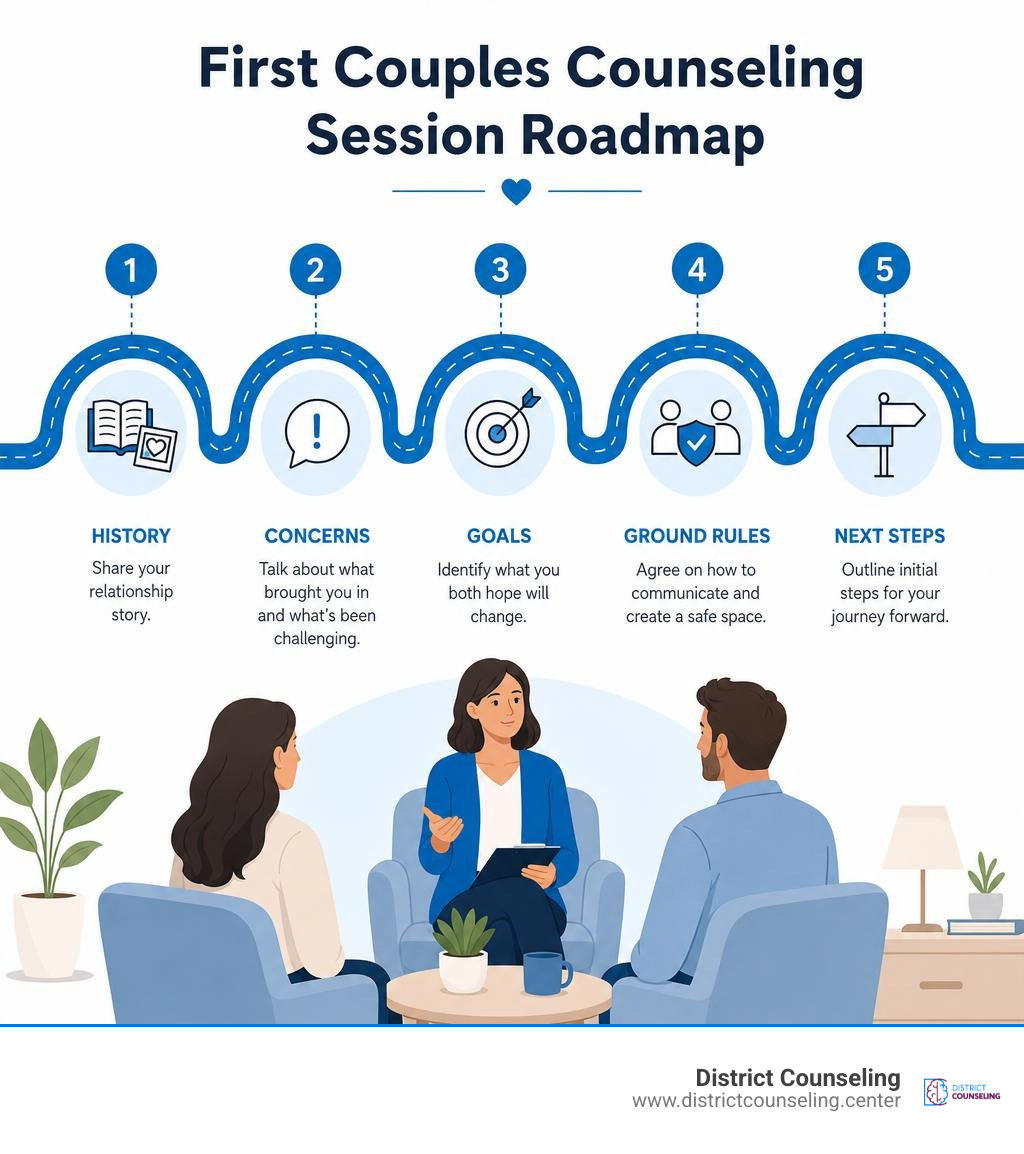
A first couples counseling session is not about deciding who is right or getting a therapist to fix your partner. It is a guided first step to understand what is happening in the relationship, help each person feel heard, and agree on a safer way to work on the problem.
Come prepared to:
- Share a brief relationship history and the concerns that brought you in.
- Describe what you have already tried and what you hope will change.
- Listen while your partner shares their view, even if you see things differently.
- Identify one or two shared goals, such as less conflict, better communication, or rebuilding trust.
You do not need to have the perfect words. Most couples seek help after stress, hurt, or repeated arguments have been building for a long time. A skilled counselor slows the conversation down, sets ground rules, and helps you move from blame toward understanding and practical next steps.
I am Francisco Ortiz, a Licensed Professional Counselor-Supervisor with experience helping couples and families navigate trauma, mood concerns, conflict, and major life stress. In a first couples counseling session, my focus is creating a structured, emotionally safe space where both partners can begin the work with clarity.
Handy first couples counseling session terms:
What Really Happens in Your First Couples Counseling Session
Walking into a therapy office or logging into a virtual session can feel daunting. You might wonder whether the therapist will take sides, uncover secrets, or force you into dramatic emotional breakthroughs right away. Understanding the intake structure helps strip away that anticipatory dread.
Couples counseling operates on distinct relational dynamics rather than individual psychology multiplied by two. Interestingly, research highlighted by the American Association for Marriage and Family Therapy shows that effective couples work requires dedicated systemic training, yet many standard graduate programs emphasize individual modalities over relational dynamics. This is why working with clinicians trained specifically in relational models matters. Reading Everything You Need to Know About Couples Therapy can help you understand how specialized relationship therapy differs from standard individual counseling.
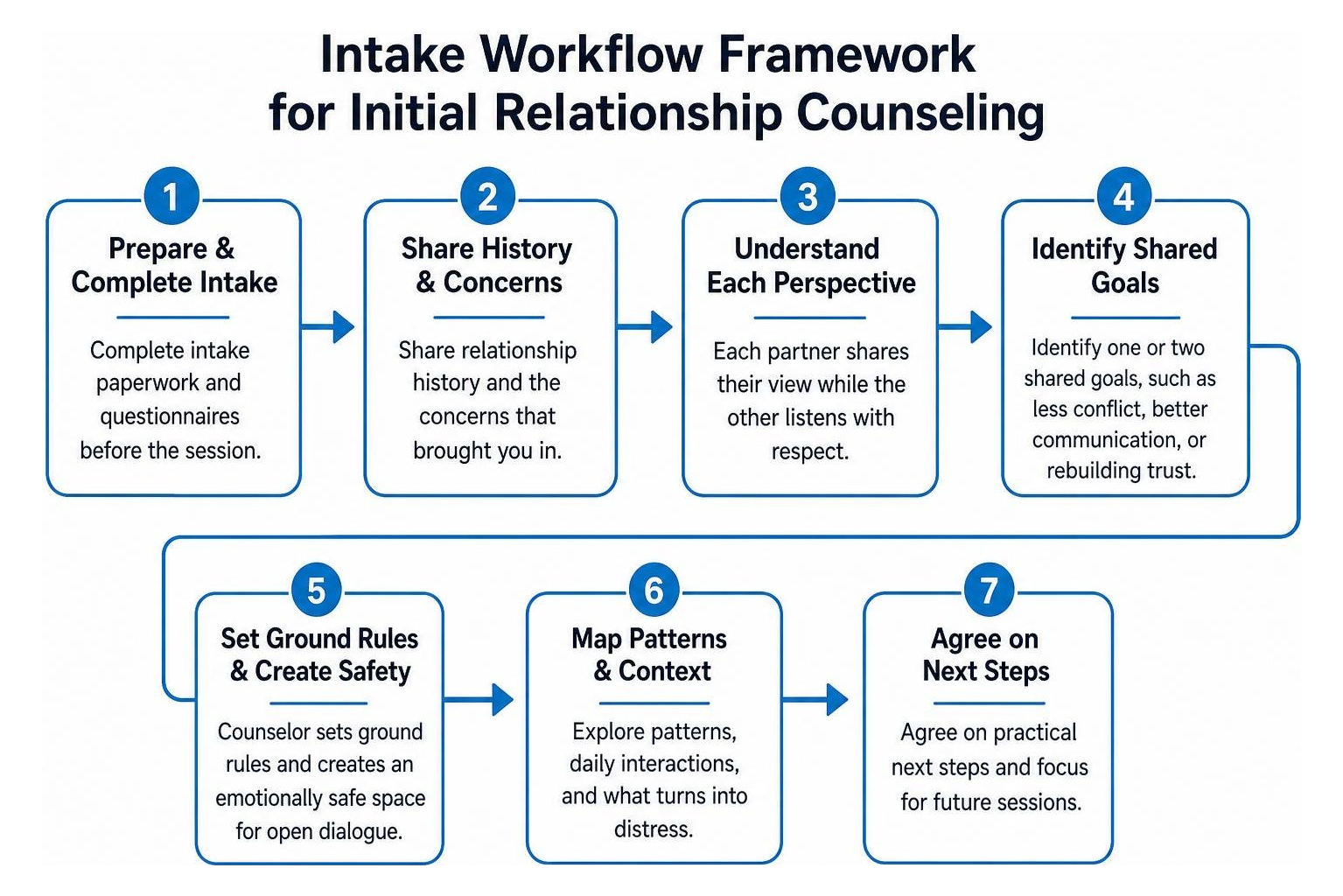
Many practices recommend starting with an extended 75- to 90-minute session instead of a standard 50-minute clinical hour. Relationship dynamics involve two complete histories, communication patterns, and emotional systems; extra time ensures neither partner leaves feeling rushed or cut off. During this initial meeting, we establish baseline assessments, map out your relationship timeline, and examine how your daily interactions turn into distress.
Intake Paperwork and Gathering Relational History
Before sitting on the couch, the process starts with comprehensive intake paperwork. Completing pre-session questionnaires online gives us vital context before our first greeting.
These forms collect foundational information:
- Demographic details, living arrangements, and children or blended family dynamics.
- Physical health factors, sleep patterns, and medical conditions.
- Recent life stressors, such as job transitions, moves, or financial strain.
- Past experiences with counseling (both individual and relational).
- A brief relationship timeline: how you met, what initially attracted you to each other, and when the friction began.
Whether visiting us in person—such as at our Copperfield Counseling & Therapy office—or attending via telehealth from Austin, Fort Worth, or Houston, gathering background information up front frees up our time on the couch. Instead of spending 45 minutes recording basic facts, we can focus on your lived experiences and immediate needs.
Joint Meetings vs. Individual Breakouts
One common question couples ask is whether the first appointment happens together or separately. Clinical approaches vary, but therapists often use a hybrid model: starting together, holding brief one-on-one breakouts, and reconvening at the end.
| Session Format | Key Advantages | Primary Purpose |
|---|---|---|
| Joint Meeting | Allows the therapist to observe real-time nonverbal interactions, body language, and communication breakdowns. | Establishes shared accountability, joint relationship goals, and mutual transparency. |
| Individual Breakout | Gives each partner a private space to speak without fear of immediate retaliation or defensiveness. | Screens for emotional safety, hidden trauma, substance issues, and commitment levels. |
Individual breakouts require a clear “secrets policy.” As couples therapists, our client is the relationship itself. If one partner shares an active affair or hidden financial betrayal in an individual breakout and expects the therapist to keep it secret, therapy cannot function effectively. We establish transparency agreements early so individual breakouts remain safe spaces for personal history and individual perspective rather than holding grounds for covert secrets.
Core Objectives and Questions Asked on the Couch
Most couples arrive in the office with major conflicts after being in a relationship for years or even decades. Partners rarely book an appointment at the first sign of a disagreement; they usually schedule only when the chill in their relationship has reached pneumonia proportions.

The primary goal of the initial assessment is not to fix years of accumulated pain in sixty minutes. Instead, we aim to:
- Identify existing relationship strengths and what originally worked.
- Gauge current motivation levels and emotional investment from both sides.
- Map communication breakdowns and cyclical conflict loops.
- Establish emotional safety so productive dialogue can happen.
Gaining a broader perspective on the therapeutic journey through The Ultimate Guide to Relationship Therapy can help contextualize these early steps.
Preparing Before Your First Couples Counseling Session
You do not need to prepare a detailed legal brief listing every argument you have had over the past five years. Arriving with a laundry list of past grievances often triggers immediate defensiveness and stalls progress.
Instead, prepare by reflecting on these key areas:
- Core pain points: What specific patterns or emotional barriers hurt the most right now?
- Emotional readiness: Are you open to looking at your own habits alongside your partner’s?
- Realistic hopes: What does a realistic, positive outcome look like over the next three to six months?
Knowing When to Seek Couples Counseling is often half the battle; arriving with an open mind allows the process to work as intended.
The Crucial Questions Therapists Ask Both Partners
During your first hour, your counselor will guide the conversation with purposeful questions designed to reveal patterns beneath everyday surface arguments:
- Why did you decide to start couples therapy right now? (Pinpoints the tipping point that brought you through the door.)
- What have you tried so far to solve these challenges? (Highlights past efforts, books, or informal strategies.)
- Why do you want to stay together? (Uncovers the core emotional glue still holding the partnership together.)
- What is the best thing about your relationship? (Reminds both partners that the bond is not solely defined by conflict.)
- How would you describe each other’s roles and division of labor? (Examines unspoken expectations, domestic load, and balance.)
- How would you rate the chances that things can improve on a scale of 1 to 10? (Measures optimism and readiness for change.)
- What could you individually do to promote positive change? (Shifts the dynamic from blaming the other person to personal accountability.)
Ground Rules and In-Session Exercises for Building Safety
Starting an open-ended conversation with “So, tell me what’s wrong with your marriage” can quickly trigger an argument in the room. A skilled counselor sets clear boundaries, introduces basic emotional regulation tools, and guides the discussion to prevent sessions from turning into screaming matches.
Understanding how evidence-based frameworks operate—such as Decoding the Gottman Method: How to Find a Certified Relationship Pro—illustrates why structured boundaries are essential for clinical progress.
Deconstructing the Referee Myth and Brain Reactivity
A common misconception is that the couples therapist acts as a referee, judge, or jury. Clients often arrive hoping the counselor will blow a whistle, declare one partner guilty, and tell them how to change.
We dismantle this expectation immediately. If a therapist acts as a referee, one person wins, one person loses, and the relationship ultimately suffers.
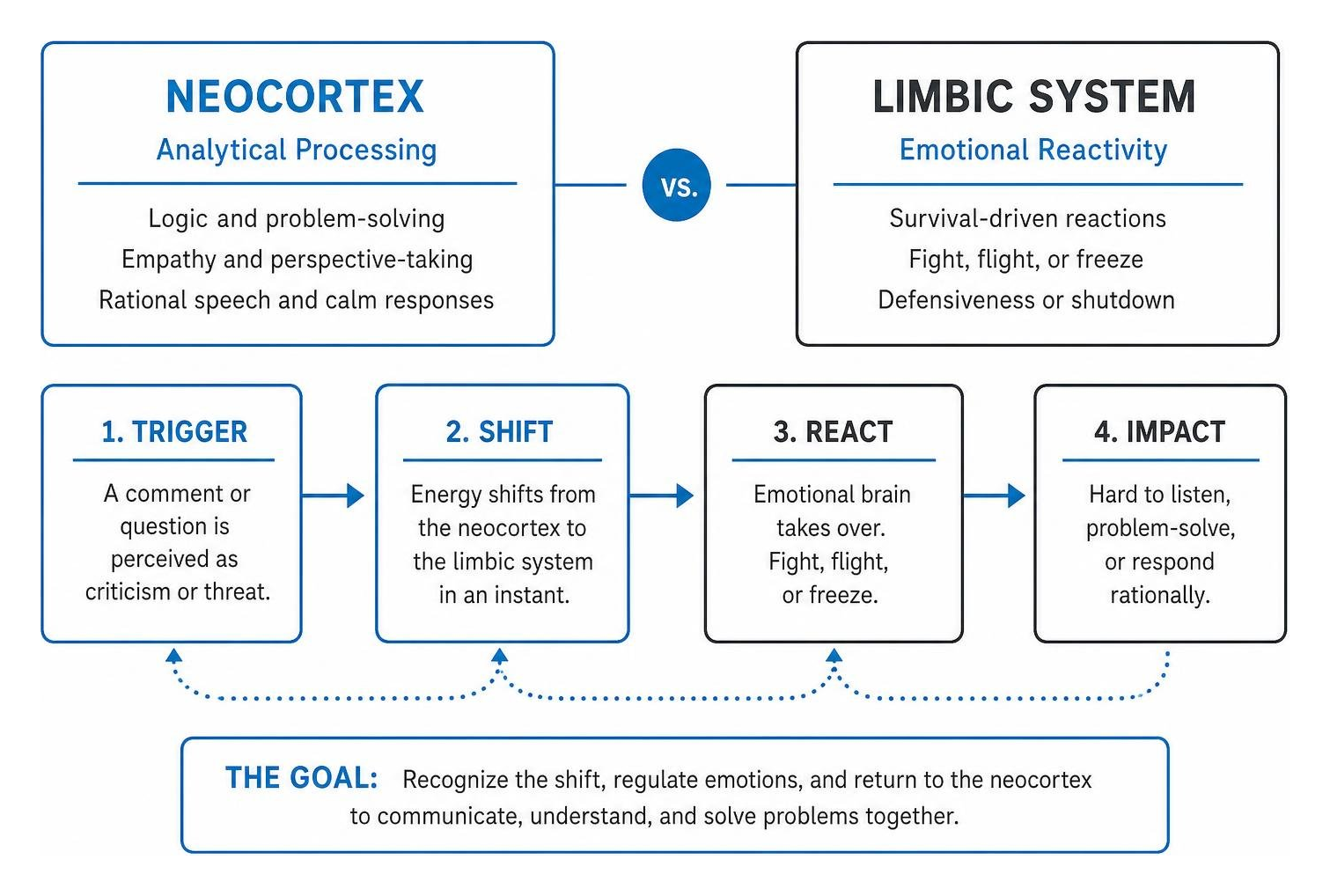
We also provide basic psychoeducation on how the human brain processes conflict:
- The Neocortex: The analytical, logical part of the brain that manages problem-solving, empathy, and rational speech.
- The Limbic System: The reactive, survival-driven center responsible for fight, flight, or freeze responses.
When a partner feels criticized, the brain contains roughly 100 billion neurons that can shift energy instantly toward the limbic system. An innocent question about loading the dishwasher can be perceived as an emotional attack, triggering defensiveness or emotional withdrawal. Depersonalizing this reaction helps couples realize they are not fighting each other; they are caught in a neurobiological cycle of perceived threat.
Structured Exercises: Eye-to-Eye Appreciation and the Platinum Rule
To establish safety and break reactive habits, therapists often introduce simple, structured exercises during the very first session.

1. Eye-to-Eye Appreciation and Mirroring Dialogue
Partners turn their chairs to face each other, maintain gentle eye contact, and share a structured appreciation statement using clear stems:
- “One thing I truly appreciate about you this week is…”
- “I value this because it made me feel…”
The listening partner repeats what they heard without debating or minimizing: “What I hear you saying is that you appreciated…” This slows down reactive habits and ensures both partners feel validated.
2. The Platinum Rule vs. The Golden Rule
We often grow up hearing the Golden Rule: “Do unto others as you would have them do unto you.” In relationships, this can backfire. If you crave verbal praise when stressed, you might offer your partner praise when they are overwhelmed—even if what they actually need is quiet time or practical help with chores.
We practice the Platinum Rule: “Do unto others as they would like you to do unto them.” This shifts the focus from assuming your partner thinks like you to learning what makes them feel supported.
3. Perspective-Taking Guessing Exercise
Each partner takes a turn guessing why their significant other wanted to come to counseling, using gentle curiosity rather than sarcasm:
- “I imagine you wanted to come today because you feel overwhelmed by our routine and want us to feel closer.”
The other partner responds by validating what fits and clarifying what was missed. This simple exercise builds empathy and shows that both partners often share the same underlying hopes.
Common Pitfalls and Next Steps for Ongoing Success
The initial intake lays the groundwork for future work, but certain common missteps can hinder progress if not addressed early.
Pacing is essential. Rushing into deep trauma or high-volatility topics without first establishing emotional safety can leave partners feeling exposed and defensive.
Setting Shared Goals and Navigating Secrets
By the end of your first hour, your therapist will help you synthesize your concerns into two or three clear, achievable goals. These might include:
- De-escalating arguments before they turn into shouting or stonewalling.
- Rebuilding emotional and physical intimacy.
- Establishing healthy parenting boundaries in blended family dynamics.
- Clarifying expectations regarding finances and household responsibilities.
We also confirm commitment alignment. Both partners must agree to approach therapy as a collaborative effort rather than a one-sided correction course.
Homework and Safety Agreements Between Sessions
Therapy continues outside the consulting room. At the close of the intake session, your therapist will outline clear expectations for the days ahead:
- Ban “atomic bomb” discussions at home: High-volatility topics that routinely spiral into shouting matches should be paused at home. Agree to reserve those conversations for the safety of the therapy room.
- Limit outside venting: Avoid venting about session details to friends or family members who might take sides and reinforce one-sided narratives.
- Daily appreciation habits: Practice sharing one direct, sincere appreciation with your partner every day.
- Schedule regular follow-ups: Consistency is vital. Establishing a weekly or bi-weekly cadence builds momentum.
Frequently Asked Questions About Starting Couples Therapy
What if my partner refuses to participate in the first couples counseling session?
Reluctance is common. Partners often avoid counseling because they fear being blamed or ganged up on. You can suggest attending a single exploratory intake session just to see what the environment feels like, with no long-term commitment required. If your partner still declines, you can begin individual relationship-focused therapy to explore your own boundaries, communication patterns, and emotional responses.
How much does initial relationship therapy typically cost?
Session fees vary based on clinical experience, location, and session length (such as 50-minute versus extended 90-minute formats). Reviewing our guide on the Marriage Counseling Price Tag: What You’ll Actually Pay offers a clear breakdown of private pay rates, sliding scale options, and how to evaluate therapy as an investment in your shared future.
Should we avoid talking about our major arguments after the initial appointment?
Yes. It is best to avoid dissecting high-conflict arguments in the car on the way home. The first appointment brings vulnerability and sensitive topics to the surface, which can leave both partners feeling emotionally raw. Give yourselves an evening to decompress, focus on simple routines, and save major arguments for future guided sessions.
Conclusion
Your first hour on the couch is not an interrogation or an arena for settling scores—it is a supportive, structured opportunity to gain clarity on your relationship patterns. By setting aside the need for a referee and committing to an honest look at communication, both partners can build a stronger, more resilient foundation.
At District Counseling, we offer compassionate, trauma-informed, and practical relationship guidance tailored to couples across Texas—including Greater Heights, Memorial, Katy, The Woodlands, Pearland, and West Lake Hills. When you are ready to take that first step, explore our dedicated Relationship & Marital Counseling Services to schedule an appointment with one of our experienced clinicians.
Visited 55 times, 1 visit(s) today
Similar Posts

Francisco Ortiz
October 16, 2026
Navigating Neuropsychological Evaluations from Katy to Pasadena
Back-to-School Mental Health: Tips for a Smooth Transition – Discover practical tips to ease back-to-school anxiety for kids, teens, and parents. Build healthy routines, manage stress, and foster emotional… …...

Francisco Ortiz
October 14, 2026
How Texas caregivers can beat exhaustion with virtual therapy
Beat caregiver exhaustion therapy Texas caregivers trust—virtual sessions for stress, boundaries, and recovery. Start today....

Francisco Ortiz
October 12, 2026
Find Local Youth Counselor: How They Can Help Your Teen Thrive (52 characters)
Find a qualified youth counselor near me to help your teen thrive with evidence-based support for anxiety, trauma, and more....

Francisco Ortiz
October 9, 2026
Faith-Based Pastoral Counseling: A Comprehensive Guide
Discover how pastoral counseling integrates faith and psychology for holistic healing, grief, trauma, and marital support....

Francisco Ortiz
October 7, 2026
Houston Counseling Options: Find Local Help Nearby
Find affirming counseling in Houston for trauma, LGBTQ+ care, couples, and more. Explore local options and start your healing today....

Francisco Ortiz
October 5, 2026
Why every teacher needs a burnout therapy game plan
Why every teacher needs a burnout therapy game plan – Learn about burnout therapy for teachers...

Francisco Ortiz
October 2, 2026
Child Therapist Near Me? Here is How to Spot a Great One
Find a child therapist near me who fits your child’s needs. Learn signs, costs, and effective therapy options....

Adalid Blandin
September 30, 2026
Mental Health and Miracles: Finding Local Christian Care
Find pastoral counselling near me for faith-based emotional and spiritual support in Texas....

Adalid Blandin
September 28, 2026
Missouri City and Houston Couples Therapy 101
Explore relationship counseling in Houston options, from couples therapy to intensives, with costs, insurance, and therapist tips for Missouri City families....

Adalid Blandin
September 25, 2026
How to find authentic therapy for emotional exhaustion in Houston
Find emotional exhaustion therapy Houston that helps professionals and caregivers move from burnout to renewed energy and balance....


