A Comprehensive Guide to Effective Relationship Counseling Options
When the Same Argument Keeps Happening, It’s Time to Talk to Someone
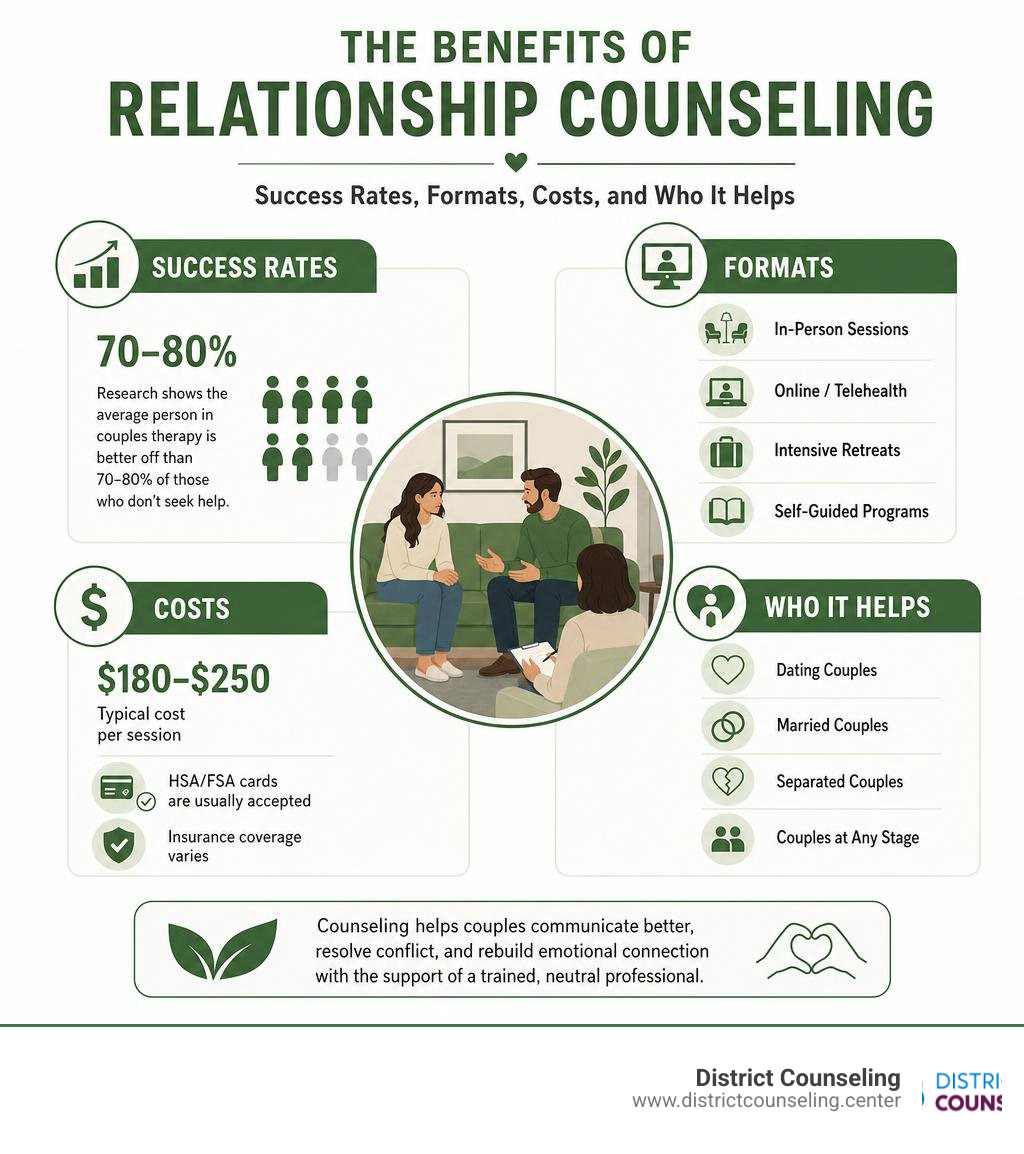
Relationship counseling is professional support that helps couples and partners communicate better, resolve conflict, and rebuild emotional connection — with a trained, neutral therapist guiding the process.
Quick answers:
- What it is: A structured therapy process where a licensed therapist helps partners identify and break negative patterns
- Who it’s for: Couples at any stage — dating, married, separated, or anywhere in between
- Common reasons people seek it: Communication breakdown, infidelity, financial stress, emotional distance, life transitions
- Formats available: In-person sessions, online/telehealth, intensive retreats, self-guided programs
- Does it work? Research shows the average person in couples therapy is better off than 70–80% of those who don’t seek help
- Cost: Typically $180–$250 per session; HSA/FSA cards are usually accepted; insurance coverage varies
If you’ve had the same fight ten times and still can’t resolve it, you’re not alone. Around 20% of married couples experience significant relationship distress at any given time — and most wait years before asking for help.
That delay is costly. The longer unresolved conflict sits, the harder it becomes to untangle.
Relationship counseling isn’t a last resort. For many couples, it’s the turning point — the moment things finally start to shift.
I’m Francisco Ortiz, a Licensed Professional Counselor-Supervisor with extensive experience providing counseling and psychotherapy to individuals, couples, and families navigating mood disorders, trauma, and relationship conflicts. My work in relationship counseling spans diverse populations and settings, giving me a front-row view of both how relationships break down and how they heal. In the sections below, I’ll walk you through everything you need to know to find the right support for your situation.
What is Relationship Counseling and How Does It Work?
Many couples arrive at our offices in Texas — whether in Houston, Katy, Cypress, or Austin — feeling completely stuck. They often ask, “Is there really a difference between therapy and counseling?” While the terms are frequently used interchangeably, counseling is typically short-term and focused on resolving specific, immediate issues (like a dispute over parenting styles). Therapy, on the other hand, tends to dive deeper into long-standing behavioral patterns, childhood wounds, and emotional dynamics.
To explore these differences in depth, you can read more in our guide on Everything You Need to Know About Couples Therapy.
At its core, relationship counseling works by shifting the focus from individual flaws to the relationship dynamic itself. In individual therapy, a therapist focuses on one person’s thoughts, feelings, and behaviors. In couples work, we look at the partnership through a systemic perspective. This means we treat the relationship as the client.
Rather than labeling one partner as “the problem,” we examine how your individual histories, communication habits, and cultural backgrounds interact to create repetitive, painful cycles. By addressing the system rather than the individuals in isolation, we help both partners step back and see how they are mutually keeping the conflict alive.
The Core Principles of Relationship Counseling
For therapy to be successful, we must first establish a foundation of emotional safety. When couples feel safe, they can lower their defensive walls and express their true vulnerabilities.
The primary goals of our sessions are:
- Creating a Neutral Zone: Ensuring both partners feel heard and validated without the therapist taking sides.
- De-escalating Conflict: Interrupting the toxic “attack-defend” loop so partners can actually hear each other.
- Building Emotional Safety: Helping partners express deep-seated fears and needs rather than just trading superficial complaints.
To understand the broader framework of how these principles come together to save marriages, check out The Ultimate Guide to Relationship Therapy.
How It Differs From Individual Therapy
In individual therapy, you have a private space to process your personal struggles. However, if you only address relationship issues individually, you risk creating a one-sided narrative.
In a joint session, we observe your real-time relational patterns. We watch how you interrupt each other, read your body language, and witness the subtle eye-rolls or heavy sighs that fuel arguments.
Joint sessions allow us to intervene in the exact moment a communication breakdown occurs, which simply isn’t possible when working with just one partner. For a deeper look at how joint dynamics are structured, see our dedicated resources on Couple Counseling.
Common Reasons Couples Seek Professional Support
Every relationship has its rough patches, but how do you know when it’s time to bring in a professional? Many couples wait until they are on the verge of divorce to seek help, but therapy is highly effective as a preventive measure too. To help you identify if your relationship is reaching a critical point, you can read our article on When to Seek Couples Counseling.
While communication breakdowns are the most common complaint, couples also seek support for:
- Financial Stress: Differing values on spending, saving, or managing debt.
- Intimacy Issues: A decline in physical affection, sexual desire, or emotional closeness.
- Unresolved Resentment: Carrying the invisible “mental load” of household management, which breeds silent anger.
Rebuilding Trust After Infidelity and Betrayal
Betrayal is one of the most painful experiences a relationship can endure. Whether it is a physical affair, an emotional connection, or financial deceit, the impact is traumatic. Many couples believe that an affair automatically means the end of their relationship, but with dedicated work, healing is entirely possible.
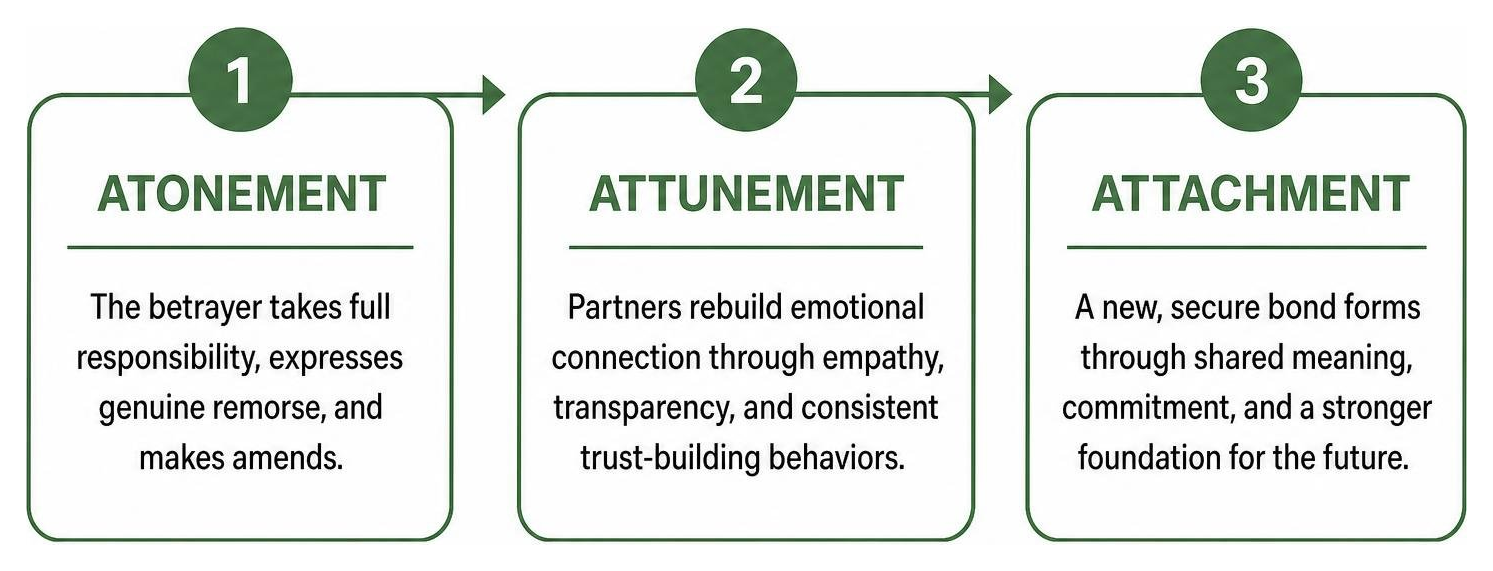
In our work with couples, we emphasize that rebuilding trust is not about restoring the old relationship — because the old relationship allowed the betrayal to happen. Instead, it is about co-creating an entirely new, more transparent partnership from scratch. This journey requires moving through three distinct phases:
To explore this healing process further, read our guide on Couples Counseling After Betrayal and learn how to navigate the emotional aftermath in our article on How to Cope with Trauma Caused by Infidelity in a Relationship.
It is also worth noting that infidelity is not exclusive to younger couples. In fact, self-admitted infidelity rates in older demographics are surprisingly high: women in their 60s report a rate of around 16%, while men in their 70s have a rate of around 26%. No matter your life stage, betrayal recovery is a structured, achievable path.
Navigating Life Transitions and Retirement
Relationships are constantly evolving, and major life transitions can easily throw a couple out of sync. For middle-aged and older couples, transitions like the “empty nest” syndrome, career changes, or retirement can trigger unexpected identity crises.
When children leave the home, the daily distractions of parenting disappear, bringing long-standing emotional distance and negative communication patterns into sharp focus. Suddenly, partners are forced to look at each other and ask, “Who are you, and who are we without the kids?”
Retirement can also disrupt an established marital dynamic. For many, leaving the workforce causes a profound sense of identity loss. If one partner wants to spend retirement traveling while the other prefers to stay home, conflict inevitably arises.
Furthermore, health issues often introduce caregiving dynamics. Approximately 15% of older couples experience a shift where one partner must act as the primary caregiver for the other. This imbalance can lead to exhaustion, caregiver burnout, and a loss of romantic intimacy, making professional guidance essential for navigating these tender years.
Different Formats and Methodologies of Relationship Support
Just as every couple is unique, the therapeutic approach must be tailored to your specific needs. Today, couples have access to a wide variety of evidence-based methodologies and counseling formats.
| Format / Method | Best For | Key Focus | Typical Duration |
|---|---|---|---|
| Gottman Method | Couples wanting practical, research-backed communication tools | Disarming conflicting verbal communication; increasing intimacy and respect | Short to medium-term |
| Emotionally Focused Therapy (EFT) | Couples feeling emotionally disconnected or stuck in deep anger | Reorganizing emotional responses and creating secure attachment bonds | Medium to long-term |
| Discernment Counseling | “Mixed-agenda” couples where one partner wants to stay and the other wants out | Gaining clarity and confidence about the future of the relationship | 1 to 5 sessions |
| Online Telehealth | Busy couples, parents, or long-distance partners | Convenience, accessibility, and high scheduling flexibility | Flexible |
To find out how to locate a clinician trained in these evidence-based frameworks, see our guide on Decoding the Gottman Method How to Find a Certified Relationship Pro.
Traditional In-Person Sessions vs. Online Relationship Counseling
With busy work schedules, parenting demands, and traffic in major Texas metro areas, getting to a physical office can be a challenge. That is why telehealth has become an incredibly popular option for relationship counseling.
Online counseling offers unparalleled convenience. In fact, many modern platforms allow partners to join a single virtual therapy session from two different physical locations. This is a game-changer for long-distance couples, business travelers, or parents trying to squeeze in a session during a lunch break.
To learn how to make virtual sessions work for your partnership, read Long Distance Marriage Counseling Making Therapy Work When You Are Apart.
Intensive Retreats and Discernment Counseling
For couples in acute crisis, standard weekly sessions might feel too slow. In these cases, intensive couples retreats serve as an accelerated, high-level intervention. Rather than waiting weeks to make progress, couples spend consecutive full days working intensively with a senior therapist to untangle deep-seated issues rapidly.
Another specialized framework is Discernment Counseling (often referred to as ‘Make-it-or-Break-It’ counseling). This is a highly structured, short-term process designed specifically for “mixed-agenda” couples — where one partner is leaning toward ending the relationship and the other wants to save it.
Instead of trying to solve your marital problems, discernment counseling helps you decide whether to commit to six months of intensive therapy or move toward an amicable separation. You can learn more about these structured choices in our overview of All About Marital Counseling Options.
What to Expect and How to Prepare for Your Sessions
Walking into your first counseling session can feel intimidating. You might worry that the therapist will judge you, take your partner’s side, or force you to talk about things you aren’t ready to share.
In reality, a typical session is a collaborative, structured conversation. During your first few visits, your therapist will ask about your relationship history, your individual backgrounds, and your goals for therapy.
Over time, you will practice communication exercises, slow down your arguments to see where they go off the rails, and receive therapeutic homework assignments to practice at home. To understand how these sessions improve communication, check out Improving Communication with Spouse Why Couple Counseling is Important for Improving Communication Between Spouses.
The Role of the Therapist as an Objective Guide
A licensed relationship therapist does not act as a judge who decides who is “right” or “wrong.” Instead, they serve as a neutral mediator and communication coach.
The therapist’s job is to help you identify the hidden relational habits that sabotage your connection. For example, in Gottman-based therapy, we help couples identify and defeat “The Four Horsemen” of relationship decline: criticism, contempt, defensiveness, and stonewalling.
To learn how to spot and stop these toxic behaviors, read The Gottman Four Horsemen and How to Defeat Them.
Maximizing Your Progress Outside of Therapy
Therapy only takes up one hour of your week; the real transformation happens in the other 167 hours. To get the most out of your investment, both partners must commit to active practice outside of the office. This means implementing the tools you learn, completing your homework assignments, and showing up with emotional vulnerability.
Building a secure bond requires consistent, daily effort. For practical advice on strengthening your connection between sessions, read our Tips to Build Trust in a Relationship.
Frequently Asked Questions about Relationship Therapy
Finding local support can feel overwhelming, but we are here to help you navigate the search. If you are looking for a clinician near you, start with our resource on Relationship Counseling Near Me Find Local Counselors.
How effective is relationship therapy according to research?
The data is incredibly encouraging. Research highlighted by the American Psychological Association shows that the average person receiving couples therapy is better off at the end of treatment than 70% to 80% of individuals who do not participate. Furthermore, structured goal-setting in specialized clinics leads to over a 75% success rate in clients reaching or exceeding their therapeutic goals.
When it comes to specific methodologies, Integrative Behavioral Couples Therapy (IBCT) — which focuses on emotional acceptance alongside behavioral change — boasts a 69% efficacy rate, compared to 50–60% for traditional behavioral models. In a five-year follow-up of couples who participated in these therapies, 48% improved or recovered completely, 14% remained unchanged, and 38% deteriorated, proving that while therapy is highly effective, maintaining the work long-term is key.
How much does relationship therapy cost and does insurance cover it?
In the private sector, standard relationship therapy rates typically range between $180 and $250 per session, depending on the therapist’s experience and credentials.
Most health insurance plans do not cover couples counseling unless one partner has a specific, diagnosable mental health condition that requires family involvement. However, because our therapists are licensed healthcare providers, you can almost always use your Health Savings Account (HSA) or Flexible Spending Account (FSA) cards to pay for services.
Under the No Surprises Act, self-pay clients are also entitled to a clear Good Faith Estimate (GFE) outlining projected costs before therapy begins. If you have out-of-network benefits, you can request a “Superbill” from your provider to submit to your PPO insurance for potential reimbursement.
What if my partner is resistant to attending counseling?
It is very common for one partner to feel hesitant or resistant to therapy. If your partner refuses to attend, do not let that stop you from seeking help. You can still attend therapy individually to work on your relational patterns.
When an individual changes how they respond to conflict, it naturally forces the entire relationship system to shift. If you want to encourage your partner to join you, try using a “soft startup” — focus on your desire to make the relationship happier for both of you, rather than pointing fingers. For steps on how to handle this transition, read Stop Arguing and Start Searching.
Conclusion
Your relationship is your most valuable asset. While conflict and miscommunication are inevitable parts of sharing a life with someone, staying stuck in painful, repetitive loops is not.
At District Counseling, we provide compassionate, authentic, and evidence-based relationship support tailored to what matters most to Texas couples. Whether you are in Houston, Cypress, Katy, Sugar Land, Fort Worth, or Austin, our team is ready to help you repair your connection, rebuild trust, and build a partnership that lasts.
Are you ready to take the first step toward a healthier, happier relationship? Explore our Relationship Marital Counseling services today and schedule your initial consultation. Let’s work together to restore the love and connection you both deserve.
Visited 1 times, 1 visit(s) today
Similar Posts

Francisco Ortiz
October 16, 2026
Navigating Neuropsychological Evaluations from Katy to Pasadena
Learn how an ADHD evaluation for Houston teens works, from medication management to school accommodations and 504 plans....

Francisco Ortiz
October 14, 2026
How Texas caregivers can beat exhaustion with virtual therapy
Beat caregiver exhaustion therapy Texas caregivers trust—virtual sessions for stress, boundaries, and recovery. Start today....

Francisco Ortiz
October 12, 2026
Find Local Youth Counselor: How They Can Help Your Teen Thrive (52 characters)
Find a qualified youth counselor near me to help your teen thrive with evidence-based support for anxiety, trauma, and more....

Francisco Ortiz
October 9, 2026
Faith-Based Pastoral Counseling: A Comprehensive Guide
Discover how pastoral counseling integrates faith and psychology for holistic healing, grief, trauma, and marital support....

Francisco Ortiz
October 7, 2026
Houston Counseling Options: Find Local Help Nearby
Find affirming counseling in Houston for trauma, LGBTQ+ care, couples, and more. Explore local options and start your healing today....
Francisco Ortiz
October 5, 2026
Why every teacher needs a burnout therapy game plan
Why every teacher needs a burnout therapy game plan – Learn about burnout therapy for teachers...

Francisco Ortiz
October 2, 2026
Child Therapist Near Me? Here is How to Spot a Great One
Find a child therapist near me who fits your child’s needs. Learn signs, costs, and effective therapy options....

Adalid Blandin
September 30, 2026
Mental Health and Miracles: Finding Local Christian Care
Find pastoral counselling near me for faith-based emotional and spiritual support in Texas....

Adalid Blandin
September 28, 2026
Missouri City and Houston Couples Therapy 101
Explore relationship counseling in Houston options, from couples therapy to intensives, with costs, insurance, and therapist tips for Missouri City families....

Adalid Blandin
September 25, 2026
How to find authentic therapy for emotional exhaustion in Houston
Find emotional exhaustion therapy Houston that helps professionals and caregivers move from burnout to renewed energy and balance....


