What Is Marital Counseling — and Could It Help Your Relationship?
Marital counseling is a form of therapy where a licensed professional helps couples work through conflict, rebuild trust, and strengthen their connection. It addresses issues specific to marriage — like shared finances, parenting, intimacy, and long-term commitment.
Quick answers to common questions:
- What is it? Structured therapy sessions with a trained counselor, focused on the unique challenges of married life
- Who is it for? Any couple — newlyweds, long-term partners, or those considering separation
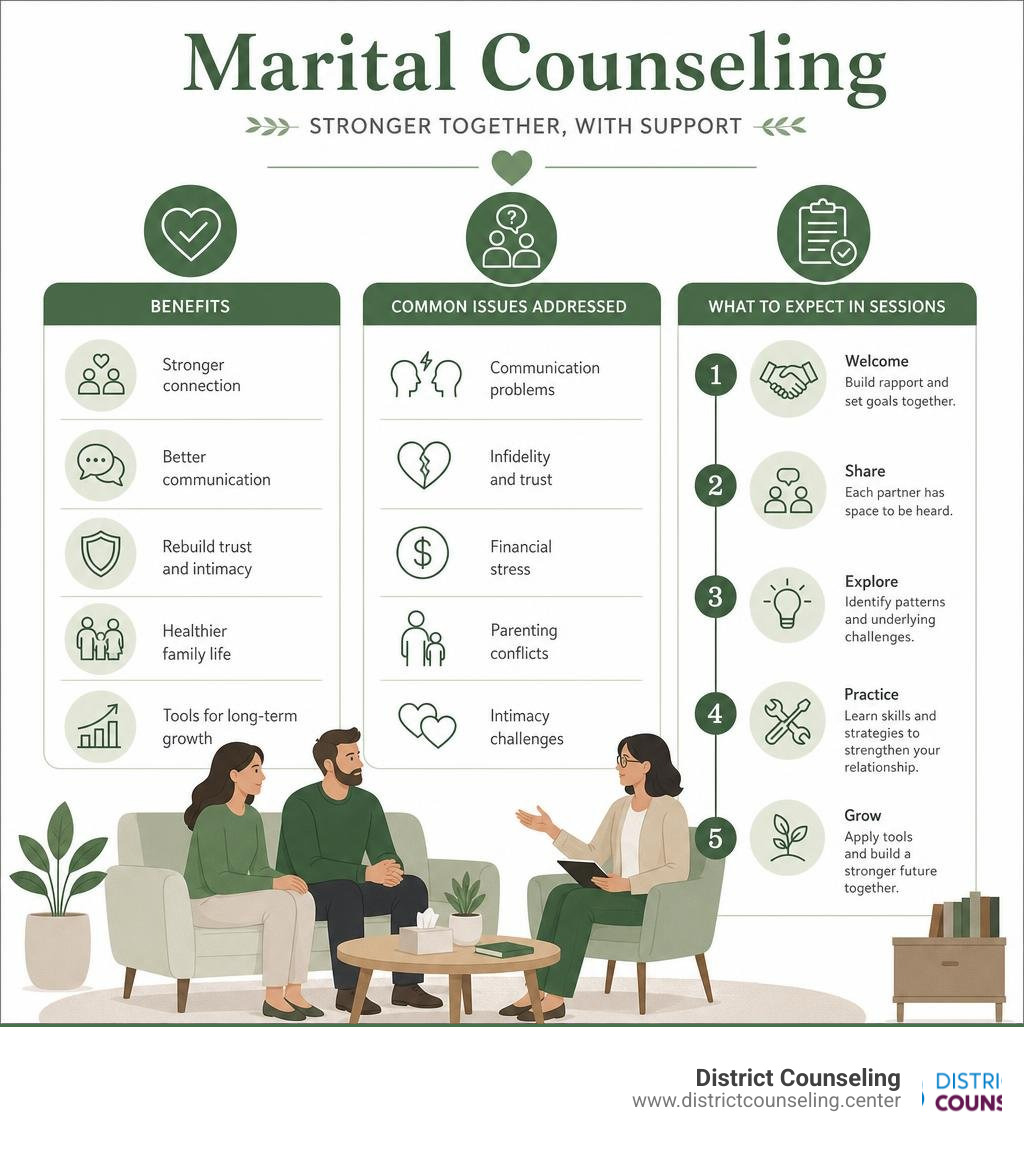
- What does it help with? Communication problems, infidelity, financial stress, parenting conflicts, intimacy issues, and more
- Does it work? Yes — research published in Family Process (2022) found that people who receive couples therapy are better off than 70–80% of those who don’t
- How long does it take? Anywhere from 8–12 focused sessions to several months, depending on your situation
- Is it covered by insurance? Often not — but superbills and sliding scale options are frequently available
Most couples don’t seek help after one dramatic event. More often, it’s a slow drift — conversations that go nowhere, growing emotional distance, or the feeling that you’re living alongside a stranger rather than a partner. That gradual erosion is exactly what marital counseling is designed to address.
Whether you’re navigating a specific crisis or simply want a stronger relationship, counseling gives both partners a structured, safe space to be heard — and practical tools to actually move forward.
I’m Francisco Ortiz, a Licensed Professional Counselor-Supervisor with extensive experience providing counseling and psychotherapy to individuals, couples, and families dealing with relationship conflicts, trauma, and mood disorders — including marital counseling across a wide range of challenges. That background shapes everything you’ll read in this guide.
Understanding Marital Counseling and How It Works

At its core, marital counseling is a collaborative process. Unlike individual therapy, where the sole focus is on one person’s mental health and personal history, the “client” in marriage therapy is the relationship itself. We do not take sides, nor do we act as a judge to declare who is “right” or “wrong.” Instead, we work as neutral facilitators to help you map out the patterns that keep you stuck.
When relationships experience distress, partners often fall into repetitive, unproductive communication cycles. One partner might pursue and demand connection, while the other withdraws or shuts down. In our sessions, we slow these interactions down. By examining these dynamics in a safe, structured setting, couples learn to recognize their triggers and respond to each other with empathy rather than defensiveness. For a deeper look at how this process unfolds, explore The Ultimate Guide to Marital Counseling.
The Core Differences: Marriage vs. Couples Therapy
While people often use the terms interchangeably, there is a distinct difference between general couples therapy and specialized marital counseling. Couples therapy can apply to any romantic relationship at any stage, focusing on dating dynamics, early compatibility, or general relationship maintenance.
Marital counseling, however, specifically addresses the unique legal, social, and emotional realities of marriage. It honors the sacred commitment of marriage vows and directly tackles complex issues such as co-parenting, blending families, managing joint assets, and navigating long-term life transitions.
To understand how structured guidance shifts across different relationship stages, consider this comparison between premarital preparation and post-wedding therapy:
| Feature | Premarital Counseling | Marriage Counseling |
|---|---|---|
| Primary Focus | Proactive foundation-building and skill development | Resolving active conflicts and rebuilding connection |
| Typical Topics | Core values, financial expectations, future parenting styles | Communication breakdowns, broken trust, intimacy loss |
| Relationship State | Anticipatory and generally positive | Experiencing distress, drift, or a specific crisis |
| Goal | Prevent future pitfalls and align life visions | Repair existing damage and restore relationship health |
What to Expect in Your First Marital Counseling Session
Walking into a therapist’s office for the first time can feel intimidating. You might worry that the therapist will judge you, or that the session will devolve into a shouting match. We design our environment to be a safe, non-judgmental space where both partners can speak openly.
Your first session typically begins with a comprehensive, one-hour assessment. During this intake, we will:
- Gather a detailed history of your relationship (how you met, early years, and when the drift began).
- Identify the primary issues bringing you to therapy.
- Establish clear, mutual goals for our work together.
Confidentiality is the cornerstone of this process. It fosters the safety required for both of you to share your deepest concerns without fear of retaliation or judgment. If you are wondering whether your relationship has reached the point where professional intervention is necessary, read our guide on When to Seek Couples Counseling.
Evidence-Based Approaches to Marital Therapy
Not all therapy is the same. To help couples achieve lasting change, we utilize proven, research-backed modalities tailored to your specific relationship dynamics. When looking to Find a Marriage Counseling Therapist, it is highly beneficial to understand the scientific approaches they use to guide their practice.
Gottman Method and Emotionally Focused Therapy (EFT)
Two of the most widely respected and clinically validated frameworks in modern relationship therapy are the Gottman Method and Emotionally Focused Therapy (EFT).
- The Gottman Method: Developed by Drs. John and Julie Gottman, this approach is based on over 40 years of research with thousands of couples. It focuses on disarming conflicting verbal communication, increasing intimacy, respect, and affection, and removing barriers that create a feeling of stagnancy. A key component is identifying the “Four Horsemen of the Apocalypse”—Criticism, Contempt, Defensiveness, and Stonewalling—and replacing them with healthy relationship habits. By utilizing tools like the Gottman Relationship Checkup, we help couples build a “Sound Relationship House.” Learn more about these foundational principles in our article on What Makes Love Last?.
- Emotionally Focused Therapy (EFT): Developed by Dr. Sue Johnson, EFT is rooted in adult attachment theory. It views relationship distress as a threat to emotional security. When partners fight, they are often asking a fundamental question: “Are you there for me? Do I matter to you?” EFT helps couples identify their negative interactive cycles (such as the demand-withdraw pattern) and restructure their emotional bonds so they can express their needs from a place of vulnerability rather than anger.
Systemic, Bowenian, and Structural Approaches
In addition to Gottman and EFT, we draw from classic family systems theories to address multi-generational and structural dynamics within a marriage:
- Bowenian Therapy: This approach looks at how individuals differentiate themselves from their families of origin. It helps partners understand how unresolved issues with parents or siblings are being projected onto their current spouse.
- Structural Therapy: Here, the therapist examines the boundaries and power dynamics within the household. We look at whether the parental unit is strong, or if children, in-laws, or external stressors are interfering with the marital boundary.
- Systemic and Strategic Therapy: These modalities focus on the repetitive patterns of communication within the relationship system. We identify the unspoken rules of your marriage and design specific, practical interventions to disrupt negative feedback loops.
Common Reasons Couples Seek Help and the Benefits of Therapy
Marriages face pressure from many directions. Seeking professional support is not a sign of failure; rather, it indicates that you care enough to fight for your relationship. Whether you are seeking specialized help or looking to connect with therapists near our Cypress or Copperfield locations, modern therapy offers practical paths forward.
The benefits of engaging in this work are profound:
- Improved Communication: Shifting from defensive reactions to active, empathetic listening.
- Enhanced Emotional Connection: Moving past “roommate syndrome” to find deep emotional intimacy.
- Better Conflict Resolution: Learning to “fight fair” and de-escalate arguments before they spiral.
If you are struggling to break the cycle of constant arguments, our resource on Improving Communication with Spouse: Why Couple Counseling is Important for Improving Communication Between Spouses offers valuable guidance.
Rebuilding Trust After Infidelity and Betrayal
Infidelity is one of the most painful crises a marriage can face. Whether it is a physical affair or an emotional betrayal, the discovery of a breach of trust shatters the foundation of the relationship.
However, healing is entirely possible. In specialized affair recovery, we guide couples through a structured three-stage process:
- Atonement: Establishing complete transparency, answering questions honestly, and addressing the immediate trauma of the betrayal.
- Attunement: Investigating the vulnerabilities in the relationship that existed prior to the affair, helping both partners express their pain and unmet needs.
- Attachment: Rebuilding a completely new relationship based on renewed commitment, trust, and mutual respect.
For couples navigating this difficult path, we recommend reading our dedicated guide on Couples Counseling After Betrayal.
Navigating Life Transitions: Empty Nesters and Retirees

Relationship challenges do not disappear as we age; instead, they evolve. Many couples put their marriage on “cruise control” for decades while focusing on demanding careers and raising children. When those distractions disappear, the relationship is suddenly put under a microscope.
Older couples face distinct transitions that can strain even long-standing marriages:
- The Empty Nest: When adult children leave home, partners may realize they have grown apart and no longer know each other.
- Retirement Transitions: Spending 24 hours a day together can reveal previously masked communication gaps and lead to identity struggles.
- Caretaking Dynamics: Statistics show that when an individual turns 65, they have almost a 70 percent chance of needing some form of long-term care in their remaining years. In approximately 15 percent of couples, one spouse must step into a demanding caretaking role for the other, which can quickly lead to physical exhaustion and emotional resentment.
- Late-Life Infidelity: Research by the Institute for Family Studies highlights a surprising trend in older demographics. Women in their 60s report an infidelity rate of approximately 16 percent, while men in their 70s admit to an infidelity rate of around 26 percent.
Whether you are seeking support in the Greater Heights area, looking for premier Houston couples care, or seeking counseling in Austin, navigating these later-life transitions with a professional can help you redefine your relationship with grace and purpose.
Preparing for Therapy and What to Avoid
To get the most out of your therapeutic journey, it is vital to approach the process with intentionality. Therapy is not a passive experience; it requires active commitment and vulnerability from both partners. If you are ready to break the pattern of emotional distance, explore our strategies in No More Silent Treatment: Finding Quality Couples Therapy Near You.
How to Prepare for Your First Marital Counseling Appointment
Before you sit down for your first session, we recommend taking the following steps:
- Have an Open Conversation: Talk with your partner about your hopes and goals for therapy. Frame it as a team effort to improve the relationship, rather than a punishment.
- Cultivate Open-Mindedness: Be prepared to hear perspectives that differ from your own without immediately jumping to defend yourself.
- Establish Clear Personal Goals: Ask yourself, “How can I show up differently to help our relationship succeed?”
If you are looking for immediate steps you can take at home before your first appointment, read our guide on How to Save Your Marriage for Free.
What to Avoid Saying and Doing in Sessions
To maintain a productive, emotionally safe environment during therapy, couples should actively avoid several common communication pitfalls:
- Using Global Accusations (“Always” and “Never”): Statements like “You always ignore me” or “You never help” trigger immediate defensiveness and stall constructive dialogue.
- Dismissing Your Partner’s Feelings: Saying “You’re overreacting” or “That’s ridiculous” invalidates your partner’s reality and shuts down vulnerability.
- Listing Grievances Without Seeking Solutions: Bringing a laundry list of past mistakes without a genuine desire to resolve them keeps the relationship stuck in the past.
- Comparing Your Spouse Negatively to Others: Making comparisons to friends, family members, or ex-partners erodes self-esteem and trust within the marriage.
Handling a Reluctant Partner
It is incredibly common for one partner to be a step behind the other in wanting to start therapy. If your spouse is hesitant, try these approaches:
- Frame it as a Team Effort: Avoid saying, “You need counseling to fix your issues.” Instead, say, “I want our relationship to be stronger, and I need a professional’s help to learn how to be a better partner to you.”
- Suggest a Trial Period: Ask them to commit to just three or four sessions before making a final decision.
- Start Individually: If they absolutely refuse, you can still begin individual therapy. When one partner shifts their responses and behaviors, it naturally alters the dynamic of the entire relationship system.
If you are navigating this situation, you can find further guidance on how to Find a Therapist in for Couples Relationship Issues.
Frequently Asked Questions About Marital Therapy
Does marriage counseling actually work?
Yes, when both partners are willing to engage in the process. A landmark study published in the journal Family Process (2022) demonstrated that the average person receiving couples therapy is better off at the end of treatment than 70 to 80 percent of individuals who do not participate in therapy.
The success of therapy is heavily influenced by early intervention. When problems arise, the sooner couples start counseling, the more progress they tend to make. Waiting years to address deep-seated resentments makes the repair process longer and more complex. For a deeper look at why consistent care is so effective, read Healthy Marriages: Regular Couples Counseling is the Key to a Healthy Marriage.
How long does therapy typically last and how many sessions are needed?
The duration of marital counseling varies based on the depth of the issues and the goals of the couple.
- Short-Term Support: Many couples see significant progress in 8 to 12 weekly sessions focused on a specific, circumscribed issue (like navigating a major life transition or improving basic communication).
- Long-Term Healing: For deep-seated issues, complex trauma, or recovery from severe betrayal, couples may benefit from several months of weekly sessions before gradually reducing frequency as trust is restored.
Is therapy covered by insurance and what are the typical costs?
Typically, health insurance plans do not cover intimate partner or couples counseling, as insurance companies require a diagnosed mental health disorder in an individual to justify treatment.
However, we strive to make care accessible:
- Superbills: We can provide you with detailed superbills that you can submit to your insurance provider for potential out-of-network reimbursement.
- Flexible Budgets: Many couples utilize Health Savings Accounts (HSA) or Flexible Spending Accounts (FSA) to cover the cost of therapy.
Conclusion: Take the Next Step with District Counseling
At District Counseling, we provide advanced, evidence-based marital counseling, psychotherapy, and trauma care designed to help couples move from surviving conflict to building a partnership that actually works. Our unique strength lies in our sincere, authentic, and compassionate alignment to what matters most to families across Texas.
No matter where you are starting from — whether you are experiencing a slow drift, recovering from a major betrayal, or navigating the complex transitions of later life — you do not have to walk this path alone. We offer convenient, secure virtual sessions as well as in-person care across our Texas locations, including Houston, Fort Worth, Austin, Katy, Cypress, Copperfield, Greater Heights, Sugar Land, and the surrounding areas.
Your marriage is worth investing in. We invite you to reach out to our team today to take your first step toward a stronger, healthier, and more fulfilling connection. Learn more about our specialized approach to healing relationships on our Relationship & Marital Counseling page.
Visited 8 times, 1 visit(s) today
Similar Posts

Francisco Ortiz
October 16, 2026
Navigating Neuropsychological Evaluations from Katy to Pasadena
Back-to-School Mental Health: Tips for a Smooth Transition – Discover practical tips to ease back-to-school anxiety for kids, teens, and parents. Build healthy routines, manage stress, and foster emotional… …...

Francisco Ortiz
October 14, 2026
How Texas caregivers can beat exhaustion with virtual therapy
Beat caregiver exhaustion therapy Texas caregivers trust—virtual sessions for stress, boundaries, and recovery. Start today....

Francisco Ortiz
October 12, 2026
Find Local Youth Counselor: How They Can Help Your Teen Thrive (52 characters)
Find a qualified youth counselor near me to help your teen thrive with evidence-based support for anxiety, trauma, and more....

Francisco Ortiz
October 9, 2026
Faith-Based Pastoral Counseling: A Comprehensive Guide
Discover how pastoral counseling integrates faith and psychology for holistic healing, grief, trauma, and marital support....

Francisco Ortiz
October 7, 2026
Houston Counseling Options: Find Local Help Nearby
Find affirming counseling in Houston for trauma, LGBTQ+ care, couples, and more. Explore local options and start your healing today....

Francisco Ortiz
October 5, 2026
Why every teacher needs a burnout therapy game plan
Why every teacher needs a burnout therapy game plan – Learn about burnout therapy for teachers...

Francisco Ortiz
October 2, 2026
Child Therapist Near Me? Here is How to Spot a Great One
Find a child therapist near me who fits your child’s needs. Learn signs, costs, and effective therapy options....

Adalid Blandin
September 30, 2026
Mental Health and Miracles: Finding Local Christian Care
Find pastoral counselling near me for faith-based emotional and spiritual support in Texas....

Adalid Blandin
September 28, 2026
Missouri City and Houston Couples Therapy 101
Explore relationship counseling in Houston options, from couples therapy to intensives, with costs, insurance, and therapist tips for Missouri City families....

Adalid Blandin
September 25, 2026
How to find authentic therapy for emotional exhaustion in Houston
Find emotional exhaustion therapy Houston that helps professionals and caregivers move from burnout to renewed energy and balance....


