
Licensed Telehealth Therapy Providers in Texas: A Quick Start Guide
Navigating Legal Requirements and Insurance for Telehealth Therapy Texas
To start licensed telehealth therapy Texas residents can quickly connect with a credentialed clinician online in three direct steps: select a state-licensed therapist (LPC, LMFT, LCSW, or licensed psychologist), confirm your insurance mental health telehealth benefits or self-pay rates, and complete digital intake paperwork through a secure client portal. Under Texas law, you can begin comprehensive mental healthcare immediately via secure video without ever attending an in-person intake visit.
Virtual care across the Lone Star State is governed by rigorous standards to ensure you receive the same standard of care online as you would sitting in an office. In Texas, behavioral health professionals must strictly adhere to the rules set by the Texas Behavioral Health Executive Council (BHEC) as well as the Texas Medical Board. These regulations ensure that therapists maintain client confidentiality, utilize compliant digital platforms, and obtain comprehensive informed consent before beginning clinical treatment.
Texas Licensing Laws and Senate Bill 1107
Therapists practicing online in Texas must be actively licensed within the state. This includes Licensed Professional Counselors (LPCs), Licensed Marriage and Family Therapists (LMFTs), Licensed Clinical Social Workers (LCSWs), and Licensed Psychologists. A milestone in expanding digital healthcare came when lawmakers passed Senate Bill 1107, which permanently established that a valid practitioner-patient relationship can be created via telemedicine without requiring an initial in-person visit. This legislation opened doors for more than 29 million Texans to access care seamlessly from any location in the state.
Whether you are connecting from Austin, Fort Worth, Katy, or anywhere in between, Texas law requires that your therapist hold a valid Texas license and verify your physical location at the start of every session. Therapists must also confirm your local emergency contact details before initiating clinical interventions. Understanding these standards helps you focus entirely on your healing journey, as detailed in our guide on Making the Most of Telehealth Counseling.
Insurance Coverage and Parity Mandates
Texas insurance laws require state-regulated commercial health plans to provide reimbursement parity for behavioral health services delivered via telehealth. This means covered virtual counseling sessions are reimbursed at rates comparable to traditional, in-person clinical sessions, ensuring that patients do not face discriminatory copays or unfair out-of-pocket costs simply for choosing video therapy. Furthermore, Texas Medicaid provides coverage for comprehensive virtual psychotherapy services when rendered by eligible, enrolled providers across synchronous audio-visual networks.
| Coverage Feature | In-Person Therapy Sessions | Telehealth Therapy Sessions |
|---|---|---|
| Initial Visit Requirement | In-office evaluation | No in-person visit required (SB 1107) |
| Texas Regulated Plans | Standard mental health copay/coinsurance | Parity mandated; same copay structure applies |
| Medicaid Coverage | Covered for eligible behavioral health | Covered via synchronous audio-visual platforms |
| Out-of-Pocket / Self-Pay | Standard clinic rates | Identical flat fee or sliding scale options |
| Documentation Standards | Standard clinical record keeping | Requires confirmed physical client address |
While state-regulated plans follow strong parity laws, self-funded employer plans (governed by federal ERISA guidelines) may establish their own independent telehealth benefits. We always encourage verifying your specific policy terms, deductibles, copayments, and out-of-network benefits prior to your initial clinical assessment to avoid unexpected billing issues.
Clinical Care, Effectiveness, and Specialized Conditions
Online counseling is backed by decades of clinical research demonstrating that remote therapeutic interventions match traditional office visits in both clinical efficacy and patient satisfaction. Texas patients benefit from the ability to access evidence-based psychological modalities directly from the privacy of their homes, workplaces, or private spaces without the stress of navigating traffic.
Measuring Clinical Outcomes in Telehealth Therapy Texas
Clinical studies and state survey data consistently demonstrate that approximately 70% of virtual therapy users report high satisfaction rates, pointing to reduced commute times, scheduling flexibility, and the comfort of speaking from their own homes. The elimination of logistical barriers directly enhances treatment adherence, resulting in fewer missed appointments and more consistent clinical momentum.
Evidence-based frameworks such as Cognitive Behavioral Therapy (CBT), Acceptance and Commitment Therapy (ACT), and psychodynamic interventions translate effectively across digital platforms. When addressing pervasive mood struggles through specialized Depression and Anxiety Counseling, clinicians build a robust therapeutic alliance online, guiding clients toward meaningful, lasting behavioral transformation while teaching concrete coping skills.
Specialized Treatments and Online Modalities
Many individuals are surprised to learn how extensive virtual care modalities can be. Highly focused clinical modalities like trauma-informed stabilization, specialized Trauma Counseling, and bilateral stimulation via virtual EMDR Treatment are successfully delivered over secure video using specialized digital visual and auditory bilateral stimulus tools. When clinical care requires comprehensive psychiatric evaluation and balance, online Psychiatric Medication Management provides a path forward by coordinating prescriptions and clinical follow-ups smoothly.
We serve diverse communities across Texas, providing accessible support through regional hubs such as our Copperfield Telehealth Counseling services.
Virtual care effectively supports a broad range of mental health needs, including:
- Generalized anxiety, panic disorders, and social phobias
- Major depressive disorder and persistent depressive challenges
- Post-traumatic stress injuries, acute trauma, and relational distress
- Obsessive-compulsive challenges and adjustment disorders
- Relationship, marital, and family communication hurdles
- ADHD coaching and executive function scaffolding
- Grief, life transitions, and chronic stress management
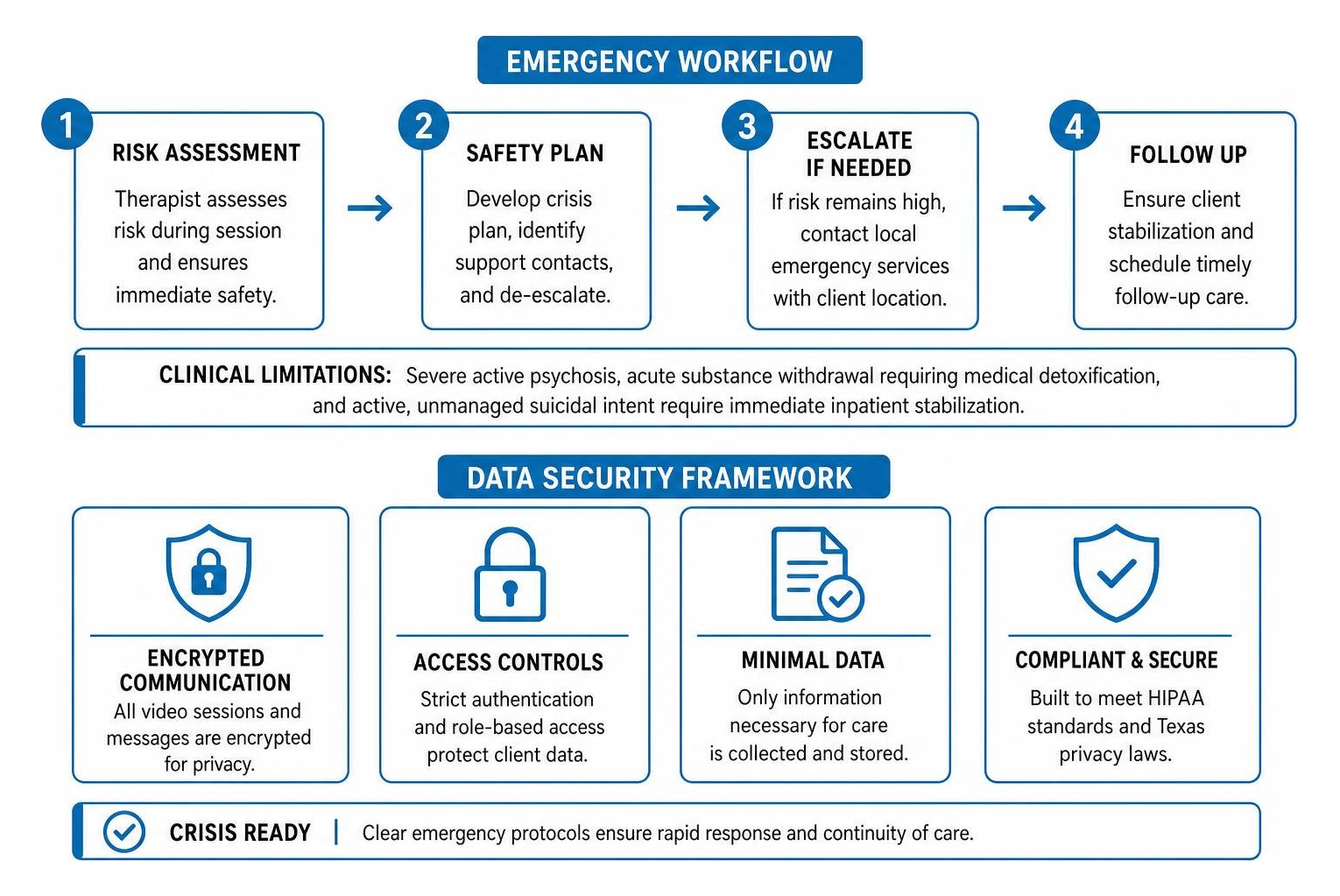
Clinical Limitations: While virtual modalities are versatile, telehealth is not universally appropriate for every clinical situation. Severe active psychosis, acute substance withdrawal requiring medical detoxification, and active, unmanaged suicidal intent necessitating immediate inpatient stabilization require intensive, face-to-face medical or psychiatric intervention.
Safety, Platforms, and Addressing Regional Healthcare Disparities
The rapid expansion of virtual mental health services has bridged significant geographical gaps across Texas, while setting high standards for digital security and crisis readiness.
Overcoming Regional Barriers with Telehealth Therapy Texas
Access to mental health support has historically been uneven across our state. In Texas, 87% of counties are designated as Mental Health Professional Shortage Areas (HPSAs). Residents living in rural counties often face round-trip drives of two to four hours simply to see a specialist. Consequently, rural Texans are 3 times more likely to use virtual behavioral healthcare compared to urban residents who have a higher density of local clinics.
From bustling metropolitan centers like Houston, Sugar Land, Pasadena, Pearland, Cypress, Spring, and Tomball to rural communities across West and Central Texas, secure Telehealth Counseling breaks down transportation barriers, bridges provider shortages, and delivers care right to your home.
HIPAA Compliance and Virtual Crisis Management Protocols
To protect personal health information, compliant virtual care must never take place over standard, unencrypted commercial video apps. Providers utilize SOC-2 compliant, HIPAA-certified platforms that employ end-to-end 256-bit AES encryption to ensure that sessions remain strictly confidential under both federal HIPAA standards and the Texas Medical Privacy Act.
Safety planning is integrated into every virtual session. Texas therapists maintain structured emergency protocols, which include:
- Verifying the client’s exact physical address and current room location at the start of every appointment.
- Keeping an active local emergency contact on file.
- Identifying the closest emergency medical services (EMS) and local crisis mobile teams relative to the client’s physical location, rather than the therapist’s office.
- Utilizing established safety plans and connecting with resources like the 988 Suicide and Crisis Lifeline when immediate escalation is required.
Frequently Asked Questions About Texas Virtual Mental Health
How do therapists verify client identity and location during a virtual session?
At the beginning of each appointment, Texas regulations require your clinician to verify your identity and confirm your exact physical location (including street address). This ensures state jurisdictional compliance and provides emergency services with your location if an unexpected medical or psychiatric crisis arises during the session.
Can out-of-state therapists provide online counseling to someone located in Texas?
Generally, no. A clinician must hold an active Texas license (issued by the corresponding BHEC board or the Texas State Board of Examiners of Psychologists) to treat a client who is physically situated in Texas at the time of the appointment, unless they practice under recognized multi-state compacts like PSYPACT or temporary emergency rules.
What happens if a mental health emergency occurs during a video therapy session?
If a client experiences an acute psychiatric emergency during a telehealth appointment, the therapist initiates an established crisis protocol. Because the therapist verifies your physical address at the start of the session, they can coordinate directly with local crisis response teams or municipal emergency dispatchers in your specific area while remaining on the video line with you to provide continuous de-escalation and support.
Conclusion
Virtual mental health care offers Texans a confidential, flexible, and evidence-based pathway to meaningful personal growth. At District Counseling, our team is dedicated to offering sincere, authentic, and compassionate care tailored to your unique story. Whether you are navigating life transitions, addressing mood disorders, or healing from trauma, you can connect directly with our clinicians through The Virtual Couch from anywhere in Texas.
Visited 24 times, 1 visit(s) today
Related posts:
Similar Posts

Francisco Ortiz
October 7, 2026
Houston Counseling Options: Find Local Help Nearby
Back-to-School Mental Health: Tips for a Smooth Transition – Discover practical tips to ease back-to-school anxiety for kids, teens, and parents. Build healthy routines, manage stress, and foster emotional… …...

Francisco Ortiz
October 5, 2026
Why every teacher needs a burnout therapy game plan
Why every teacher needs a burnout therapy game plan – Learn about burnout therapy for teachers...

Francisco Ortiz
October 2, 2026
Child Therapist Near Me? Here is How to Spot a Great One
Find a child therapist near me who fits your child’s needs. Learn signs, costs, and effective therapy options....

Adalid Blandin
September 30, 2026
Mental Health and Miracles: Finding Local Christian Care
Find pastoral counselling near me for faith-based emotional and spiritual support in Texas....

Adalid Blandin
September 28, 2026
Missouri City and Houston Couples Therapy 101
Explore relationship counseling in Houston options, from couples therapy to intensives, with costs, insurance, and therapist tips for Missouri City families....

Adalid Blandin
September 25, 2026
How to find authentic therapy for emotional exhaustion in Houston
Find emotional exhaustion therapy Houston that helps professionals and caregivers move from burnout to renewed energy and balance....

Francisco Ortiz
September 23, 2026
A Practical Guide to Finding Licensed Telehealth Counselors in Texas
Find licensed telehealth counseling in Texas with this guide to legal standards, privacy, insurance, and best practices for virtual care....

Adalid Blandin
September 21, 2026
All About Psychiatric Weight Loss Options and Treatments
Explore psychiatric weight loss options, including medications, therapy, and bariatric support for holistic wellness....

Francisco Ortiz
September 18, 2026
No Traffic, No Waiting Rooms: Your Guide to Telehealth Counseling in Texas
Learn the rules, rights, and benefits of telehealth counseling in Texas with this complete guide to virtual therapy....

Adalid Blandin
September 16, 2026
Why Your Mitochondria Might Be Depressed
Explore metabolic mental health to boost brain energy, ease mood disorders, and support recovery through mitochondria-focused strategies....


