
Why So Many Houston Residents Are Turning to EMDR Therapy
EMDR therapy Houston residents are searching for is widely available — and here’s a quick look at what you need to know:
| Question | Quick Answer |
|---|---|
| What is EMDR? | Eye Movement Desensitization and Reprocessing — a structured, evidence-based therapy for trauma |
| Who is it for? | Children, teens, adults, veterans, and anyone struggling with trauma, anxiety, PTSD, or painful memories |
| How many sessions? | Varies — a few sessions for single-event trauma, longer for complex PTSD |
| Where in Houston? | Available across Montrose, The Heights, River Oaks, Sugar Land, Katy, and more — plus telehealth |
| Does insurance cover it? | Often yes — many Houston therapists accept major insurers or offer sliding scale fees |
| How do I find a provider? | Search EMDRIA’s directory or Psychology Today, which lists 500+ EMDR therapists in Houston |
Trauma doesn’t just live in the mind. It shows up in the body — as a clenched jaw, a racing heart, a sleep-stealing nightmare, or a belief you can’t shake no matter how hard you try. For busy Houston professionals and parents carrying that weight, finding the right support can feel overwhelming. That’s where EMDR comes in.
EMDR is now one of the most researched and recommended approaches for trauma recovery. Organizations like the EMDRIA have more than 18,000 trained members worldwide, and research consistently shows it effectively reduces PTSD symptoms for the majority of clients.
I’m Francisco Ortiz, a Licensed Professional Counselor-Supervisor and trauma-informed therapist with extensive experience providing counseling for trauma, mood disorders, and complex mental health challenges — including EMDR therapy Houston clients seek at District Counseling. My work across school-based and community mental health settings has shown me how transformative the right trauma therapy can be.
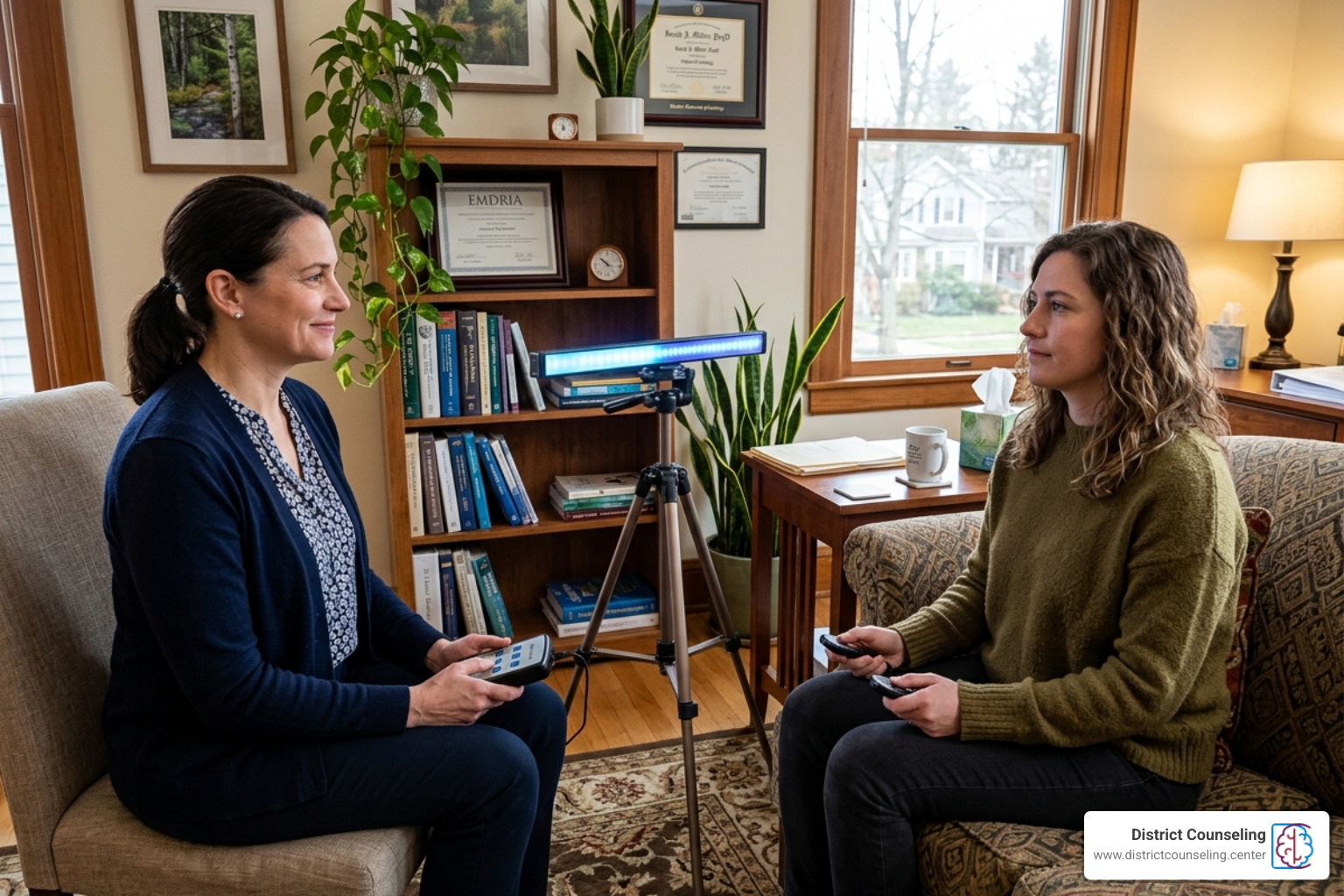
Understanding EMDR Therapy Houston: A Path to Healing
If you have ever felt “stuck” in a memory, you are not alone. Many people in Houston find that even after years of traditional talk therapy, certain experiences still feel as raw as the day they happened. EMDR therapy Houston offers a different approach by focusing on how the brain processes and stores information.
EMDR stands for Eye Movement Desensitization and Reprocessing. It is an integrative psychotherapy approach that helps the brain resume its natural healing process. Think of it like a physical wound: if you get a cut, your body naturally works to close it. But if a foreign object—like a splinter—gets stuck in that wound, it stays inflamed and painful. Trauma is like that splinter. EMDR helps “remove the splinter” so your mind can finish its job of healing.
This method is rooted in the Adaptive Information Processing (AIP) model. This theory suggests that our brains are hardwired to process experiences toward emotional health. However, when we face overwhelming trauma, that processing system can get blocked. The memory becomes “stuck” in its original, distressing form. Through EMDR, we use bilateral stimulation to unlock that memory and move it to a more functional part of the brain.
Interestingly, the eye-opening truth about how EMDR therapy works is that it mimics the rapid eye movement (REM) sleep phase. During REM sleep, our brains process the events of the day. EMDR harnesses this biological mechanism to help you “digest” traumatic experiences that have been sitting heavy in your system for years.
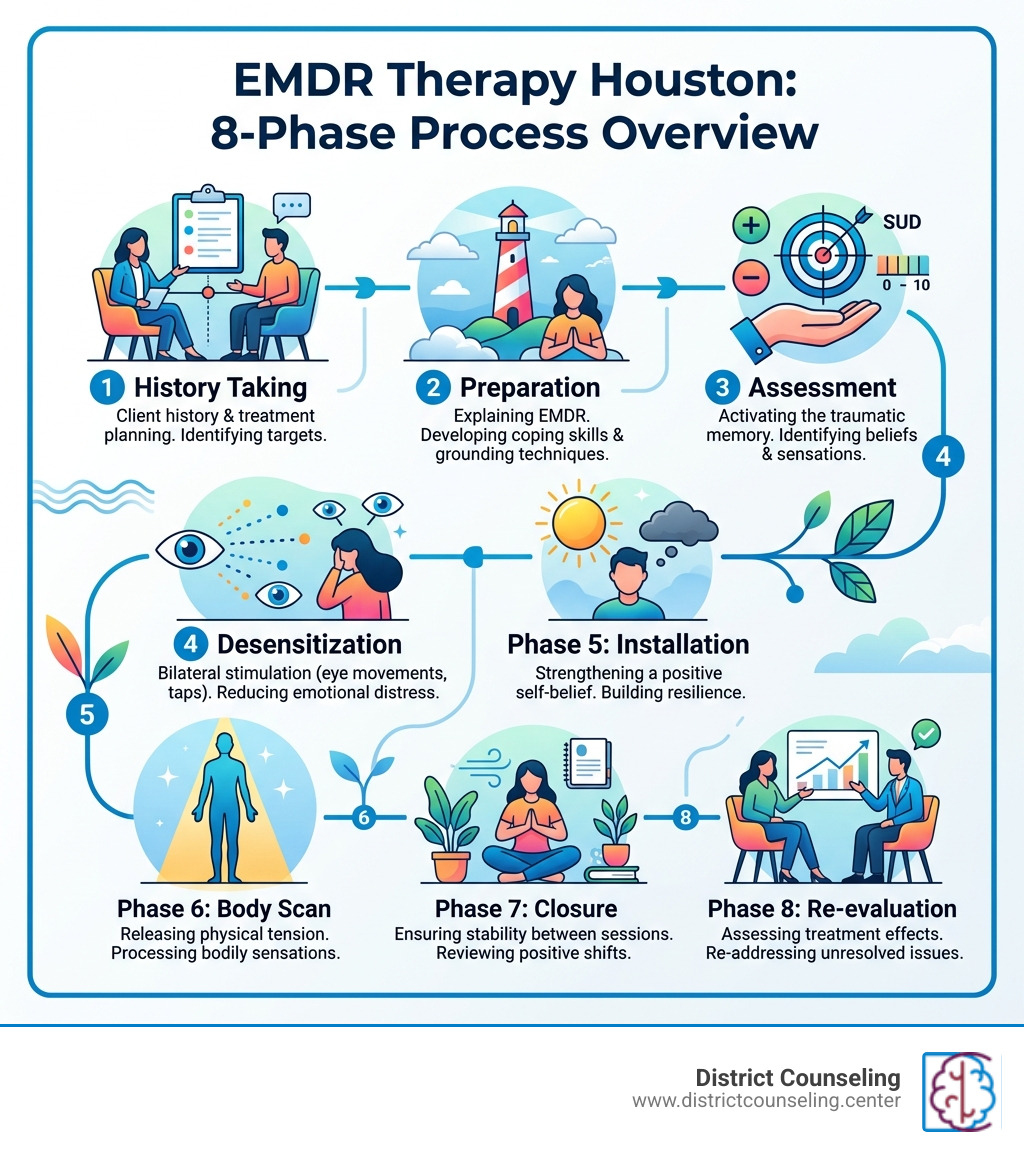
The 8 Phases of EMDR Therapy Houston
EMDR is not just about moving your eyes back and forth; it is a highly structured, eight-phase treatment protocol designed to ensure your safety and success. In our Houston-area clinics, we follow these phases carefully:
- History Taking: We discuss your background and identify specific “targets” (memories or triggers) to work on.
- Preparation: We help you build a “toolbox” of coping skills and grounding techniques so you feel safe before we dive into the deep work.
- Assessment: We identify the specific image, negative belief (like “I am unsafe”), and physical sensations associated with the memory.
- Desensitization: This is where the bilateral stimulation happens. We focus on the memory while using eye movements or taps until the distress level drops.
- Installation: We “install” and strengthen a positive belief to replace the old negative one (e.g., “I am safe now”).
- Body Scan: We check for any lingering physical tension in the body.
- Closure: We ensure you feel grounded and stable at the end of every session.
- Reevaluation: At the start of the next session, we check your progress to see if the healing has held.
For a deeper dive, you can read the ultimate guide to healing through trauma EMDR therapy.
How Bilateral Stimulation Reprocesses Memories
The “magic” of EMDR lies in bilateral stimulation (BLS). This simply means stimulating both sides of the brain in a rhythmic pattern. While eye movements (visual tracking) are the most common form, we also use tactile tapping or auditory tones.
This rhythmic stimulation helps regulate the nervous system. When you are triggered, your “survival brain” takes over. BLS helps keep your “logical brain” online while you process the memory. This allows the memory to move from the amygdala (the alarm center) to the neocortex (the library), where it can be stored as a narrative of the past rather than a terrifying experience in the present. If you are curious about how this compares to other methods, you might enjoy exploring EMDR and Brainspotting therapies for anxiety and depression.
Conditions and Symptoms Effectively Treated in Houston
While EMDR therapy Houston is famous for treating PTSD, its reach is much broader. We see many residents who don’t have a formal PTSD diagnosis but are struggling with “small-t” traumas—life events that have left them feeling anxious, unworthy, or stuck.
Commonly treated conditions include:
- PTSD and Acute Stress Disorder: From car accidents to natural disasters like Houston floods.
- Panic Attacks and Phobias: Such as fear of flying or public speaking.
- Complicated Grief: Processing the loss of a loved one when the pain feels impossible to move through.
- Performance Anxiety: Helping Houston professionals and athletes overcome “the yips” or stage fright.
- Relational Trauma: Healing from childhood neglect, abuse, or difficult breakups.
Our trauma counseling services are designed to help you move from survival mode to thriving mode.

EMDR for Children, Teens, and Veterans
EMDR is remarkably versatile and safe for all ages. For children and teens, we often adapt the protocol to be more play-based or use “storytelling” methods. It is particularly effective for pre-verbal trauma—events that happened before a child could speak—and attachment wounds.
For our Houston veterans, EMDR is a frontline treatment for combat trauma. It allows veterans to process horrific experiences without having to describe every painful detail out loud, which can sometimes be less re-traumatizing than traditional talk therapy. It’s about intergenerational healing; by healing the individual, we help the whole Houston family.
Somatic Symptoms and the Body-Mind Connection
Trauma isn’t just a story we tell; it’s a physical experience. Many people seeking EMDR therapy Houston report physical symptoms that doctors can’t quite explain. This is because, as trauma researchers often explain, the body keeps the score.
| Symptom Type | Common Manifestations |
|---|---|
| Physical | Chronic pain, clenched jaw (TMJ), migraines, digestive issues |
| Neurological | Hypervigilance, exaggerated startle response, sleep disturbances |
| Emotional | Numbing, “brain fog,” sudden outbursts of anger or tears |
EMDR addresses these somatic symptoms directly. During the “Body Scan” phase, we make sure the trauma is cleared not just from your thoughts, but from your muscles and nervous system as well.
Accessing Local Services and Neighborhood Options
Houston is a massive city, and we know that fighting I-10 traffic is the last thing you want to do when you’re already feeling stressed. That’s why we’ve made sure EMDR therapy Houston options are accessible across the Greater Houston area.
Whether you are in the historic streets of Montrose, the family-friendly neighborhoods of The Heights, or the bustling centers of River Oaks and Tanglewood, there are qualified providers ready to help. We also offer specialized local support in surrounding areas:
- EMDR Treatment in Sugar Land
- EMDR Treatment in Katy
- EMDR Treatment in Pearland
- EMDR Treatment in Cypress
Finding the Best EMDR Therapy Houston Providers
When searching for a therapist, look for “EMDRIA-trained” or “EMDRIA-certified” clinicians. This ensures they have completed rigorous training and ongoing consultation. At District Counseling, our team includes Licensed Professional Counselors (LPCs) who specialize in this modality.
Neighborhood accessibility matters, but clinical expertise is the most important factor. You want a therapist who understands the nuances of trauma and can pace the treatment to your specific needs.
Cost, Insurance, and Online Therapy in Texas
We believe mental health care should be accessible. The cost of EMDR therapy Houston can vary, but many providers accept major insurance plans or offer “superbills” that you can submit for out-of-network reimbursement.
For those with busy schedules or who live further out in areas like Missouri City or Pasadena, telehealth options are a game-changer. Research shows that online EMDR can be just as effective as in-person sessions, provided you have a stable internet connection and a private space.
Frequently Asked Questions about EMDR
Does EMDR therapy erase painful memories?
This is a common fear, but the answer is no. EMDR does not erase memories; it transforms them. After successful treatment, you will still remember that the event happened, but the “emotional charge” will be gone. The memory moves from being a live, painful experience to a neutral, historical fact. You gain a sense of narrative integration—the past stays in the past.
How many sessions are typically needed for results?
There is no one-size-fits-all answer. For a single-event trauma (like a recent car accident), some people see significant relief in just 3 to 6 sessions. For complex PTSD (trauma that happened repeatedly over many years), the process takes longer. We work at your pace, ensuring you feel stable and supported throughout the journey.
Is EMDR safe for everyone to use?
Yes, when guided by a trained professional. The key is the therapeutic alliance and the “Preparation” phase. We don’t start reprocessing until you have the grounding and stabilization skills needed to handle the emotions that may come up. You are always in the driver’s seat; you have total autonomy to stop or pause the process at any time.
Conclusion
Healing is possible. You don’t have to stay stuck in the shadows of the past. At District Counseling, we offer a sincere, authentic, and compassionate approach to EMDR therapy Houston residents can rely on. Whether you are dealing with a recent crisis or a lifelong struggle, our goal is to align with what matters most to you and help you find your way back to yourself.
If you’re ready to take that first step toward a lighter, more resilient life, we are here for you. We serve clients across Houston, Katy, Sugar Land, Pearland, Cypress, and beyond.
Schedule your consultation with District Counseling today and begin your journey toward authentic healing.
Visited 8 times, 1 visit(s) today


Similar Posts

Francisco Ortiz
October 19, 2026
Why therapy for caregiver exhaustion is a necessity not a luxury
Find relief with exhaustion therapy for caregivers. Learn how clinical support heals burnout and restores your well-being....

Francisco Ortiz
October 16, 2026
Navigating Neuropsychological Evaluations from Katy to Pasadena
Learn how an ADHD evaluation for Houston teens works, from medication management to school accommodations and 504 plans....

Francisco Ortiz
October 14, 2026
How Texas caregivers can beat exhaustion with virtual therapy
Beat caregiver exhaustion therapy Texas caregivers trust—virtual sessions for stress, boundaries, and recovery. Start today....

Francisco Ortiz
October 12, 2026
Find Local Youth Counselor: How They Can Help Your Teen Thrive (52 characters)
Find a qualified youth counselor near me to help your teen thrive with evidence-based support for anxiety, trauma, and more....

Francisco Ortiz
October 9, 2026
Faith-Based Pastoral Counseling: A Comprehensive Guide
Discover how pastoral counseling integrates faith and psychology for holistic healing, grief, trauma, and marital support....

Francisco Ortiz
October 7, 2026
Houston Counseling Options: Find Local Help Nearby
Find affirming counseling in Houston for trauma, LGBTQ+ care, couples, and more. Explore local options and start your healing today....

Francisco Ortiz
October 5, 2026
Why every teacher needs a burnout therapy game plan
Why every teacher needs a burnout therapy game plan – Learn about burnout therapy for teachers...

Francisco Ortiz
October 2, 2026
Child Therapist Near Me? Here is How to Spot a Great One
Find a child therapist near me who fits your child’s needs. Learn signs, costs, and effective therapy options....

Adalid Blandin
September 30, 2026
Mental Health and Miracles: Finding Local Christian Care
Find pastoral counselling near me for faith-based emotional and spiritual support in Texas....

Adalid Blandin
September 28, 2026
Missouri City and Houston Couples Therapy 101
Explore relationship counseling in Houston options, from couples therapy to intensives, with costs, insurance, and therapist tips for Missouri City families....


