
What You Need to Know About Trauma EMDR Therapy (And Why It Works)
Trauma EMDR therapy is a structured, evidence-based treatment that helps your brain reprocess painful memories — often in far fewer sessions than traditional talk therapy.
Here’s a quick overview:
| Question | Answer |
|---|---|
| What is it? | Eye Movement Desensitization and Reprocessing — a therapy using bilateral stimulation to reprocess traumatic memories |
| Who is it for? | Children and adults with PTSD, anxiety, depression, grief, addiction, and more |
| How long does it take? | 3–6 sessions for single-event trauma; 8–12+ for complex trauma |
| Does it require talking about trauma? | No — you think about the memory, but rarely need to describe it in detail |
| Is it recognized? | Yes — by the WHO, APA, VA, and Department of Defense |
| Does it work? | Research shows 84%–90% of single-trauma survivors no longer meet PTSD criteria after just three 90-minute sessions |
If you’ve ever felt stuck — replaying a painful memory, flinching at a sound, or feeling like the past keeps breaking into the present — you’re not alone. Trauma has a way of lodging itself deep in the brain, making it hard to simply “move on,” no matter how much you want to.
The good news? Your brain already knows how to heal.
EMDR therapy doesn’t force that healing. It removes the roadblock that’s been getting in the way. Much like the body closes a wound on its own when conditions are right, the mind can process trauma when given the right support. EMDR creates those conditions.
This guide explains exactly how it works, what to expect, and whether it might be right for you.
I’m Francisco Ortiz, Licensed Professional Counselor-Supervisor and trauma specialist at District Counseling, with hands-on clinical experience using trauma EMDR therapy to help individuals and families recover from PTSD, complex trauma, and distressing life events. Whether you’re a busy parent in Houston or a professional navigating a painful past, this guide is written to give you clear, honest answers.
What is Trauma EMDR Therapy?
At its core, trauma EMDR therapy (Eye Movement Desensitization and Reprocessing) is a mental health treatment that helps people heal from the emotional distress resulting from disturbing life experiences. Developed in 1987 by Dr. Francine Shapiro, it was born from a simple but profound observation: moving her eyes back and forth seemed to decrease the intensity of her own distressing thoughts.
What started as a curious observation evolved into a highly structured clinical protocol. EMDR is guided by the Adaptive Information Processing (AIP) model. This model suggests that our brains have an innate ability to process stressful information toward a state of mental health. However, when a traumatic event occurs, this natural processing system can be overwhelmed. The memory becomes “stuck” or frozen in its original, raw form—complete with the same sights, sounds, smells, and intense emotions felt at the time of the event.
Because these memories are stored improperly, they are easily triggered by everyday events, leading to the flashbacks and hypervigilance common in PTSD. According to the American Psychological Association, EMDR focuses on the memory itself to change how it is stored in the brain, reducing its power to cause pain.

The Science Behind Trauma EMDR Therapy
To understand why EMDR works, we have to look at the “inner hardware” of the brain. When we experience trauma, three key areas are affected:
- The Amygdala: The brain’s alarm system. In trauma survivors, this alarm stays “on,” keeping the body in a constant state of fight, flight, or freeze.
- The Hippocampus: The librarian that stamps memories with a date and time. Trauma prevents the hippocampus from doing its job, which is why a memory from ten years ago can feel like it’s happening right now.
- The Prefrontal Cortex: The rational part of the brain that knows you are safe. During a flashback, this area often goes offline.
EMDR uses bilateral stimulation (BLS)—typically side-to-side eye movements, auditory tones, or tactile taps—to bridge the gap between these areas. Many researchers believe this process mimics the biological mechanism of REM (Rapid Eye Movement) sleep, the phase of sleep where we naturally process the day’s events. By engaging both sides of the brain while focusing on a traumatic memory, we “jumpstart” the stalled processing. This allows the memory to move from the emotional amygdala to the rational parts of the brain where it can be properly filed away as a past event.
For those looking for specialized care, more info about EMDR treatment is available to explain how these biological shifts happen in a clinical setting.
History and Global Recognition
Since its inception in the late 1980s, EMDR has moved from a “fringe” therapy to a primary recommendation for trauma recovery. It has been used to treat millions of people across 130 countries. Its effectiveness is so well-documented that it is now recognized as a top-tier treatment by the World Health Organization (WHO), the U.S. Department of Veterans Affairs (VA), and the Department of Defense.
With over 100,000 clinicians worldwide now trained in the protocol, it has become a global standard for trauma care. It’s not just for veterans; it’s for anyone whose life has been disrupted by a “Big T” trauma (like a major accident) or “small t” traumas (like chronic neglect or workplace bullying).
The Eight Phases of the EMDR Protocol
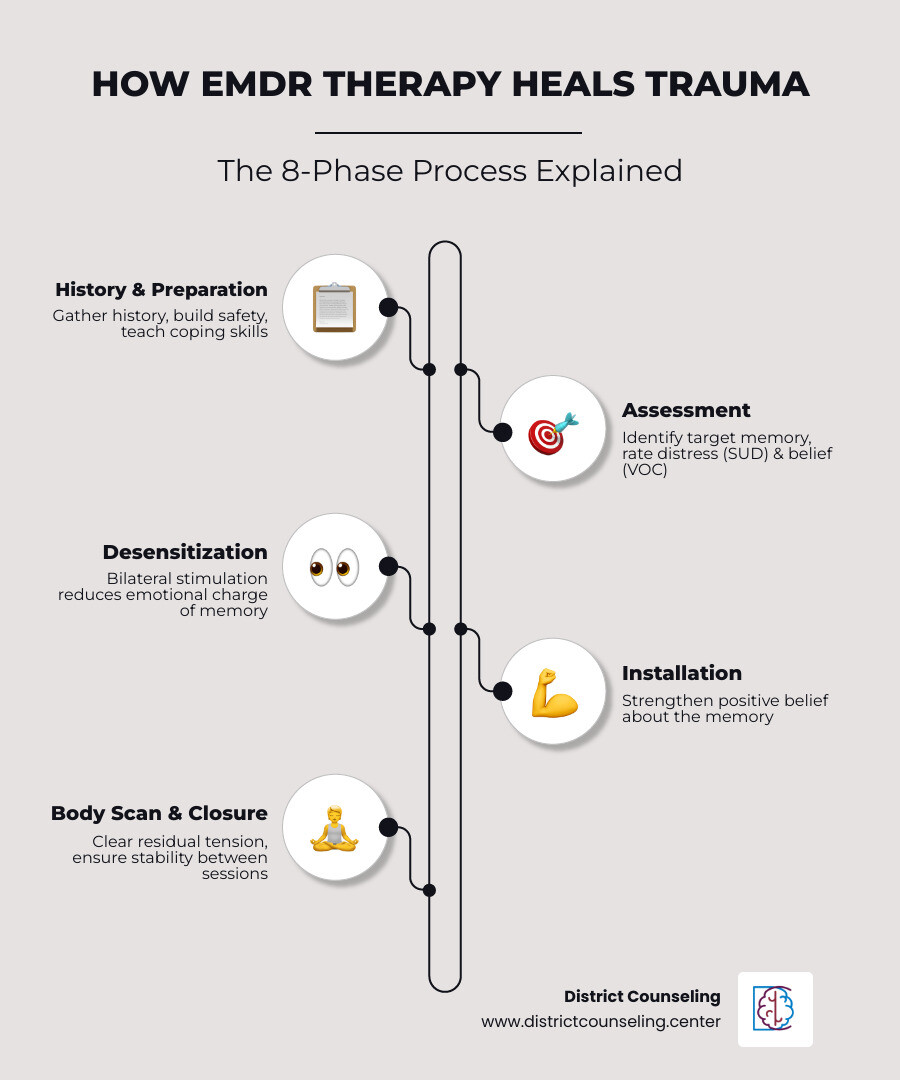
One common misconception is that EMDR is just “waving fingers in front of someone’s face.” In reality, the bilateral stimulation is only one part of a rigorous, eight-phase protocol designed to ensure safety and lasting results.

Phase 1 and 2: Foundation and Safety
We don’t dive into the deep end on day one.
- Phase 1: History-Taking. We look at your past, current triggers, and what you want your future to look like. We identify “targets”—the specific memories or situations we want to process.
- Phase 2: Preparation. This is where we build your “emotional toolbox.” We teach you self-calming techniques, such as the “Safe/Calm Place” exercise. We ensure you have the coping skills to handle the emotional intensity that can arise during processing.
At District Counseling, we prioritize this stabilization. For example, our Emdr Treatment in Austin focuses heavily on ensuring clients feel grounded before the heavy lifting begins.
Phase 3 through 6: The Processing Core
This is where the actual “reprocessing” happens.
- Phase 3: Assessment. We pick a target memory and identify the negative belief associated with it (e.g., “I am powerless”). We also identify a positive belief you’d rather have (e.g., “I am in control now”).
- Phase 4: Desensitization. This is the bilateral stimulation phase. You focus on the memory while following the therapist’s fingers or listening to tones. We use the SUD (Subjective Units of Disturbance) scale (0–10) to track how much the memory still hurts. The goal is to get that number to zero.
- Phase 5: Installation. Once the distress is gone, we strengthen that positive belief using the VOC (Validity of Cognition) scale (1–7), helping you feel the truth of your new perspective.
- Phase 6: Body Scan. We check for any lingering physical tension. If your chest feels tight when thinking of the memory, we process that until your body feels completely calm.
Phase 7 and 8: Integration and Growth
- Phase 7: Closure. Every session ends with you feeling better than when you started, or at least stable and safe. We provide “containment” techniques to help you manage any thoughts that come up between sessions.
- Phase 8: Re-evaluation. At the start of the next session, we check in. Is the memory still neutral? Have new insights emerged? Our Emdr Treatment in Fort Worth and other locations use this phase to ensure the healing is sticking.
Why EMDR is the Gold Standard for PTSD
The numbers behind trauma EMDR therapy are nothing short of remarkable. Research indicates that 84%–90% of single-trauma victims no longer have PTSD after only three 90-minute sessions. For those with more complex histories, the success rates remain high: 100% of single-trauma victims and 77% of multiple-trauma victims were free of a PTSD diagnosis after just six 50-minute sessions.
Even for combat veterans—who often face the most stubborn forms of PTSD—77% were found to be free of the disorder in just 12 sessions. This is why organizations like the American Psychological Association list it as a conditionally recommended treatment for PTSD.
Benefits of Trauma EMDR Therapy for Children and Adults
One of the most beautiful aspects of EMDR is its versatility. It is highly effective for:
- Developmental Trauma: Healing the wounds of childhood neglect or “attachment” issues.
- Phobias: Desensitizing the irrational fear of spiders, heights, or flying.
- Grief: Helping the brain process the “stuck” reality of a devastating loss.
For our Spanish-speaking community in Texas, we offer Tratamiento Emdr to ensure that language is never a barrier to trauma recovery.
Conditions Treated Beyond PTSD
While EMDR is famous for treating PTSD, it has proven effective for a wide range of other conditions where “stuck” memories or negative beliefs play a role. These include:
- Anxiety and Panic Attacks
- Depression
- OCD (Obsessive-Compulsive Disorder)
- Chronic Pain
- Eating Disorders
- Addiction and Substance Abuse
If you are in the Katy area, our Emdr Treatment in Katy specialists can help you determine if EMDR is the right tool for your specific symptoms.
Comparing EMDR to CBT and Prolonged Exposure
When choosing a trauma therapy, you’ll likely hear about CBT (Cognitive Behavioral Therapy) and PE (Prolonged Exposure). While all are effective, EMDR offers a very different experience.
| Feature | EMDR | CBT / PE |
|---|---|---|
| Homework | None required | Extensive (worksheets, exposure tasks) |
| Talking | Minimal detail needed | Detailed trauma narrative required |
| Focus | Memory storage & brain processing | Changing thoughts & behavior |
| Speed | Often faster for single events | Generally takes longer (12–16+ sessions) |
Unlike CBT, which requires you to logically challenge your thoughts, or PE, which requires you to tell your trauma story over and over again until you “habituate” to it, EMDR focuses on the brain’s internal associations. It’s less about talking and more about processing.
Why EMDR is Often Faster
EMDR is often faster because it bypasses the need for long-winded verbal explanations. By using bilateral stimulation, it taps into the neurobiological “fast track” for healing. Instead of spending months talking about the problem, we go straight to the source of the problem in the brain.
In many cases, a memory that has caused decades of pain can be “cleared” in 1–3 sessions of active processing. For those in the Cypress area, our Emdr Treatment in Cypress can provide a more accelerated path to relief compared to traditional talk therapy.
Practical Considerations: Sessions, Risks, and Finding Help
A typical EMDR session lasts between 60 and 90 minutes. During this time, you and your therapist will work through the phases mentioned above. The bilateral stimulation might involve watching a light bar, holding “tappers” that vibrate in your hands, or listening to alternating tones in headphones.
Potential Risks and Side Effects
While EMDR is safe, it is “work.” Some people experience:
- Emotional Intensity: You are looking at a hard memory, so you might feel sad or angry during the session.
- Vivid Dreams: As your brain continues to process the information at night, you might have more vivid dreams.
- Physical Fatigue: Processing trauma is exhausting! Many clients feel “brain fog” or a need for a nap after a session.
This is why Trauma Counseling must always be done with a professional who can help you navigate these temporary side effects.
How to Find a Qualified Clinician
Not all therapists are trained in EMDR. It is a specialized skill that requires specific training through organizations like EMDRIA (EMDR International Association). When looking for a therapist, always ask if they are “EMDR Trained” or “EMDR Certified.”
If you are looking for EMDR Therapists in Fort Worth, TX, ensure they have the credentials to back up their practice.
Frequently Asked Questions about EMDR
How long does EMDR therapy typically take?
As of April 2026, the standard remains 3–6 sessions for a single incident (like a car crash). For complex trauma (like years of childhood abuse), it can take 12 or more sessions. However, many people feel a significant “shift” in their distress levels after just one or two processing sessions. Our Emdr Treatment in Sugar Land team works with you to create a timeline that fits your history.
Is EMDR therapy suitable for children?
Yes! EMDR is highly effective for children and adolescents. Therapists often adapt the protocol using play therapy, drawing, or storytelling. It helps children process scary events before those events become hard-wired into their adult personality. Our Emdr Treatment in Pearland provides specialized care for younger clients.
Can I perform EMDR on myself?
No. While there are “DIY” videos online, this is strongly discouraged by every major health organization. Processing trauma can open up intense emotions and “abreactions” (sudden, overwhelming emotional releases). Without a trained therapist to guide you and provide safety, you risk re-traumatizing yourself. Professional supervision is essential. If you’re in Missouri City, reach out to our Emdr Treatment in Missouri City for safe, guided care.
Conclusion
Trauma doesn’t have to be a life sentence. Whether you are dealing with a recent event or a shadow from your childhood, trauma EMDR therapy offers a scientifically proven path to reclaim your peace of mind. At District Counseling, we are committed to providing sincere, authentic, and compassionate care that aligns with what matters most to you.
We serve communities across Texas—from the Greater Heights and Memorial to The Woodlands and West Lake Hills—offering both in-person and telehealth options. You don’t have to carry the weight of the past forever. Your brain is ready to heal; we’re just here to help it along.
Start your healing journey today and see how EMDR can help you move from surviving to thriving.
Visited 7 times, 1 visit(s) today
Similar Posts

Francisco Ortiz
October 7, 2026
Houston Counseling Options: Find Local Help Nearby
Find affirming counseling in Houston for trauma, LGBTQ+ care, couples, and more. Explore local options and start your healing today....

Francisco Ortiz
October 5, 2026
Why every teacher needs a burnout therapy game plan
Why every teacher needs a burnout therapy game plan – Learn about burnout therapy for teachers...

Francisco Ortiz
October 2, 2026
Child Therapist Near Me? Here is How to Spot a Great One
Find a child therapist near me who fits your child’s needs. Learn signs, costs, and effective therapy options....

Adalid Blandin
September 30, 2026
Mental Health and Miracles: Finding Local Christian Care
Find pastoral counselling near me for faith-based emotional and spiritual support in Texas....

Adalid Blandin
September 28, 2026
Missouri City and Houston Couples Therapy 101
Explore relationship counseling in Houston options, from couples therapy to intensives, with costs, insurance, and therapist tips for Missouri City families....

Adalid Blandin
September 25, 2026
How to find authentic therapy for emotional exhaustion in Houston
Find emotional exhaustion therapy Houston that helps professionals and caregivers move from burnout to renewed energy and balance....

Francisco Ortiz
September 23, 2026
A Practical Guide to Finding Licensed Telehealth Counselors in Texas
Find licensed telehealth counseling in Texas with this guide to legal standards, privacy, insurance, and best practices for virtual care....

Adalid Blandin
September 21, 2026
All About Psychiatric Weight Loss Options and Treatments
Explore psychiatric weight loss options, including medications, therapy, and bariatric support for holistic wellness....

Francisco Ortiz
September 18, 2026
No Traffic, No Waiting Rooms: Your Guide to Telehealth Counseling in Texas
Learn the rules, rights, and benefits of telehealth counseling in Texas with this complete guide to virtual therapy....

Adalid Blandin
September 16, 2026
Why Your Mitochondria Might Be Depressed
Explore metabolic mental health to boost brain energy, ease mood disorders, and support recovery through mitochondria-focused strategies....


