
What Is EMDR Therapy and How Does It Work? A Quick Answer
What is emdr therapy and how does it work is one of the most searched questions in mental health today — and for good reason. Here’s the short version:
EMDR (Eye Movement Desensitization and Reprocessing) is a structured psychotherapy that helps your brain reprocess traumatic memories so they no longer cause emotional distress. It was developed by psychologist Francine Shapiro in the late 1980s and is now recognized by the World Health Organization (WHO), the American Psychological Association (APA), and the U.S. Department of Veterans Affairs.
How it works, in plain terms:
- You briefly focus on a distressing memory
- Your therapist guides your eyes (or uses tapping or sounds) in a rhythmic, side-to-side pattern
- This bilateral stimulation helps your brain “unstick” the memory and process it in a healthier way
- Over time, the memory loses its emotional charge — you remember what happened, but it no longer feels overwhelming
Research backs this up strongly. Studies show 84%–90% of single-trauma survivors no longer meet the criteria for PTSD after just three 90-minute sessions. More than 40 controlled clinical trials support its effectiveness, and over 100,000 clinicians worldwide use it today.
Unlike traditional talk therapy, EMDR doesn’t require you to describe your trauma in detail or complete homework between sessions. The healing comes from your brain’s own natural processing ability — once the blockage is cleared.
I’m Francisco Ortiz, a Licensed Professional Counselor-Supervisor and Certified Forensic Mental Health Evaluator with experience in trauma-informed care, including working directly with individuals whose lives have been shaped by unprocessed traumatic experiences — precisely the population for whom understanding what is emdr therapy and how does it work can be life-changing. In the sections below, we’ll walk through every layer of this evidence-based approach, from the brain science behind it to what actually happens in a session.
What is EMDR Therapy and How Does It Work?
To understand EMDR, we have to go back to 1987. Dr. Francine Shapiro was walking in a park when she noticed that moving her eyes rapidly back and forth seemed to decrease the intensity of her own distressing thoughts. This “aha!” moment led to the development of a therapy that has since helped millions of people worldwide, including many of our neighbors across Texas in cities like Houston, Austin, and Fort Worth.
At its core, EMDR is based on the Adaptive Information Processing (AIP) model. This theory suggests that our brains have a natural capacity to process what happens to us and move toward mental health. However, when a traumatic event occurs, the brain’s information processing system can get overwhelmed. The memory of the event gets “stuck” or frozen in its original, raw state.
When you ask, “what is emdr therapy and how does it work?”, you’re really asking how we unfreeze those memories. In a standard EMDR Treatment in Houston, we use specific protocols to access those frozen memory networks and allow them to finally be processed to an “adaptive resolution.” This means you still remember the event, but the horror, the self-disgust, or the “I’m in danger” feeling is replaced by a sense of “I survived it, and I am strong.” For a deeper look at the clinical foundations, you can explore the EMDR Therapy: Procedure & Effectiveness guide from the Cleveland Clinic.
The Science Behind What is EMDR Therapy and How Does It Work
Neurobiology plays a massive role here. In a healthy brain, the left hemisphere (logical, linguistic) and the right hemisphere (emotional, creative) work together to process experiences. But traumatic memories often get trapped in the right hemisphere and the amygdala—the brain’s alarm system—without the benefit of the left brain’s “it’s over now” logic.
When we engage in bilateral stimulation (like moving your eyes back and forth), we are essentially forcing the two hemispheres to communicate. This helps move the memory from the “emotional” storage area to the “narrative” storage area. It’s like moving a stack of messy, terrifying polaroids into a neat, organized photo album. This process of cognitive restructuring happens naturally during the sessions as the brain makes new connections. If you’re looking for specialized care in the Mid-Atlantic region, EMDR Therapy in Washington, DC is another great resource for understanding these mechanisms.
The Adaptive Information Processing (AIP) Model
Think of the AIP model like your body’s ability to heal a physical wound. If you cut your hand, your body immediately begins to close the wound. However, if a piece of glass or a splinter is stuck in that cut, the wound will fester and won’t heal. It’s not that your body can’t heal; it’s that there is a block in the way.
Psychological trauma works the same way. The traumatic memory is the “splinter.” It prevents your mind from closing the emotional wound. EMDR doesn’t “fix” you; it simply removes the splinter (the mental block) so your brain’s natural healing system can do its job. We find that once that block is removed, healing can happen surprisingly fast—sometimes in weeks rather than the years often required by traditional talk therapy.
The Eight Phases of the EMDR Treatment Process

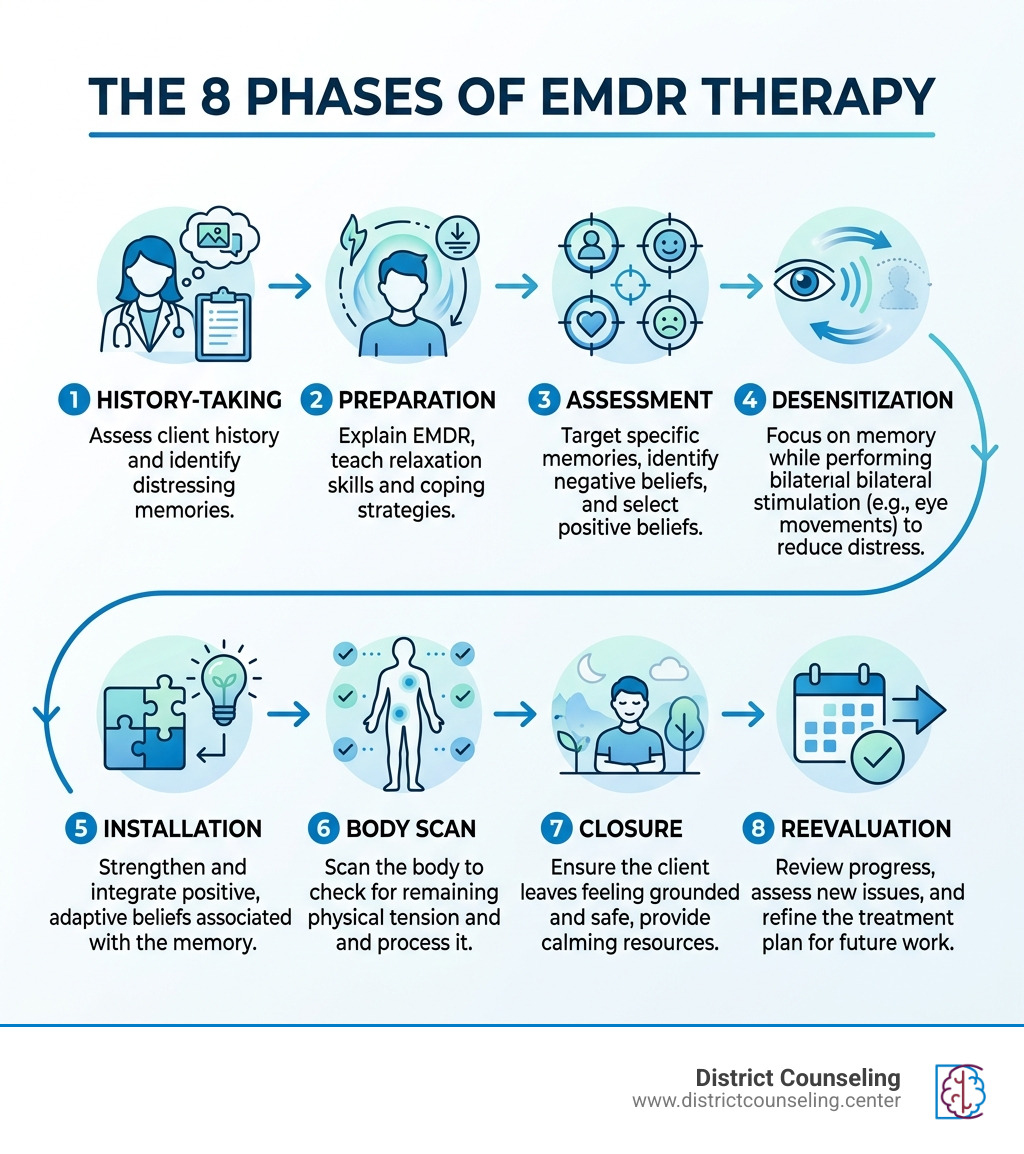
EMDR is not just about waving fingers in front of someone’s face. It is a highly structured, eight-phase approach. Whether you visit us for EMDR Treatment in Austin or any of our other Texas locations, we follow these specific steps to ensure safety and effectiveness.
Phase 1 through 3: Preparation and Target Identification
The first three phases are all about laying the groundwork. We don’t jump into the “heavy stuff” immediately.
- Phase 1: History-taking. We look at your past, your current triggers, and your goals for the future. We identify specific “targets”—distressing memories or situations—to work on.
- Phase 2: Preparation. This is crucial. We teach you coping skills and stabilization techniques. You learn how to use “Safe Place” imagery or “Container” exercises to handle any emotional distress that might come up. We want you to feel in control.
- Phase 3: Assessment. We “activate” the target memory by identifying the visual image, the negative belief (like “I am powerless”), the emotions, and the physical sensations associated with it.
For those in North Texas, our EMDR Treatment in Fort Worth focuses heavily on this preparation to ensure every client feels supported before moving into reprocessing.
Phase 4 through 8: Reprocessing and Integration
This is where the “work” of EMDR happens.
- Phase 4: Desensitization. This is the phase most people think of. While you focus on the memory, we use bilateral stimulation (eye movements, taps, or tones). We continue until your distress level drops to zero or near zero.
- Phase 5: Installation. We “install” a positive belief (like “I am in control now”) to replace the old negative one.
- Phase 6: Body Scan. We check if there is any lingering tension in your body. If you feel a knot in your stomach when thinking of the memory, we process that until it’s gone.
- Phase 7: Closure. We ensure you feel stable and balanced before you leave the session.
- Phase 8: Reevaluation. At the start of the next session, we check in to see how the processing has continued and if we need to address new material.
Our team at EMDR Treatment in Katy uses these phases to help clients move from “surviving” to “thriving.”
Bilateral Stimulation: The Engine of Emotional Healing
Bilateral stimulation is the “secret sauce” of EMDR. It simply means stimulating the brain in a rhythmic, left-right-left-right pattern. While eye movements are the most common form, they aren’t the only option. We also use auditory tones (through headphones) or tactile pulsars (small devices you hold that vibrate gently).
This dual attention stimulus is powerful because it keeps you “grounded” in the present moment while you briefly visit the past. It prevents you from becoming overwhelmed by the memory. For those struggling with mood disorders, EMDR Therapy for Depression often uses these techniques to break the cycle of negative rumination.
Why Eye Movements Mimic Natural Sleep Cycles
There is a fascinating theory that EMDR mimics the mechanisms of REM (Rapid Eye Movement) sleep. During REM sleep, your brain processes the events of the day and consolidates memories. EMDR may be “jump-starting” that same process while you are awake. By engaging the prefrontal cortex and calming the amygdala, we allow the brain to sort through traumatic data and file it away correctly. You can read more about how this compares to other techniques in our post on Exploring EMDR and Brainspotting for Anxiety.
Alternatives to Visual Tracking
Not everyone likes following a finger or a light bar with their eyes. Some people find it tiring or distracting. That’s okay! We offer several alternatives:
- Tactile Pulsars: Small handheld devices that pulse gently in a left-right rhythm.
- Hand Tapping: The therapist (or the client) taps rhythmically on the hands or knees.
- Audio Tones: Beeps or soft music that alternates between the left and right ears. We always tailor the method to what feels most comfortable for you.
Who Can Benefit? Conditions and Clinical Effectiveness
EMDR was originally designed for PTSD, but its applications have grown significantly over the last 33 years. If you’re in the Pearland area, our EMDR Treatment in Pearland helps individuals with a wide range of challenges.
The statistics are truly eye-opening:
- 84%-90% of single-trauma victims no longer have PTSD after just three 90-minute sessions.
- 100% of single-trauma victims and 77% of multiple-trauma victims are free of a PTSD diagnosis after six 50-minute sessions.
- 77% of combat veterans were free of PTSD in 12 sessions.
Real-World Results: What is EMDR Therapy and How Does It Work for PTSD?
For someone with PTSD, the past is constantly intruding on the present. Flashbacks, nightmares, and “snapping” at loved ones are common. EMDR helps “digest” these memories so they stay in the past. As noted in the What is EMDR therapy? – Harvard Health article, EMDR is a proven method for healing from even the most persistent traumatic memories, including those from war, assault, or childhood abuse.
Beyond Trauma: Anxiety, Depression, and OCD
We also see incredible results with:
- Panic Attacks and Phobias: Reprocessing the first time you had a panic attack can often stop the cycle.
- Performance Anxiety: Helping athletes or public speakers overcome “the yips” or stage fright.
- Chronic Pain: Addressing the emotional component of physical pain.
- Eating Disorders and Addiction: Reprocessing the underlying traumas that often drive these behaviors.
Our EMDR Treatment in Sugar Land often works with clients who don’t have a “major” trauma but are struggling with “small-t” traumas—like a bad breakup or workplace bullying—that still impact their daily lives.
Comparing EMDR to CBT and Traditional Talk Therapy
People often ask us, “How is this different from regular counseling?” The main difference is that EMDR is non-verbal and accelerated.
| Feature | EMDR Therapy | CBT (Cognitive Behavioral Therapy) |
|---|---|---|
| Focus | Memory reprocessing via brain stimulation | Challenging thoughts and changing behaviors |
| Homework | Rarely required | Frequent (worksheets, exposure tasks) |
| Talking | Minimal detail required | Extensive discussion of thoughts/events |
| Speed | Often faster for trauma (3-12 sessions) | Longer-term (12-20+ sessions) |
| Mechanism | Physiological (brain-based) | Cognitive (thought-based) |
If you are in Missouri City, our EMDR Treatment in Missouri City provides a space where you don’t have to talk through every painful detail if you don’t want to. The brain does the heavy lifting.
Why EMDR Often Works Faster
In talk therapy, you are often using your “thinking brain” to try and convince your “emotional brain” to feel better. That’s a slow process. EMDR goes straight to the “emotional brain” (the limbic system). By accessing these networks directly, we can achieve breakthroughs in three sessions that might take three years in talk therapy. As the Eye Movement Desensitization and Reprocessing center notes, this structured approach is designed for rapid relief.
Choosing the Right Modality for Your Needs
Is EMDR right for everyone? Not necessarily. Some people prefer the verbal processing of talk therapy. However, if you feel “stuck,” or if you find yourself saying, “I know logically I’m safe, but I don’t feel safe,” EMDR might be the missing piece. You can learn more about how we integrate these approaches at EMDR & Trauma Therapy.
Safety, Side Effects, and Finding a Qualified Provider

EMDR is very safe, but it is “work.” Because we are opening up old memory networks, you might experience some temporary side effects.
- Vivid Dreams: As your brain continues to process the information at night.
- Emotional Sensitivity: You might feel a bit “raw” or emotional for a day or two after a session.
- Lightheadedness: Some people feel a bit “floaty” immediately after reprocessing.
These are actually signs that the therapy is working! It means your brain is busy filing things away.
What to Expect After a Session
After a session, we recommend “low-demand” activities. Don’t go straight from a deep EMDR session to a high-stress board meeting if you can help it. We teach our clients grounding exercises—like the “5-4-3-2-1” technique—to stay present if they feel a bit “loopy” after a session.
How to Identify a Certified EMDR Therapist
It is vital that you work with a licensed professional who has specific training in EMDR. Look for therapists who are members of EMDRIA (the EMDR International Association). This ensures they have completed the rigorous training and consultation required to practice safely. For those in the Fort Worth area, What is EMDR Therapy? – Fort Wellness offers great insights into finding qualified care.
Frequently Asked Questions about EMDR
How many sessions of EMDR are typically required?
For a single-incident trauma (like a car accident), many people see significant relief in 3 to 6 sessions. For complex or “developmental” trauma (like childhood neglect or multiple combat tours), it may take 8 to 12 sessions or more. Sessions are typically 60 to 90 minutes long.
Is EMDR therapy safe for children and adolescents?
Yes! We often use “Storytelling EMDR” or more creative approaches for kids. It is highly effective for attachment trauma and childhood fears. You can find more information about pediatric trauma care at EMDR & Trauma Therapy.
Can EMDR be performed through telehealth?
Absolutely. In April 2026, virtual EMDR has become a standard offering. We use specialized screen-sharing software that provides a visual light bar for you to follow on your screen, or we guide you through self-tapping. It is just as effective as in-person therapy when done correctly.
Conclusion
At District Counseling, we believe that no one should have to live trapped in the shadows of their past. Whether you are in Houston, Cypress, The Woodlands, or West Lake Hills, our mission is to provide sincere, authentic, and compassionate care that aligns with what matters most to you.
Understanding what is emdr therapy and how does it work is the first step toward a life where your memories are just memories—not monsters. If you’re ready to clear the “splinters” and let your mind heal, we are here to help. Explore our EMDR Treatment services today and take the first step toward a brighter, lighter future. We serve clients across the entire Houston metro area, including Pasadena, Spring, Tomball, and beyond. Your healing journey starts here.
Visited 6 times, 1 visit(s) today


Similar Posts

Francisco Ortiz
October 19, 2026
Why therapy for caregiver exhaustion is a necessity not a luxury
Find relief with exhaustion therapy for caregivers. Learn how clinical support heals burnout and restores your well-being....

Francisco Ortiz
October 16, 2026
Navigating Neuropsychological Evaluations from Katy to Pasadena
Learn how an ADHD evaluation for Houston teens works, from medication management to school accommodations and 504 plans....

Francisco Ortiz
October 14, 2026
How Texas caregivers can beat exhaustion with virtual therapy
Beat caregiver exhaustion therapy Texas caregivers trust—virtual sessions for stress, boundaries, and recovery. Start today....

Francisco Ortiz
October 12, 2026
Find Local Youth Counselor: How They Can Help Your Teen Thrive (52 characters)
Find a qualified youth counselor near me to help your teen thrive with evidence-based support for anxiety, trauma, and more....

Francisco Ortiz
October 9, 2026
Faith-Based Pastoral Counseling: A Comprehensive Guide
Discover how pastoral counseling integrates faith and psychology for holistic healing, grief, trauma, and marital support....

Francisco Ortiz
October 7, 2026
Houston Counseling Options: Find Local Help Nearby
Find affirming counseling in Houston for trauma, LGBTQ+ care, couples, and more. Explore local options and start your healing today....

Francisco Ortiz
October 5, 2026
Why every teacher needs a burnout therapy game plan
Why every teacher needs a burnout therapy game plan – Learn about burnout therapy for teachers...

Francisco Ortiz
October 2, 2026
Child Therapist Near Me? Here is How to Spot a Great One
Find a child therapist near me who fits your child’s needs. Learn signs, costs, and effective therapy options....

Adalid Blandin
September 30, 2026
Mental Health and Miracles: Finding Local Christian Care
Find pastoral counselling near me for faith-based emotional and spiritual support in Texas....

Adalid Blandin
September 28, 2026
Missouri City and Houston Couples Therapy 101
Explore relationship counseling in Houston options, from couples therapy to intensives, with costs, insurance, and therapist tips for Missouri City families....


