
Can Your Therapist Actually Diagnose Your ADHD
What It Really Means When You Ask “Can a Therapist Diagnose ADHD”
Can a therapist diagnose ADHD? The short answer depends on what kind of therapist you’re seeing and what state you’re in.
Here’s a quick breakdown:
| Professional | Can Diagnose ADHD? | Can Prescribe Medication? |
|---|---|---|
| Psychiatrist (MD) | Yes | Yes |
| Clinical Psychologist (PhD/PsyD) | Yes | No (in most states) |
| Licensed Professional Counselor (LPC) | Sometimes (state-dependent) | No |
| Licensed Clinical Social Worker (LCSW) | Sometimes (state-dependent) | No |
| Licensed Marriage & Family Therapist (LMFT) | Sometimes (state-dependent) | No |
| Primary Care Physician | Yes | Yes |
| Nurse Practitioner | Yes | Yes |
Most people assume their therapist can simply tell them whether they have ADHD. But the reality is more complicated — and getting it wrong can delay real treatment, affect insurance coverage, and shape your entire mental health journey.
ADHD affects roughly 4.4% of U.S. adults, and many cases go unrecognized well into adulthood, especially in women. Yet the path to an official diagnosis is rarely straightforward, particularly when psychiatrists are scarce. More than two-thirds of U.S. counties have no practicing psychiatrist at all.
I’m Francisco Ortiz, a Licensed Professional Counselor-Supervisor with experience in psychological assessment and mental health care — including helping clients navigate the question of can a therapist diagnose ADHD within the real-world limits of licensing and scope of practice. In the sections below, I’ll walk you through exactly who can diagnose ADHD, what a proper evaluation looks like, and how to build the right care team for your situation.
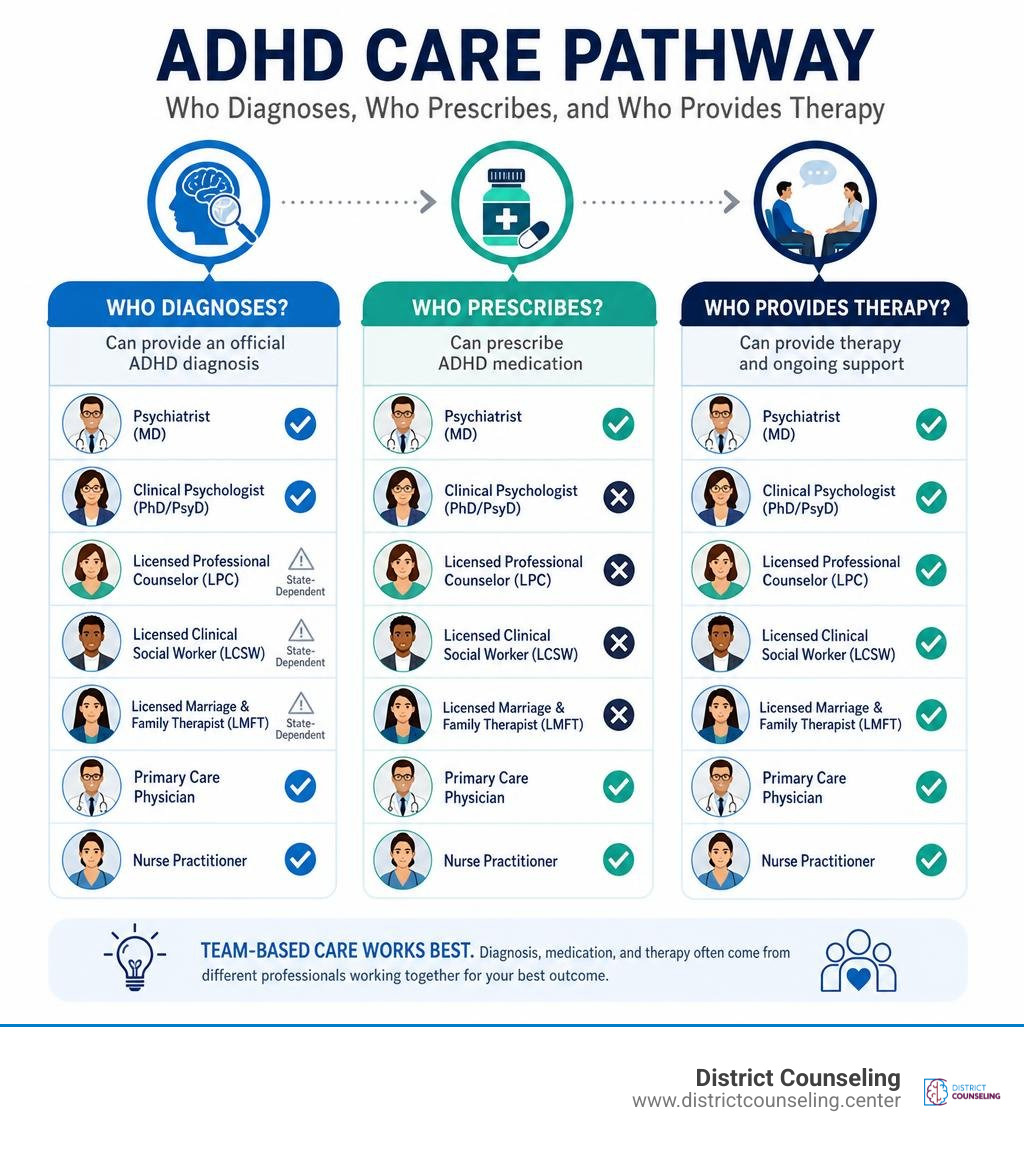
Can a Therapist Diagnose ADHD? Legal and Professional Boundaries
When you sit on a therapy couch trying to figure out why your keys are in the freezer and your self-esteem is in the basement, it is natural to look across at your therapist and ask, “Do I have ADHD?” But whether that professional can hand you an official, legally recognized diagnosis is a complex question.
As explored in Can Therapists Diagnose ADHD? Professional Roles Explained, there is a massive difference between a therapist recognizing ADHD patterns and having the legal authority to write a formal diagnosis into your permanent medical record.
In the United States, diagnostic authority is determined by state licensing boards and scope-of-practice laws. While medical doctors (like psychiatrists) and doctoral-level psychologists have universal diagnostic authority across all states, master’s-level therapists operate under a patchwork of regional regulations.
The Licensing Paradox: Can a Therapist Diagnose ADHD Under State Law?
To understand if your therapist can diagnose you, we have to look at their specific letters (credentials) and the laws of your state. For our clients in Texas—spanning from Houston and Katy to Austin and Fort Worth—the Texas Behavioral Health Executive Council (TBHEC) sets strict guidelines.
- Clinical Psychologists (PhD or PsyD): These doctoral-level professionals have full authority in all states to diagnose ADHD. They utilize specialized psychological testing batteries to measure cognitive functioning, attention, and executive processing.
- Licensed Professional Counselors (LPCs), Licensed Clinical Social Workers (LCSWs), and Licensed Marriage and Family Therapists (LMFTs): In Texas, these master’s-level clinicians are legally permitted to diagnose mental and emotional disorders, including neurodevelopmental conditions like ADHD, using the DSM-5-TR. However, there is a catch. To learn more about how these roles differ across other conditions, check out Can Therapists Diagnose Mental Illness? Understanding Roles.
This brings us to the “Licensing Paradox.” While a Texas LPC or LCSW may legally write a diagnosis of ADHD in your therapeutic record, many insurance companies, schools, and prescribing physicians (like psychiatrists or primary care doctors) will not accept a master’s-level diagnosis on its own.
If your ultimate goal is to obtain academic accommodations or start stimulant medication, a physician or school board may require a comprehensive psychological evaluation performed by a clinical psychologist or a medical assessment by a psychiatrist.
Why Some Clinicians Hesitate: What to Do When You Ask “Can a Therapist Diagnose ADHD?” and Get a No
If master’s-level therapists in Texas legally can diagnose ADHD, why do so many refuse to do so? If you ask your therapist for a diagnosis and they hesitate, it is usually due to one of three reasons:
- Ethical Boundaries and Competence: The professional code of ethics dictates that a clinician must only practice within their boundaries of competence. If a therapist has not received advanced training in neurodevelopmental screening, standardized rating scales, and differential diagnosis, they are ethically obligated to refer you to a specialist.
- The Complexity of Adulthood: ADHD does not exist in a vacuum. By the time an adult realizes they might have ADHD, they have often accumulated decades of coping mechanisms, trauma, chronic stress, or sleep disorders. A therapist may feel that your symptoms require a deep-dive cognitive assessment to rule out other issues—making a simple clinical impression insufficient. For a closer look at this dynamic, see Why Your Adult Brain Might Need an ADHD Evaluation.
- The Medication Limitation: Therapists cannot prescribe medication. If a therapist knows that you are seeking pharmacological support, they may prefer to refer you directly to a prescribing medical professional to avoid making you pay for two separate diagnostic processes.
The ADHD Evaluation Process vs. Standard Therapy
A common point of confusion is assuming that a standard weekly therapy session is the same thing as an ADHD evaluation. It isn’t. Standard therapy is designed for processing emotions, developing coping strategies, and working through relational issues. An ADHD evaluation is a structured, scientific investigation designed to gather objective data.
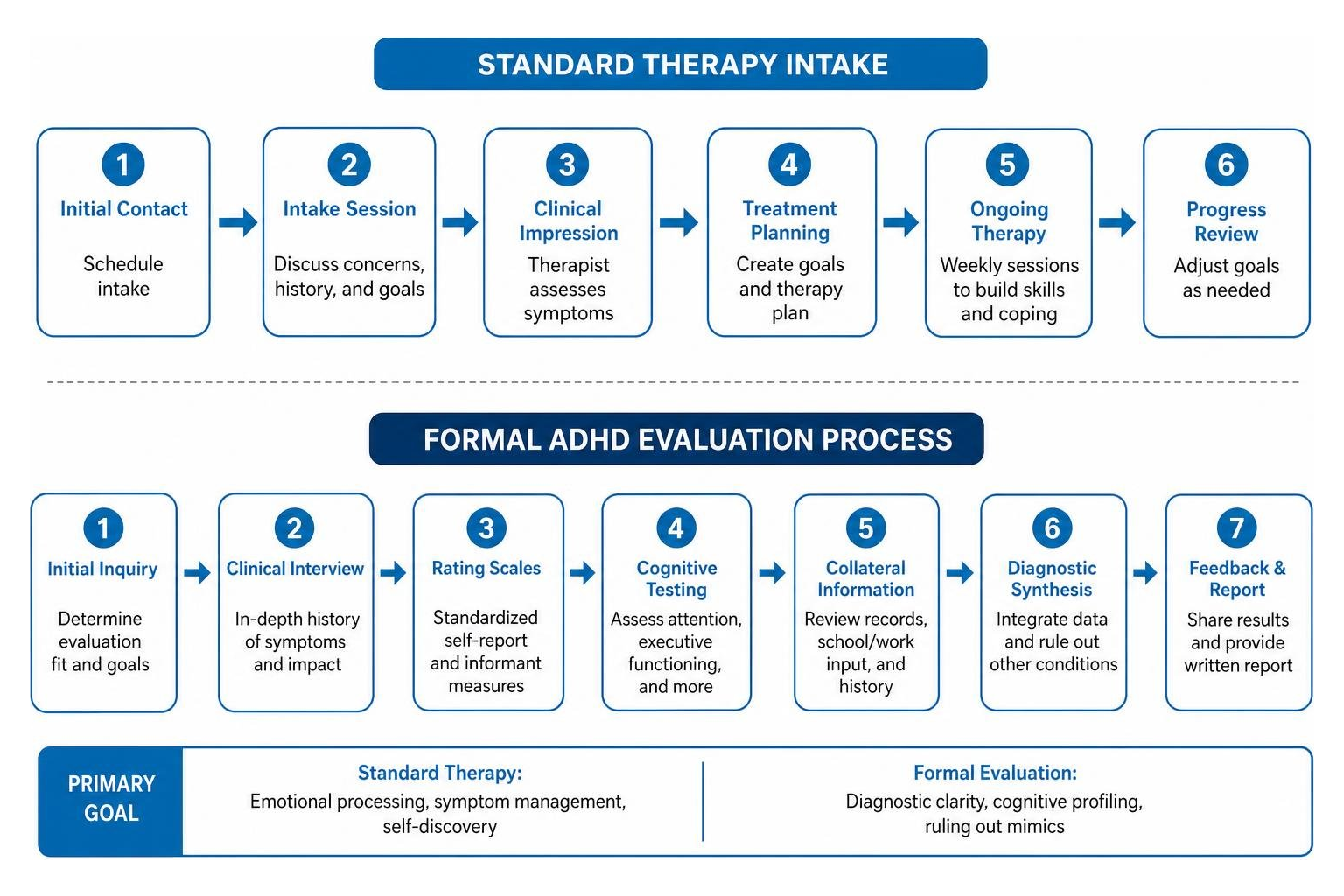
Here is how a standard therapy session compares to a formal diagnostic evaluation:
| Feature | Standard Therapy Session | Formal ADHD Evaluation |
|---|---|---|
| Primary Goal | Emotional processing, symptom management, self-discovery | Diagnostic clarity, cognitive profiling, ruling out mimics |
| Structure | Conversational, client-led, fluid | Standardized, clinician-led, highly structured |
| Time Commitment | 50 minutes weekly or bi-weekly | 2 to 8+ hours across multiple appointments |
| Tools Used | Clinical discussion, worksheets, behavioral tracking | Standardized rating scales, cognitive tests, multi-informant reports |
| Output | Progress notes, personalized coping strategies | Comprehensive written diagnostic report with recommendations |
What a Comprehensive ADHD Evaluation Actually Involves
A proper ADHD evaluation is rigorous. If a provider offers you an ADHD diagnosis after a brief 15-minute conversation, that is a major red flag. According to the DSM-5-TR, a comprehensive evaluation must prove that symptoms have persisted for at least six months, were present before the age of 12, and cause significant impairment in two or more settings (such as at home, work, or in social environments).
At District Counseling, our structured evaluations are designed to meet these high clinical standards. If you are looking for a detailed roadmap of what to expect, we recommend reviewing our Ultimate Checklist for Adult ADHD Testing as well as our guide on ADHD Evaluation for Children, Teens and Adults in Texas.
A thorough assessment typically includes:
- A Deep Clinical Interview: We discuss your developmental, academic, occupational, and medical history.
- Standardized Rating Scales: Tools like the Conners Adult ADHD Rating Scales (CAARS) or the Brown Executive Function/Attention Scales help us compare your symptoms against normative data.
- Multi-Informant Reports: Because ADHD is a life-long developmental condition, gathering collateral information from a partner, parent, or close friend helps paint an accurate picture of how your symptoms present to the outside world.
The Risks of Misdiagnosis and Self-Diagnosis
With the rise of social media, self-diagnosis has skyrocketed. While online videos can be incredibly validating, relying entirely on self-diagnosis or an inadequate screening carries significant risks. Many mental health conditions mimic or co-occur with ADHD.
For instance, chronic trauma (PTSD), generalized anxiety, major depression, bipolar disorder, and even physical conditions like thyroid imbalances or sleep apnea can cause severe executive dysfunction, brain fog, and restlessness.
Treating secondary anxiety or depression without addressing the underlying ADHD is like mopping the floor around a running faucet. Conversely, taking stimulant medication for “ADHD” when your primary issue is actually untreated trauma or bipolar mania can severely worsen your symptoms. To see how top self-screeners compare to clinical tools, read our breakdown of the ADHD Symptoms Test: A Comparison of Top Online Screeners.
Alternative Paths: Getting Diagnosed Without a Psychiatrist
If you cannot find or afford a psychiatrist, do not panic. You do not necessarily need to see one to get an official ADHD diagnosis and begin treatment.
As outlined in Who Treats ADHD or ADD? Doctors, Psychologists, & More, several alternative medical and psychological professionals can step in.
- Primary Care Physicians (PCPs): Your family doctor can diagnose ADHD and prescribe medication. However, many PCPs have limited psychiatric training and may feel uncomfortable diagnosing adult ADHD without a referral report from a psychologist.
- Psychiatric Nurse Practitioners (PMHNPs): These specialized nurse practitioners are excellent options. They can perform diagnostic assessments, provide therapy, and prescribe medication, often with shorter wait times than traditional psychiatrists.
- Clinical Psychologists: While they cannot prescribe medication in Texas, a psychologist’s comprehensive diagnostic report is considered the “gold standard.” You can take this report directly to your PCP or a PMHNP to establish a medication plan. To understand the legal limits of what different clinicians can do, see Can a Therapist Diagnose You? ADHD, Autism & Depression.
Navigating the Cost and Wait Times of ADHD Testing
One of the biggest hurdles to getting help is the financial and logistical strain. Private neuropsychological testing can cost thousands of dollars out-of-pocket, and waitlists for specialized clinics can stretch out for six months or longer.
At District Counseling, we believe that seeking answers shouldn’t break your bank or your spirit. We offer structured, affordable testing options across our Texas locations, including Houston, Cypress, and Katy.
To help you plan financially, we have broken down the expenses in our guide, Breaking Down the Average Cost of ADHD Testing Without Losing Your Mind. If you are tempted to put off your assessment, consider reading about The Hidden Cost of Waiting for an ADHD Evaluation to understand how delayed answers can impact your career and relationships.
The Therapist’s Role in Post-Diagnosis Care and Coordination
Once you receive an official diagnosis, the journey is only half over. Medication can help level the chemical playing field, but it does not teach you how to manage your time, organize your space, or heal from years of feeling “lazy.” This is where your therapist becomes your most valuable asset.
Post-diagnosis therapy focuses on:
- Cognitive Behavioral Therapy (CBT) for ADHD: Rebuilding your relationship with productivity and self-worth.
- Executive Function Coaching: Developing concrete, personalized systems for calendar management, task initiation, and emotional regulation.
- Processing Late-Diagnosis Grief: Many adults experience a wave of grief for the life they could have lived had they been diagnosed sooner. Your therapist helps you process this transition.
If you are currently feeling overwhelmed by chronic executive dysfunction, read our survival guide on How to Recover from ADHD Burnout Without Losing Your Mind and explore our ADHD Treatment and Interventions Guiding Principles for Personalized Care in Cypress, Texas.
Frequently Asked Questions about ADHD Diagnosis
How long does a formal ADHD evaluation typically take?
A comprehensive ADHD evaluation is not a single, rapid appointment. It typically takes anywhere from 2 to 8 hours spread across multiple sessions. The process involves a thorough intake interview, several standardized testing questionnaires, and a follow-up feedback session where your clinician explains the results and hands you a written report.
If you want a step-by-step breakdown of how this process unfolds, check out How to Get Tested for ADHD in 7 Simple Steps and learn about our structured ADHD Psychological Evaluation services.
What should I do if my therapist suspects ADHD but cannot diagnose it?
If your therapist suspects ADHD but does not have the diagnostic scope, specialized training, or resources to provide a formal evaluation, they should act as your “care navigator.” You should ask them for a direct referral to a trusted clinical psychologist, psychiatric nurse practitioner, or primary care physician.
Your therapist can also provide a clinical summary of your sessions to your new evaluator, ensuring your care is coordinated and seamless. For more on how to identify the right medical professional for this next step, read What Kind of Doctor Can Diagnose ADHD? | Psych Central and explore Can Therapists Diagnose ADHD? Scope, Assessment & Referrals.
Can I use an online screener to diagnose my ADHD?
No. While online screeners and self-tests are excellent tools for building self-awareness and starting a conversation with a professional, they are not legally or clinically valid diagnostic tools.
An online quiz cannot perform a differential diagnosis to rule out mimicking conditions like sleep disorders, trauma, or thyroid issues. To understand what actual clinical screeners look like and how they are used by professionals, see Everything You Need to Know About an Adult ADHD Symptoms Test.
Conclusion
Understanding whether can a therapist diagnose adhd is the first step toward getting the clear, validated answers you deserve. While the mental health system can feel incredibly complex, you do not have to navigate it alone.
At District Counseling, we provide compassionate, authentic, and highly professional psychological evaluations and therapeutic support across Texas. Whether you are in Houston, Katy, Cypress, Austin, Fort Worth, or Pearland, our team is here to align with what matters most to you. We also offer bilingual services, which you can learn more about through our ADHD Evaluation (Spanish) page.
Stop wondering and start moving forward. Contact us today to Schedule an ADHD Evaluation and take the first step toward reclaiming your focus and peace of mind.
Visited 94 times, 3 visit(s) today



Similar Posts

Francisco Ortiz
October 19, 2026
Why therapy for caregiver exhaustion is a necessity not a luxury
Find relief with exhaustion therapy for caregivers. Learn how clinical support heals burnout and restores your well-being....

Francisco Ortiz
October 16, 2026
Navigating Neuropsychological Evaluations from Katy to Pasadena
Learn how an ADHD evaluation for Houston teens works, from medication management to school accommodations and 504 plans....

Francisco Ortiz
October 14, 2026
How Texas caregivers can beat exhaustion with virtual therapy
Beat caregiver exhaustion therapy Texas caregivers trust—virtual sessions for stress, boundaries, and recovery. Start today....

Francisco Ortiz
October 12, 2026
Find Local Youth Counselor: How They Can Help Your Teen Thrive (52 characters)
Find a qualified youth counselor near me to help your teen thrive with evidence-based support for anxiety, trauma, and more....

Francisco Ortiz
October 9, 2026
Faith-Based Pastoral Counseling: A Comprehensive Guide
Discover how pastoral counseling integrates faith and psychology for holistic healing, grief, trauma, and marital support....

Francisco Ortiz
October 7, 2026
Houston Counseling Options: Find Local Help Nearby
Find affirming counseling in Houston for trauma, LGBTQ+ care, couples, and more. Explore local options and start your healing today....

Francisco Ortiz
October 5, 2026
Why every teacher needs a burnout therapy game plan
Why every teacher needs a burnout therapy game plan – Learn about burnout therapy for teachers...

Francisco Ortiz
October 2, 2026
Child Therapist Near Me? Here is How to Spot a Great One
Find a child therapist near me who fits your child’s needs. Learn signs, costs, and effective therapy options....

Adalid Blandin
September 30, 2026
Mental Health and Miracles: Finding Local Christian Care
Find pastoral counselling near me for faith-based emotional and spiritual support in Texas....

Adalid Blandin
September 28, 2026
Missouri City and Houston Couples Therapy 101
Explore relationship counseling in Houston options, from couples therapy to intensives, with costs, insurance, and therapist tips for Missouri City families....


