
What Most Adults Don’t Know About ADHD Testing (And Why It Matters)
Adult ADHD testing is a multi-step clinical process used to determine whether your symptoms of inattention, impulsivity, or restlessness meet the diagnostic criteria for ADHD — and it’s the only reliable way to know for sure.
Here’s what the process typically involves:
- Screening — A validated self-report tool like the ASRS helps identify symptoms worth investigating
- Clinical interview — A licensed professional reviews your symptom history, childhood onset, and daily functioning
- Collateral information — Input from a partner, family member, or colleague adds important context
- Differential diagnosis — Other conditions like anxiety, depression, and sleep disorders are ruled out
- Formal diagnosis — Based on DSM-5 criteria, a licensed psychologist or psychiatrist makes the final call
Here’s a surprising fact: roughly 4.4% of U.S. adults have ADHD — yet most of them are living with it completely undiagnosed. That means millions of people are struggling with missed deadlines, relationship strain, and mental exhaustion without ever knowing why.
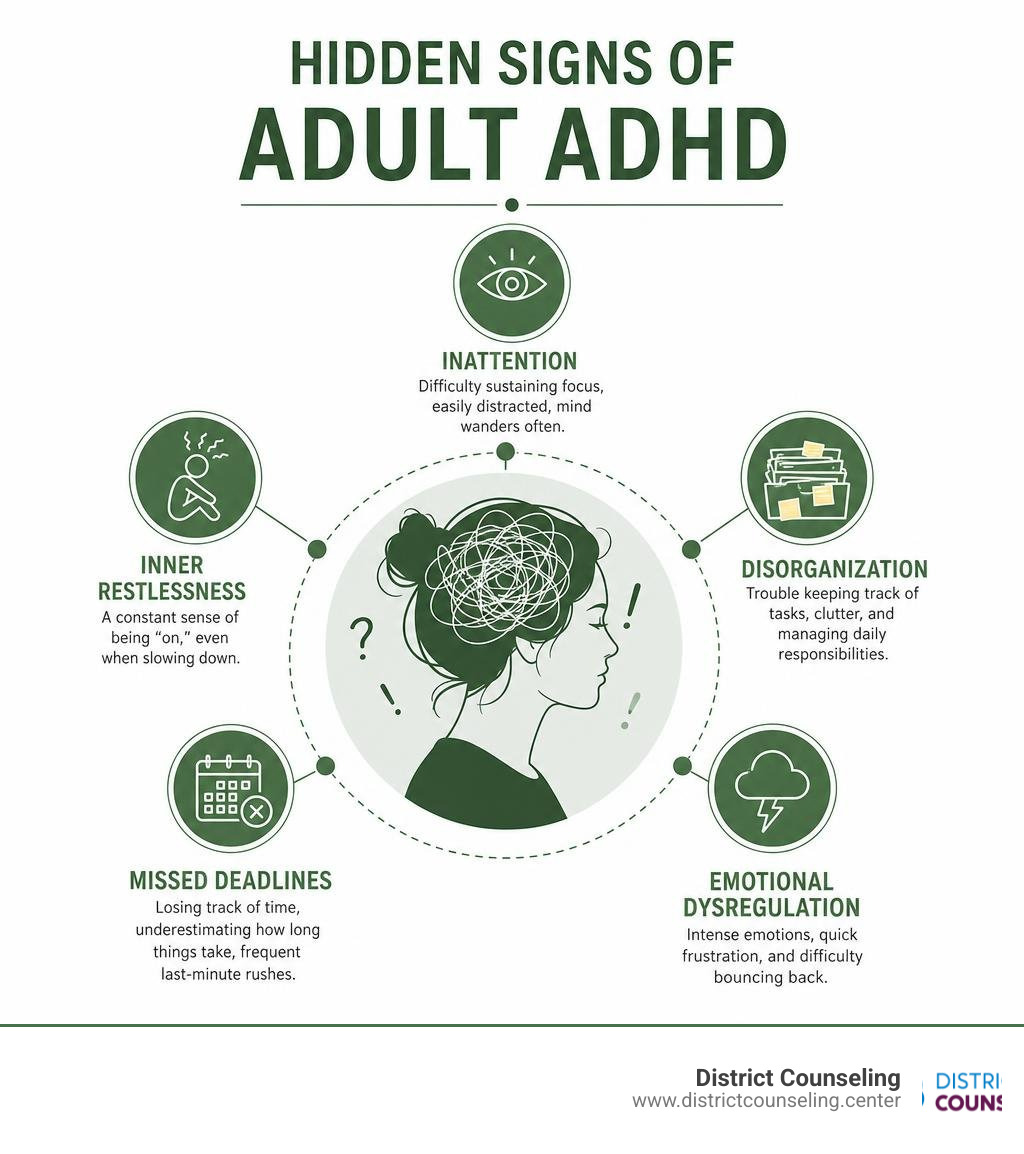
Adult ADHD doesn’t always look like the restless, distracted kid in the back of a classroom. In adults, it often shows up quietly — as chronic disorganization, an inability to finish tasks, or a nagging feeling that you’re always falling behind no matter how hard you try.
The problem? Those symptoms overlap with anxiety, depression, burnout, and a dozen other conditions. Without proper testing, it’s easy to misattribute what’s really going on.
I’m Francisco Ortiz, Licensed Professional Counselor-Supervisor and Certified Forensic Mental Health Evaluator at District Counseling, and my background in psychological assessment directly informs how I approach adult ADHD testing — from differential diagnosis to understanding how ADHD intersects with trauma, mood disorders, and legal contexts. In this guide, I’ll walk you through everything you need to know to take the right next steps.
Understanding Adult ADHD: DSM-5 Criteria and Presentation

When we evaluate adults for attention-deficit/hyperactivity disorder (ADHD), we don’t just rely on a hunch or a quick online quiz. We utilize the Diagnostic and Statistical Manual of Mental Disorders, Fifth Edition (DSM-5), which outlines the precise clinical criteria required for an official diagnosis.
According to the DSM-5, while children must exhibit at least six symptoms of inattention and/or hyperactivity-impulsivity, the threshold is lower for adults. Individuals aged 17 and older must present at least five persistent symptoms of inattention, hyperactivity, or impulsivity. These symptoms must have been present for at least six months, must be disruptive to daily life, and must show up in two or more settings (such as at home and in the workplace).
Crucially, the DSM-5 mandates that several symptoms must have been present before the age of 12. Even if you were never formally diagnosed as a child, we must establish a clear developmental pattern showing that your struggles with executive function began during childhood.
If you are constantly asking yourself why your brain seems to struggle with basic tasks that others complete with ease, understanding these formal benchmarks is the first step toward finding answers. To explore this topic in greater depth, you can read our detailed breakdown on Why Your Adult Brain Might Need an ADHD Evaluation.
How Adult ADHD Differs from Childhood Presentation
The classic childhood stereotype of ADHD—the young boy bouncing off the walls, interrupting class, and unable to sit still—rarely matches the reality of adult ADHD. As we age, overt physical hyperactivity often morphs into a chronic state of inner restlessness. You might not be running around your office, but you might feel an intense mental itch, an inability to relax, or a constant urge to fidget during meetings.
In adults, ADHD primarily manifests as a profound deficit in executive functioning. This translates to:
- Chronic disorganization: A desk buried under papers, missed bills, or a digital inbox with thousands of unread emails.
- Severe time blindness: Routinely underestimating how long tasks will take, leading to chronic lateness.
- Emotional dysregulation: Quickness to anger, low frustration tolerance, or intense rejection sensitivity.
Many high-functioning adults manage to fly under the clinical radar for decades by developing complex masking and coping strategies. You might overcompensate by staying up all night to finish projects, using a hyper-rigid system of alarms, or relying on pure anxiety to meet deadlines. While these strategies might keep your career afloat temporarily, they come at a massive cost to your mental health, leading to chronic burnout and delayed diagnoses.
The Clinical Framework of Adult ADHD Testing

A truly comprehensive ADHD evaluation is a highly structured, multi-step clinical process. There is no single medical test, blood draw, or brain scan that can definitively diagnose ADHD. Instead, a licensed psychologist or clinical evaluator must piece together a complex puzzle.
As outlined in the Updated European Consensus Statement on diagnosis and treatment of adult ADHD, clinical interviews remain the gold standard of diagnosis. Neuropsychological tests are highly useful for mapping cognitive strengths and weaknesses, but they only show a 53% to 66% classification accuracy when used in isolation. Thus, our clinical framework relies on a combination of:
- Detailed Clinical Interview: Exploring your current struggles, occupational history, and relationship patterns.
- Developmental History: Gathering retrospective evidence of childhood symptoms.
- Collateral Information: Because our own self-perception can be biased, we often ask for behavioral observations from spouses, partners, parents, or close friends to confirm how symptoms manifest in different settings.
Validated Screening Tools: ASRS and DIVA
To standardize our assessments, we utilize highly validated, peer-reviewed screening tools and diagnostic interviews.
The most common starting point is the Adult ADHD Self-Report Scale (ASRS v1.1), developed in collaboration with the World Health Organization (WHO) and researchers from Harvard Medical School. The ASRS is an 18-item questionnaire that measures the frequency of inattentive and hyperactive symptoms over the past six months. Part A of the ASRS contains the six most predictive questions; if you score highly on four or more of these questions, there is a strong clinical indication that a formal evaluation is warranted. If you want to check your symptoms privately, you can access a ADHD Test Free Online — Adult ASRS & Child SNAP-IV / Vanderbilt.
For the formal clinical interview, we frequently utilize the Diagnostic Interview for ADHD in Adults (DIVA-5). The DIVA-5 is a highly structured tool that systematically guides clinicians through the DSM-5 criteria, providing concrete real-world examples of how symptoms present in both childhood and adulthood.
Why Online Screeners Are Not a Substitute for Professional Adult ADHD Testing
In the age of social media, online ADHD quizzes are everywhere. While a quick 3-minute internet test can be an excellent eye-opener and a great conversation starter with your doctor, it is not a substitute for a professional evaluation.
Self-administered tests have significant limitations:
- High Rate of False Positives: Online quizzes cannot differentiate between ADHD and other conditions that cause focus issues (like severe stress or sleep deprivation).
- Lack of Context: They do not evaluate your developmental history or require collateral evidence.
- No Differential Diagnosis: They cannot rule out co-occurring psychiatric conditions.
Using an unverified quiz to self-diagnose or self-treat can lead to inappropriate interventions. To understand the differences between these tools, read our guide on ADHD Symptoms Test: A Comparison of Top Online Screeners.
Differential Diagnosis and Common Comorbidities
One of the most critical responsibilities of a clinical evaluator is performing a differential diagnosis. This means carefully ruling out or identifying other conditions that mimic or co-occur with ADHD.
For example, did you know that adults with ADHD are nearly three times more likely to experience depression? Furthermore, about 50 percent of adults who meet the criteria for ADHD also meet the criteria for generalized anxiety disorder (GAD), and about a quarter will experience at least one major depressive episode.
To help visualize how these symptoms overlap and differ, look at the clinical comparison table below:
| Symptom / Behavior | ADHD | Generalized Anxiety Disorder | Major Depressive Disorder |
|---|---|---|---|
| Inattention / Distractibility | Constant, driven by a search for stimulation or novelty. | Driven by intrusive worries, fear, and catastrophic thoughts. | Driven by low energy, brain fog, and lack of interest (anhedonia). |
| Restlessness | Physical or mental “itch”; present since childhood across settings. | Muscle tension, somatic worry, and situational dread. | Psychomotor agitation or slowing; episodic rather than lifelong. |
| Sleep Disturbances | Delayed sleep onset (circadian shift in 70% of cases). | Trouble sleeping due to racing thoughts and situational anxiety. | Early morning awakening, hypersomnia, or insomnia during depressive episodes. |
| Origin of Struggles | Chronic, neurodevelopmental (lifelong executive dysfunction). | Episodic or chronic, tied to worry and perceived threats. | Episodic, accompanied by profound sadness or loss of pleasure. |
Beyond mood disorders, sleep is a massive piece of the puzzle. Approximately 70 percent of adults with ADHD suffer from delayed circadian sleep phase disorder. This means their internal biological clock is naturally shifted, making it incredibly difficult to fall asleep before 2:00 AM and equally painful to wake up early. Often, chronic sleep deprivation mimics or severely worsens executive dysfunction, creating a vicious cycle.
Special Populations: Women, Older Adults, and Substance Use
ADHD does not present the same way in everyone. Clinicians must take a highly tailored approach when assessing special populations:
- Women: Women are historically underdiagnosed because they are more likely to present with the inattentive presentation of ADHD. Instead of acting out, they may struggle internally with disorganization, mental fatigue, and deep-seated rejection sensitivity. Many women are misdiagnosed with primary anxiety or depression before their underlying ADHD is recognized.
- Older Adults: As we age, natural cognitive decline can overlap with ADHD symptoms. Evaluating older adults requires careful differentiation between lifelong neurodevelopmental patterns and late-onset cognitive changes.
- Substance Use Disorders (SUD): ADHD is disproportionately common in incarcerated populations (ranging from 25% to 40%) and among individuals struggling with addiction. Many adults self-medicate their understimulated brains with caffeine, nicotine, or illicit substances. When treating patients with a history of SUD, we utilize strict risk-reduction strategies, including detailed treatment agreements and a preference for long-acting or non-stimulant medications.
If you are looking for a comprehensive, neurodiversity-affirming assessment tailored to your unique history, you can learn more about our specialized ADHD Psychological Evaluation services.
Evidence-Based Treatment and Management Strategies
Once a formal diagnosis of adult ADHD is established, the door opens to highly effective, evidence-based treatment options. The goal of treatment is not to change who you are, but to give you the tools and neurological support needed to manage your symptoms and thrive.
Pharmacological Treatments
For many adults, medication is a life-changing component of treatment. There are two primary categories of ADHD medications:
- Stimulants (e.g., Adderall, Ritalin, Vyvanse): These are first-line treatments that increase dopamine and norepinephrine levels in the prefrontal cortex. The efficacy rate for psychostimulant medications in adults with ADHD is incredibly high—90-plus percent. They are highly effective but require careful monitoring of blood pressure, heart rate, and sleep.
- Non-Stimulants (e.g., Strattera, Qelbree, Intuniv): These are excellent alternatives for individuals who do not tolerate stimulants, have co-occurring anxiety, or have a history of substance use. While stimulants work almost immediately, non-stimulant medications can take 2 to 8 weeks to reach full clinical efficacy.
Clinical Monitoring Note: Best practices dictate that after starting any ADHD medication, you should be reassessed within 30 days, followed by monthly check-ins until your dose is stabilized, and then every 3 to 6 months thereafter.
For residents in our local communities, we offer integrated support pathways. You can read about our clinical philosophy in ADHD Treatment and Interventions: Guiding Principles for Personalized Care in Cypress, Texas.
Non-Pharmacological Interventions and Lifestyle Support
Medication can give your brain the “battery power” it needs to focus, but it doesn’t teach you organizational skills. That is where behavioral and lifestyle interventions come in:
- Cognitive Behavioral Therapy (CBT) & Metacognitive Therapy: These targeted therapies help you dismantle negative self-talk, manage emotional dysregulation, and build practical executive functioning skills (like planning, prioritizing, and starting tasks).
- Rigid Lifestyle Routines: Adults with ADHD actually thrive under structured routines. Implementing a “one-touch” system (e.g., putting your keys in the exact same bowl every single day) and keeping physical clutter to a minimum can dramatically reduce daily anxiety.
- Circadian Sleep Hygiene: Setting a consistent wake-up time, using morning light therapy, and incorporating low-dose melatonin in the evenings can help regulate a delayed sleep cycle.
- Regular Exercise: Physical activity naturally boosts dopamine and norepinephrine levels, acting as a natural, short-term primer for your brain’s attention systems.
Step-by-Step Guide: What to Do If You Suspect ADHD
If you suspect you have undiagnosed adult ADHD, you don’t have to suffer in silence or keep spinning your wheels. Here is a practical, step-by-step checklist to guide you from suspicion to clarity:
- Conduct a Preliminary Screen: Start by taking a validated, free self-assessment like the 18-question ASRS.
- Document Your Symptoms: Keep a running log for two weeks. Note instances of forgetfulness, missed deadlines, concentration struggles, or emotional outbursts.
- Gather Historical Clues: If possible, look at old school report cards for teacher comments like “has great potential but lacks focus” or “is easily distracted.” Talk to parents or older siblings about your childhood behaviors.
- Schedule a Consultation: Book an appointment with a licensed mental health professional or psychologist who specializes in adult ADHD. If you are in Texas, you can review our step-by-step walkthrough on How to Get Tested for ADHD in 7 Simple Steps.
- Complete the Evaluation: Participate in the diagnostic interviews and cognitive testing batteries.
- Review Your Custom Report: Go over the findings with your evaluator to understand your cognitive profile and differential diagnoses.
- Build Your Treatment Team: Collaborate with therapists, psychiatrists, or primary care providers to establish a personalized combination of therapy, lifestyle changes, and medication management.
What to Expect During Your Professional Adult ADHD Testing
When you step into a professional clinic for testing, you should expect a thorough, respectful, and validating experience. A typical evaluation at our offices involves:
- The Diagnostic Interview: A deep-dive conversation about your life, career, relationships, and childhood.
- Standardized Battery of Screeners: Completing clinical-grade rating scales.
- Objective Computerized Testing: In many cases, we utilize tools like the QBTest—an FDA-cleared computerized continuous performance test that objectively measures attention, motor activity, and impulse control over a 20-minute span.
Taking the time to complete a professional evaluation is an investment in your future. To understand why delaying this process can be costly to your career and relationships, see our article on The Hidden Cost of Waiting for an ADHD Evaluation.
Frequently Asked Questions About Adult ADHD
Can you be diagnosed with ADHD as an adult if you didn’t have symptoms as a child?
By clinical definition under the DSM-5, ADHD is a neurodevelopmental condition, meaning it must have been present during childhood (specifically before age 12). You cannot suddenly “catch” ADHD as an adult. However, many adults were never diagnosed as children because they were highly intelligent, had highly supportive environments, or presented with the quiet, inattentive subtype. During your evaluation, we will work with you to look back at your childhood and identify subtle, retrospective signs of executive dysfunction that may have been missed.
What other conditions mimic adult ADHD?
Several physical and mental health issues can closely mimic ADHD symptoms. These include generalized anxiety disorder, major depressive disorder, bipolar disorder, borderline personality disorder, thyroid imbalances, chronic vitamin deficiencies, and sleep apnea. Because these conditions require vastly different treatment approaches, a formal clinical evaluation is essential to rule them out. If you want to explore how your symptoms compare to clinical benchmarks, you can check out this ADHD Test for Adults – Free ADD Quiz Online | Freudly.
How long does a professional ADHD evaluation take?
The timeline varies depending on the depth of the assessment. Typically, the clinical interview and testing battery take between 1 to 2 hours of direct face-to-face or virtual time. After the testing is complete, the evaluator scores the instruments, analyzes the objective data, and writes a comprehensive psychological report. At District Counseling, we strive to make this process as efficient and transparent as possible. For residents looking for local evaluations in Texas, you can find detailed timeline and location-specific information in our guide on ADHD Evaluation for Children, Teens and Adults in Texas.
Additionally, we provide localized testing services across our major Texas hubs. If you are located in the capital area, you can learn more about our ADHD Evaluations in Austin, or if you are in the DFW metroplex, you can visit our page for ADHD Evaluations in Fort Worth.
Conclusion
Living with undiagnosed ADHD can feel like running a marathon with weights tied to your ankles. You are putting in twice the effort of everyone else just to stay in the same place. But it doesn’t have to be that way.
Getting tested isn’t about collecting a label; it’s about gaining a roadmap. A formal diagnosis is a protective measure that helps you understand exactly how your brain works, paving the way for self-compassion, workplace accommodations, and highly effective medical and therapeutic treatments.
At District Counseling, we provide advanced counseling, compassionate psychotherapy, and comprehensive psychological evaluations across Texas. Whether you are in Houston, Cypress, Katy, Austin, or Fort Worth, our team is dedicated to offering sincere, authentic, and compassionate care aligned with what matters most to you.
When you are ready to stop guessing and start thriving, take the first step and Schedule an ADHD Evaluation with us today.
Visited 82 times, 1 visit(s) today
Similar Posts

Francisco Ortiz
October 7, 2026
Houston Counseling Options: Find Local Help Nearby
Back-to-School Mental Health: Tips for a Smooth Transition – Discover practical tips to ease back-to-school anxiety for kids, teens, and parents. Build healthy routines, manage stress, and foster emotional… …...

Francisco Ortiz
October 5, 2026
Why every teacher needs a burnout therapy game plan
Why every teacher needs a burnout therapy game plan – Learn about burnout therapy for teachers...

Francisco Ortiz
October 2, 2026
Child Therapist Near Me? Here is How to Spot a Great One
Find a child therapist near me who fits your child’s needs. Learn signs, costs, and effective therapy options....

Adalid Blandin
September 30, 2026
Mental Health and Miracles: Finding Local Christian Care
Find pastoral counselling near me for faith-based emotional and spiritual support in Texas....

Adalid Blandin
September 28, 2026
Missouri City and Houston Couples Therapy 101
Explore relationship counseling in Houston options, from couples therapy to intensives, with costs, insurance, and therapist tips for Missouri City families....

Adalid Blandin
September 25, 2026
How to find authentic therapy for emotional exhaustion in Houston
Find emotional exhaustion therapy Houston that helps professionals and caregivers move from burnout to renewed energy and balance....

Francisco Ortiz
September 23, 2026
A Practical Guide to Finding Licensed Telehealth Counselors in Texas
Find licensed telehealth counseling in Texas with this guide to legal standards, privacy, insurance, and best practices for virtual care....

Adalid Blandin
September 21, 2026
All About Psychiatric Weight Loss Options and Treatments
Explore psychiatric weight loss options, including medications, therapy, and bariatric support for holistic wellness....

Francisco Ortiz
September 18, 2026
No Traffic, No Waiting Rooms: Your Guide to Telehealth Counseling in Texas
Learn the rules, rights, and benefits of telehealth counseling in Texas with this complete guide to virtual therapy....

Adalid Blandin
September 16, 2026
Why Your Mitochondria Might Be Depressed
Explore metabolic mental health to boost brain energy, ease mood disorders, and support recovery through mitochondria-focused strategies....


