
A Practical Guide to Finding Licensed Telehealth Counselors in Texas
Understanding the Legal Standards for Telehealth Counseling Texas
Finding a licensed telehealth counselor in Texas starts with verifying the provider’s credentials through the Texas Behavioral Health Executive Council (BHEC), confirming they use a HIPAA-compliant video platform, and checking whether your insurance or Medicaid plan covers virtual sessions. Once those basics are in place, you can focus on the clinical work itself.
Navigating mental health care across the Lone Star State involves understanding the regulatory safeguards designed to protect you. In Texas, behavioral healthcare providers are governed by the Texas Behavioral Health Executive Council (BHEC), which oversees Licensed Professional Counselors (LPCs), Licensed Marriage and Family Therapists (LMFTs), Licensed Clinical Social Workers (LCSWs), and Licensed Psychologists. State law defines telehealth as the delivery of healthcare services using telecommunications technologies by a licensed professional who is located at a different site than the client.
To protect clinical integrity, Texas statutes require the standard of care in a virtual setting to be identical to that of an in-person session. This means therapists must perform thorough assessments, gather comprehensive clinical histories, and uphold all ethical guidelines. Before therapy begins, providers must establish informed consent tailored to virtual care. This documentation covers critical elements such as:
- The limits of confidentiality when using digital technology.
- Practical benefits and potential risks of remote sessions.
- Clear fee structures, billing codes, and payment methods.
- The right to withhold or withdraw consent at any time without affecting future care.
- Explicit protocols for managing technology failures mid-session.
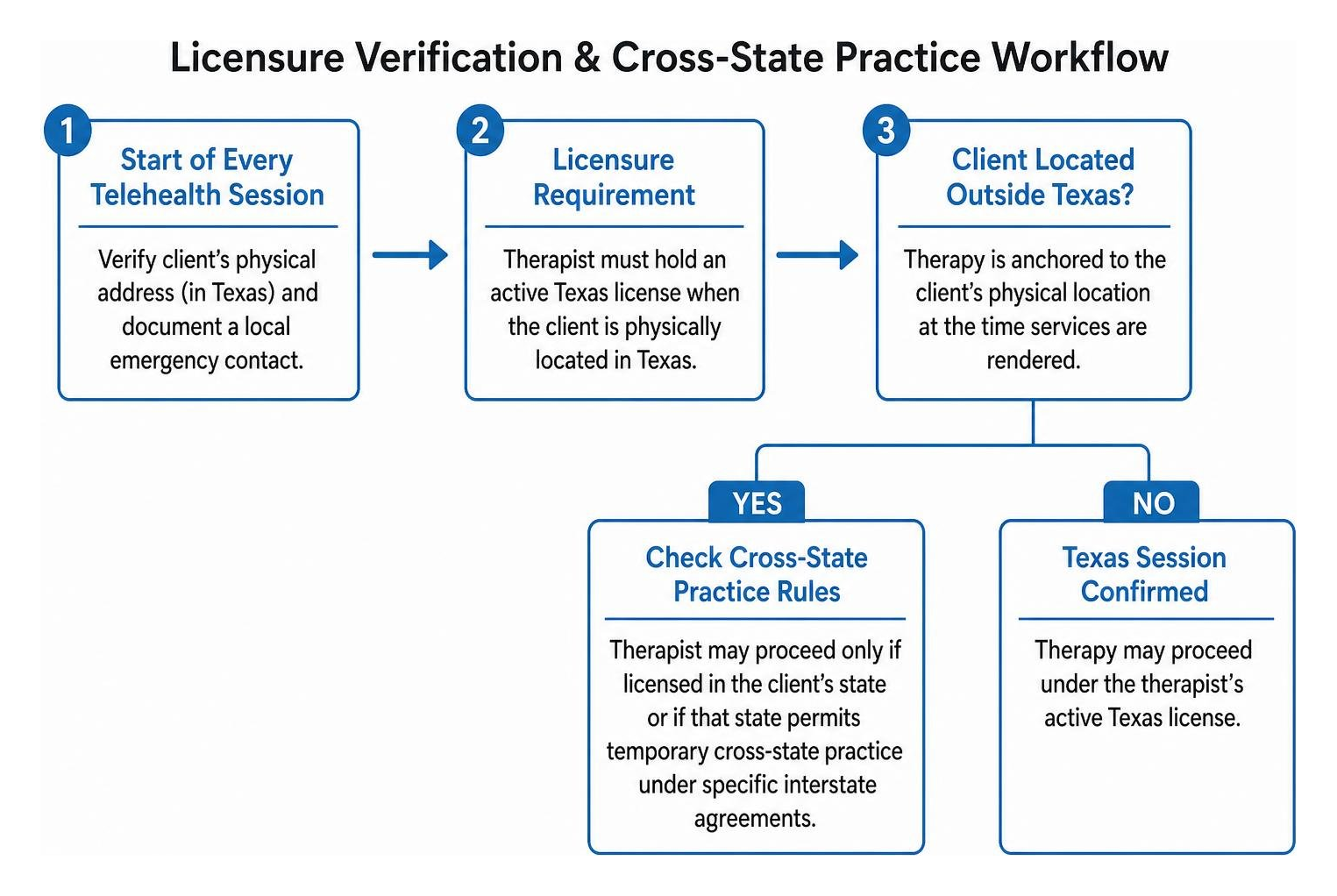
Before starting treatment, working with licensed telehealth therapy providers in Texas helps ensure that all state board requirements are met. Every clinician must verify your physical address at the start of every session and document a local emergency contact. If an urgent clinical crisis occurs, your therapist must know exactly where you are sitting to coordinate immediate local emergency services.
Licensing, Consent, and Cross-State Practice Rules
Under the Texas Occupations Code, the legal jurisdiction of therapy is anchored to the physical location of the client at the time services are rendered. If you are sitting in a living room in Fort Worth, a home office in Pearland, or an apartment in Greater Heights, your provider must hold an active Texas professional license. You can confirm a counselor’s license status through the Texas Behavioral Health Executive Council license search.
Practicing therapy without a state license is prohibited, which creates strict boundaries around cross-state practice. If you are a Texas resident traveling out of state for vacation or temporary business, your therapist generally cannot conduct your session unless they hold a license in your destination state or that state permits temporary cross-state practice under specific interstate agreements. While interstate compacts like the Counseling Compact and PSYPACT are modernizing these processes across the country, Texas clinicians must consistently follow individual state laws to remain fully compliant.
When establishing telehealth counseling in Texas, ethical practices also maintain explicit professional liability coverage for tele-mental health. This guarantees that your care remains legally sound and professionally managed, regardless of which Texas city you call home.
How Telehealth Counseling Texas Standards Protect Client Privacy
Confidentiality remains the cornerstone of effective psychotherapy, and virtual therapy relies on rigorous data protection standards. Federal standards under the Health Insurance Portability and Accountability Act (HIPAA) establish strict administrative, physical, and technical safeguards. Texas adds another layer of security through the Texas Medical Records Privacy Act (often associated with state HB 300), which enforces even stricter privacy protections and penalties than federal law alone.
To comply with these high standards, legitimate practices never conduct clinical sessions over standard consumer video platforms. Instead, we use dedicated, secure tele-mental health software featuring:
- End-to-End Encryption: Audio and video streams are scrambled during transmission, preventing unauthorized interception or recording.
- Business Associate Agreements (BAAs): Legal contracts between the healthcare provider and the technology vendor ensuring the platform meets all HIPAA and state regulatory privacy mandates.
- No Stored Video Data: Standard virtual therapy platforms do not store session recordings, ensuring your vulnerable conversations leave no digital trail on third-party servers.
- Access Controls: Therapists operate from private, soundproof rooms on password-protected, encrypted devices connected to secure networks.
Delivery Modalities and Clinical Best Practices
Building a strong therapeutic relationship online is entirely achievable. Research consistently reveals that the strength of the therapeutic alliance—the shared trust, warmth, and mutual collaboration between client and therapist—is just as robust in virtual care as it is in traditional office settings.
Therapists achieve this by optimizing non-verbal communication, maintaining intentional eye contact through proper camera positioning, and creating a patient, empathetic space. For clients, reviewing guidance on making the most of online sessions can help establish comfortable routines that deepen clinical engagement.
Tele-mental health is delivered across several distinct modalities:
- Synchronous Video Counseling: Real-time, two-way audiovisual communication. This represents the gold standard for remote psychotherapy, allowing both parties to observe micro-expressions, posture, and vocal nuance.
- Audio-Only (Telephone) Therapy: Real-time telephone sessions. This modality is vital for clients in rural areas facing intermittent broadband issues or for individuals who experience screen fatigue.
- Asynchronous Communication: Secure messaging via client portals used exclusively for scheduling, administrative updates, or brief check-ins between formal clinical sessions.
Key Differences Between In-Person and Virtual Sessions
Choosing between in-person therapy and virtual care comes down to lifestyle needs, geographical location, and clinical presentation. The following comparison highlights key differences:
| Clinical & Practical Factors | In-Person Counseling | Telehealth Counseling in Texas |
|---|---|---|
| Travel & Commute | Requires navigating traffic and allocating parking time. | Zero commute; join directly from home or office. |
| Attendance & Consistency | Vulnerable to transit delays and weather disruptions. | Reduces no-show rates by 30% across Texas clinics. |
| Clinical Efficacy | Highly effective across all psychological presentations. | Clinically equivalent for anxiety, trauma, and mood disorders. |
| Access to Specialists | Limited to providers within a reasonable driving radius. | Statewide access to specialized EMDR, couples, and trauma care. |
| Crisis Management | Clinician manages safety directly within the office suite. | Relies on pre-established local emergency protocols. |
For individuals living near local clinics, such as those seeking Copperfield Telehealth Counseling, virtual care offers an easy bridge when balancing work demands, school schedules, and family responsibilities.
Technical Setup and HIPAA-Compliant Platforms
A successful telehealth session relies on clear communication, stable connectivity, and thoughtful preparation. Setting up a dependable virtual environment minimizes distractions and protects your privacy.
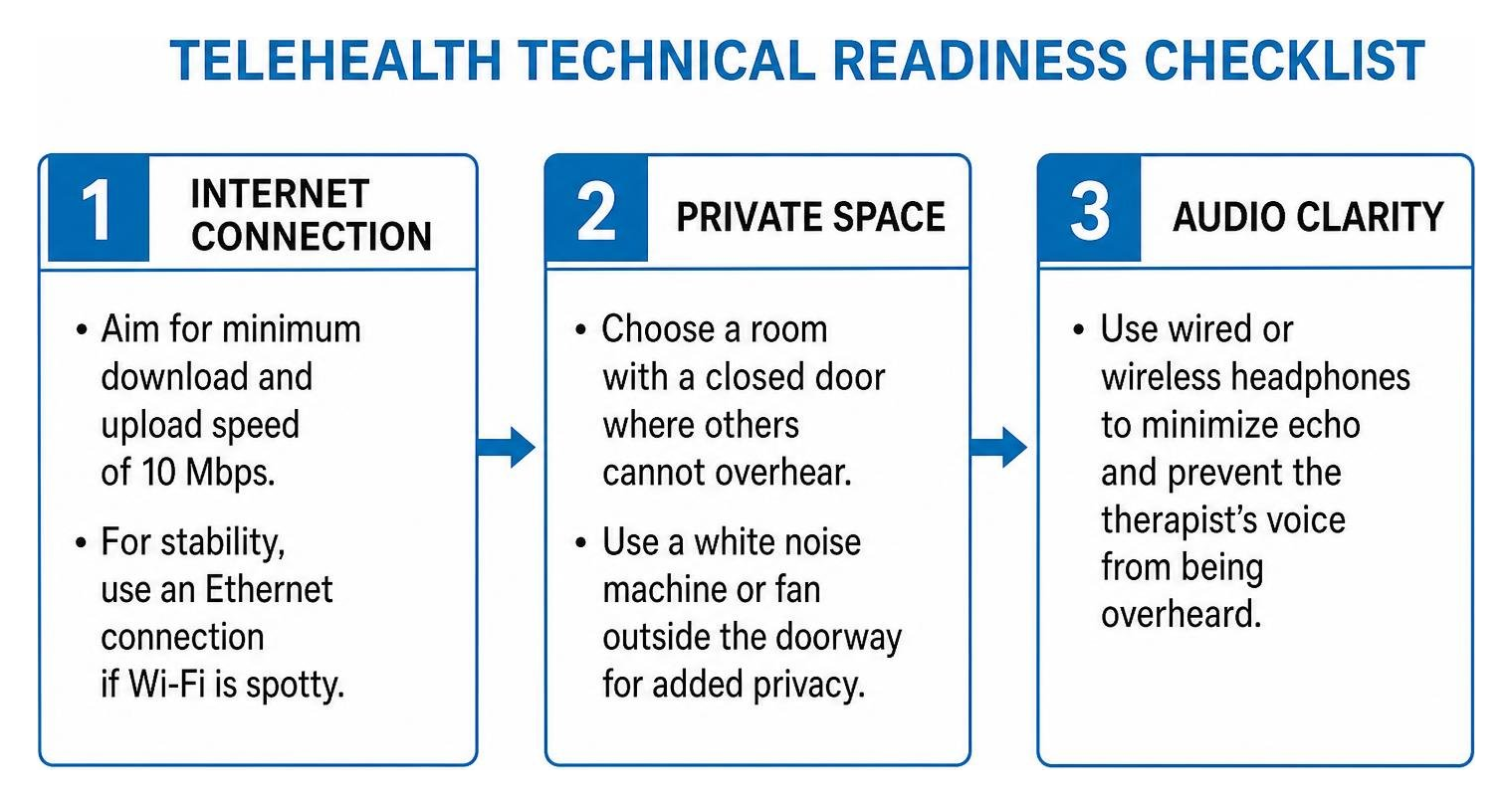
To ensure smooth sessions, keep these practical setup steps in mind:
- Internet Bandwidth: Aim for a minimum download and upload speed of 10 Mbps. If your Wi-Fi is spotty, plugging directly into your router with an Ethernet cable can prevent lag.
- Dedicated Private Space: Choose a room with a closed door where family members, roommates, or coworkers cannot overhear you. Using a white noise machine or fan outside the doorway adds an extra layer of privacy.
- Audio Clarity: Using wired or wireless headphones minimizes room echo and prevents the therapist’s voice from being overheard by others in your home.
- Lighting and Framing: Position light sources in front of you rather than behind you so your therapist can clearly see your facial expressions.
- Secondary Plan: Always confirm a backup phone number with your counselor at the beginning of therapy so they can immediately call you if your internet connection drops.
Whether connecting with virtual mental health services in Austin or signing in from Tomball, having your tech prepared lets you focus entirely on your healing.
Insurance and Medicaid Policies for Remote Care
Navigating behavioral health insurance can sometimes feel overwhelming, but Texas has made substantial strides in expanding coverage for remote therapy. Under the Texas Insurance Code, state-regulated commercial health plans are generally subject to parity laws. These regulations require insurance carriers to cover services delivered via telehealth in a manner comparable to in-person services, provided the treatment is medically necessary and clinically appropriate.
This means copays, deductibles, and coinsurance responsibilities for virtual counseling are typically the same as in-person visits. However, self-funded employer plans (governed by federal ERISA law rather than state statutes) can establish their own benefit limits. Always verify your specific behavioral health benefits before your first appointment.
Insurance and Medicaid Coverage for Telehealth Counseling Texas
Texas Medicaid, administered by the Texas Health and Human Services Commission (HHSC), provides comprehensive support for tele-mental health. Medicaid and associated Managed Care Organizations (MCOs) cover individual psychotherapy, family therapy, and psychiatric diagnostic evaluations provided through interactive audio-video systems.
Key coverage details include:
- Billing Codes: Providers submit standard behavioral health Current Procedural Terminology (CPT) codes (such as 90834 for 45-minute individual therapy or 90837 for 60-minute individual therapy) paired with specific telehealth modifiers (such as 95 or GT) and place-of-service indicators (02 or 10).
- Audio-Only Parity: Texas Medicaid permits reimbursement for audio-only behavioral health services under specific conditions, ensuring that individuals without reliable internet or smart devices can still receive essential care.
- Provider Parity: Licensed mental health professionals enrolled with Texas Medicaid are reimbursed at rates comparable to in-person sessions, which supports a steady network of participating clinicians.
If you are coordinating care in suburban communities like Telehealth Counseling in Katy, working with practices that understand insurance and Medicaid billing processes helps prevent unexpected medical bills.
Overcoming Access Barriers and Navigating Care
Historically, access to specialized mental health support across Texas was limited by geography. Rural regions and smaller communities often faced severe provider shortages. Today, virtual care bridges that gap, connecting clients across the state with experienced clinicians.
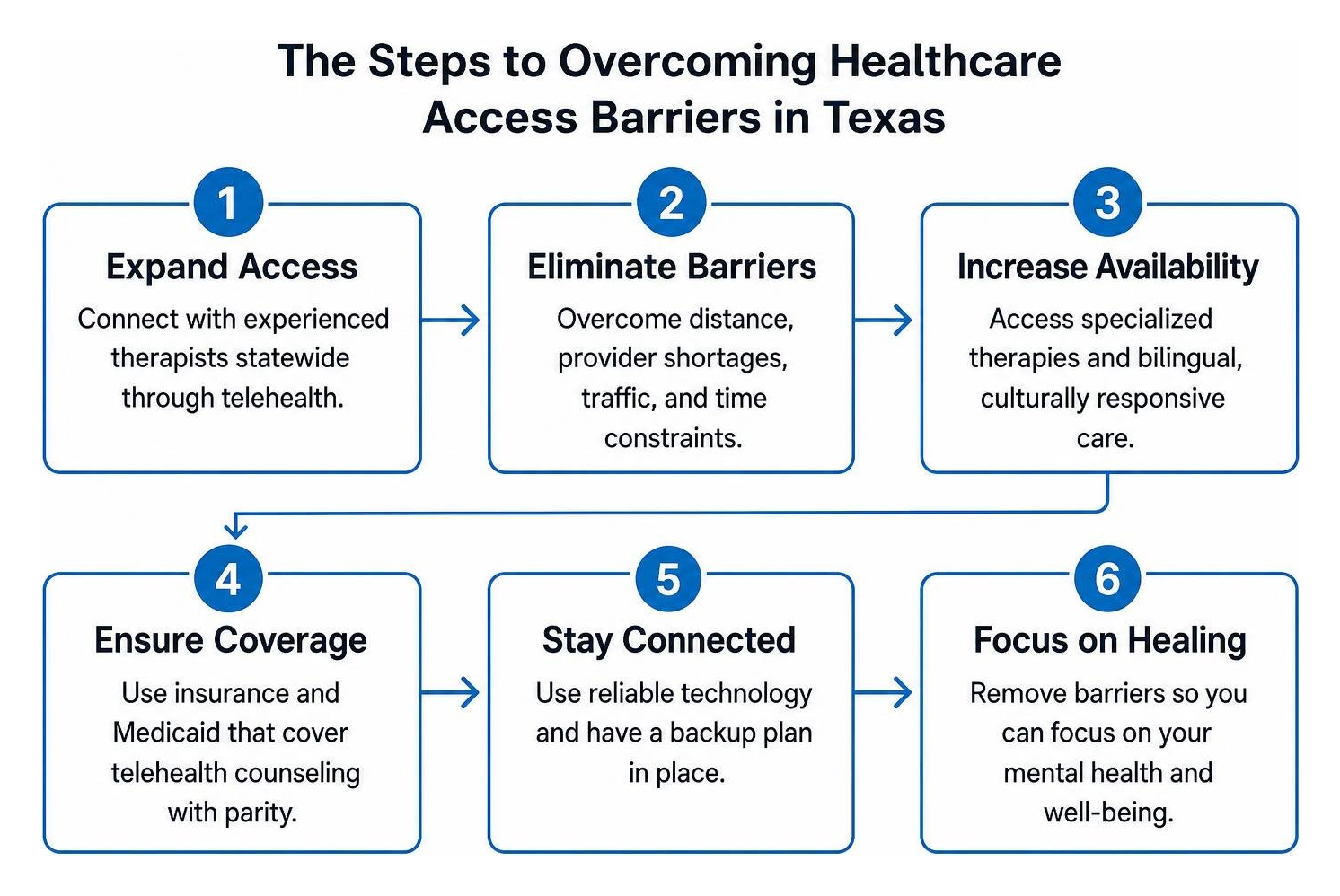
Virtual therapy addresses key care barriers by providing:
- Specialized Modalities: Access trauma therapies like Eye Movement Desensitization and Reprocessing (EMDR), comprehensive psychological evaluations (such as ADHD, autism, or immigration evaluations), and specialized couples therapy without long drives.
- Bilingual Therapy: Spanish-speaking individuals and families can connect with culturally responsive, bilingual clinicians regardless of local provider availability.
- Zero Commute Stress: Eliminating traffic and parking hassles helps keep stress levels low and prevents therapy from feeling like an overwhelming chore.
- Flexible Scheduling: Morning, evening, and lunchtime openings make it easier to maintain treatment consistency without disrupting your work schedule.
For those eager to find support quickly, exploring strategies for navigating online therapy without waitlists can connect you with compassionate care in just a few clicks.
Frequently Asked Questions About Remote Therapy in Texas
Can a Texas counselor provide therapy if I am traveling out of state?
Generally, no. Under state licensing laws, a mental health provider must be legally licensed in the state where the client is physically present at the moment of the session. While some states have temporary practice exemptions or participate in interstate compacts, you should always notify your clinician ahead of time if you plan to travel outside Texas so they can verify state-specific practice laws.
What safety protocols are required for virtual counseling sessions?
Texas licensing boards require clinicians to establish and document safety protocols before or during the initial intake session. These protocols require verifying your exact physical address at the start of every appointment, collecting the name and phone number of an emergency contact located near you, identifying the closest emergency room, and creating a safety plan if you are managing acute distress or crisis situations.
Does Texas Medicaid cover tele-mental health services?
Yes. Texas Medicaid covers a wide array of tele-mental health services, including individual, family, and group psychotherapy, as well as comprehensive diagnostic evaluations. Services delivered via real-time synchronous video are fully covered when medically necessary, and certain audio-only counseling services are also eligible for coverage when technical limitations prevent video use.
Conclusion
Telehealth counseling has transformed mental health care across Texas, replacing traffic jams and crowded waiting rooms with convenient, secure care from the comfort of home. Whether you need support for anxiety, depression, trauma recovery, or relationship challenges, remote counseling provides the same clinical depth and warm connection as an in-office visit.
Our team at District Counseling provides compassionate psychotherapy, advanced EMDR trauma care, couples counseling, and psychological evaluations for individuals and families across Texas. When you are ready to take the next step toward balance and clarity, we invite you to connect with us on the virtual couch and begin your healing journey today.
Visited 7 times, 1 visit(s) today
Similar Posts

Francisco Ortiz
October 9, 2026
Faith-Based Pastoral Counseling: A Comprehensive Guide
Back-to-School Mental Health: Tips for a Smooth Transition – Discover practical tips to ease back-to-school anxiety for kids, teens, and parents. Build healthy routines, manage stress, and foster emotional… …...

Francisco Ortiz
October 7, 2026
Houston Counseling Options: Find Local Help Nearby
Find affirming counseling in Houston for trauma, LGBTQ+ care, couples, and more. Explore local options and start your healing today....

Francisco Ortiz
October 5, 2026
Why every teacher needs a burnout therapy game plan
Why every teacher needs a burnout therapy game plan – Learn about burnout therapy for teachers...

Francisco Ortiz
October 2, 2026
Child Therapist Near Me? Here is How to Spot a Great One
Find a child therapist near me who fits your child’s needs. Learn signs, costs, and effective therapy options....

Adalid Blandin
September 30, 2026
Mental Health and Miracles: Finding Local Christian Care
Find pastoral counselling near me for faith-based emotional and spiritual support in Texas....

Adalid Blandin
September 28, 2026
Missouri City and Houston Couples Therapy 101
Explore relationship counseling in Houston options, from couples therapy to intensives, with costs, insurance, and therapist tips for Missouri City families....

Adalid Blandin
September 25, 2026
How to find authentic therapy for emotional exhaustion in Houston
Find emotional exhaustion therapy Houston that helps professionals and caregivers move from burnout to renewed energy and balance....

Francisco Ortiz
September 23, 2026
A Practical Guide to Finding Licensed Telehealth Counselors in Texas
Find licensed telehealth counseling in Texas with this guide to legal standards, privacy, insurance, and best practices for virtual care....

Adalid Blandin
September 21, 2026
All About Psychiatric Weight Loss Options and Treatments
Explore psychiatric weight loss options, including medications, therapy, and bariatric support for holistic wellness....

Francisco Ortiz
September 18, 2026
No Traffic, No Waiting Rooms: Your Guide to Telehealth Counseling in Texas
Learn the rules, rights, and benefits of telehealth counseling in Texas with this complete guide to virtual therapy....


