
How to Become a Substance Abuse Professional: The Fast, Compliant Path
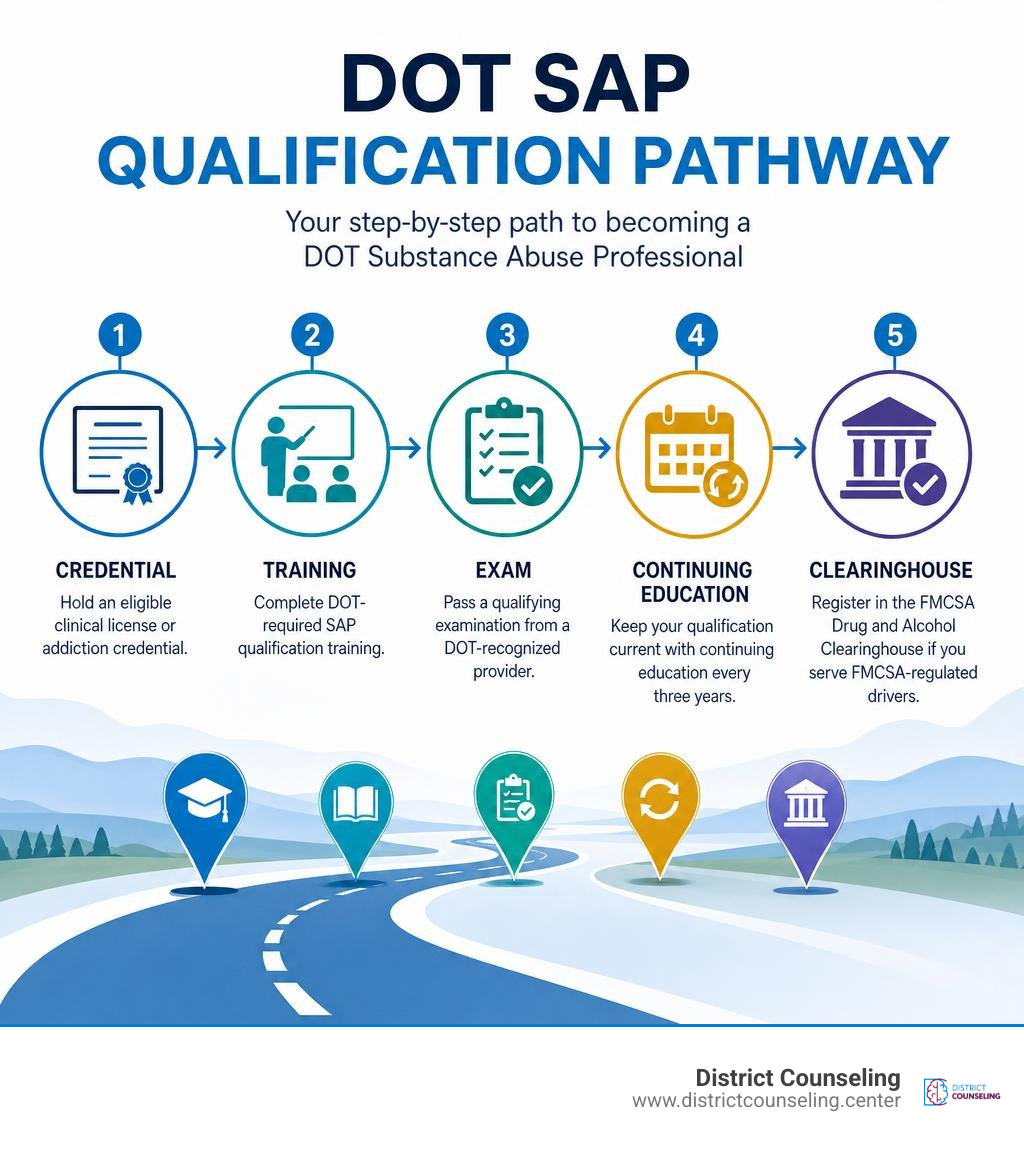
To become a DOT Substance Abuse Professional (SAP), you must first hold an eligible clinical license or addiction credential, complete DOT-required SAP qualification training, and pass a qualifying examination from a DOT-recognized provider. You must then keep your qualification current with continuing education every three years. If you serve FMCSA-regulated drivers, you also need to register in the FMCSA Drug and Alcohol Clearinghouse.
A SAP is not simply an addiction counselor. Under 49 CFR Part 40, a SAP evaluates transportation workers after a DOT drug or alcohol violation, recommends education or treatment, conducts a follow-up evaluation, and creates the required follow-up testing plan. Their decisions can help a qualified employee return to a safety-sensitive role while protecting the public.
For professionals who already hold a qualifying license or credential, the DOT-specific portion can often be completed in weeks. The longer timeline usually comes from earning the prerequisite degree, license, or addiction counseling credential.
I am Francisco Ortiz, LPC-S, CEAP, and a forensic mental health evaluator with experience in clinical assessment, counseling, and employee-assistance work. In this guide to how to become a substance abuse professional, I will break down the DOT pathway, the limits of the SAP role, and the practical steps to stay compliant.
Understanding the Substance Abuse Professional Role and DOT Mandates
Under federal guidelines established by the United States Department of Transportation (DOT), public safety is paramount. When an employee in a safety-sensitive role fails or refuses a drug or alcohol test, they are immediately removed from safety-sensitive duties. They cannot simply return to work after waiting out a suspension. They must successfully complete the Return-to-Duty (RTD) process managed exclusively by a qualified Substance Abuse Professional (SAP).
The governing regulation for this entire ecosystem is 49 CFR Part 40, specifically Subpart O, which outlines the exact responsibilities, boundaries, and ethical limits required of every SAP. The role is unique because a SAP does not act as the employee’s personal therapist, defense advocate, or company representative. Instead, a SAP acts as a neutral evaluator whose primary obligation is to protect public safety while charting a fair, clinically sound path toward recovery.
Understanding Substance Abuse Evaluation Requirements helps clinicians see why this role carries legal weight. The DOT mandates that a SAP conduct face-to-face clinical assessments, determine the appropriate level of education or treatment, track compliance, and formulate an unalterable follow-up testing schedule. To stay aligned with federal standards, practitioners frequently consult the official U.S. Department of Transportation SAP Guidelines to manage complex client cases.
SAP vs. Traditional Addiction Counselor: Key Distinctions
While many SAPs come from an addiction treatment background, the duties and clinical boundaries of a SAP differ fundamentally from standard counseling roles. Traditional addiction counselors focus on ongoing therapeutic rapport, processing trauma, building coping skills, and providing open-ended support. In contrast, a SAP is a regulatory evaluator and gatekeeper.
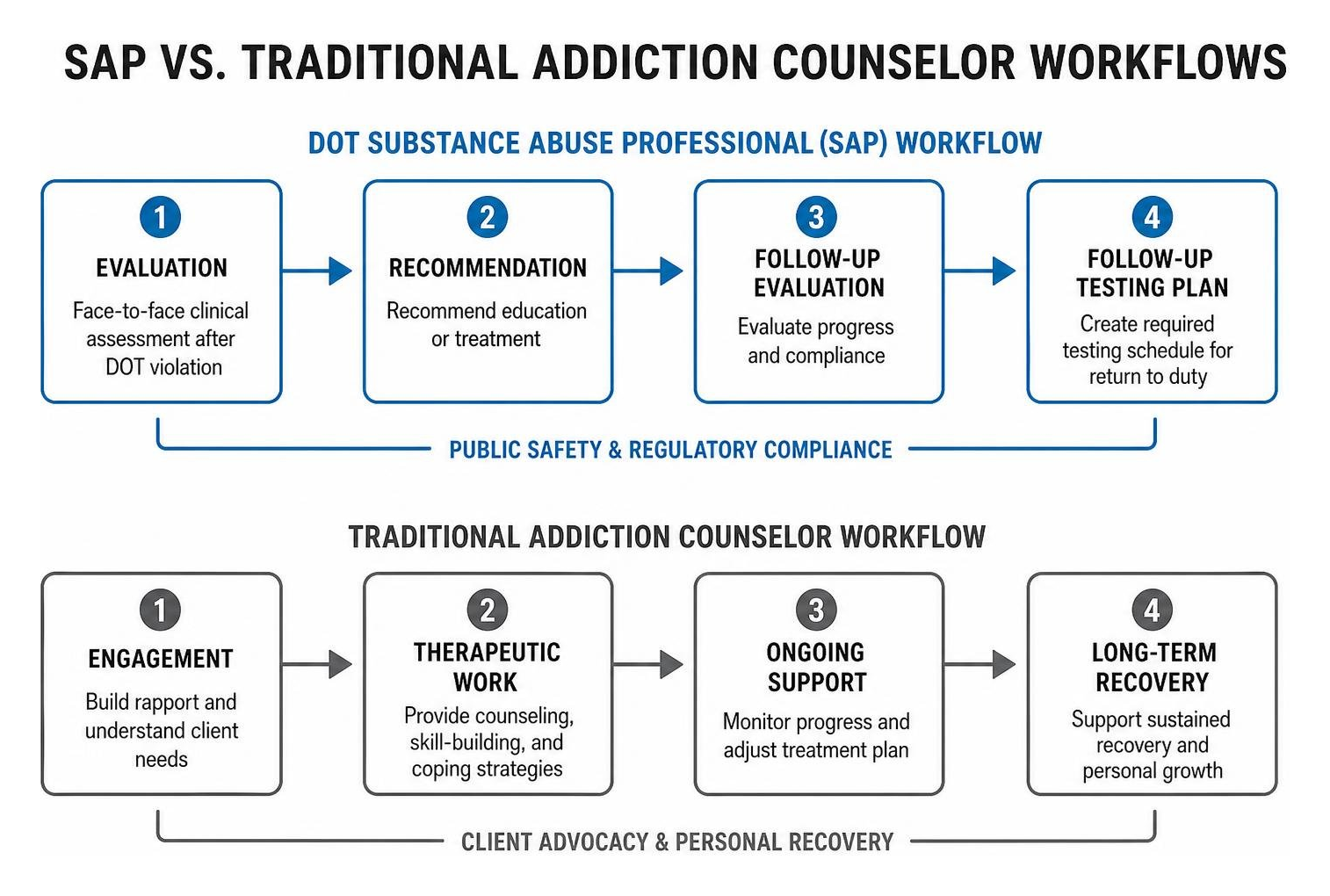
The table below highlights the operational and regulatory differences:
| Operational Area | DOT Substance Abuse Professional (SAP) | Traditional Addiction Counselor (LCDC/CADC) |
|---|---|---|
| Primary Mission | Public safety and regulatory compliance | Client advocacy, healing, and personal recovery |
| Core Function | Objective diagnostic assessment and RTD recommendations | Ongoing psychotherapy, coping skills, and relapse prevention |
| Treatment Provision | Prohibited from providing direct therapy to evaluated clients | Delivers direct individual, group, or family therapy |
| Regulatory Framework | Federal law: 49 CFR Part 40 Subpart O | State behavioral health and licensing boards |
| Key Output | Prescriptive education/treatment plans and follow-up testing schedules | Individualized treatment plans and clinical progress notes |
| Authority | Decides whether an employee is eligible for return-to-duty testing | Supports client recovery milestones and community reintegration |
Under DOT conflict-of-interest regulations, a SAP who performs an initial assessment cannot provide the subsequent education or treatment program directly, nor can they refer the individual to a private practice or program in which they have a financial stake (with narrow exceptions for certain employer-sponsored plans). This guarantees uncompromised objectivity.
Safety-Sensitive Modes and Industry Coverage
The SAP’s authority extends across all transportation sectors regulated by the DOT. When you qualify as a SAP, your evaluations directly impact workers across six distinct operating administrations:
- Federal Motor Carrier Safety Administration (FMCSA): Commercial truck drivers, interstate bus drivers, and hazardous material haulers.
- Federal Aviation Administration (FAA): Commercial pilots, flight attendants, flight dispatchers, and aircraft maintenance personnel.
- Federal Railroad Administration (FRA): Locomotive engineers, conductors, dispatchers, and track maintenance crews.
- Federal Transit Administration (FTA): City bus drivers, light rail operators, and subway operators.
- Pipeline and Hazardous Materials Safety Administration (PHMSA): Pipeline operators, emergency response controllers, and maintenance crews.
- United States Coast Guard (USCG): Commercial vessel captains, engineers, and crew members operating in maritime commerce.
Because a single mistake in any of these roles can result in catastrophic loss of life, the SAP carries significant responsibility when evaluating fitness for duty.
Step-by-Step Guide: How to Become a Substance Abuse Professional

Entering this specialty requires meeting clear prerequisite standards before you can complete qualification training. For clinicians wondering how to become a substance abuse professional, the pathway is structured into four main phases: establishing an eligible clinical license, completing 12 hours of specialized training, passing a national exam, and registering with the appropriate federal clearinghouses.
When conducting a formal DOT SAP Evaluation, clinicians must demonstrate competence across clinical interviewing, psychopharmacology, diagnostic classification, and transportation agency regulations.
Prerequisite Credentials: How to Become a Substance Abuse Professional
You cannot become a SAP without first holding an active, state-approved clinical license or a nationally recognized master-level addiction credential. Under 49 CFR § 40.281, eligible credentials include:
- Licensed Physicians: Doctors of Medicine (MD) or Doctors of Osteopathic Medicine (DO).
- Licensed Psychologists: Doctoral-level clinical or counseling psychologists.
- Licensed Clinical Social Workers (LCSW): Master’s-level clinical social workers holding active state licensure.
- Licensed Marriage and Family Therapists (LMFT): Fully licensed marriage and family clinicians.
- Licensed Professional Counselors (LPC) or Mental Health Counselors: State-licensed professional counselors.
- Certified Alcohol and Drug Counselors: Addiction specialists certified by organizations whose credentialing standards are recognized by the DOT, including the National Commission for Certifying Agencies (NCCA) or the National Association of Alcoholism and Drug Abuse Counselors (NAADAC) National Certification Commission for Addiction Professionals (NCC AP).
In Texas, professionals certified through the Texas Certification Board of Addiction Professionals (such as advanced alcohol and drug counselors) or state-licensed clinicians (LPC, LCSW, LMFT) meet the prerequisite baseline to pursue SAP status.
Qualification Training and Examination Standards
Once you hold a qualifying credential, you must complete specialized qualification training. This training must cover nine distinct clinical and administrative areas outlined in 49 CFR Part 40, including:
- DOT drug and alcohol testing rules and collection procedures.
- The specific roles of the Medical Review Officer (MRO), Breath Alcohol Technician (BAT), and Designated Employer Representative (DER).
- Proper clinical assessment methods for safety-sensitive employees.
- How to write prescriptive education and treatment referrals.
- Developing follow-up testing schedules (including direct-observation guidelines).
- Recordkeeping, confidentiality limits, and public interest exclusions.
Training programs generally require 12 contact hours. Following training, candidates must sit for and pass an approved qualification examination. Organizations like the NAADAC Substance Abuse Professional Qualification program offer nationally recognized training and comprehensive 100-question exams covering all practical and ethical scenarios a SAP will encounter.
Final Steps: How to Become a Substance Abuse Professional and Enter the Field
After passing the exam, you hold the SAP qualification, but several administrative steps remain before you can begin seeing safety-sensitive employees:
- Subscribe to Federal Update Listservs: You must subscribe to the Office of Drug and Alcohol Policy and Compliance (ODAPC) listserv to receive regulatory amendments and official interpretations.
- Register in the FMCSA Clearinghouse: If you intend to evaluate commercial motor vehicle drivers, you must create an account in the FMCSA Drug and Alcohol Clearinghouse, verify your credentials, and designate your status so drivers can select you for evaluations.
- Establish Objective Assessment Protocols: Familiarize yourself with standard screening tools and the broader Drug Abuse Evaluation Process to ensure your evaluations withstand federal scrutiny.
- Network with C/TPAs and Employers: Many transportation companies manage their drug testing programs through Consortium/Third-Party Administrators (C/TPAs). Partnering with these networks creates a steady stream of evaluation referrals.
Career Outlook, Compensation, and Work Settings
Demand for addiction treatment and assessment specialists continues to expand rapidly across the healthcare sector. According to the Bureau of Labor Statistics (BLS), employment of substance abuse, behavioral disorder, and mental health counselors is projected to grow 17% from 2024 to 2034, significantly faster than the national average for all occupations. This growth generates approximately 48,300 job openings each year.
Several market realities drive this heightened demand:
- Treatment Gaps: Data shows that over 56% of Americans with a substance use disorder received no treatment in 2024, creating severe backlogs across community and occupational health settings.
- High Prevalence: Millions of individuals live with unaddressed substance use conditions; historical baselines show over 14.5 million people with an alcohol use disorder and 1.7 million people with a prescription pain reliever disorder.
- Transportation Logistics: Growth in supply chain, logistics, and interstate transit has created high demand for qualified evaluators who can complete RTD processes without administrative delays.
Financial compensation reflects this specialized expertise. The median annual wage for substance abuse, behavioral disorder, and mental health counselors reached $59,350 as of May 2025. Early-career practitioners start around $38,940 per year, while the top 10% of clinicians earn more than $97,590 annually. Adding a SAP qualification provides private practices and clinics with an additional direct-pay revenue stream, as SAP evaluations typically command flat clinical assessment fees paid upfront by the employee or employer.
In Texas regions like Houston, clinicians offering specialized services such as Substance Abuse Counseling in Spring Branch can expand their private practice offerings by integrating DOT evaluations alongside standard therapeutic care.
High-Demand Work Environments and Practice Models
Qualified SAPs operate across a range of professional settings:
- Private Practice & Independent Consulting: Many clinicians add SAP evaluations as a private-pay specialty to their existing therapy clinics.
- Occupational Health Clinics: Medical facilities that handle DOT physicals, employee screenings, and occupational medicine frequently retain on-staff or contract SAPs.
- Hospital Systems & Outpatient Programs: Inpatient and intensive outpatient centers rely on SAPs to coordinate admissions for safety-sensitive workers. At District Counseling, our teams provide comprehensive Substance Abuse Treatment to help individuals build sustainable recovery.
- Employee Assistance Programs (EAPs): Large transit and logistics companies partner with EAP providers to manage initial crisis assessments and referrals.
Loan Forgiveness and Professional Incentives
Clinicians entering the addiction and mental health workforce can access substantial student debt relief. The National Health Service Corps (NHSC) SUD Workforce Loan Repayment Program awards up to $75,000 in loan repayment assistance in exchange for a 36-month service commitment.
Eligible clinicians must provide substance use disorder treatment at approved Health Professional Shortage Area (HPSA) facilities. This program supports LPCs, LCSWs, LMFTs, psychologists, and medical providers, easing the financial burden of advanced clinical education.
Maintaining Qualification: Continuing Education and Audit Readiness
Earning your SAP credential is not a one-time achievement. Under 49 CFR § 40.281, you must actively maintain your qualification through ongoing education and clear record-keeping:
- 3-Year Re-qualification Cycle: Every three years, a SAP must earn 12 professional development hours (CEUs) specifically relevant to SAP functions. These courses must include a formal test or assessment and cover new testing technologies, regulatory amendments, and updated DOT guidance.
- Maintain Credential Standing: Your underlying prerequisite license (LPC, LCSW, MD, LMFT, or qualifying addiction credential) must remain active and in good standing with your state licensing board.
- Document Retention Protocols: DOT regulations require SAPs to maintain evaluation records, clinical notes, employer reports, and compliance documentation for a minimum of 5 years.
- Audit Readiness: DOT auditors and federal inspectors do not maintain a central national database of all qualified SAPs; instead, they conduct direct audits. You must be prepared to show proof of your original qualification training certificate, passing exam results, current professional license, and 12-hour continuing education certificates upon request.
Keeping your documentation organized in a secure, digital file ensures you can respond to DOT employer requests and federal audits immediately.
Frequently Asked Questions About Substance Abuse Professionals
How long does it take to become a fully qualified SAP?
If you already hold an active prerequisite clinical license (such as an LPC, LCSW, LMFT, or qualifying addiction credential), you can complete the 12-hour training course and pass the 100-question qualification exam within two to four weeks. If you are starting from the beginning without a degree or clinical license, the educational journey takes approximately 2 to 6 years depending on whether you pursue an associate, bachelor’s, or master’s degree followed by supervised clinical hours.
Can I conduct DOT SAP evaluations remotely via telehealth?
Under updated DOT guidelines, SAPs are permitted to conduct evaluations via synchronous audio-visual telehealth technology, provided the platform offers high-resolution, secure, real-time video interaction. The SAP must be licensed to practice in the state where the employee is physically located during the assessment, and the evaluation must maintain the same clinical depth and security as an in-person interview.
What happens if an employee fails to comply with SAP recommendations?
If an employee fails or refuses to participate in recommended education or treatment, the SAP issues a formal letter of non-compliance to the employer’s Designated Employer Representative (DER). The SAP also enters the non-compliance status into the FMCSA Clearinghouse (for commercial drivers). The employee remains legally barred from performing safety-sensitive duties across all DOT-regulated industries until they re-engage and successfully complete the entire process.
Conclusion
Becoming a Substance Abuse Professional allows mental health clinicians and addiction counselors to step into an impactful gatekeeper role. By balancing clinical insight with public safety mandates, SAPs protect our highways, railways, skies, and waterways while providing employees with a structured path to recovery and career restoration.
Whether you are looking to expand your private practice, support commercial drivers across Texas, or address the nationwide addiction workforce shortage, obtaining your SAP qualification establishes you as a recognized authority in occupational behavioral health.
If you are an employer seeking reliable employee assessments or an individual navigating return-to-duty requirements, our experienced clinicians provide thorough, compassionate care. Schedule a professional Substance Abuse Evaluation with District Counseling today to take the next step forward safely.
Visited 1 times, 1 visit(s) today


Similar Posts

Francisco Ortiz
October 30, 2026
How to Become a Substance Abuse Professional and Help Save Careers
Learn how to become a substance abuse professional and help save careers with this step-by-step guide to DOT SAP qualification and certification....

Francisco Ortiz
October 28, 2026
Demystifying the Evaluation for Immigration Process
Learn how a professional evaluation for immigration supports asylum, waivers, and visa cases with expert forensic assessments....

Francisco Ortiz
October 26, 2026
The Complete Guide to Emotional Exhaustion
Learn the signs, causes, and recovery paths for emotional exhaustion—plus proven strategies to reclaim your energy and well-being....

Francisco Ortiz
October 23, 2026
Demystifying the Court-Ordered Mental Health Evaluation Process
Learn what to expect in a court ordered mental health evaluation, including legal criteria, costs, and outcomes....

Francisco Ortiz
October 21, 2026
Finding the Right EMDR Specialist in Cypress Texas for Real Healing
Find a qualified EMDR specialist in Cypress Texas for real trauma healing and lasting anxiety relief....

Francisco Ortiz
October 19, 2026
Why therapy for caregiver exhaustion is a necessity not a luxury
Find relief with exhaustion therapy for caregivers. Learn how clinical support heals burnout and restores your well-being....

Francisco Ortiz
October 16, 2026
Navigating Neuropsychological Evaluations from Katy to Pasadena
Learn how an ADHD evaluation for Houston teens works, from medication management to school accommodations and 504 plans....

Francisco Ortiz
October 14, 2026
How Texas caregivers can beat exhaustion with virtual therapy
Beat caregiver exhaustion therapy Texas caregivers trust—virtual sessions for stress, boundaries, and recovery. Start today....

Francisco Ortiz
October 12, 2026
Find Local Youth Counselor: How They Can Help Your Teen Thrive (52 characters)
Find a qualified youth counselor near me to help your teen thrive with evidence-based support for anxiety, trauma, and more....

Francisco Ortiz
October 9, 2026
Faith-Based Pastoral Counseling: A Comprehensive Guide
Discover how pastoral counseling integrates faith and psychology for holistic healing, grief, trauma, and marital support....


