
No Traffic, No Waiting Rooms: Your Guide to Telehealth Counseling in Texas
Telehealth Counseling in Texas: Your Quick-Start Guide
Telehealth counseling in Texas lets you meet with a licensed therapist from your home, office, or anywhere with a reliable internet connection — no commute, no waiting room, no disruption to your day.
Here’s what you need to know right away:
- Who can use it: Any Texas resident seeking mental health support, including help with depression, anxiety, trauma, ADHD, or relationship issues
- How it works: Sessions happen over secure video platforms that meet state and federal privacy standards
- Is it legit? Yes — Texas law requires therapists to provide the same standard of care via telehealth as they would in person
- Who regulates it: The Texas Department of Licensing and Regulation (TDLR), under Texas Occupations Code Chapter 111
- What counts as telehealth: Secure video and audio technology — not regular phone calls, email, or fax
Whether you’re a busy parent, a working professional, or someone who simply prefers the comfort of home, virtual therapy in Texas is a fully regulated, clinically sound option — and it’s more accessible than ever.
I’m Francisco Ortiz, a Licensed Professional Counselor-Supervisor and Certified Forensic Mental Health Evaluator with extensive experience providing telehealth counseling in Texas to individuals, couples, and families navigating trauma, mood disorders, and complex life challenges. In this guide, I’ll walk you through everything — from your legal rights as a client to how billing works — so you can make a confident, informed decision about starting virtual therapy.
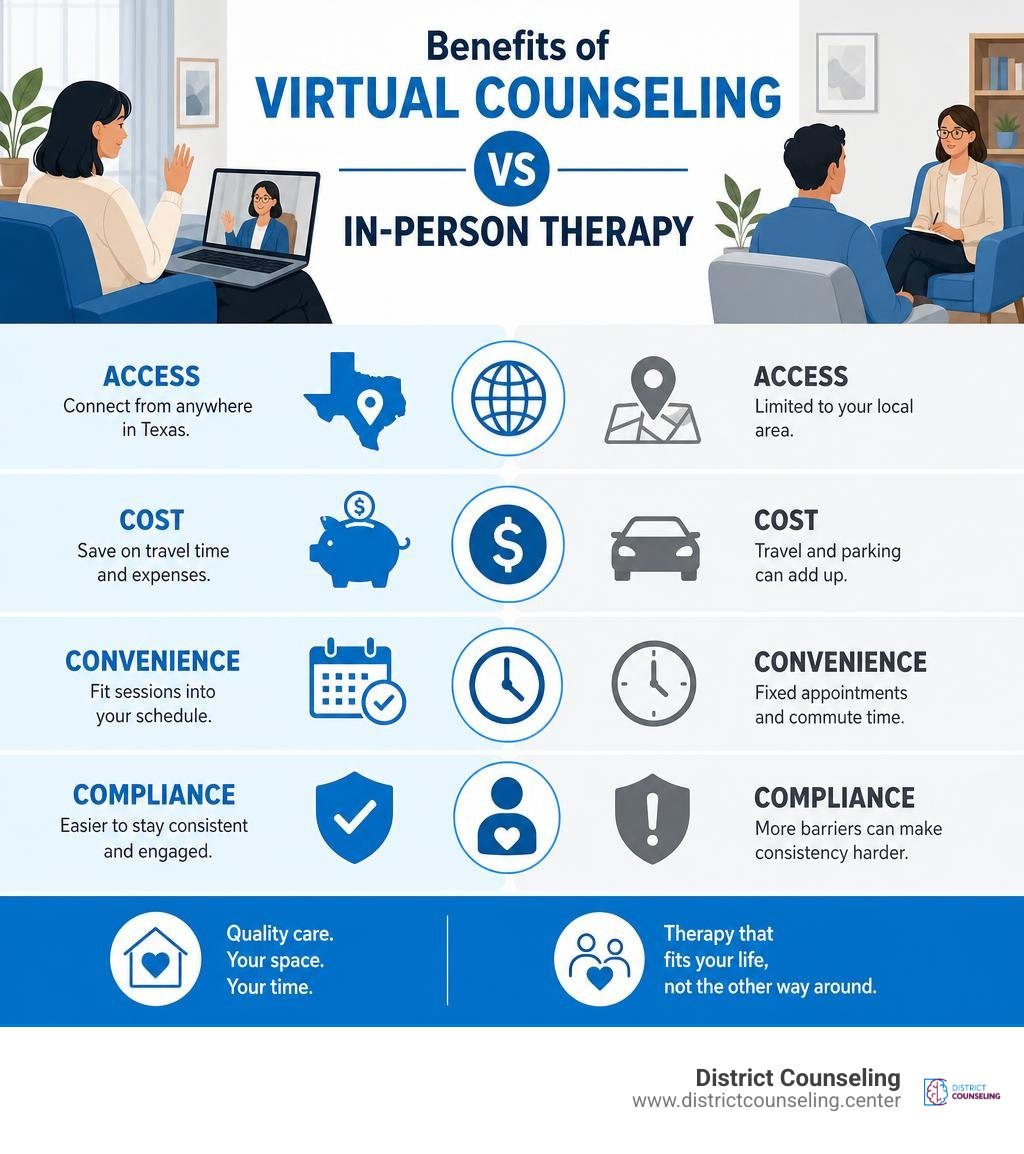
The Rise of Telehealth Counseling in Texas: Rules, Rights, and Benefits
Over the last few years, the landscape of healthcare has changed dramatically. What once felt like a temporary alternative has cemented itself as a preferred method of care. As we navigate July 2026, the efficiency, accessibility, and comfort of virtual therapy have made it a staple for Texans seeking mental health support.

The convenience of accessing therapy from your own living room is undeniable. You no longer have to fight rush-hour traffic on I-10 or the Loop, find parking, or sit awkwardly in a public waiting room. However, convenience is only half the equation. The state of Texas has established robust legal frameworks to ensure that virtual services do not compromise on quality.
Under Texas Occupations Code Chapter 111 and Texas Administrative Code Chapter 100, the state mandates that the standard of care provided via telehealth must be equal to that of an in-person visit. This means your therapist must utilize the same clinical rigor, ethical standards, and evidence-based practices online as they would if you were sitting on their physical office couch. For those curious about how these standards translate to practice, we provide More info about telehealth services to help demystify the process.
No matter where you reside in the Lone Star State, finding a qualified provider is highly accessible. You can easily view our comprehensive list of Telehealth Counseling Locations to connect with a professional licensed to serve your specific area.
Understanding Telehealth Counseling in Texas for Behavior Analysts
While mental health counselors (such as LPCs, LMFTs, and LCSWs) utilize telehealth for psychotherapy, behavior analysts also rely heavily on virtual platforms to deliver Applied Behavior Analysis (ABA) and related services. In Texas, the Texas Department of Licensing and Regulation (TDLR) oversees behavior analysts and has modernized its systems—such as making the TDLR CORE licensing system live—to streamline provider registration and management.
According to Texas regulations, “telehealth” for behavior analysts is defined as the use of telecommunications and information technologies to facilitate the assessment, diagnosis, consultation, treatment, education, and care management of a client.
However, Texas law is very specific about information technology exclusions. The legal definition of telehealth excludes the use of:
- Standard analog telephones (traditional voice-only landlines without video capability)
- Standard email messages
- Fax machines
For a session to legally qualify as telehealth, it must utilize secure, interactive, real-time telecommunications technology. This ensures that sessions remain dynamic and protective of your private information. For families seeking behavior analysis or specialized therapy in the suburban Houston area, we offer dedicated Telehealth Counseling in Katy to ensure local access to these highly regulated services.
How to Access Quality Telehealth Counseling in Texas Today
Finding virtual therapy in Texas is straightforward, but it requires verifying that your provider is licensed in the state of Texas. Because licensing boards protect consumers within state borders, a therapist must be legally authorized to practice in Texas to treat a client physically located here.
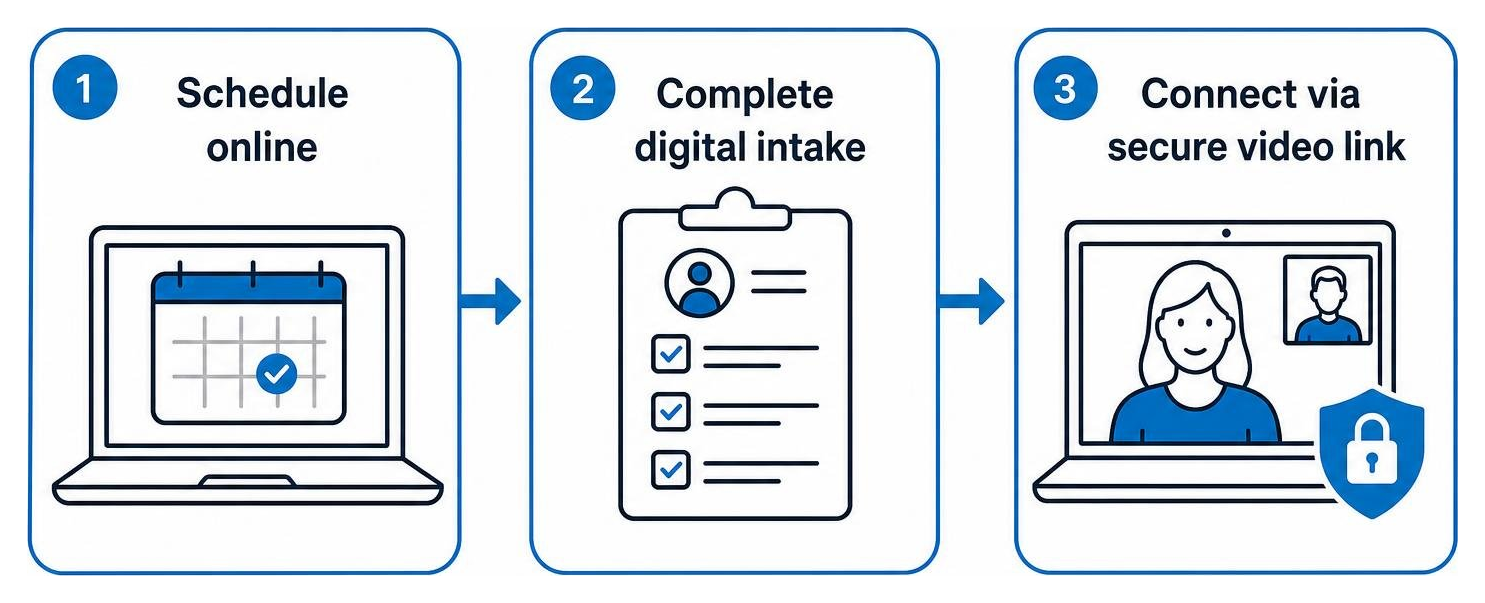
At District Counseling, we have designed our virtual platform to be incredibly user-friendly for Texas residents. Whether you are living in the busy urban center of Travis County and need Telehealth Counseling in Austin, or residing in Tarrant County and seeking Telehealth Counseling in Fort Worth, our services are tailored to bridge the geographic gap.
Texas TDLR Regulations and Standards of Care
To maintain clinical integrity, the TDLR and other state licensing boards hold telehealth providers to exceptionally high standards. It is a common misconception that online therapy is a “watered-down” version of traditional counseling. In reality, the regulatory oversight is incredibly strict to protect the public.

First and foremost, therapists and behavior analysts must verify the identity of the client at the start of every session. This prevents identity fraud and ensures that services are being delivered to the correct individual.
Additionally, providers must establish a clear protocol for follow-up care. If a client experiences a mental health crisis during a session, the therapist cannot simply log off. They must have an established safety plan, know the client’s physical location at the time of the call, and have local emergency contact numbers on hand.
Clinical research supports this structured approach. According to Scientific research on telehealth efficacy, virtual mental health interventions are highly effective and yield clinical outcomes comparable to traditional face-to-face therapy for a wide range of psychological conditions.
Legal Framework of Telehealth Counseling in Texas
The legal framework governing behavioral telehealth in Texas is designed to protect your rights as a consumer. The TDLR and the Texas Behavioral Health Executive Council (BHEC) require all practitioners to operate strictly within their professional scope of practice.
For residents in the outer loops of Houston, we provide localized virtual care options, such as Telehealth Counseling in Cypress and Telehealth Counseling in Spring. Regardless of where your therapist is physically located, they must adhere to the laws of the state where the client is sitting. If you are in Texas, Texas law applies.
Out-of-State Providers and Temporary Practice Rules
What happens if you want to work with a specialist who is located outside of Texas? Texas has strict rules regarding out-of-state practitioners to ensure they do not bypass state licensing laws.
For behavior analysts, an out-of-state provider who is licensed in another jurisdiction or holds a Board Certified Behavior Analyst (BCBA) credential may provide temporary telehealth services in Texas for no more than 20 days in a calendar year.
To do this legally, the out-of-state provider must:
- Notify the client in writing that they are not licensed in Texas.
- Clearly state that the services are time-limited (subject to the 20-day limit).
- Ensure they comply with all other Texas standards of care.
This temporary rule is highly beneficial for families who need a short-term consultation with an out-of-state specialist, such as those coordinating care for a loved one receiving Telehealth Counseling in Sugar Land.
Client Consent, Privacy, and Record-Keeping Requirements
Compliance in telehealth involves several layers of administrative protection. The table below outlines how virtual therapy compliance compares to traditional, in-person counseling:
| Requirement | In-Person Counseling | Telehealth Counseling |
|---|---|---|
| Standard of Care | High (Standard clinical protocols) | Identical (Must match in-person standards) |
| Identity Verification | Visual (In-person greeting) | Required at the start of every session |
| Consent Form | Standard written consent | Written or documented audio-only consent |
| Emergency Protocol | Immediate office safety measures | Local emergency contacts & location tracking |
| Record Retention | Varying by board (usually 5-7 years) | Minimum 5 years (specifically for consent & data sharing) |
| Platform Security | Physical room privacy | HIPAA-compliant, encrypted video software |
We take these security standards seriously across all our service areas, including clients seeking Telehealth Counseling in Pearland.
Consent Protocols and Audio-Only Options
Before any telehealth services can begin, a provider must obtain informed client consent. This consent must outline the risks and benefits of telehealth, the technology being used, and what to do in case of a technical failure.
Interestingly, Texas law allows for flexibility in how this consent is obtained. If a written signature is not immediately possible, a healthcare professional can obtain audio-only consent. This is legally permissible as long as the consent is:
- Documented in writing in the client’s file in advance, OR
- Explicitly noted and recorded during the audio call itself.
This flexible approach ensures that clients who may have limited internet access or technical difficulties can still legally consent to and receive vital services, which is a key component of our outreach in areas like Telehealth Counseling in Tomball.
Maintaining HIPAA Compliance and Confidentiality
Privacy is often the primary concern for individuals considering virtual therapy. Under the Health Insurance Portability and Accountability Act (HIPAA), therapists must use secure, encrypted video platforms designed specifically for healthcare. Public platforms like standard FaceTime, Skype, or public Zoom rooms do not meet these federal security standards.
Practitioners must implement strict protocols to prevent unauthorized access to client communications. This includes:
- Restricting session links to authorized users only.
- Explicitly informing patients of potential data breach risks.
- Ensuring all supervised staff, interns, and administrative personnel comply fully with state and federal privacy laws.
At District Counseling, we prioritize these security measures. Whether we are serving clients through Telehealth Counseling in Copperfield or any of our other Texas locations, your data and conversations remain completely confidential and secure.
Record Retention and Documentation Standards
Texas administrative rules dictate strict record-keeping requirements for telehealth providers. Documentation related to:
- Treatment consent
- Data collection
- Data sharing
Must be kept for a minimum of 5 years, or the length of time required by specific program rules or state statutes—whichever is longer. This ensures a reliable clinical paper trail is maintained, protecting both the client and the clinician. We maintain these rigorous archives for all our clients, including those utilizing Telehealth Counseling in Missouri City.
Billing, Insurance, and Practical Considerations
Understanding the administrative side of telehealth is crucial to avoiding unexpected out-of-pocket expenses.
Before beginning virtual therapy, clients should always verify their insurance benefits. While many insurance plans cover telehealth identically to in-person sessions, some policies have specific clauses regarding virtual networks or require the use of specific, pre-approved platforms.
To prevent billing errors and fraud, providers must:
- Verify the identity of the client.
- Use accurate CPT (Current Procedural Terminology) codes that include specific “telehealth modifiers” (such as GT or 95) to indicate the service was delivered virtually.
- Check with insurance payors to verify reimbursement rates and coverage rules before initiating services.
For residents in the Houston metroplex, including those utilizing Telehealth Counseling in Spring Branch, our administrative team works closely with clients to make this process as transparent as possible.
Navigating Insurance and Billing for Telehealth Counseling in Texas
Navigating insurance can feel overwhelming, but a few proactive steps can save you time and money. We always recommend calling the member services number on the back of your insurance card and asking the following questions:
- Does my plan cover outpatient mental health services delivered via telehealth?
- Are there any restrictions on the type of licensed professional I can see virtually?
- Do I have a copay or deductible that applies to virtual visits?
Taking these steps ensures you can focus entirely on your healing. For more practical tips on preparing your environment and mind for virtual care, read our guide on Making the Most of Telehealth Counseling.
Frequently Asked Questions About Texas Telehealth
Can out-of-state behavior analysts practice temporarily in Texas?
Yes. An out-of-state behavior analyst who is licensed in another state or holds a valid BCBA certification may provide temporary telehealth services in Texas for up to 20 days in a calendar year. They must notify the client in writing that they are unlicensed in Texas and that the services are time-limited.
What are the record retention requirements for telehealth in Texas?
Documentation related to telehealth services—including treatment consent, data collection, and data sharing—must be retained for a minimum of 5 years, or longer if required by specific state programs or statutes.
Is audio-only consent legally allowed for Texas telehealth?
Yes. A health professional may obtain client consent in an audio-only format, provided it is documented in advance in the client’s file or explicitly recorded during the call.
Conclusion
Virtual therapy has opened doors for thousands of Texans who previously struggled to find the time, transport, or local resources to support their mental health. At District Counseling, we believe that high-quality, compassionate mental health care should fit seamlessly into your life—not disrupt it.
Our team is dedicated to providing sincere, authentic, and compassionate therapy tailored to your unique goals. If you are ready to experience the convenience and clinical excellence of virtual therapy, we invite you to take the next step.
Begin your journey with District Counseling’s Virtual Couch today.
Visited 1 times, 1 visit(s) today
Similar Posts

Francisco Ortiz
September 18, 2026
No Traffic, No Waiting Rooms: Your Guide to Telehealth Counseling in Texas
Learn the rules, rights, and benefits of telehealth counseling in Texas with this complete guide to virtual therapy....

Adalid Blandin
September 16, 2026
Why Your Mitochondria Might Be Depressed
Explore metabolic mental health to boost brain energy, ease mood disorders, and support recovery through mitochondria-focused strategies....

Adalid Blandin
September 14, 2026
The Definitive Guide to Life Coaching
Discover how life coaching can help you achieve goals, gain clarity, and create lasting change in 2026....

Adalid Blandin
September 11, 2026
The Ultimate Guide to Identifying Emotional Abuse in Relationships
The Ultimate Guide to Identifying Emotional Abuse in Relationships – Learn about emotional abuse relationship...

Adalid Blandin
September 9, 2026
A Comprehensive Guide to Effective Relationship Counseling Options
A Comprehensive Guide to Effective Relationship Counseling Options – Learn about relationship counseling...

Francisco Ortiz
September 7, 2026
First Couples Counseling Session: A Guide to Your First Hour on the Couch
Learn what happens in your first couples counseling session, from intake to ground rules, and how to prepare for a successful start....

Adalid Blandin
September 4, 2026
Spotting the Signs and Finding Help for Emotional Abuse
Recognize emotional abuse signs and connect with a relationship emotional abuse therapist for healing and support....

Francisco Ortiz
September 2, 2026
Riding Out the Storm: The Four Horsemen of Couples Therapy and Their Antidotes
Learn how the four horsemen couples therapy framework identifies destructive conflict patterns and provides proven antidotes to strengthen your relationship....

Francisco Ortiz
August 31, 2026
Premarital Counseling Online: Prep for Marriage from Your Couch
Prepare for marriage with premarital counseling online from your couch. Build skills, save on licenses, and strengthen your future today....

Francisco Ortiz
August 28, 2026
Licensed Telehealth Therapy Providers in Texas: A Quick Start Guide
Find licensed telehealth therapy Texas providers with this guide to legal rules, insurance parity, and clinical best practices....


