Spotting the Signs and Finding Help for Emotional Abuse
When Something Feels Wrong in Your Relationship but You Can’t Quite Name It
A relationship emotional abuse therapist helps people recognize, process, and recover from patterns of psychological harm in intimate relationships. Here’s a quick overview of what that means for you:
What a relationship emotional abuse therapist does:
- Helps you identify whether what you’re experiencing is emotional abuse
- Validates your feelings and experiences in a safe, judgment-free space
- Creates a personalized safety plan if you’re still in the relationship
- Uses evidence-based therapies (CBT, EMDR, DBT) to treat trauma symptoms
- Supports you in rebuilding self-trust and setting healthy boundaries
When to reach out:
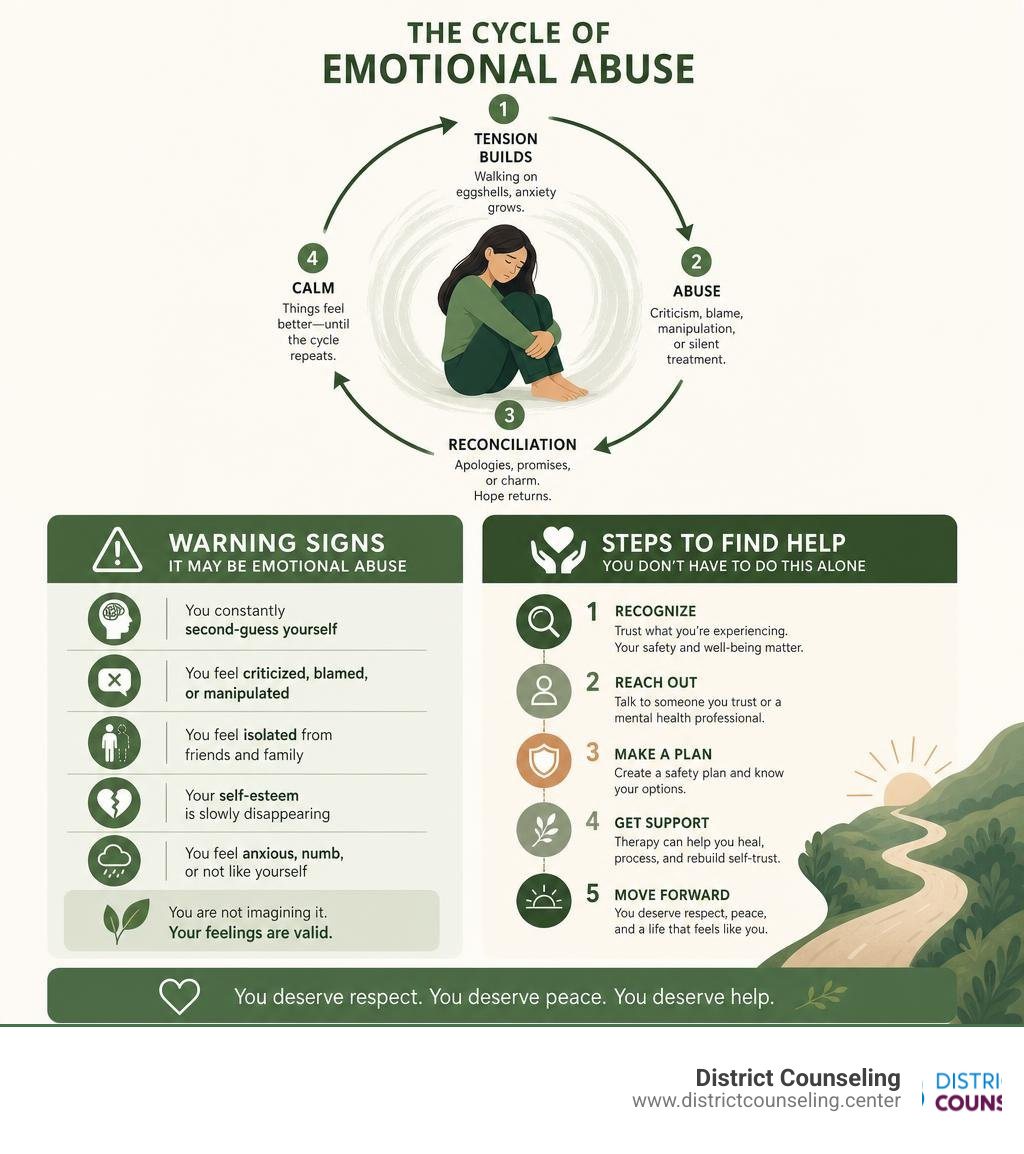
- You constantly second-guess yourself or feel like you’re “walking on eggshells”
- You feel responsible for your partner’s moods and emotions
- You’ve noticed patterns of criticism, isolation, or manipulation
- Friends or family have expressed concern about your relationship
- You feel anxious, numb, or don’t recognize yourself anymore
You don’t have to be yelled at or physically hurt to be experiencing abuse. Emotional abuse is often quiet, gradual, and deeply confusing — which is exactly what makes it so hard to name. Research shows that nearly 48% of women experience some form of emotional abuse in intimate relationships, and a Canadian public health survey found that 17% of men and 18% of women reported emotional abuse — linking it to anxiety, depression, chronic stress, and PTSD. Yet many people still wonder: Is this really that bad? Am I overreacting?
If you’ve found yourself replaying conversations late at night, trying to figure out what you did wrong — you’re not alone, and you’re not imagining it.
I’m Francisco Ortiz, a Licensed Professional Counselor-Supervisor with extensive experience providing psychotherapy to individuals and couples navigating trauma, relationship conflict, and mood disorders — the core concerns that bring many people to a relationship emotional abuse therapist. My training in trauma-informed care and forensic mental health gives me a unique lens for understanding the complex power dynamics that make emotional abuse so difficult to see clearly.
Understanding Emotional Abuse vs. Normal Relationship Conflict
Every couple argues. Disagreements, hurt feelings, and occasional bouts of poor communication are normal parts of sharing a life with someone. So, how do we distinguish between everyday friction and something more systemic?
The core difference lies in power, control, and patterns.
Normal relationship conflict is situational. It is a disagreement between two equals who both have a voice, can express their feelings safely, and ultimately seek a resolution. In contrast, emotional abuse is a systematic pattern of behavior designed to establish a power imbalance. One partner uses manipulation, fear, or humiliation to control, dominate, and degrade the other.
While physical abuse leaves visible marks, the wounds of emotional abuse are completely invisible, wearing away at your self-esteem, self-trust, and identity over time. To help you evaluate your own situation, we have detailed 5 Signs You’re in an Emotionally Abusive Relationship to look out for.
If you are struggling to tell the difference, the table below highlights the key distinctions between healthy conflict and psychological control:
| Healthy Relationship Conflict | Emotionally Abusive Pattern |
|---|---|
| Mutual Respect: Both partners can voice opinions without fear of retaliation. | Fear and Obligation: You feel like you must agree to keep the peace or avoid anger. |
| Shared Responsibility: Both people can admit when they are wrong or made a mistake. | Blame-Shifting: Everything is always your fault; your partner never takes accountability. |
| Healthy Boundaries: Partners respect each other’s independence, friends, and hobbies. | Isolation: Your partner tries to control who you see, talk to, or spend time with. |
| Focus on Resolution: The goal of an argument is to solve a problem together. | Focus on Winning: The goal is to demean, punish, or force you into submission. |
| Emotional Safety: You feel safe expressing sadness, anger, or vulnerability. | Walking on Eggshells: You constantly monitor your partner’s mood to protect yourself. |
If you recognize these abusive patterns in your dynamic, standard Relationship & Marital Counseling is often not the safest first step. Instead, working with a specialized therapist individually is crucial to processing what is happening without putting your safety at risk.
Recognizing the Subtle Signs and Tactics of Psychological Control
Emotional abusers rarely start out showing their true colors. In the beginning, they may engage in “love-bombing” — showering you with intense affection, grand gestures, and declarations of a perfect future. This rapid escalation builds a powerful bond, making it incredibly confusing when the controlling behaviors slowly begin to creep in.
As the relationship progresses, abusers deploy highly calculated psychological tactics to keep you off-balance:
- Gaslighting: This is a form of manipulation where the abuser denies your reality, twists the truth, or insists that events didn’t happen the way you remember. Over time, gaslighting erodes your confidence to the point where you completely stop trusting your own memory and intuition.
- Isolation: By slowly convincing you that your friends are toxic, your family is interfering, or that “we only need each other,” the abuser cuts off your support system. This leaves you entirely dependent on them for validation and connection.
- DARVO (Deny, Attack, and Reverse Victim and Offender): When you try to address a hurtful behavior, the abuser will deny it, attack you for bringing it up, and somehow twist the situation to make themselves look like the victim. You end up apologizing to them for being hurt.
- Intermittent Reinforcement: Abusers are rarely cruel 100% of the time. They mix periods of criticism and coldness with sudden bursts of warmth and affection. This cycle creates a powerful psychological “trauma bond,” keeping you hooked on the hope that the loving partner will return.
In our modern world, these control tactics have also migrated online. Abusers frequently use digital surveillance to monitor their partners. In fact, a landmark study showed that 75% of domestic violence shelters helped individuals whose abusers used hidden mobile apps or spyware to eavesdrop on them.

Whether it is demanding your passwords, tracking your location, or constantly checking your texts, digital tracking is a severe violation of trust. If you are experiencing this, you can read our guide on When Trust is Hacked: Navigating the Relational Fallout of a Digital World to understand how digital control impacts your mental health.
Additionally, abusers often use financial control to restrict your freedom. They may limit your access to bank accounts, demand that you account for every penny spent, or prevent you from working so that leaving feels financially impossible.
How a Relationship Emotional Abuse Therapist Can Help You Heal
When you have been subjected to psychological control, your internal compass gets skewed. You might feel deeply confused, exhausted, and completely disconnected from who you used to be. A specialized relationship emotional abuse therapist serves as an objective, compassionate guide to help you untangle the web of manipulation.
First and foremost, a therapist provides unconditional validation. They help you realize that you are not crazy, you are not overreacting, and the abuse is absolutely not your fault.
Beyond emotional validation, a therapist acts as a practical partner in your safety. Together, you will work on:
- Safety Planning: If you are still living with your partner, we will help you build a secure exit plan. This includes identifying safe people to contact, keeping vital documents accessible, and utilizing private communication methods so your abuser cannot track your plans. If you need immediate, confidential support, you can always reach out to the National Domestic Violence Hotline.
- Deconstructing Trauma Bonds: Leaving an emotionally abusive partner is incredibly difficult because of the biological and emotional addiction created by the cycle of abuse. We will help you understand this bond so you can break its grip without self-blame.
- Rebuilding Self-Worth: Years of criticism can leave you feeling worthless. Through specialized Trauma Counseling, we help you reconnect with your strengths, rediscover your voice, and learn to trust your own judgment again.
When to Seek a Relationship Emotional Abuse Therapist
You do not need to wait until you are ready to leave your relationship to seek professional support. In fact, starting therapy while you are still in the relationship can give you the clarity and strength you need to make the best decisions for your future.
You should consider reaching out to a therapist if you experience any of the following:
- You feel like you are constantly walking on eggshells, monitoring your words and actions to avoid setting off your partner.
- You experience physical symptoms of chronic stress, such as frequent headaches, digestive issues, insomnia, or panic attacks.
- You have completely stopped expressing your own needs, opinions, or emotions because it is “not worth the fight.”
- You feel anxious every time your phone buzzes or you hear your partner’s car pull into the driveway.
- You are unsure whether your relationship is healthy or unhealthy, but you know that you feel increasingly smaller, sadder, and more confused.
If you are trying to decide what kind of help you need, our article on When to Seek Couples Counseling can help you determine whether couples work or individual Trauma Counseling is the safest path forward.
What to Expect in Your First Sessions with a Relationship Emotional Abuse Therapist
Taking the first step to speak with a therapist can feel incredibly intimidating. You might worry that the therapist will judge you for staying, push you to leave before you are ready, or dismiss your pain.
At District Counseling, we want to demystify this process for you. In your first few sessions, our primary goal is simply to build a safe, warm, and strictly confidential environment.
Here is what you can expect during those initial meetings:
- No Pressure or Judgment: We have no agenda. We will never force you to make a decision or leave your partner. You are in the driver’s seat, and we are here to support you at your own pace.
- A Thorough Intake Assessment: We will talk gently about what brought you in, explore your relationship history, and look at how these dynamics are affecting your daily life, sleep, and physical health.
- Establishing Confidentiality: We will explain how your privacy is legally protected, helping you feel secure that your sessions are a completely private space.
- Collaborative Goal Setting: We will work together to define what progress looks like for you — whether that is learning how to set a small boundary, managing your anxiety, or safely planning an exit.
If you are ready to find a supportive professional, you can explore how to Find a Therapist in for Couples Relationship Issues to guide you through this initial phase.
Evidence-Based Therapies for Recovering from Relational Trauma
Recovering from emotional abuse is not just about “talking it out.” Because psychological control systematically alters your brain’s threat-response system, trauma actually gets stored in your body. This is why you might feel your heart race, your muscles tense, or your mind go blank when you are triggered, even long after the abuse has ended.
To truly heal, we utilize highly effective, evidence-based Trauma Counseling modalities tailored to your unique needs:
- Cognitive Behavioral Therapy (CBT): CBT helps you identify and challenge the deeply ingrained, negative core beliefs that your partner drilled into you (such as “I am unlovable” or “Everything is my fault”). We work to replace these toxic narratives with realistic, self-compassionate thoughts.
- Dialectical Behavior Therapy (DBT): DBT is incredibly helpful for managing intense emotional distress and rebuilding your relationship with yourself. Through mindfulness, distress tolerance, and interpersonal effectiveness skills, you will learn how to regulate your nervous system and set firm, healthy boundaries.
- Eye Movement Desensitization and Reprocessing (EMDR): EMDR is a powerful, research-backed therapy that helps your brain reprocess traumatic memories. By using bilateral stimulation (like side-to-side eye movements), EMDR takes the emotional “sting” out of painful memories, helping your body finally realize that the danger is in the past.
- Somatic Experiencing and Body-Based Therapy: Because trauma lives in your physical body, we incorporate somatic techniques to help you tune into your physical sensations. Through guided breathing, grounding exercises, and body scans, we help you release trapped survival energy and restore a sense of physical safety.
At District Counseling, our suite of District Counseling Services is designed to support both your mind and your body, giving you a holistic toolkit for complete nervous system regulation and lasting recovery.
Frequently Asked Questions about Emotional Abuse Therapy
Can couples counseling help fix an emotionally abusive relationship?
As a general rule, no. We strongly advise against entering couples therapy if there is active emotional abuse, coercive control, or domestic violence in the relationship.
In a standard couples counseling setting, the therapist assumes both partners are equal contributors to the relationship’s issues and can speak honestly. However, in an abusive dynamic, the abuser will often manipulate the therapist, play the victim, or use what you share in therapy as ammunition to punish you later at home. This can make the abuse worse and further silence you.
If you have experienced betrayal or control, read our guide on Couples Counseling After Betrayal to understand when joint therapy is appropriate and when individual safety must come first.
How does emotional abuse affect long-term mental health?
The long-term effects of emotional abuse can be just as severe as those of physical violence. Prolonged exposure to psychological control keeps your body in a constant state of fight-or-flight, which can lead to:
- Complex PTSD (C-PTSD): Characterized by chronic anxiety, hypervigilance, flashbacks, and difficulty trusting others.
- Severe Depression and Anxiety: Feeling helpless, hopeless, and isolated from the world.
- Eroded Self-Esteem: Feeling like you are fundamentally flawed or incapable of making your own decisions.
- Relational Trauma: Struggling to form healthy attachments in future relationships due to a fear of being controlled or betrayed.
To learn more about navigating the painful aftermath of relationship trauma, you can read our insights on How to Cope with Trauma Caused by Infidelity in a Relationship.
Is therapy confidential if I am still living with my partner?
Yes, absolutely. By law, your therapy sessions are completely confidential. Your therapist cannot share any information about you with your partner, family members, or anyone else without your explicit, written consent. The only rare exceptions to this rule involve imminent risk of serious harm to yourself or someone else, or the abuse of a child or vulnerable adult.
We understand that living with an abuser requires extra safety precautions. We will work with you to ensure your therapy remains private, which may include using secure, password-protected client portals, scheduling sessions when your partner is out of the house, or utilizing highly private telehealth options from a safe, secure location.
Rebuilding trust after it has been shattered is a delicate process. If you want to explore the nature of trust and privacy, read The Unbreakable Bond: When Trust is Betrayed and How We Heal.
Conclusion
Recovering from emotional abuse is a journey, not a destination. It takes immense courage to look at a painful situation, acknowledge that something is wrong, and take the first step toward getting help. Please remember: you are stronger than you know, and you deserve to be treated with absolute respect, kindness, and love at all times.
At District Counseling, we are deeply committed to providing sincere, authentic, and compassionate mental health support across Texas. Whether you are in Houston, Katy, Austin, Fort Worth, Cypress, Sugar Land, The Woodlands, or any of our other Texas communities, our highly trained Therapists are here to walk alongside you.
We will help you quiet the self-doubt, regulate your nervous system, and rebuild the beautiful, independent life that is waiting for you on the other side of this fog.
Ready to take your next step toward healing? Schedule a session for Relationship & Marital Counseling today, or reach out to our team to find the perfect individual trauma therapist for your journey.
Visited 19 times, 1 visit(s) today


Similar Posts

Francisco Ortiz
October 23, 2026
Demystifying the Court-Ordered Mental Health Evaluation Process
Learn what to expect in a court ordered mental health evaluation, including legal criteria, costs, and outcomes....

Francisco Ortiz
October 21, 2026
Finding the Right EMDR Specialist in Cypress Texas for Real Healing
Find a qualified EMDR specialist in Cypress Texas for real trauma healing and lasting anxiety relief....

Francisco Ortiz
October 19, 2026
Why therapy for caregiver exhaustion is a necessity not a luxury
Find relief with exhaustion therapy for caregivers. Learn how clinical support heals burnout and restores your well-being....

Francisco Ortiz
October 16, 2026
Navigating Neuropsychological Evaluations from Katy to Pasadena
Learn how an ADHD evaluation for Houston teens works, from medication management to school accommodations and 504 plans....

Francisco Ortiz
October 14, 2026
How Texas caregivers can beat exhaustion with virtual therapy
Beat caregiver exhaustion therapy Texas caregivers trust—virtual sessions for stress, boundaries, and recovery. Start today....

Francisco Ortiz
October 12, 2026
Find Local Youth Counselor: How They Can Help Your Teen Thrive (52 characters)
Find a qualified youth counselor near me to help your teen thrive with evidence-based support for anxiety, trauma, and more....

Francisco Ortiz
October 9, 2026
Faith-Based Pastoral Counseling: A Comprehensive Guide
Discover how pastoral counseling integrates faith and psychology for holistic healing, grief, trauma, and marital support....

Francisco Ortiz
October 7, 2026
Houston Counseling Options: Find Local Help Nearby
Find affirming counseling in Houston for trauma, LGBTQ+ care, couples, and more. Explore local options and start your healing today....

Francisco Ortiz
October 5, 2026
Why every teacher needs a burnout therapy game plan
Why every teacher needs a burnout therapy game plan – Learn about burnout therapy for teachers...

Francisco Ortiz
October 2, 2026
Child Therapist Near Me? Here is How to Spot a Great One
Find a child therapist near me who fits your child’s needs. Learn signs, costs, and effective therapy options....


