
Discernment Counseling for Couples: The Last Stop Before You Call It Quits
When One of You Is Ready to Leave and the Other Isn’t
Discernment counseling for couples is a short-term, structured process that helps partners decide whether to stay together, separate, or commit to a focused period of couples therapy — before making any permanent decisions.
Quick answer for couples considering this approach:
| Question | Answer |
|---|---|
| What is it? | A decision-making process, not relationship repair |
| Who is it for? | Couples where one partner is leaning out and the other wants to stay |
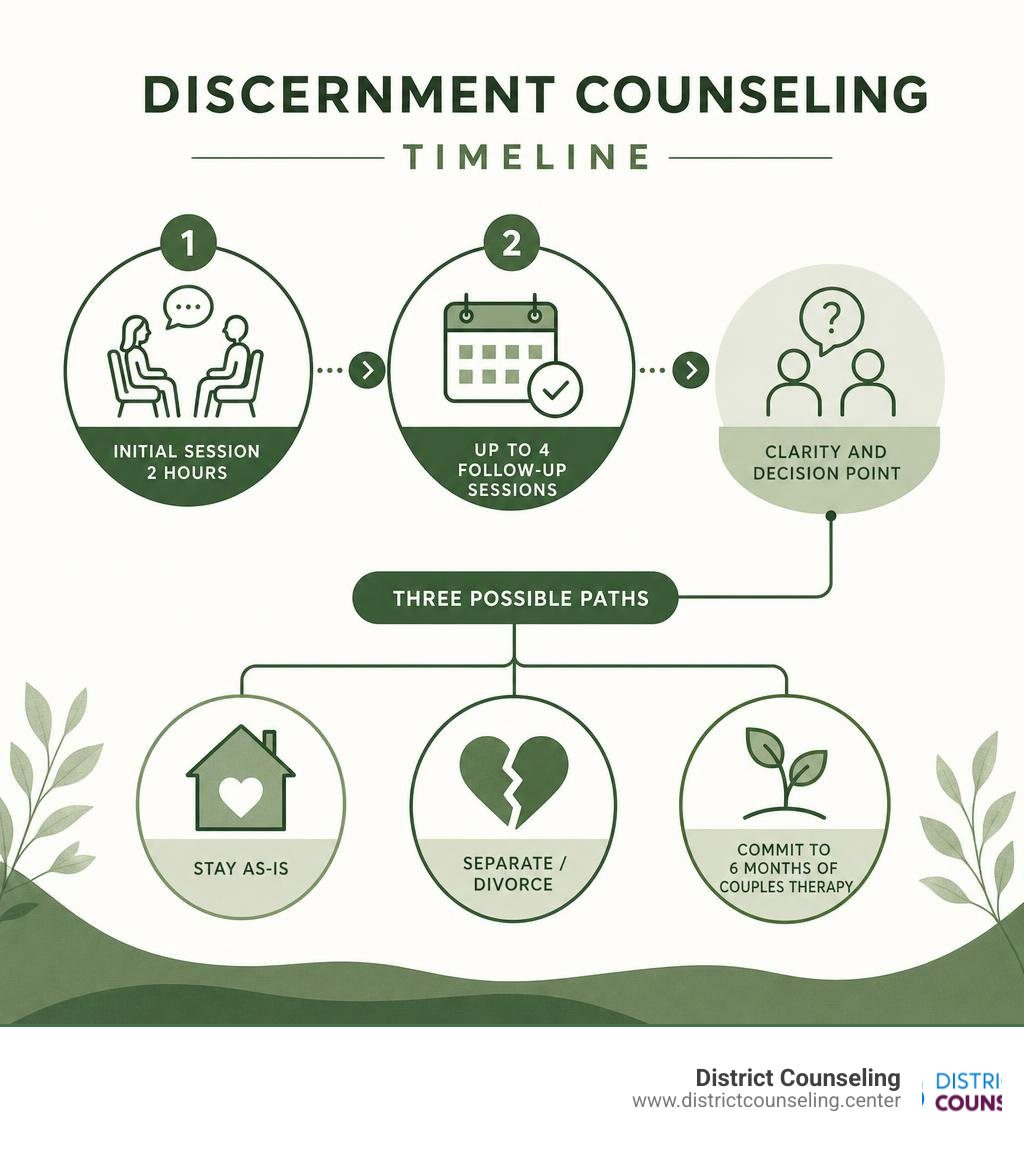
| How long does it take? | 1 to 5 sessions (first session is 2 hours) |
| What are the three paths? | Stay as-is, separate/divorce, or commit to 6 months of couples therapy |
| Does the therapist take sides? | No — the therapist stays completely neutral |
| Is it covered by insurance? | Typically no; it’s a private-pay service |
You’re not alone if you’re sitting with the weight of a relationship that feels stuck. Maybe one of you is already mentally halfway out the door, while the other is still fighting to hold things together. That tension — what therapists call a mixed-agenda dynamic — is exactly what discernment counseling was designed for.
Traditional couples therapy assumes both partners are ready to do the work. But when one person is deeply uncertain about the relationship’s future, that model often breaks down fast. It can even make things worse.
Discernment counseling, developed by Dr. Bill Doherty at the University of Minnesota, takes a different approach. It slows things down. It gives both partners space to be honest about where they actually stand — without pressure to fix anything yet.
I’m Francisco Ortiz, a Licensed Professional Counselor-Supervisor with extensive experience working with individuals, couples, and families navigating some of the most difficult moments in their lives, including the kind of relationship crossroads that discernment counseling for couples is built to address. My background in both clinical counseling and forensic mental health has given me a deep understanding of how high-stakes decisions affect people — and why clarity matters before you act.
What is Discernment Counseling for Couples?
When a marriage or long-term partnership is on the brink of collapse, couples often believe their only options are to grin and bear it or call a divorce lawyer. However, discernment counseling for couples offers a crucial third option. It is a highly specialized, short-term decision-making process designed to help you and your partner find clarity and confidence about how to move forward.
Unlike traditional therapy, discernment counseling is an assessment process rather than a treatment process. The goal is not to solve your communication issues, heal deep-seated childhood wounds, or fix the relationship. Instead, the counselor’s job is to help you determine if your relationship’s problems are actually solvable, and whether both of you have the desire and energy to try and solve them.
Because of this specific focus, the process is intentionally brief. It is designed to be completed in just 1 to 5 sessions. This time-limited structure prevents couples from getting stuck in a perpetual state of limbo, forcing a compassionate yet necessary look at the reality of the relationship. To understand how this fits into the broader landscape of relationship support, you can read The Ultimate Guide to Marital Counseling.
For a deeper look into the clinical frameworks and benefits of this approach, Discernment Counseling: Benefits, Techniques & How It Works provides excellent context on how therapists help couples evaluate their compatibility and options.
How It Differs from Traditional Couples Therapy
Entering traditional couples therapy when one partner has “one foot out the door” is often a recipe for frustration. Traditional therapy requires a high level of mutual commitment, a willingness to be vulnerable, and a shared goal of saving the relationship. When one partner lacks that motivation, therapy can feel like an uphill battle where the “leaning-in” partner tries to drag the “leaning-out” partner toward healing, often resulting in resentment and wasted resources.
Discernment counseling changes the rules. It does not require a commitment to work on the relationship. In fact, it operates on a different confidentiality framework. While traditional couples therapy typically utilizes a “no secrets” policy to foster open communication, discernment counseling relies heavily on confidential, individual conversations between each partner and the therapist during the session. This allows each person to speak with absolute honesty without the fear of triggering an immediate argument.
To help you decide which path fits your current situation, you can read about When to Seek Couples Counseling. Below is a direct comparison of how these two approaches operate:
| Feature | Discernment Counseling | Traditional Couples Therapy |
|---|---|---|
| Primary Goal | Gain clarity and confidence on the future direction of the relationship | Resolve conflicts, improve communication, and rebuild the bond |
| Required Commitment | One session at a time (up to 5 sessions max); no commitment to stay together | Ongoing commitment to work on relationship repair |
| Session Structure | Heavy focus on individual conversations with the therapist | Primarily joint sessions with both partners present |
| Therapist’s Stance | Neutral; does not push to save or end the relationship | Supportive of relationship growth and preservation |
| Confidentiality | Allows individual processing of sensitive topics (e.g., affairs, secret doubts) | Typically enforces a strict “no secrets” policy |
Who is This Process Designed For?
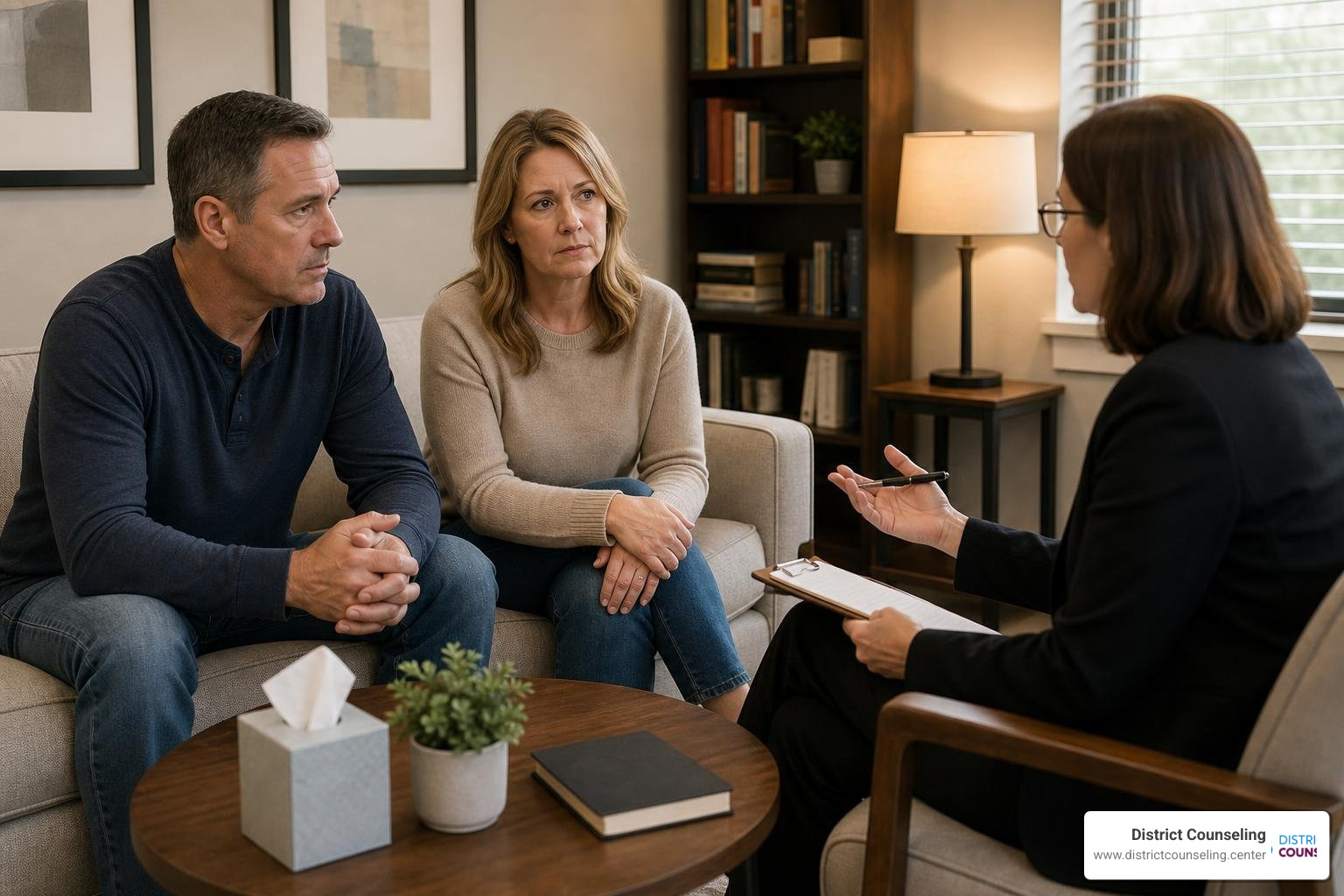
This process is tailor-made for “mixed-agenda” couples. These are relationships where one partner is highly motivated to preserve the relationship and salvage the commitment (the leaning-in partner), while the other partner is seriously considering ending the relationship or is highly ambivalent about staying (the leaning-out partner).
It is also highly effective for couples experiencing severe divorce ambivalence. Many people do not actually want a divorce; they simply want the pain, conflict, or distance in their current relationship to stop. If you are facing a severe relationship crisis, sitting at a painful crossroads, or feeling completely stuck in limbo, this structured process provides a psychological safety net to help you make a logical, clear-headed decision.
The Leaning-In vs. Leaning-Out Partner Dynamic in Discernment Counseling for Couples
In a mixed-agenda relationship, both partners carry a heavy, yet entirely different, emotional burden. The discernment process respects and validates both of these stances without making either partner the “bad guy.”
- The Leaning-Out Partner: This partner is often emotionally exhausted, checked out, or actively contemplating separation. They may feel hopeless that things can ever change and feel pressured by their partner’s pleas to try harder. In discernment counseling, the leaning-out partner finds a pressure-free zone. The counselor will not try to convince them to stay. Instead, they are helped to look at what went wrong and whether they are truly finished, or if there is a sliver of hope worth exploring.
- The Leaning-In Partner: This partner is often living in a state of high anxiety, panic, or deep grief, desperately trying to hold the relationship together. They may feel helpless and constantly try to convince their partner to change. The discernment process helps the leaning-in partner step back, lower the pressure, and bring their “best self” to this crisis. It helps them understand their partner’s perspective and prepare for whatever outcome lies ahead.
By giving both roles equal validity, the counselor helps de-escalate the pursue-withdraw cycle that keeps so many couples trapped in high-conflict loops.
When Discernment Counseling for Couples is Contraindicated
While this process is incredibly helpful for many, it is not a universal solution. There are specific situations where discernment counseling for couples is highly contraindicated and cannot be safely or ethically conducted:
- Active Domestic Violence or Abuse: If there is physical violence, severe emotional abuse, or a threat to safety, joint counseling of any kind is unsafe.
- Coercion: Both partners must participate voluntarily. If one partner is being threatened or forced to attend, the process cannot proceed.
- A Final Decision Has Already Been Made: If the leaning-out partner has already fully decided to divorce and is simply looking for a therapist to break the news gently to their spouse, discernment counseling is not appropriate.
- Untreated, Severe Mental Illness or Substance Abuse: If active addiction or untreated psychosis impairs a partner’s ability to make rational, clear decisions, those issues must be addressed individually first.
The Three Paths: Outcomes of the Discernment Process
The ultimate objective of discernment counseling is to help couples choose one of three distinct paths for their future.
- Path 1: Status Quo: The couple decides to make no immediate decisions. They agree to remain together as they are, pausing any talk of divorce or intensive therapy for the time being. This is often a temporary holding pattern while other life stressors settle.
- Path 2: Move Toward Separation or Divorce: The couple decides that the relationship has run its course and that ending the partnership is the healthiest decision. Because this path is chosen after careful reflection rather than in the heat of an argument, couples who choose Path 2 are often able to navigate the divorce process more humanely, collaboratively, and with less litigation.
- Path 3: Commit to Six Months of Intensive Therapy: The couple agrees to take divorce completely off the table for a six-month period and throw their full energy into intensive couples therapy. During these six months, both partners commit to showing up fully, implementing changes, and seeing if the relationship can be rebuilt. At the end of the six months, they re-evaluate.
When alliances fail and communication breaks down completely, having these three clear options simplifies what feels like an impossibly complex web of decisions. You can read more about navigating these moments in When Alliances Fail: Navigating Communication Breakdowns in Your Own Coalition.
Transitioning to the Next Phase
Once a path is chosen, the discernment counselor helps the couple transition smoothly into the next phase of their lives.
If the couple chooses Path 3, they transition into structured couples therapy. Remarkably, more than half of the discernment cases transition into couples therapy. Because they spent time clarifying their goals first, these couples enter therapy with a clear roadmap and a shared commitment, making their subsequent therapy far more effective.
If the couple chooses Path 2, the focus shifts to a healthy, respectful separation. This often involves referring the couple to collaborative divorce mediators or co-parenting specialists, ensuring that children are protected from high-conflict custody battles. No matter which path is chosen, the ultimate goal is to help both partners learn how to build trust moving forward, whether together or apart. For those looking to understand the mechanics of rebuilding, see How to Build Trust Between a Couple.
What to Expect: Structure and Session Format
If you decide to take this step, it is helpful to know exactly how the process is structured. Discernment counseling is brief, typically lasting between 1 to 5 sessions.
The initial session is always 2 hours long, while any subsequent follow-up sessions are usually 90 minutes. Here is how a typical session breaks down:
- The Joint Start (15-20 minutes): The counselor meets with both of you together to set the agenda, check in on how things have been going, and hear from each of you briefly.
- Individual Conversation – Partner A (30-40 minutes): The counselor meets with one partner individually. During this time, you can speak with complete candor about your fears, doubts, hopes, or secrets. The counselor will help you look at your own contribution to the relationship’s issues.
- Individual Conversation – Partner B (30-40 minutes): The counselor meets with the second partner individually, focusing on their unique perspective and emotional stance.
- The Joint Summary (10-15 minutes): Both partners return to the room. Each partner shares a brief summary of what they learned or realized during their individual time. The counselor does not share secrets from the individual sessions; instead, they help each partner present their own insights in a constructive way.
- The Decision to Return: At the very end of the session, the counselor asks each partner a simple question: Do you want to sign up for one more session of discernment counseling? There is no long-term contract. You decide to come back one session at a time, up to a maximum of five sessions.
To learn more about the official clinical guidelines and resources for this structured format, you can visit Discernment Counseling: Home.
Measuring Success: Clarity and Confidence Over Saving the Marriage
In traditional therapy, “success” means saving the relationship. In discernment counseling, success is measured differently. Success means gaining clarity and confidence about the future of your relationship.

Even if a couple completes the process and decides to divorce, the counseling is considered highly successful if both partners leave with:
- A deeper understanding of what went wrong in the relationship.
- A clear view of their own individual contributions to the relationship’s demise (which prevents them from repeating the same mistakes in future relationships).
- A sense of peace that they explored every option before making a life-altering decision, which drastically reduces future regret.
This process is about helping you bring your “best self” to a difficult situation, helping you understand What Makes Love Last? while also giving you the grace to let go if the foundation is no longer there.
Frequently Asked Questions About Discernment Counseling
How many sessions does discernment counseling take?
Discernment counseling is designed to be a brief, time-limited process. It typically takes between 1 to 5 sessions to reach a decision. The first session is 2 hours long, and any subsequent sessions are 90 minutes. You commit to only one session at a time, deciding at the end of each session whether you want to return for another.
Is discernment counseling covered by insurance?
Generally, no. Because discernment counseling is a short-term decision-making assessment rather than a treatment for a diagnosed mental health condition, it is classified as a private-pay service. However, because it is strictly limited to a maximum of five sessions, most couples find it to be a highly cost-effective alternative to jumping straight into months of traditional therapy or paying thousands of dollars in early divorce attorney retainers.
What if my partner refuses to attend?
Both partners must participate voluntarily for discernment counseling to work. If your partner is completely unwilling to attend, you cannot complete the full process. However, you can still schedule an individual consultation with a therapist trained in this model. This individual session can help you gain clarity on your own stance, lower your anxiety, and learn how to communicate with your partner in a way that reduces pressure and might make them more open to a joint session down the road.
Conclusion
Making the decision to end a relationship or commit to intense rebuilding is one of the most high-stakes choices you will ever make. You do not have to make it in a state of panic, anger, or confusion.
At District Counseling, we understand how painful relationship limbo can be. We provide a compassionate, structured, and completely neutral space to help you and your partner slow down, catch your breath, and find the clarity you need to move forward with confidence. With multiple convenient locations across Texas — including Houston, Katy, Sugar Land, Fort Worth, and Austin — our team is here to support you with authentic, compassionate alignment to what matters most.
If you are ready to take a breath and explore your options without pressure, we are here to help. You can learn more or schedule a session by visiting our Relationship & Marital Counseling page.
Visited 14 times, 1 visit(s) today
Similar Posts

Adalid Blandin
September 21, 2026
All About Psychiatric Weight Loss Options and Treatments
Explore psychiatric weight loss options, including medications, therapy, and bariatric support for holistic wellness....

Francisco Ortiz
September 18, 2026
No Traffic, No Waiting Rooms: Your Guide to Telehealth Counseling in Texas
Learn the rules, rights, and benefits of telehealth counseling in Texas with this complete guide to virtual therapy....

Adalid Blandin
September 16, 2026
Why Your Mitochondria Might Be Depressed
Explore metabolic mental health to boost brain energy, ease mood disorders, and support recovery through mitochondria-focused strategies....

Adalid Blandin
September 14, 2026
The Definitive Guide to Life Coaching
Discover how life coaching can help you achieve goals, gain clarity, and create lasting change in 2026....

Adalid Blandin
September 11, 2026
The Ultimate Guide to Identifying Emotional Abuse in Relationships
The Ultimate Guide to Identifying Emotional Abuse in Relationships – Learn about emotional abuse relationship...

Adalid Blandin
September 9, 2026
A Comprehensive Guide to Effective Relationship Counseling Options
A Comprehensive Guide to Effective Relationship Counseling Options – Learn about relationship counseling...

Francisco Ortiz
September 7, 2026
First Couples Counseling Session: A Guide to Your First Hour on the Couch
Learn what happens in your first couples counseling session, from intake to ground rules, and how to prepare for a successful start....

Adalid Blandin
September 4, 2026
Spotting the Signs and Finding Help for Emotional Abuse
Recognize emotional abuse signs and connect with a relationship emotional abuse therapist for healing and support....

Francisco Ortiz
September 2, 2026
Riding Out the Storm: The Four Horsemen of Couples Therapy and Their Antidotes
Learn how the four horsemen couples therapy framework identifies destructive conflict patterns and provides proven antidotes to strengthen your relationship....

Francisco Ortiz
August 31, 2026
Premarital Counseling Online: Prep for Marriage from Your Couch
Prepare for marriage with premarital counseling online from your couch. Build skills, save on licenses, and strengthen your future today....


