
Demystifying the Evaluation for Immigration Process
Start With the Right Evaluation for Immigration
An evaluation for immigration can mean two very different things. For Canadian immigration, an Educational Credential Assessment (ECA) confirms how an education earned outside Canada compares with Canadian credentials. For many U.S. immigration cases, a psychological evaluation documents trauma, mental health symptoms, or the likely hardship of family separation.
To move forward without wasting time:
- Check which country and immigration program applies to you.
- For Canadian Express Entry, obtain an ECA from an organization designated by Immigration, Refugees and Citizenship Canada.
- For a U.S. legal case involving asylum, VAWA, a U-visa, or hardship, ask your immigration attorney whether a forensic psychological evaluation could support the evidence in your case.
- Use the right professional for the right question. Credential evaluators assess education; licensed mental health professionals assess psychological impact and functioning.
An ECA is generally valid for five years for Express Entry. Applicants usually submit their highest completed credential, although country-specific document rules and exceptions can apply.
I am Francisco Ortiz, a Licensed Professional Counselor-Supervisor and Certified Forensic Mental Health Evaluator with experience in asylum matters, immigration court competency evaluations, and trauma-informed forensic assessment. In this guide, I will explain how an evaluation for immigration works, what it can and cannot establish, and how to prepare for the process.
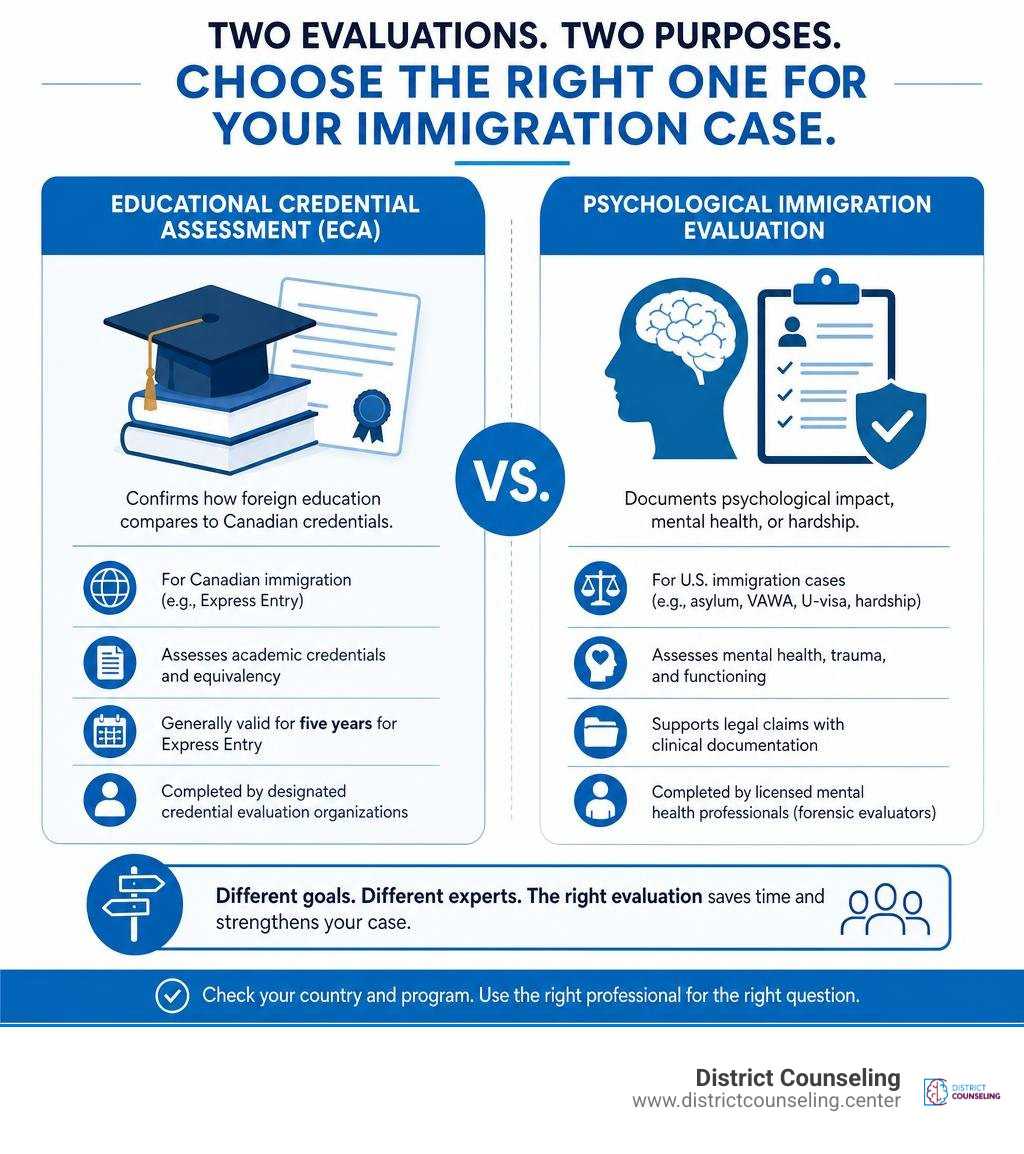
Types of Evaluation for Immigration: Educational Credentials vs. Psychological Assessments
When someone mentions that they need an evaluation for immigration, the legal jurisdiction and procedural goals dictate the exact path forward. Submitting an academic assessment when a court requires a forensic clinical report—or vice versa—leads to costly delays.
| Evaluation Dimension | Educational Credential Assessment (ECA) | Psychological Immigration Evaluation |
|---|---|---|
| Primary Jurisdiction | Canada (IRCC / Express Entry) | United States (USCIS / EOIR Immigration Courts) |
| Adjudicating Bodies | Immigration, Refugees and Citizenship Canada (IRCC) | USCIS Adjudicators, Immigration Judges, BIA |
| Assessment Purpose | Authenticate degrees and verify Canadian equivalency | Document trauma, extreme hardship, or mental competence |
| Professional Evaluator | IRCC-designated credential evaluation bodies | Licensed mental health clinicians & forensic psychologists |
| Evidentiary Burden | Academic proof and institutional verification | Clinical diagnoses, functional impact, and psycholegal nexus |
| Primary Focus | Human capital points and educational leveling | Humanitarian relief, family preservation, and persecution |
For applicants and attorneys seeking clinical clarity, reviewing Psychological Evaluations for Immigration: A Guide helps define how mental health documentation functions within civil legal proceedings.
Educational Credential Evaluation for Immigration Pathways
For Canadian economic immigration streams such as Express Entry, an Educational Credential Assessment validates that foreign degrees, diplomas, or certificates are genuine and equal to Canadian educational standards. Designated bodies verify transcripts directly with issuing international universities.
An ECA report remains valid for five years from its date of issuance. For most programs, applicants only need to submit their highest completed credential (such as a master’s degree). However, certain regional educational structures require submitting bachelor’s degrees alongside postgraduate awards to establish complete academic progression. Furthermore, family sponsorship applications may involve separate administrative assessments, such as calculating minimum necessary income requirements using the Financial Evaluation Form (IMM 1283).
Clinical and Forensic Psychological Evaluation for Immigration Relief
In contrast, United States immigration proceedings frequently hinge on proving emotional, psychological, or developmental harm. A clinical immigration assessment is a formal civil forensic evaluation rather than routine therapy. Its purpose is to answer explicit psycholegal questions for U.S. Citizenship and Immigration Services (USCIS) or the Executive Office for Immigration Review (EOIR).
Clinicians evaluate diagnostic criteria, document functional impairment, assess cognitive abilities, and provide objective evidence regarding the psychological sequelae of persecution or separation. At District Counseling, our clinicians conduct comprehensive assessments across Texas, including specialized Houston Psychological Evaluation for Immigration services tailored to complex immigration proceedings.

Navigating Legal Relief Types and Psychological Evaluation Protocols
United States immigration law covers a population of roughly 11 million undocumented immigrants navigating complex legal pathways. Research indicates that approximately 15% of individuals held in immigration detention facilities suffer from a psychiatric disorder. Psychological evaluations provide objective clinical documentation of these conditions to assist adjudicators in making informed legal rulings.
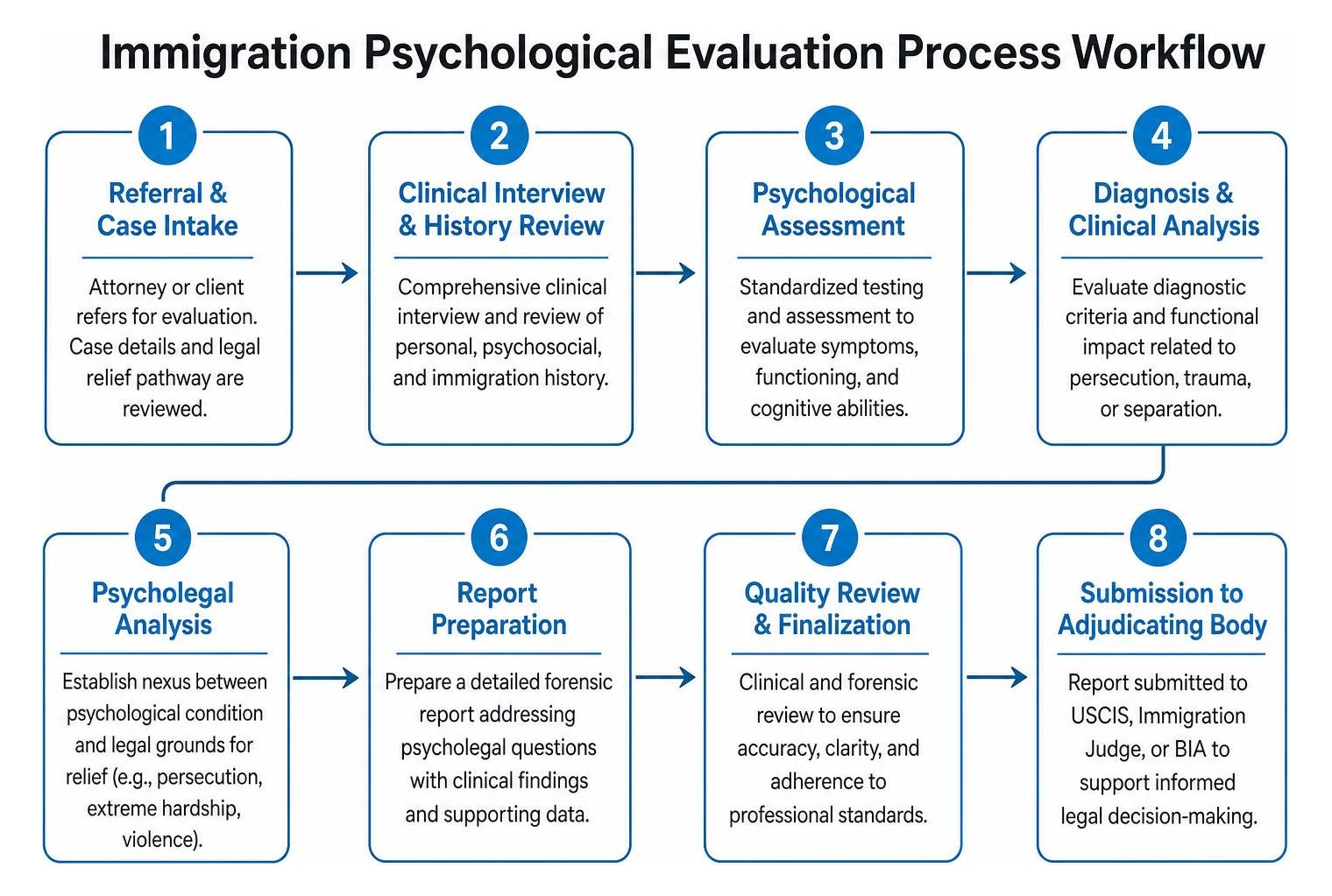
Persecution-Based and Humanitarian Relief (Asylum, VAWA, and U-Visas)
Persecution-based and humanitarian petitions focus on documenting past trauma and establishing the psychological consequences of interpersonal violence:
- Asylum Claims: Evaluators assess individuals fleeing persecution based on race, religion, nationality, political opinion, or membership in a particular social group. Clinical evaluations document post-traumatic stress disorder (PTSD), severe anxiety, and depressive disorders, connecting these symptoms to past torture or fear of future harm. For cases in Harris County, our team provides dedicated Greater Heights Asylum Evaluation services.
- VAWA Self-Petitions: Under the Violence Against Women Act, noncitizen survivors of domestic abuse by a U.S. citizen or lawful permanent resident spouse or parent can self-petition. The evaluation documents the psychological footprint of physical battery, emotional abuse, coercive control, and isolation. Detailed clinical protocols are available through our Greater Heights VAWA Evaluation team.
- U-Visas and T-Visas: U-visas protect victims of qualifying crimes who assist law enforcement, requiring proof of substantial physical or mental abuse. T-visas assist survivors of severe human trafficking. Clinicians conduct comprehensive trauma assessments, such as our Greater Heights U Visa Evaluation, to measure ongoing functional impairment.
Discretion-Based Relief and Extreme Hardship Waivers
Discretion-based petitions require proving that qualifying U.S. citizen or lawful permanent resident family members would suffer exceptional distress if their relative were deported or denied entry:
- Hardship Waivers (I-601 / I-601A): These waivers require establishing that family separation or joint relocation would result in “extreme hardship” to a qualifying spouse or parent. Evaluators evaluate existing medical, psychiatric, and financial stressors, which can be explored through a Greater Heights Waiver Evaluation.
- Cancellation of Removal: In immigration court removal proceedings, non-permanent residents must meet the higher statutory threshold of “exceptional and extremely unusual hardship” to their qualifying citizen or resident children, spouse, or parents. Our clinicians provide specialized Greater Heights Cancellation of Removal Evaluation reports, as well as evaluations for families working with our Austin Psychological Evaluation for Immigration office.
USCIS Discretionary Analysis and Adjudication Standards
Meeting the baseline statutory criteria for an immigration benefit does not guarantee approval. USCIS adjudicators evaluate applications under a strict discretionary framework detailed in Chapter 8 – Discretionary Analysis of the USCIS Policy Manual.

The Three-Step Adjudication Process and Totality of Circumstances
USCIS officers apply a three-step adjudication sequence to discretionary benefit requests:
- Fact-Finding: Reviewing all testimony, criminal records, identity documents, and corroborating expert reports.
- Threshold Statutory Eligibility: Confirming the applicant meets statutory and regulatory requirements for the specific benefit.
- Discretionary Analysis: Weighing positive equities against negative factors to determine whether granting relief serves the public interest.
Under federal standards like Chapter 4 – Prospective Determination Based on the Totality of the Circumstances, officers make prospective determinations based on the whole record, evaluating health, age, family status, and overall stability.
Balancing Positive Equities Against Adverse Factors
Adjudicative discretion is not a mechanical scoring system. Instead, adjudicators balance cumulative positive factors against adverse factors:
- Positive Factors: Long-term community ties, tax compliance, steady employment, military service, family obligations, severe medical or psychiatric conditions, and documented extreme hardship to qualifying relatives.
- Negative Factors: Immigration violations, criminal history, public safety risks, or fraud.
When significant negative factors exist in a case, USCIS requires “unusual or outstanding equities” to warrant a favorable decision. Objective psychological evaluation reports serve as vital evidence by providing clear documentation of family ties, clinical diagnoses, and the severe psychological harm of separation.
Forensic Standards, Cross-Cultural Competencies, and Best Practices
Conducting an immigration evaluation requires a careful blend of forensic methodology and cross-cultural clinical competence. Treating an immigration assessment like a routine counseling intake compromises report credibility before immigration judges and USCIS officers.
Navigating Language Barriers and Cross-Cultural Diagnostic Nuances
Evaluators must account for linguistic, cultural, and educational factors during clinical testing:
- Idioms of Distress: Trauma often manifests through culture-specific somatic idioms, such as headaches, chest pressure, or descriptions of “weak nerves,” rather than standard Western psychological terms.
- Qualified Medical Interpreters: Evaluators must use professional interpreters. Ad hoc translations or using family members compromises confidentiality and distorts diagnostic accuracy.
- Psychometric Validity: Many standardized psychological instruments lack normative data for diverse immigrant groups. Clinicians must avoid ad hoc, real-time translations of English test forms, as this invalidates standardized administration.
- Symptom Validity and Response Style: Evaluators must rule out malingering or symptom exaggeration using structured clinical interviews and validated response-style testing tools.
Impartial Expert Testimony vs. Client Advocacy
A forensic mental health professional functions as an impartial objective evaluator, not a legal advocate:
- Objective Stance: The evaluator’s ethical duty is to provide objective, scientifically grounded clinical findings to the court or adjudicator.
- Avoiding Legal Conclusions: Evaluators must never make ultimate legal determinations, such as stating an applicant “qualifies for asylum” or “meets the legal definition of extreme hardship.” Legal findings rest solely with adjudicators.
- Report Readability: Adjudicators often review reports in 10 to 15 minutes. Evaluations must avoid generic boilerplate templates, present DSM-5-TR diagnostic reasoning clearly, and explain forensic standards transparently.
Frequently Asked Questions about Immigration Evaluations
How long is an Educational Credential Assessment valid for Canadian immigration?
An Educational Credential Assessment (ECA) issued by an IRCC-designated body like WES is valid for five years from its date of issuance. If your ECA expires before you receive an Invitation to Apply (ITA) for Canadian Permanent Residency, you must renew it or obtain a new evaluation.
What role does a mental health professional serve in immigration court?
In immigration court, a mental health professional serves as an independent expert evaluator or expert witness. The clinician’s role is to assess mental health conditions, document trauma, evaluate family hardship, and present objective clinical findings without acting as a legal advocate.
Do applicants need to submit every academic credential for immigration evaluation?
For Canadian ECA applications, individuals usually only need to submit their highest completed credential. Exceptions apply depending on the country of education or when professional licensing boards specifically require documentation of all completed post-secondary studies.
Conclusion
Whether you are completing an Educational Credential Assessment for Canadian Express Entry or obtaining a forensic psychological evaluation for U.S. immigration relief, thorough documentation is essential. Navigating immigration proceedings requires clear evidence, adherence to statutory standards, and the support of experienced professionals.
Our team at District Counseling provides comprehensive, culturally informed psychological evaluations across our Texas offices—including Austin, Fort Worth, Greater Heights, Houston, Katy, Pearland, and Sugar Land. If your immigration legal case requires an objective mental health evaluation, reach out to our team to schedule an appointment.
Visited 1 times, 1 visit(s) today
Similar Posts

Francisco Ortiz
October 28, 2026
Demystifying the Evaluation for Immigration Process
Learn how a professional evaluation for immigration supports asylum, waivers, and visa cases with expert forensic assessments....

Francisco Ortiz
October 26, 2026
The Complete Guide to Emotional Exhaustion
Learn the signs, causes, and recovery paths for emotional exhaustion—plus proven strategies to reclaim your energy and well-being....

Francisco Ortiz
October 23, 2026
Demystifying the Court-Ordered Mental Health Evaluation Process
Learn what to expect in a court ordered mental health evaluation, including legal criteria, costs, and outcomes....

Francisco Ortiz
October 21, 2026
Finding the Right EMDR Specialist in Cypress Texas for Real Healing
Find a qualified EMDR specialist in Cypress Texas for real trauma healing and lasting anxiety relief....

Francisco Ortiz
October 19, 2026
Why therapy for caregiver exhaustion is a necessity not a luxury
Find relief with exhaustion therapy for caregivers. Learn how clinical support heals burnout and restores your well-being....

Francisco Ortiz
October 16, 2026
Navigating Neuropsychological Evaluations from Katy to Pasadena
Learn how an ADHD evaluation for Houston teens works, from medication management to school accommodations and 504 plans....

Francisco Ortiz
October 14, 2026
How Texas caregivers can beat exhaustion with virtual therapy
Beat caregiver exhaustion therapy Texas caregivers trust—virtual sessions for stress, boundaries, and recovery. Start today....

Francisco Ortiz
October 12, 2026
Find Local Youth Counselor: How They Can Help Your Teen Thrive (52 characters)
Find a qualified youth counselor near me to help your teen thrive with evidence-based support for anxiety, trauma, and more....

Francisco Ortiz
October 9, 2026
Faith-Based Pastoral Counseling: A Comprehensive Guide
Discover how pastoral counseling integrates faith and psychology for holistic healing, grief, trauma, and marital support....

Francisco Ortiz
October 7, 2026
Houston Counseling Options: Find Local Help Nearby
Find affirming counseling in Houston for trauma, LGBTQ+ care, couples, and more. Explore local options and start your healing today....


