
Navigating Neuropsychological Evaluations from Katy to Pasadena
Why Getting an ADHD Evaluation for Houston Teens Is the First Step Toward Real Support
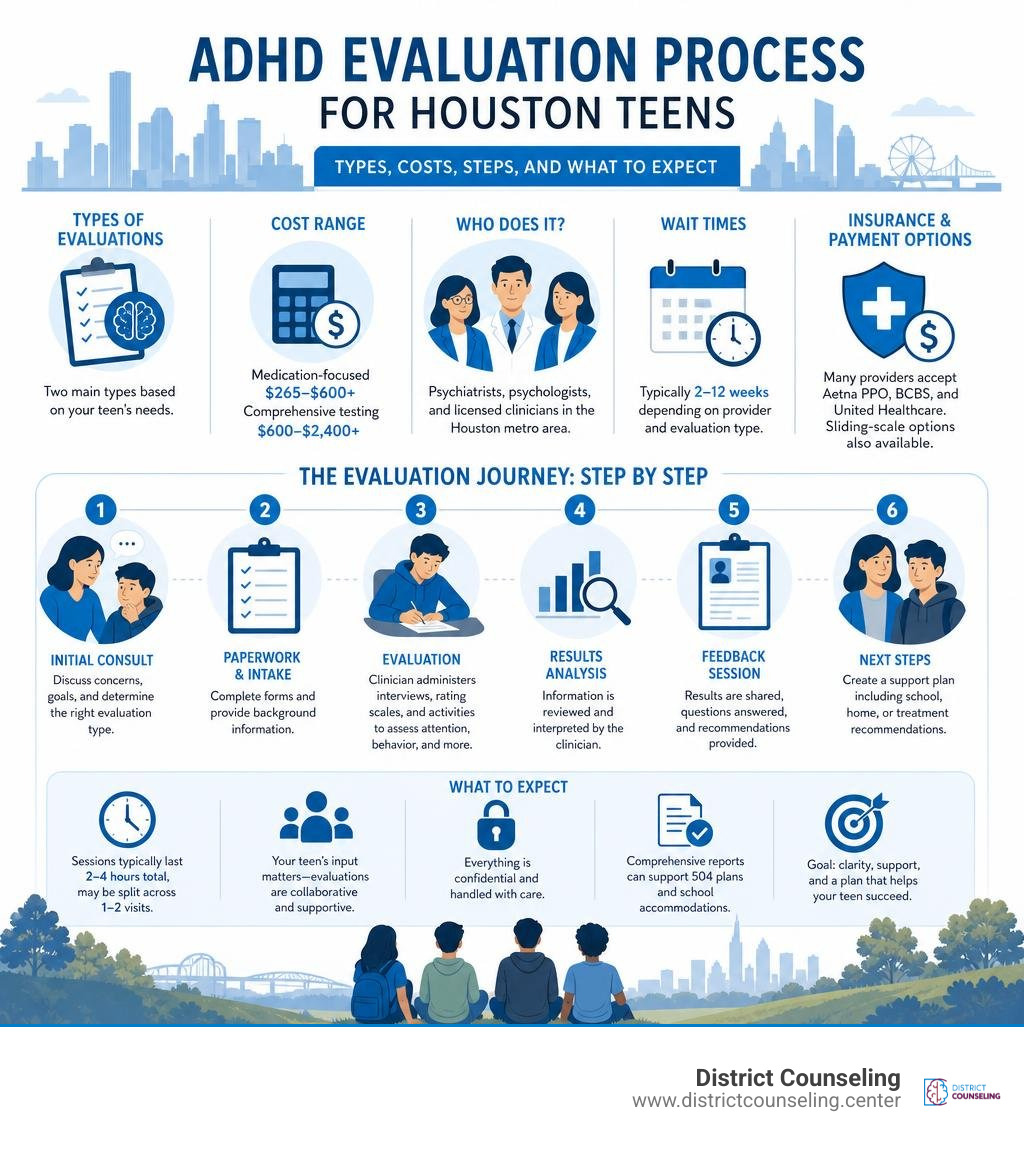
If your teen is struggling in school, losing focus, or getting overwhelmed — and you’re not sure why — you’re probably looking for answers fast. Here’s a quick overview of what to know:
Quick answers for Houston families:
- What it is: A structured assessment to determine if your teen has ADHD and what kind of support they need
- Two main types: Medication-focused evaluations ($265–$600+) vs. comprehensive testing for school accommodations ($600–$2,400+)
- Who does it: Psychiatrists, psychologists, and licensed clinicians in the Houston metro area
- Wait times: Typically 2–12 weeks depending on provider and evaluation type
- Insurance: Many Houston providers accept Aetna PPO, BCBS, and United Healthcare; sliding-scale options also exist
Navigating the options — from Katy to Pasadena — can feel overwhelming. Providers vary widely in what they test for, what they charge, and whether their reports will actually qualify your teen for school accommodations or a 504 plan. Not every evaluation is built the same, and choosing the wrong type can mean starting over.
The right evaluation starts with one question: what does your teen actually need from this process?
My name is Francisco Ortiz, a Licensed Professional Counselor-Supervisor and Director of School-based Clinical Mental Health Services with hands-on experience guiding Houston families through ADHD evaluations for teens — from initial concerns to practical next steps. In the sections below, I’ll walk you through every key decision so you can move forward with confidence.
Understanding the Purpose of an ADHD Evaluation for Houston Teens
When a teenager starts falling behind in school, losing track of assignments, or acting out, it is easy to mistake these struggles for typical “teen attitude” or laziness. However, under the surface, their brain might be working overtime just to keep up. As we look at the landscape of teen mental health in July 2026, the academic and social pressures on adolescents in the Houston metro area have never been higher.
The primary goal of an ADHD evaluation for Houston teens is to identify their specific functional needs. We want to understand why they are struggling. Is it a core deficit in executive functioning? Is it anxiety mimicking ADHD? Or is it a combination of learning differences?
For parents, watching a teen struggle with focus issues or emotional dysregulation can be heartbreaking. This is where parent involvement becomes absolutely critical. Unlike adult assessments, a teen evaluation relies heavily on the observations of those who see them every day—parents, teachers, and coaches.
If you are beginning to notice these patterns, utilizing an informal ADHD Test for Kids and Teens can be a helpful starting point to organize your observations. However, a screening tool cannot replace a formal diagnostic process. For a comprehensive look at how these assessments are structured across our state, you can read our guide on ADHD Evaluation for Children, Teens, and Adults in Texas.
Medication Management vs. Academic Accommodations
One of the most common mistakes families make is booking the first available appointment without asking what the final report will actually cover. The evaluation you need depends entirely on your goals.
Are you looking to see if medication might help your teen focus, or do you need a detailed portfolio of documentation to secure extra time on the SAT, ACT, or college entrance exams?
Screening for Medication-Focused ADHD Evaluation for Houston Teens
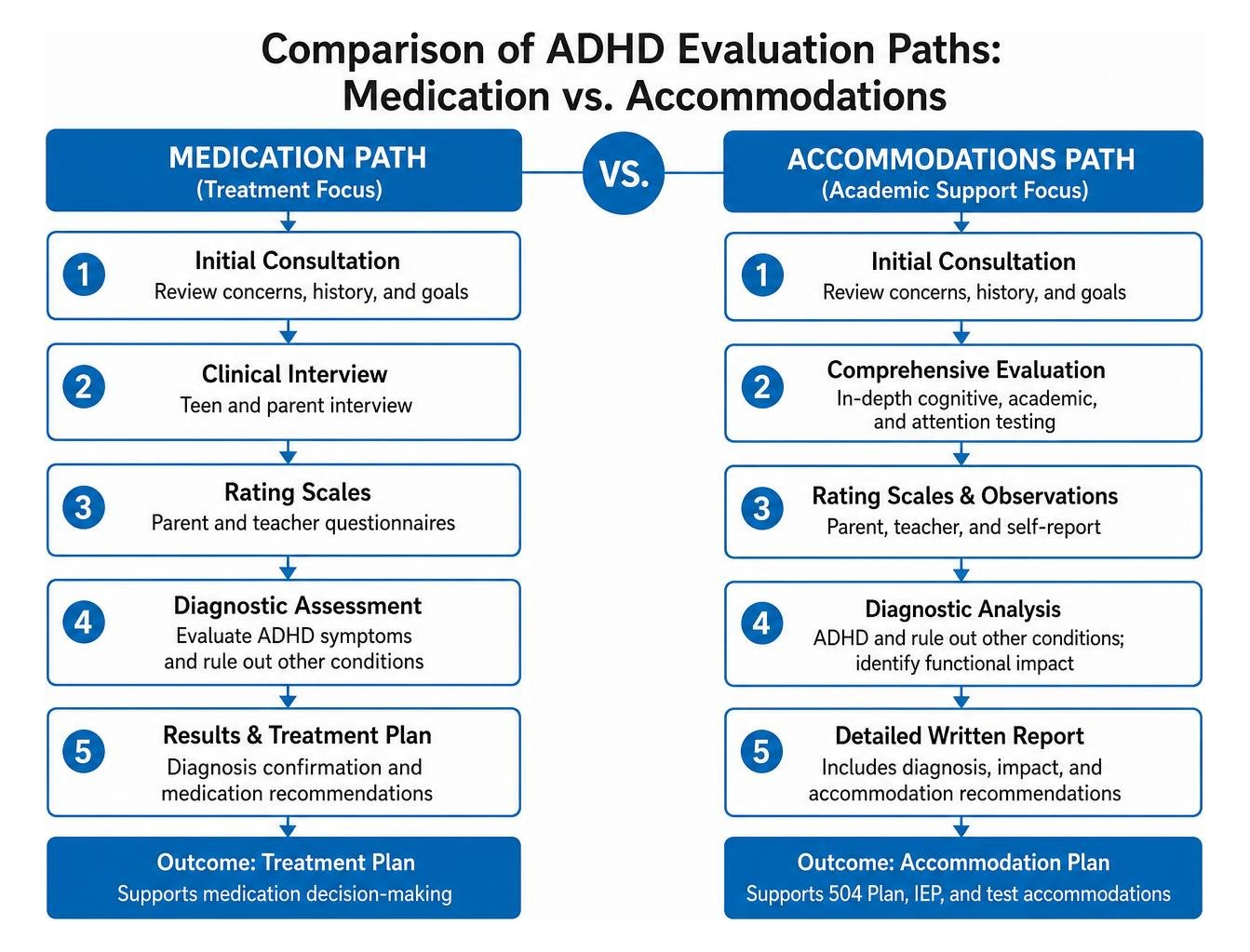
If your primary goal is to explore medical treatment options, the evaluation process is generally shorter and more direct. A medication-focused assessment is designed to confirm a clinical diagnosis so a psychiatrist or pediatric provider can safely begin treatment planning.
This path typically includes:
- A thorough clinical interview with the teen and parents.
- Standardized behavioral rating scales.
- A computerized test, such as the TOVA (Test of Variables of Attention), to objectively measure attention and impulsivity.
Because this evaluation focuses on symptom management rather than academic cognitive profiles, it is usually completed in one or two shorter sessions. However, it is important to understand who can legally diagnose and treat these conditions. If you are wondering about the credentials of your current support team, read our article on Can Your Therapist Actually Diagnose Your ADHD? to clarify what your therapist can and cannot do.
Comprehensive Testing for School Accommodations and 504 Plans
If your teen needs formal school support—such as a 504 plan, an Individualized Education Program (IEP) in Texas public schools, or accommodations at the university level—a simple diagnostic screener will not suffice.
School districts and higher education institutions, such as the University of Houston’s Justin Dart, Jr. Student Accessibility Center, require rigorous, objective proof of a functional limitation. To meet these standards, your teen must undergo comprehensive psychological or neuropsychological testing.
This extensive testing battery typically includes:
- Cognitive Testing: Utilizing tools like the Wechsler Adult Intelligence Scale (WAIS) or the Woodcock-Johnson (WJ) Cognitive Battery to assess intellectual potential and processing speed.
- Academic Achievement Testing: Measuring reading, writing, and math fluency to rule out Specific Learning Disabilities (SLDs).
- Executive Functioning Profiles: Deep-diving into working memory, cognitive flexibility, and self-regulation.
The result of this evaluation is a comprehensive 25-to-40-page integrative report. This document details your teen’s cognitive strengths and weaknesses and outlines specific, legally defensible accommodations (like extended testing time or distraction-free environments).
For families seeking a specialized medical framework for pediatric attention issues, resources like the Pediatric ADHD Diagnostic Clinic illustrate the clinical depth required for these complex diagnoses. You can learn more about the structure of these full clinical batteries by exploring our page on the ADHD Psychological Evaluation.
What to Expect During a Teen ADHD Assessment

Demystifying the evaluation process can significantly reduce the anxiety your teen might feel about being “tested.” An ADHD assessment is not like a school exam—there are no right or wrong answers, and your teen cannot “fail.”
A typical comprehensive assessment is designed to capture a complete picture of how your teen’s brain processes information. We look at behavior, cognitive performance, and emotional health to ensure we aren’t overlooking other factors, such as anxiety or depression, which can frequently mimic or co-occur with ADHD.
The process relies on a combination of clinical interviews, objective computerized performance tests, and standardized rating scales (such as the Conners or the Behavior Assessment System for Children, also known as the BASC). These rating scales are completed by the teen, their parents, and their teachers to look for consistent patterns across different environments.
Step-by-Step ADHD Evaluation for Houston Teens Process
To help you prepare, here is how the typical journey unfolds from your first call to the final feedback session:
- Initial Consultation & Clinical Interview: We meet with you and your teen to discuss their developmental history, academic struggles, and behavioral patterns.
- Gathering Multi-Observer Input: We distribute standardized rating scales to parents and teachers to gather objective data on how your teen functions at home and in the classroom.
- Active Testing Sessions: Your teen completes a series of cognitive, achievement, and computerized attention tests. For comprehensive testing, this may take between 4 to 6 hours, often split over multiple days to prevent fatigue.
- Data Analysis & Report Writing: The clinician scores the tests, integrates the behavioral data, and writes a detailed diagnostic report.
- The Feedback Meeting: We sit down with you (and often your teen) to walk through the findings, explain the diagnostic results, and hand over a concrete roadmap of recommended next steps.
For a closer look at preparing your family for this journey, check out our guide on How to Get Tested for ADHD in 7 Simple Steps.
Costs, Insurance, and Wait Times in the Houston Metro Area

When seeking an ADHD evaluation for Houston teens, understanding the financial and logistical landscape is essential. In the Houston metro area, costs, wait times, and insurance coverage can vary dramatically depending on the type of provider you choose.
- Out-of-Pocket Costs: A medication-focused evaluation with a local psychiatrist typically ranges from $265 to over $600 for the initial consultation and diagnostics. On the other hand, a comprehensive psychological testing battery for academic accommodations ranges from $600 to $2,400+ out-of-pocket, depending on the complexity of the test battery and the clinician’s specialization.
- Insurance Considerations: Some Houston providers accept major commercial insurance plans (such as Aetna PPO, Blue Cross Blue Shield PPO/HMO, and United Healthcare Choice Plus). When covered, this can reduce your out-of-pocket expense to a standard copay of $0 to $50 after your deductible is met. Other specialty clinics operate on a private-pay basis but can provide a “superbill” for you to submit to your PPO insurance for potential out-of-network reimbursement.
- Wait Times & Expedited Fees: Due to high demand in the greater Houston area, wait times for specialized testing can range from a few weeks to up to 3 months. Some clinics offer expedited report writing (delivering the final report within days instead of weeks) for an additional fee, which typically adds about 15% to the total cost.
- Sliding-Scale Options: For families on a tighter budget, some local university training clinics and community organizations offer sliding-scale fees based on household income, with comprehensive testing prices starting as low as $600 for qualifying students.
To help you weigh your options, we have compiled a comparison of the typical pathways in the Houston area:
| Evaluation Type | Typical Cost Range | Average Wait Time | Primary Deliverable | Best Suited For |
|---|---|---|---|---|
| Medication-Focused (Psychiatrist) | $265 – $600+ | 1 – 4 Weeks | Diagnostic Summary & Treatment Plan | Teens seeking medical symptom management |
| Comprehensive Psychological | $600 – $2,400+ | 4 – 12 Weeks | 25–40 Page Integrative Report | School accommodations (504/IEPs), College Board testing |
| Sliding-Scale / University Clinic | $600 – $900 | 8 – 16 Weeks | Full Cognitive & Behavioral Report | Budget-conscious families willing to wait |
Delaying an assessment can have a compounding impact on a teenager’s self-esteem and academic trajectory. To understand the broader implications of putting off testing, you can read more about The Hidden Cost of Waiting for an ADHD Evaluation.
Frequently Asked Questions About Teen ADHD Testing
How much does an ADHD evaluation cost in Houston?
In Houston, a basic psychiatric evaluation focused on medication management generally ranges from $265 to $600. A comprehensive psychological testing battery for school accommodations (which includes cognitive and academic achievement testing) typically ranges from $600 to $2,400+. Sliding-scale options at university training clinics can lower these costs to around $600 for families who qualify.
Does insurance cover ADHD testing for teenagers?
Yes, many insurance plans cover ADHD evaluations, but coverage depends heavily on the type of testing and the provider. Many local clinics accept major plans like Aetna, Blue Cross Blue Shield, and United Healthcare. However, some insurance companies do not cover the academic testing portion of an accommodation assessment because they deem it “educational” rather than “medically necessary.” It is always best to have the clinic’s administrative team verify your benefits beforehand.
What is the difference between testing for medication and testing for academic accommodations?
Testing for medication management focuses on identifying clinical symptoms to establish a diagnosis, often utilizing brief screeners, a clinical interview, and computerized tests like the TOVA. Testing for academic accommodations is far more extensive; it requires comprehensive cognitive and achievement testing to produce a multi-page, integrated clinical report that meets the strict legal standards required by schools, standardized testing boards, and university accessibility centers.
Conclusion
Finding the right support for your teenager doesn’t have to be a lonely or confusing process. Whether you are in Katy, Pasadena, Sugar Land, Cypress, or right in the heart of Houston, obtaining a clear, accurate diagnosis is the first step toward helping your teen unlock their true potential.
At District Counseling, we provide compassionate, authentic, and clinically rigorous psychological evaluations tailored to the unique needs of Texas families. We understand the local school systems, the academic pressures, and—most importantly—how to help your teen feel seen, supported, and understood.
If you are ready to take the next step and explore how we can support your family, visit our ADHD Evaluation Services page, or connect with our team directly through our District Counseling Houston Services portal. Let’s work together to give your teen the tools they need to thrive.
Visited 1 times, 1 visit(s) today
Similar Posts

Francisco Ortiz
October 16, 2026
Navigating Neuropsychological Evaluations from Katy to Pasadena
Learn how an ADHD evaluation for Houston teens works, from medication management to school accommodations and 504 plans....

Francisco Ortiz
October 14, 2026
How Texas caregivers can beat exhaustion with virtual therapy
Back-to-School Mental Health: Tips for a Smooth Transition – Discover practical tips to ease back-to-school anxiety for kids, teens, and parents. Build healthy routines, manage stress, and foster emotional… …...

Francisco Ortiz
October 12, 2026
Find Local Youth Counselor: How They Can Help Your Teen Thrive (52 characters)
Find a qualified youth counselor near me to help your teen thrive with evidence-based support for anxiety, trauma, and more....

Francisco Ortiz
October 9, 2026
Faith-Based Pastoral Counseling: A Comprehensive Guide
Discover how pastoral counseling integrates faith and psychology for holistic healing, grief, trauma, and marital support....

Francisco Ortiz
October 7, 2026
Houston Counseling Options: Find Local Help Nearby
Find affirming counseling in Houston for trauma, LGBTQ+ care, couples, and more. Explore local options and start your healing today....

Francisco Ortiz
October 5, 2026
Why every teacher needs a burnout therapy game plan
Why every teacher needs a burnout therapy game plan – Learn about burnout therapy for teachers...

Francisco Ortiz
October 2, 2026
Child Therapist Near Me? Here is How to Spot a Great One
Find a child therapist near me who fits your child’s needs. Learn signs, costs, and effective therapy options....

Adalid Blandin
September 30, 2026
Mental Health and Miracles: Finding Local Christian Care
Find pastoral counselling near me for faith-based emotional and spiritual support in Texas....

Adalid Blandin
September 28, 2026
Missouri City and Houston Couples Therapy 101
Explore relationship counseling in Houston options, from couples therapy to intensives, with costs, insurance, and therapist tips for Missouri City families....

Adalid Blandin
September 25, 2026
How to find authentic therapy for emotional exhaustion in Houston
Find emotional exhaustion therapy Houston that helps professionals and caregivers move from burnout to renewed energy and balance....


