
Mental Health and Miracles: Finding Local Christian Care
When Faith and Mental Health Meet: What to Know About Pastoral Counselling Near Me
If you are looking for pastoral counselling near me, here is a quick answer:
How to find pastoral counseling in your area:
- Search online directories (like the Christian Counselor Directory) using your zip code
- Ask your local church for referrals to licensed pastoral counselors
- Look for counselors with a graduate degree and theological or ministry training
- Check if telehealth options are available for added flexibility
- Confirm the counselor respects your beliefs without imposing their own
There are moments in life when emotional pain and spiritual questions arrive at the same time. Grief. A shattered marriage. A crisis of faith. Anxiety that no amount of prayer seems to quiet. In those moments, many people want more than a standard therapy appointment — they want someone who understands both the mind and the soul.
That is exactly what pastoral counseling is designed for. It sits at the intersection of clinical mental health care and faith-based support. It is not just therapy with a Bible verse added. And it is not a sermon with a couch. It is a carefully integrated approach — drawing on behavioral science and theological tradition — to help people grow in relationship with themselves, with others, and with God.
For busy parents and professionals in Texas navigating depression, anxiety, trauma, or relationship strain, knowing where to find this kind of care locally can feel overwhelming. This guide makes that search simpler.
I’m Francisco Ortiz, Licensed Professional Counselor-Supervisor and founder of AdventMind by District Counseling, an outreach ministry providing pro bono psychotherapy to low-income individuals and families — work that sits at the very heart of what pastoral counselling near me is all about. My experience bridging clinical mental health services with faith-informed care gives me a front-row view of what makes this approach so powerful, and I’ll walk you through everything you need to know to find the right fit.
What “pastoral counselling near me” really means
When people search for pastoral counselling near me, they usually are not just looking for a nearby office. They are looking for care that takes emotional pain seriously and spiritual life seriously at the same time.
That can include pastoral care, Christian counseling, psychotherapy, and soul care. The exact mix varies by counselor. Some focus more on spiritual support. Others offer fully licensed clinical treatment with faith integration as part of the process. At District Counseling, our goal is sincere, compassionate care aligned with what matters most to you, whether you are in Houston, Katy, Sugar Land, The Woodlands, Fort Worth, Austin, or another one of our Texas locations.
What is pastoral counseling?
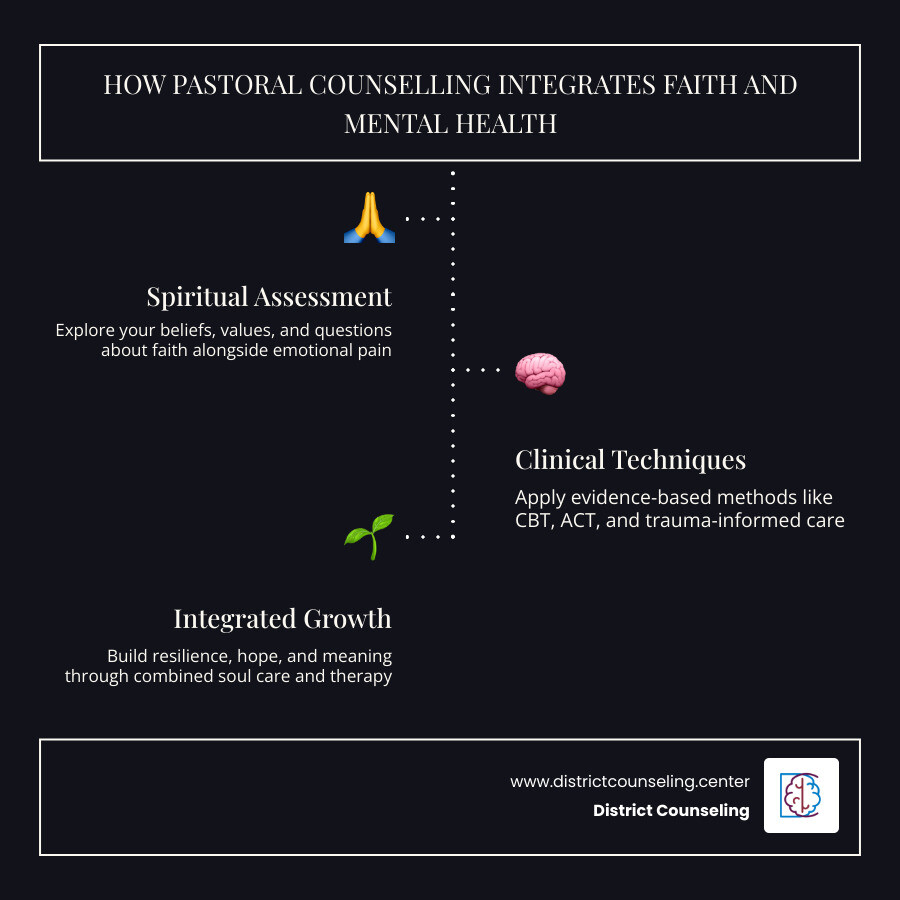
Pastoral counseling is a form of counseling that blends theology, spiritual insight, and mental health practice. Research consistently describes it as drawing from both behavioral science and theological tradition. In plain English: it helps people address symptoms, relationships, beliefs, meaning, suffering, and values without treating faith like an awkward side topic.
This matters because many people do not experience life in neat categories. Anxiety may stir spiritual fear. Grief may trigger questions about God. Marriage stress may feel both relational and moral. Pastoral counseling gives room for all of that.
You can learn more about our own Pastoral Counseling and broader Services.
How pastoral counselling near me differs from traditional therapy
Traditional therapy can be excellent, and many licensed therapists are skilled at working respectfully with religious clients. But pastoral counseling is different in emphasis.
A helpful way to think about it:
- Traditional therapy often focuses on mental health symptoms, behavior patterns, and relationships
- Pastoral counseling includes those areas while also exploring faith, conscience, spiritual practices, guilt, shame, purpose, and questions about God
- Spiritual direction focuses more on the spiritual life and less on diagnosing or treating mental health conditions
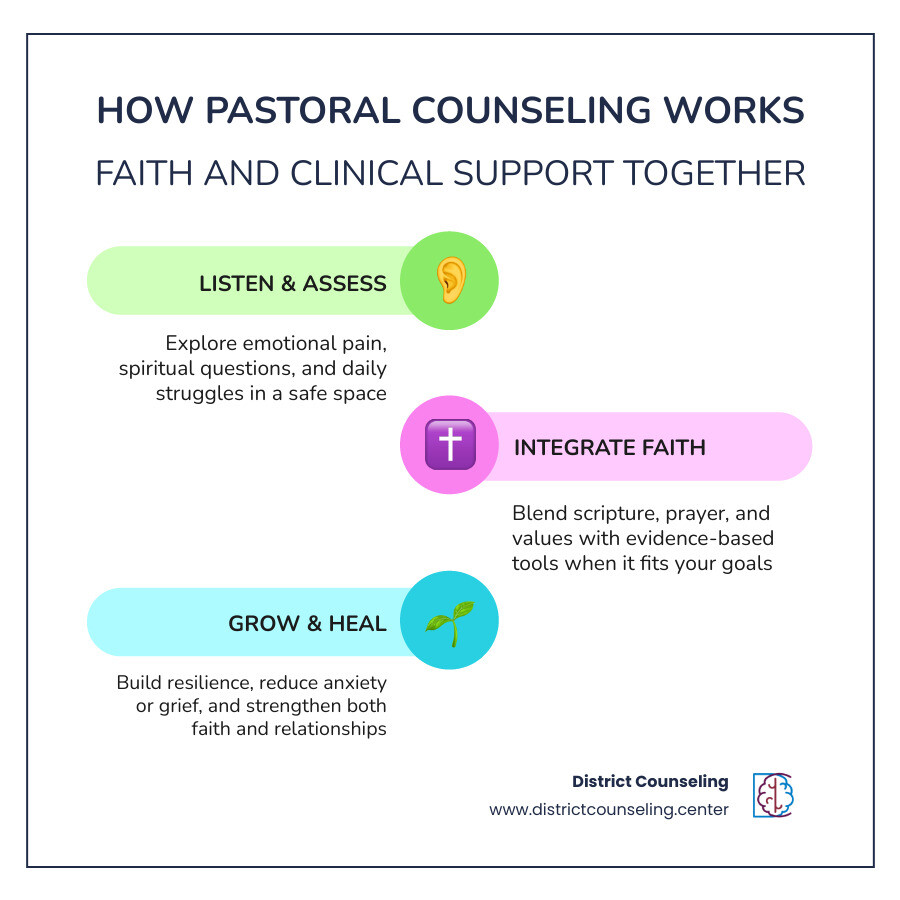
- Pastoral counseling can include prayer or scripture, but only if that fits the client’s goals and comfort
The key phrase is client choice. Good pastoral counseling does not force faith practices into every session like hot sauce on everything. It offers them thoughtfully and ethically.
Who benefits most from this kind of support?
Pastoral counseling can be especially helpful for people dealing with:
- Grief and loss
- Anxiety and depression
- Faith crisis or deconstruction
- Church hurt or religious trauma
- Marriage strain and family conflict
- Trauma and abuse recovery
- Burnout and life transitions
- Questions about identity, guilt, shame, and purpose
If you want support that honors both emotional and spiritual realities, this model can be a strong fit. For a wider overview, visit More info about services.
Benefits of choosing pastoral counselling near me
Searching locally has real advantages. Convenience is part of it, but not the whole story.
Local care can offer:
- Easier scheduling for ongoing sessions
- Better continuity for couples and families
- Faster support when stress becomes urgent
- Familiarity with your community, church culture, and Texas life
- Access to in-person care with telehealth backup
Across the broader faith-based counseling field, many centers have served their communities for decades. Some organizations report 25 years or more of service, while others highlight teams with hundreds of years of combined experience. That long-term presence reflects something important: people keep seeking this kind of integrated support because it meets a real need.
Emotional, relational, and spiritual benefits
Pastoral counseling can help people build resilience, restore hope, and reduce the isolation that often comes with pain. It can also address guilt and shame in a way that is emotionally informed and spiritually sensitive.
Common benefits include:
- Better emotional regulation
- Clearer understanding of relationship patterns
- Support during conflict resolution
- Help with burnout and stress management
- Greater connection to values and identity
- A healthier sense of belonging and meaning

For some clients, the biggest relief is finally not having to split themselves in two. They do not need to be one person in therapy and another person in church.
Why local matters for couples, families, and crisis support
For couples and families, local access can be especially important. Coordinating two adults, maybe a teenager, possibly a soccer schedule, and at least one person who forgot the calendar invite is not easy.
Nearby counseling helps with:
- Marriage and premarital support
- Parenting concerns
- Family communication problems
- Faster referrals for evaluations or higher levels of care when needed
- Consistent follow-up in times of crisis
And if getting to the office is difficult, telehealth can help bridge the gap. For couples support, explore More info about relationship and marital counseling.
Common issues addressed in pastoral counseling
Based on the research and common clinical practice, pastoral counseling often addresses:
- Grief and loss
- Anxiety
- Depression
- Addiction and recovery support
- Abuse history
- Anger and conflict
- Divorce recovery
- Spiritual issues and moral injury
- Trauma
- Parenting and family stress
At District Counseling, we also offer specialized support, including trauma care, EMDR, psychotherapy, and evaluations. If anxiety or depression is front and center, see More info about depression and anxiety counseling.
How to find qualified pastoral counselors or Christian therapists in your area
A local search should be more than “closest office wins.” You want quality, safety, and fit.
A practical search process:
- Use reputable directories and search by zip code
- Ask trusted church leaders for referrals, but verify credentials independently
- Check whether the counselor offers in-person, virtual, or hybrid care
- Review specialties, not just general descriptions
- Look for a counselor whose approach matches your spiritual and psychological goals
If you are exploring Texas options, our Therapy and pastoral counseling pages can help you start with clarity. It can also help to understand the broader professional standards around mental health licensure through trusted public resources like the American Psychological Association, especially when you are comparing training and ethical practice across providers.
Credentials and training to look for first
This is the big one. Warmth matters, but training matters too.
Look for:
- State licensure in counseling, marriage and family therapy, psychology, or social work
- At least a graduate degree in counseling, psychology, or a related field
- Additional theological, ministry, or pastoral care training
- Clear ethics and confidentiality policies
- Experience with your presenting issue
- Trauma-informed training when trauma is involved
Additional credentials may include ordination, Clinical Pastoral Education (CPE), or board certification in pastoral care fields. Research sources also note that many quality faith-based providers require at least graduate-level education and accredited professional training.
Questions to ask before booking
Before you schedule, ask direct questions. Awkward now is better than surprised later.
Helpful screening questions:
- Are you state licensed?
- What graduate training do you have?
- How do you integrate faith in counseling?
- Do you include prayer or scripture only if the client wants that?
- What issues do you specialize in?
- Do you work with couples or families?
- Are you trained in trauma care or EMDR?
- What is your policy for crises or urgent concerns?
- Do you offer telehealth?
- What are your fees, and do you provide superbills for reimbursement?
Red flags to avoid when searching locally
Not every provider who uses faith language is qualified for mental health treatment.
Watch out for:
- No clear license or vague credentials
- Claims that sound spiritual but avoid clinical specifics
- Pressure to agree with the counselor’s beliefs
- Shaming, fear tactics, or rigid advice without assessment
- Poor boundaries or unclear confidentiality
- No informed consent paperwork
- No crisis plan for serious concerns

Good pastoral counseling should feel safe, respectful, and professionally grounded.
What happens in sessions: faith, techniques, costs, and virtual options
Once you find a potential counselor, the next question is usually, “Okay, but what actually happens in the room?”
Fair question.
What to expect in your first pastoral counseling appointment
The first session is usually an intake. That means getting to know your story, current concerns, and goals.
You can generally expect:
- Questions about symptoms, relationships, stressors, and history
- Discussion of spiritual background if relevant to you
- Review of confidentiality and its limits
- Collaborative goal setting
- A chance to ask questions about the process
Research from pastoral counseling centers shows that appointments are often around 50 to 55 minutes. Early sessions usually focus on understanding the problem, building trust, and creating emotional safety before diving deep.
How faith and clinical techniques work together
This is where pastoral counseling gets practical. Faith integration does not replace clinical care. It works alongside it.
Depending on the counselor and the issue, sessions may include:
- CBT to challenge anxious or depressive thought patterns
- ACT to clarify values and respond more flexibly to distress
- EFT for couples and attachment repair
- Trauma-informed care to support nervous system safety
- EMDR for trauma processing
- Reflection on meaning, suffering, forgiveness, or spiritual practices
At its best, faith integration is client-led. If prayer, scripture, or theological reflection supports healing, we can make room for that. If you are questioning faith, grieving church hurt, or unsure what you believe, that also belongs in the room. Learn more about our Therapy approach.
Insurance, sliding scale, and typical costs
Costs vary widely by provider, location, license type, and format. Research in this space shows a common pattern:
- Some pastoral centers charge standard private-pay rates
- Some offer sliding scale fees based on income
- Some do not bill insurance directly but provide receipts or superbills for possible reimbursement
- Some licensed Christian counseling organizations accept certain insurance plans, but this varies by state and provider
One researched pastoral center listed fees around $105 to $125 per session with a sliding scale model. Another example in the field listed private-pay rates higher than that for individual and couples work. In other words, there is no universal price.
When comparing options, ask:
- What is the full session fee?
- Is there a sliding scale?
- Do you accept insurance?
- If not, do you provide a superbill?
- Are telehealth sessions priced differently?
Can pastoral counseling be virtual or only in person?
It can absolutely be virtual. Many faith-based counseling providers now offer both in-person and online care, and that flexibility matters.
Telehealth can be helpful for:
- Busy families balancing work and childcare
- Clients in parts of Texas where travel is difficult
- People who prefer privacy at home
- Couples with scheduling challenges
- Continuity when illness, weather, or commute issues interfere
At District Counseling, telehealth helps us serve clients across our Texas locations while still offering local connection.
How to choose the right pastoral counselor for your needs
The best counselor on paper is not always the best counselor for you. Fit matters.
You want someone who is qualified, yes, but also someone whose style, values, and specialty align with your needs.
Match the counselor’s specialty to your concern
Different concerns need different expertise.
Look for a counselor with experience in:
- Anxiety and depression care
- Grief work
- Religious trauma or church hurt
- Addiction recovery support
- Premarital and marriage counseling
- Family systems and parenting support
- Trauma treatment such as EMDR
- Psychological evaluations when questions about ADHD, autism, or other concerns are relevant
At District Counseling, we provide counseling, psychotherapy, trauma care, EMDR, telehealth, and psychological evaluations for concerns including ADHD, autism, and immigration-related needs.
Make sure the approach respects your faith without forcing it
Healthy pastoral counseling respects client autonomy. That means:
- Your beliefs are explored, not controlled
- Doubt is allowed
- Deconstruction is not treated as rebellion
- Nonjudgment matters
- Inclusion matters
- Spiritual practices are invited, not imposed
Some of the strongest insights in the research emphasize that faith should be treated as a resource, not as a symptom, and that spiritual elements should appear only in ways that feel right to the client. We agree.
Compare local options with confidence
When comparing providers, consider:
- Is the office convenient to your location?
- Do they offer telehealth?
- How soon can you get an appointment?
- Do they explain their treatment plan clearly?
- Do you feel heard in the consultation call?
- Do they track progress and revisit goals?
If you are ready to explore care with us, start with More info about pastoral counseling services.
Frequently Asked Questions about pastoral counselling near me
Is pastoral counseling only for deeply religious people?
No. It can help people who are deeply committed to their faith, loosely connected, spiritually curious, angry at God, hurt by church experiences, or simply wanting their beliefs respected. Good pastoral counseling is nonjudgmental and does not require a perfect faith résumé. Frankly, most people do not have one.
Do pastoral counselors handle serious mental health concerns?
Some do, especially if they are fully licensed clinicians. Serious concerns like trauma, depression, anxiety disorders, or relationship crises may be addressed in pastoral counseling when the provider has the right training. But scope matters. Some cases also require referrals for psychiatry, medication support, intensive treatment, or specialized trauma care. A responsible counselor will assess risk, discuss safety, and refer when needed.
How many sessions do most people need?
It depends on the goal. Some people benefit from short-term work focused on one issue, such as grief support or a life transition. Others need longer-term therapy for trauma, chronic anxiety, marriage distress, or complicated faith wounds. A good counselor will revisit goals, track progress, and adjust the plan over time rather than leaving you wondering whether session 19 is still about the original problem from session 2.
Conclusion
Finding pastoral counselling near me is really about finding care that can hold both your emotional pain and your spiritual life with wisdom, skill, and compassion.
That is what we aim to provide at District Counseling. Across our Texas locations, we support individuals, couples, and families with pastoral counseling, psychotherapy, trauma care, EMDR, evaluations, and telehealth. Whether you are in Houston, Fort Worth, Austin, Katy, Pearland, The Woodlands, or nearby, we want the process of getting help to feel clearer and more human.
If you are ready for next steps, explore More info about pastoral counseling services.
Visited 1 times, 1 visit(s) today
Similar Posts

Adalid Blandin
September 30, 2026
Mental Health and Miracles: Finding Local Christian Care
Find pastoral counselling near me for faith-based emotional and spiritual support in Texas....

Adalid Blandin
September 28, 2026
Missouri City and Houston Couples Therapy 101
Explore relationship counseling in Houston options, from couples therapy to intensives, with costs, insurance, and therapist tips for Missouri City families....

Adalid Blandin
September 25, 2026
How to find authentic therapy for emotional exhaustion in Houston
Find emotional exhaustion therapy Houston that helps professionals and caregivers move from burnout to renewed energy and balance....

Francisco Ortiz
September 23, 2026
A Practical Guide to Finding Licensed Telehealth Counselors in Texas
Find licensed telehealth counseling in Texas with this guide to legal standards, privacy, insurance, and best practices for virtual care....

Adalid Blandin
September 21, 2026
All About Psychiatric Weight Loss Options and Treatments
Explore psychiatric weight loss options, including medications, therapy, and bariatric support for holistic wellness....

Francisco Ortiz
September 18, 2026
No Traffic, No Waiting Rooms: Your Guide to Telehealth Counseling in Texas
Learn the rules, rights, and benefits of telehealth counseling in Texas with this complete guide to virtual therapy....

Adalid Blandin
September 16, 2026
Why Your Mitochondria Might Be Depressed
Explore metabolic mental health to boost brain energy, ease mood disorders, and support recovery through mitochondria-focused strategies....

Adalid Blandin
September 14, 2026
The Definitive Guide to Life Coaching
Discover how life coaching can help you achieve goals, gain clarity, and create lasting change in 2026....

Adalid Blandin
September 11, 2026
The Ultimate Guide to Identifying Emotional Abuse in Relationships
The Ultimate Guide to Identifying Emotional Abuse in Relationships – Learn about emotional abuse relationship...

Adalid Blandin
September 9, 2026
A Comprehensive Guide to Effective Relationship Counseling Options
A Comprehensive Guide to Effective Relationship Counseling Options – Learn about relationship counseling...


