
What You Need to Know About the Gottman Four Horsemen
The Gottman Four Horsemen are four destructive communication patterns that research shows can predict the breakdown of a relationship with striking accuracy.
Here is a quick summary:
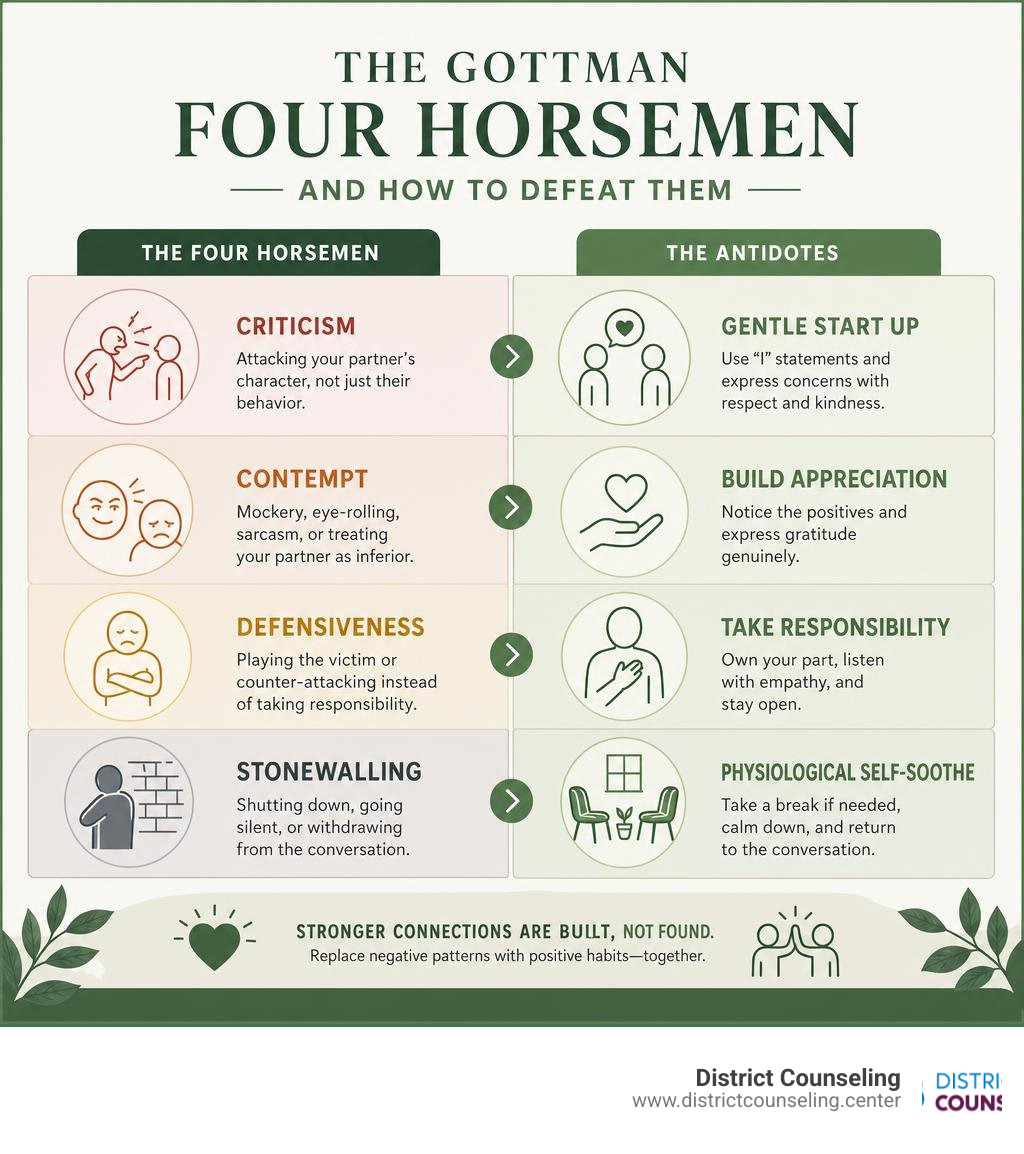
| Horseman | What It Looks Like |
|---|---|
| Criticism | Attacking your partner’s character, not just their behavior |
| Contempt | Mockery, eye-rolling, sarcasm, or treating your partner as inferior |
| Defensiveness | Playing the victim or counter-attacking instead of taking responsibility |
| Stonewalling | Shutting down, going silent, or withdrawing from the conversation |
These four patterns were identified by Dr. John Gottman after decades of observing real couples in conflict. His research found they could predict divorce with up to 93-94% accuracy. That is not a small finding. It means that how couples fight matters far more than what they are fighting about.
If any of those patterns sound familiar, you are not alone. Most couples fall into at least one of them at some point. The good news is that each one has a clear, practical antidote.
Every relationship hits rough patches. But there is a difference between normal conflict and the kind of recurring, escalating communication patterns that slowly erode trust and intimacy over time. Recognizing the Four Horsemen in your own relationship is the first and most important step toward changing course.
I’m Francisco Ortiz, a Licensed Professional Counselor-Supervisor with extensive experience helping individuals, couples, and families work through relationship conflict — including the patterns described by the Gottman Four Horsemen. In my work with couples, I see these behaviors show up regularly, and I know how transformative it can be when partners learn to identify and replace them.
What Are the Gottman Four Horsemen?
To understand where these concepts come from, we have to look back at the decades of groundbreaking research conducted by Dr. John Gottman and his team at the University of Washington’s famous “Love Lab.” By observing hundreds of couples during conflict discussions — measuring everything from their heart rates and sweat production to their specific facial expressions and word choices — Gottman uncovered something profound. Relationship failure isn’t random. It follows a highly predictable trajectory.
Gottman introduced the biblical metaphor of the “Four Horsemen of the Apocalypse” to describe the four communication styles that consistently pave the way toward separation. According to his longitudinal research, when these four behaviors become chronic, they create a destructive spiral known as the Scientific research on the Cascade Model of Relational Dissolution. This model shows that relationship decay is a progressive, step-by-step decline. One horseman opens the gate for the next, steadily dismantling the emotional safety net couples rely on.
Gottman’s research on 95 newlywed couples found that observing these behaviors allowed researchers to predict marital stability with 87.5% accuracy after four to six years, and 81% accuracy after seven to nine years. Across his broader, decades-long studies of over 300 couples, that predictive power reached an astonishing 93% to 94% accuracy rate.
However, it is vital to understand that the presence of conflict itself is not the problem. In fact, healthy conflict can be a functional catalyst for growth. What separates stable couples from those heading toward dissolution is the ratio of positive to negative interactions. In stable relationships, there is a “magic ratio” of 5:1 during conflict — meaning for every single negative interaction, there are at least five positive ones (like a smile, an affectionate touch, or an admission of agreement). During ordinary daily life, that ratio jumps to 20:1. When the gottman four horsemen take over, this ratio collapses, and the relationship enters a state of chronic distress.
The Four Destructive Communication Patterns and Their Impacts
When these toxic communication styles establish residency in your home, they do not just make arguments unpleasant; they actively reshape how you view your partner. Over time, they systematically destroy emotional intimacy, chip away at relationship satisfaction, and make it incredibly difficult to feel safe or valued.

Every time one of these behaviors is utilized, it makes a withdrawal from your relationship’s emotional bank account. If you do not actively work to rebuild that balance, you will eventually find your relationship emotionally bankrupt. Let’s break down how each horseman manifests and the unique damage they cause, keeping in mind that learning how to navigate these challenges is essential to preserving your bond. For more foundational advice on keeping your connection strong, check out our guide on Tips to Build Trust in a Relationship.
Criticism: The First of the Gottman Four Horsemen
It is completely normal to have complaints about your partner’s behavior. However, there is a massive structural difference between a complaint and criticism.
A complaint addresses a specific, situational action or behavior. It focuses on a single event and expresses how you felt about it. Criticism, on the other hand, is an ad hominem attack on your partner’s core character or personality. It implies that there is a fundamental, permanent defect in who they are.
Criticism almost always features globalizing words like “you always” or “you never.”
- Complaint: “I was scared when you were running late and didn’t call. We agreed we’d keep each other updated.”
- Criticism: “You never think about anyone but yourself! You are so incredibly selfish and forgetful.”
When you criticize, you are not just asking for a change in behavior; you are telling your partner that they are the problem. According to The Gottman Four Horsemen | Gottman Institute, criticism is particularly insidious because it acts as the gateway drug for the other three horsemen. When a partner feels constantly criticized, they naturally become defensive, which quickly invites contempt and stonewalling into the dynamic.
Contempt: The Most Poisonous of the Gottman Four Horsemen
If criticism is a warning sign, contempt is an active emergency. Contempt is widely recognized by relationship experts as the single greatest predictor of divorce. It must be completely eliminated if a relationship is to survive.
Contempt is criticism delivered from a position of moral superiority. When you speak to your partner with contempt, you are intentionally treating them with disrespect, disgust, or condescension. It is an attempt to make them feel small, worthless, or stupid. Contempt manifests as:
- Sarcasm and cynical, biting humor
- Name-calling and insults (“I thought I married an adult, not a toddler!”)
- Hostile body language, such as dramatic eye-rolling, sneering, or scoffing
Because contempt communicates utter disgust, it makes resolution virtually impossible. It is psychological abuse disguised as an argument. Furthermore, the consequences of contempt are not just emotional — they are physical. Studies show that couples who frequently express contempt toward one another actually suffer from higher rates of infectious illnesses (like colds and the flu) due to weakened immune systems caused by chronic physiological stress. As highlighted in The 4 Strongest Predictors of Divorce | Psychology Today, contempt acts as a highly toxic agent that degrades both your emotional bond and your physical well-being.
Defensiveness: Shifting Blame and Playing the Victim
When we are criticized or attacked, our biological instinct is to protect ourselves. In relationships, this self-defense mechanism manifests as the third horseman: defensiveness.
Defensiveness is essentially a way of blaming your partner. It sends the message: “The problem isn’t me, it’s you.” It typically shows up in one of two ways:
- The Innocent Victim Stance: Making excuses and whining to avoid taking responsibility. (“It’s not my fault we’re late! I had a crazy day at work, and you know how busy I was!”)
- Righteous Indignation / Counter-attacking: Meeting your partner’s complaint with a complaint of your own to deflect. (“Why are you bringing up my spending? What about that massive Amazon order you placed yesterday?”)
Defensiveness escalates conflict because it acts as a barrier to communication. When you become defensive, you refuse to hear your partner’s perspective, validate their feelings, or accept any share of the blame. This leaves your partner feeling completely unheard, which usually causes them to escalate their criticism, trapping you both in a highly destructive loop.
Stonewalling: Physiological Flooding and Emotional Withdrawal
Stonewalling occurs when one partner completely withdraws from the interaction, shutting down and refusing to respond. Instead of confronting the issue, the stonewaller checks out. They might look away, cross their arms, go entirely silent, or physically walk out of the room. It is the ultimate “silent treatment.”
While it can look like a passive-aggressive attempt to punish the other partner, stonewalling is actually a protective coping mechanism. It is triggered by emotional flooding (or Diffuse Physiological Arousal). When a person is flooded, their sympathetic nervous system goes into fight-or-flight mode. Their heart rate climbs past 100 beats per minute, stress hormones flood their body, and their brain’s prefrontal cortex (responsible for rational thought and communication) goes offline. They are physically incapable of processing information or engaging in a productive conversation.
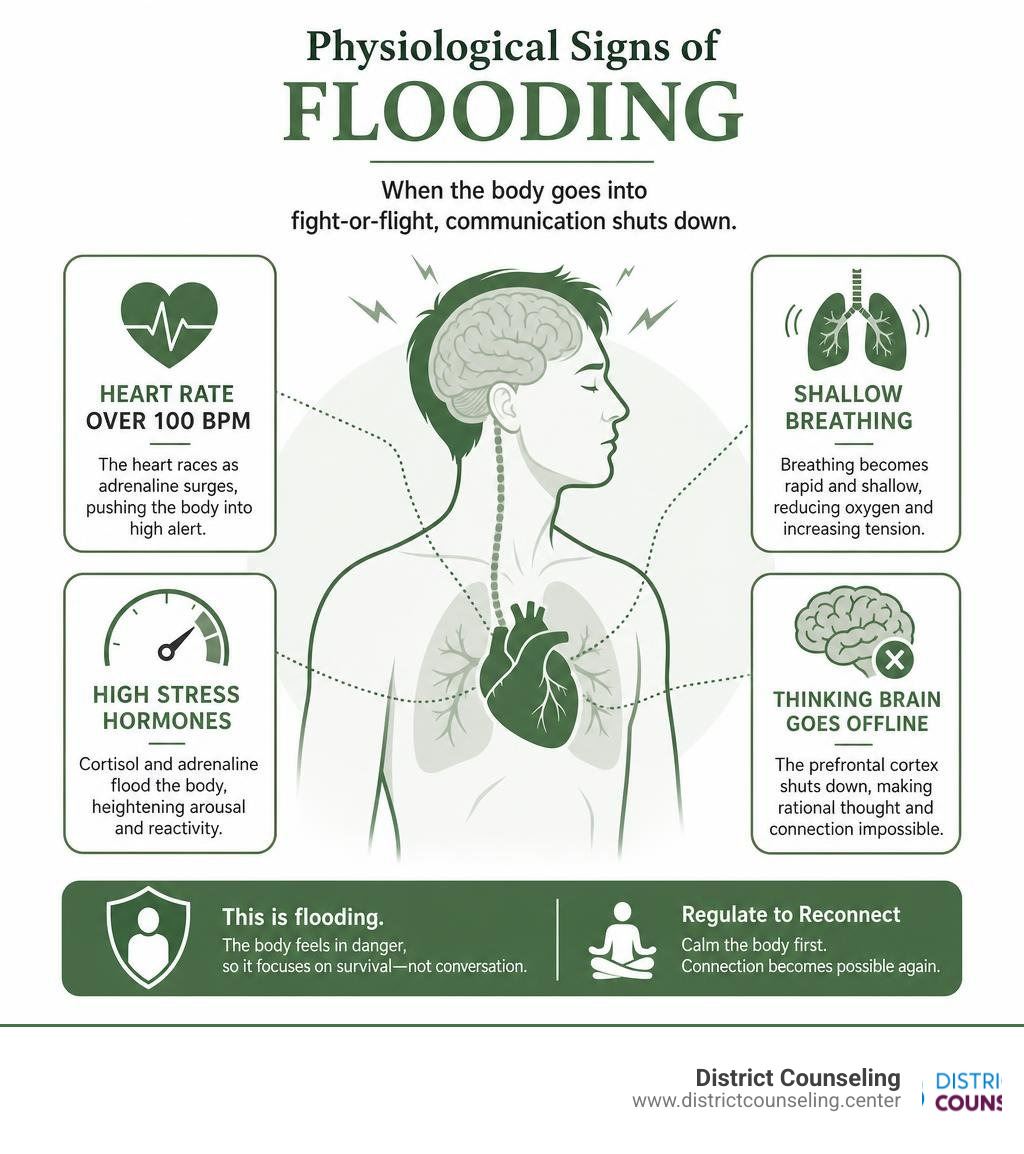
Stonewalling is incredibly damaging to relationship satisfaction. Research indicates that males are at a much higher risk for this behavior, with roughly 85% of stonewallers in heterosexual relationships being men. This is because men tend to flood faster and remain physiologically aroused longer than women. For a deeper look into how this dynamic plays out, you can read The 4 Horsemen of the Marriage Apocalypse.
How to Defeat the Four Horsemen with Proven Antidotes
Identifying these toxic behaviors in your relationship can be discouraging, but it is not a death sentence. The presence of the horsemen is simply a signal that your communication system is broken — not that your love is gone. For every single horseman, there is a scientifically proven, highly practical antidote.
| The Horseman | The Antidote | Core Objective |
|---|---|---|
| Criticism | Gentle Start-Up | Express your feelings and state a positive need without blame. |
| Contempt | Build a Culture of Appreciation | Regularly express gratitude, fondness, and respect. |
| Defensiveness | Take Responsibility | Accept your partner’s perspective and admit your own mistakes. |
| Stonewalling | Physiological Self-Soothing | Take a 20-minute break to calm your body before continuing. |
By consistently practicing these antidotes, you can systematically dismantle the horsemen and build a relationship based on mutual respect and safety. To learn more about implementing these shifts, explore The Four Horsemen: The Antidotes.
Gentle Start-Up: The Antidote to Criticism
The way a conflict conversation begins determines how it will end. Gottman’s research shows that the first three minutes of a discussion predict the outcome of the entire interaction with 96% accuracy. If you start with a harsh, critical attack, you are almost guaranteed a defensive, unproductive argument.
The antidote to criticism is a Gentle Start-Up. A gentle start-up allows you to express your complaint without assigning blame. It follows a simple three-step formula:
- Share how you feel: Start with “I feel” instead of “You always.” (e.g., “I feel overwhelmed,” “I feel lonely.”)
- Describe the specific situation: State the facts of what happened without judging or evaluating. (e.g., “when the kitchen counters are cluttered,” “when we don’t spend time together in the evening.”)
- State your positive need: Clearly ask for what you do want, rather than focusing on what you don’t want. (e.g., “I would really appreciate it if we could clear off the counters tonight,” “I need us to schedule a date night this week.”)
- Instead of: “You’re so lazy, you never help with dinner!”
- Try: “I’m feeling really tired tonight, and I would love some help chopping the vegetables for dinner.”
Building a Culture of Appreciation: The Antidote to Contempt
Because contempt stems from a place of superiority and disgust, the only way to defeat it is to cultivate the exact opposite emotions: appreciation, fondness, and respect. You cannot feel contempt for someone while actively feeling grateful for them.
Building a culture of appreciation is not a quick fix you can apply in the middle of a fight. It is a daily practice. It involves making regular, small deposits into your emotional bank account. When you actively look for your partner’s positive qualities and verbally express gratitude for them, you build an emotional buffer that protects your relationship during times of stress.
- The Daily Habit: Tell your partner at least one thing you appreciate about them every single day. It can be small (“Thank you for making the coffee this morning”) or deep (“I really admire how patient you are with our kids”).
- The Shift in Perspective: Unhappily married couples tend to undercount their partner’s positive behaviors by roughly 50%. By consciously focusing on what your partner is doing right rather than what they are doing wrong, you retrain your brain to see them as an ally, not an adversary. For more tips on fostering this mindset, read How to Build Trust Between a Couple.
Taking Responsibility: The Antidote to Defensiveness
Defensiveness is a refusal to yield. To defeat it, you must practice the courage of accountability. The antidote to defensiveness is to take responsibility for even a small part of the problem.
When your partner brings a complaint to you, your goal should not be to win the argument or prove your innocence. Your goal should be to understand their experience and find common ground. Even if you believe your partner is 90% wrong, you can still find 10% of the situation that you can own up to.
- Instead of: “I would have loaded the dishwasher if you hadn’t kept me out so late running your errands!”
- Try: “You’re right, I did forget to load the dishwasher. I was rushed and lost track of time. I’ll take care of it right now.”
By accepting responsibility, you instantly de-escalate the tension. It shows your partner that you are listening, that you value their feelings, and that you are committed to working as a team rather than fighting as opponents.
Physiological Self-Soothing: The Antidote to Stonewalling
When you are in the grips of physiological flooding, you cannot think logically, listen empathetically, or communicate constructively. Trying to force a conversation when one or both partners are flooded is like trying to drive a car with no brakes — it will inevitably end in a crash.
The only effective antidote to stonewalling is Physiological Self-Soothing. This requires a structured, intentional break:
- Recognize the signs: Pay attention to your body. Is your heart racing? Is your breathing shallow? Are your muscles clenched?
- Call a timeout: Let your partner know you are feeling overwhelmed and need a break. You must agree on a specific time to return to the conversation (e.g., “I’m feeling too flooded to hear you clearly right now. I need to take a 20-minute break to calm down, and then I want to come back and finish this discussion”).
- Soothe yourself: During the break, do not pace around ruminating on how unfair your partner is. This will keep your heart rate high. Instead, engage in activities that physically calm your nervous system. Take deep breaths, go for a walk, listen to calming music, or read a book.
- The 20-Minute Rule: It takes the human body a minimum of 20 minutes to physiologically clear stress hormones (like cortisol and adrenaline) and return to a baseline resting state. Do not attempt to resume the conversation any sooner.
When to Seek Professional Help for Relationship Conflict
While understanding the gottman four horsemen and their antidotes is incredibly empowering, putting them into practice in the heat of the moment can be exceptionally difficult. When destructive communication patterns have been running unchecked for years, they become deeply ingrained habits.

If you find that your attempts to use the antidotes repeatedly devolve into the same old arguments, or if emotional disconnection and resentment have built a wall between you, it may be time to seek professional support. We are here to help. At District Counseling, we provide specialized, evidence-based couples counseling designed to help you interrupt toxic cycles, rebuild your friendship layer, and establish healthy communication habits.
Working with a skilled therapist can help you:
- Identify your specific relational patterns in real-time.
- Practice the antidotes in a safe, neutral, and guided environment.
- Uncover the deeper attachment wounds and emotional triggers beneath your arguments.
- Learn how to make and receive “repair attempts” to stop conflicts before they escalate.
If you are ready to stop the cycle of conflict and start rebuilding your connection, we encourage you to read more about Improving Communication with Spouse or review our guide on When to Seek Couples Counseling.
Frequently Asked Questions about Relationship Communication
Can a relationship survive if all four horsemen are present?
Yes, absolutely. The presence of the Four Horsemen is a sign of distress, not a permanent death sentence for your relationship. Many couples walk into our counseling offices with all four horsemen actively running rampant in their daily interactions.
The key to survival is not having a perfect relationship; it is the willingness of both partners to learn, practice, and implement the antidotes. With commitment, self-awareness, and often the guidance of a professional, these destructive habits can be unlearned. For a comprehensive look at how therapy can guide this transformation, check out The Ultimate Guide to Marital Counseling.
Why is contempt considered the most destructive behavior?
Contempt is uniquely destructive because it is fueled by disgust and a sense of moral superiority. Unlike criticism, which is an attack on character, contempt actively seeks to strip away your partner’s self-worth. It is a form of psychological abuse that makes emotional safety impossible.
When contempt is present, it erodes the foundation of respect that every healthy partnership requires to survive. It also creates chronic physiological stress, which can severely compromise your physical health and immune system over time.
How do you stop stonewalling in the middle of an argument?
You cannot stop stonewalling by trying to force your partner to talk. If they are stonewalling, they are physiologically flooded and physically incapable of having a rational conversation.
The only way to stop stonewalling is to respect the body’s physiological limits. Name the flooding (“I can see we are both getting too upset to hear each other”), request a pause, and step away for at least 20 to 30 minutes to self-soothe. Only return to the conversation once both of your heart rates have dropped back to a normal resting state.
Conclusion
The Gottman Four Horsemen — criticism, contempt, defensiveness, and stonewalling — are incredibly common, but they do not have to define the future of your relationship. By learning to recognize these patterns and replacing them with their proven antidotes, you can transform your communication, heal old wounds, and build a partnership that is resilient, loving, and secure.
At District Counseling, we are deeply committed to providing compassionate, authentic, and expert alignment to what matters most to couples across Texas. Whether you are located in Houston, Katy, Sugar Land, The Woodlands, Austin, Fort Worth, or any of our other convenient locations, our team of dedicated therapists is here to support you every step of the way.
Do not wait until the horsemen have completely eroded your connection. Take the first step toward a healthier, happier partnership today. Schedule a consultation for Relationship & Marital Counseling with us, and let’s work together to build the strong, lasting bond you deserve.
Visited 139 times, 1 visit(s) today
Similar Posts

Francisco Ortiz
August 28, 2026
Licensed Telehealth Therapy Providers in Texas: A Quick Start Guide
Find licensed telehealth therapy Texas providers with this guide to legal rules, insurance parity, and clinical best practices....

Francisco Ortiz
August 26, 2026
The Intimacy Fix: What to Expect from Couples Sex Counselling
Learn how a relationship counsellor sex specialist helps couples rebuild intimacy, desire, and trust through evidence-based therapy....

Francisco Ortiz
August 24, 2026
Before the Nikah: Navigating Islamic Premarital Counseling
Discover how premarital counseling Islam builds a sacred, lasting union through faith-based modules, therapy, and practical guidance before your Nikah....

Francisco Ortiz
August 21, 2026
The Ultimate Guide to West Lake Hills Family Counseling and Keeping the Peace
The Ultimate Guide to West Lake Hills Family Counseling and Keeping the Peace – Learn about west lake hills family counseling...

Francisco Ortiz
August 19, 2026
How Relationship Therapy for Couples Can Save Your Sanity
Discover how relationship therapy for couples can restore connection, resolve conflict, and rebuild trust with evidence-based guidance....

Francisco Ortiz
August 17, 2026
Ready to Wed: What to Expect in Christian Premarital Counseling
Discover what to expect in premarital counseling Christian couples trust for a strong, faith-based marriage foundation....

Francisco Ortiz
August 14, 2026
Space City Love: Navigating Gottman Method Couples Therapy in Houston
Discover how Gottman Method couples therapy in Houston helps partners rebuild intimacy, manage conflict, and strengthen their bond with expert guidance....

Francisco Ortiz
August 12, 2026
A – Z Guide to Houston Counseling Options
A – Z Guide to Houston Counseling Options – Learn about Houston counseling...

Francisco Ortiz
August 10, 2026
Before You Walk Down the Aisle: Must-Read Premarital Counseling Books
Discover the best premarital counseling books for faith-based or secular marriage preparation, including workbooks and expert guides....

Francisco Ortiz
August 7, 2026
From Eye Contact to Intimacy: Relationship Therapy Exercises That Actually Work
Try these 5 relationship therapy exercises to boost intimacy, improve communication, and strengthen your bond at home....


