Depression Is More Common Than You Think — And Treatable
Finding the best therapy for depression is one of the most important steps a person can take toward feeling like themselves again.
Quick answer: What are the best therapies for depression?
| Therapy | Best For | Typical Length |
|---|---|---|
| Cognitive Behavioral Therapy (CBT) | Negative thought patterns, most depression types | 6–20 weekly sessions |
| Interpersonal Psychotherapy (IPT) | Grief, relationship stress, life transitions | 16–20 weekly sessions |
| Behavioral Activation (BA) | Low motivation, withdrawal, loss of pleasure | 20–24 weekly sessions |
| Psychodynamic Therapy | Deep-rooted patterns, self-awareness | 3–80 weekly sessions |
| Mindfulness-Based Cognitive Therapy (MBCT) | Relapse prevention, recurring depression | 8 weekly sessions |
Depression affects roughly 9% of U.S. adults every year — and up to 30% of women over a lifetime. Yet many people go months or even years without getting the right help. That gap often comes down to one thing: not knowing where to start.
The good news? Multiple evidence-based therapies have strong track records. Research including a comprehensive review of 409 trials and over 52,000 patients shows that psychotherapy produces meaningful, lasting results — often outperforming medication alone over the long term.
This guide breaks down the five most effective therapy types in plain language, so you can make a confident, informed decision.
I’m Francisco Ortiz, a Licensed Professional Counselor-Supervisor with extensive experience helping individuals, couples, and families navigate mood disorders — including finding the best therapy for depression for each person’s unique situation. I’ll walk you through what the research actually says, so you can move forward with clarity.
What is the Best Therapy for Depression?

When people ask us, “What is the best therapy for depression?” they are usually looking for a single, definitive answer. However, the reality of mental health care is beautifully complex: the “best” therapy is the one that aligns most closely with your unique symptoms, personality, history, and goals.
In the clinical world, we rely on evidence-based care—meaning treatments that have been rigorously tested and proven to work in peer-reviewed scientific studies. A landmark clinical review published in JAMA (Journal of the American Medical Association) highlights that several structured psychotherapies show medium-to-large healing effects compared to standard, unstructured care.
But does talk therapy actually make a physical difference? Absolutely. When you undergo professional counseling, your brain undergoes structural and functional changes. You are essentially rewiring your neural pathways to respond differently to stress, sadness, and negative self-talk. To explore this deeper, you can read our detailed breakdown on Does Professional Counseling Help with Depression?.
Finding the Best Therapy for Depression for Your Needs
To find the approach that will work best for you, we must look at several key factors:
- Severity Levels: If you are dealing with mild depression, you may find rapid relief through behavioral adjustments or short-term therapy without any need for medication. For moderate depression, you have a choice—both evidence-based psychotherapy and medication are highly effective, and your personal preference should guide the decision. For severe depression, combining psychotherapy with medical management often yields the most robust results.
- Your Primary Symptoms: Are you constantly fighting a critical inner voice? (CBT might be your best bet). Are you grieving a major loss or struggling with a painful divorce? (Interpersonal Therapy could be the key). Have you completely withdrawn from your hobbies and friends? (Behavioral Activation is designed specifically for this).
- Patient Preference: Therapy only works if you feel bought into the process. If you dislike homework and prefer open-ended exploration, a highly structured cognitive program might feel frustrating, whereas a psychodynamic approach might feel like home.
Taking the time to understand these nuances is the first step in Finding the Right Therapist who can tailor a treatment plan specifically to your life.
Why Psychotherapy is the Gold Standard for Depression
While antidepressant medications are widely prescribed, they have clear limitations. Large-scale clinical reanalyses show that traditional antidepressant medications relieve symptoms in only about one-third of patients who take them. Even more concerning, less than 2% of patients experience success when trying a third or fourth medication after the first few have failed.
Psychotherapy, on the other hand, provides you with mental tools that you keep for the rest of your life. According to a comprehensive systematic review on the Enduring effects of psychotherapy, antidepressants and their combination for depression, psychotherapy alone shows a clear, statistically significant superiority over pharmacotherapy alone in preventing relapse and recurrence.
Specifically, the risk of relapse or recurrence after completing a course of psychotherapy ranges from 33% to 39%. In contrast, patients who discontinue antidepressant medications face a much higher relapse rate of 47.5% to 65%. Why? Because pills manage symptoms, but therapy teaches emotional regulation, cognitive restructuring, and active problem-solving. It treats the root cause, not just the chemical downstream effects.
5 Evidence-Based Psychotherapies for Depression

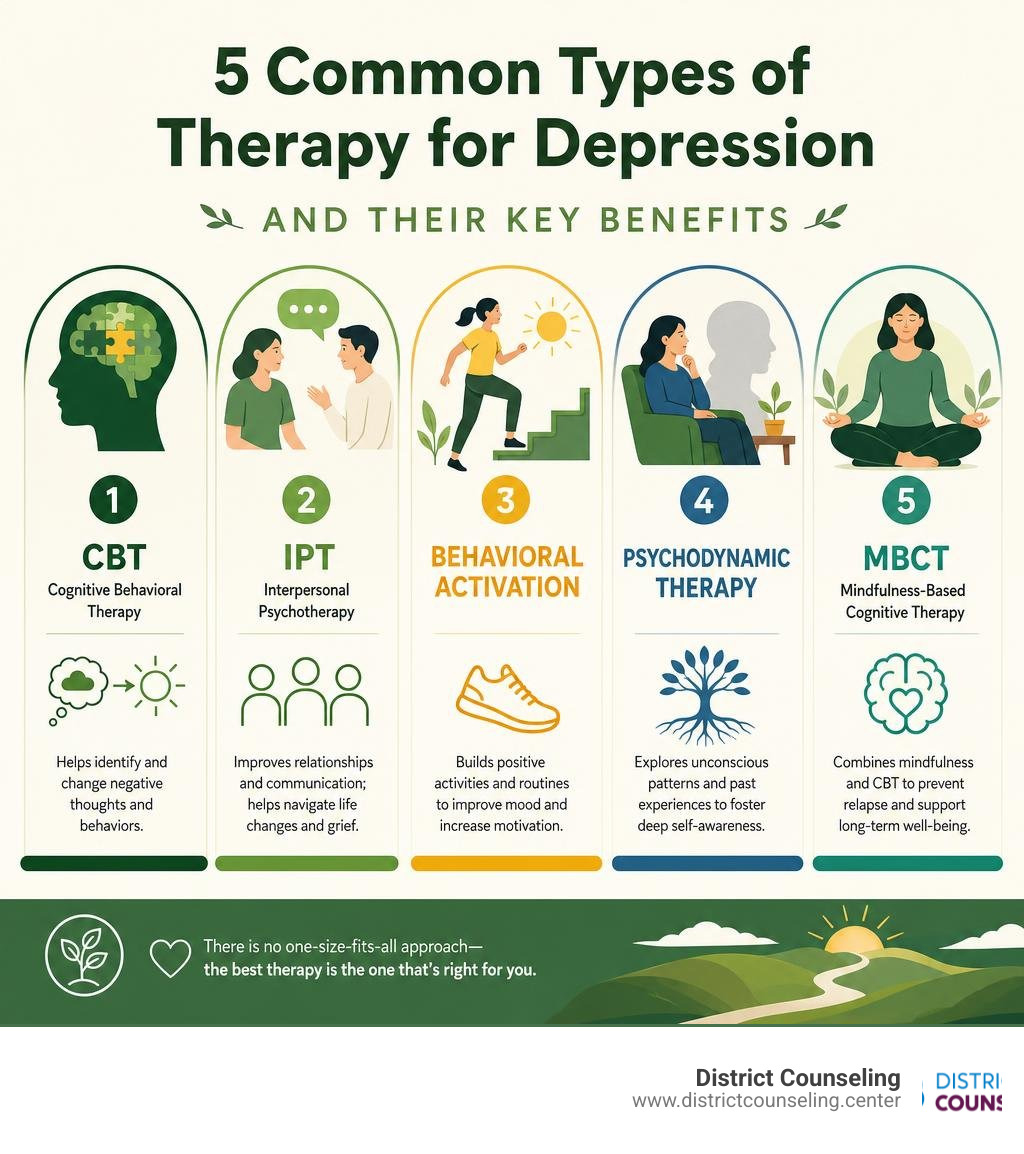
When you begin searching for help, the sheer number of acronyms and clinical terms can feel overwhelming. To simplify your search, the American Psychological Association (APA) and major clinical guidelines recommend several core psychotherapies for adult depression.
If you are wondering which of these fits your situation, you can read our guide on What Counseling Approach is Best for Depression?. Below, we compare the five most common and effective modalities.
| Therapy Type | Core Focus | Key Technique | Who It’s Best For |
|---|---|---|---|
| Cognitive Behavioral Therapy (CBT) | Identifying and changing unhelpful thought patterns | Thought records, cognitive restructuring | People dealing with harsh self-criticism, anxiety, or chronic negative thinking |
| Interpersonal Psychotherapy (IPT) | Improving relationships and resolving life transitions | Role-playing, grief processing | Those experiencing major life changes, relationship disputes, or grief |
| Behavioral Activation (BA) | Re-engaging in positive, rewarding activities | Activity scheduling, mood monitoring | Individuals struggling with severe lethargy, withdrawal, and low motivation |
| Psychodynamic Therapy | Exploring past experiences and unconscious patterns | Open association, identifying emotional defenses | People wanting to understand the deep-rooted “why” behind their emotional habits |
| Mindfulness-Based Cognitive Therapy (MBCT) | Changing your relationship to negative thoughts | Meditation, breathing exercises | Individuals with a history of chronic, recurring depressive episodes |
Is Cognitive Behavioral Therapy (CBT) the Best Therapy for Depression?
Cognitive Behavioral Therapy (CBT) is by far the most thoroughly researched psychotherapy in existence. A monumental meta-analysis published in World Psychiatry analyzed 409 clinical trials involving 52,702 patients. The study confirmed that CBT has moderate-to-large healing effects compared to control groups, and its benefits are incredibly durable.
CBT is built on a simple premise: your thoughts, feelings, and behaviors are deeply interconnected. When you are depressed, your brain falls into “cognitive distortions”—unhelpful, exaggerated patterns of thinking such as:
- All-or-Nothing Thinking: “If I’m not perfect at my job, I’m a total failure.”
- Catastrophizing: “I made a small mistake on this project, which means I’m going to get fired and lose my house.”
- Personalization: “My friend didn’t text me back immediately, so they must be angry with me.”
In a typical CBT program (which usually lasts between 6 and 20 weekly sessions), you will work collaboratively with your therapist to catch these thoughts in real-time. You will use thought records to write down negative thoughts, examine the actual evidence for and against them, and rewrite them into balanced, realistic perspectives.
The numbers speak for themselves: CBT boasts response rates ranging from 61% to 87% with large clinical effect sizes. Furthermore, while CBT and medications perform similarly in the short term, CBT shows significantly larger benefits at 6-to-12-month follow-ups, proving that the mental “muscles” you build in session keep working long after your last appointment.
2. Interpersonal Psychotherapy (IPT)
While CBT focuses on your internal thoughts, Interpersonal Psychotherapy (IPT) focuses on your external relationships. IPT is based on the idea that depression is closely tied to how we interact with the people around us. When our relationships are strained, our mood plummets; conversely, when we are depressed, our relationships suffer.
IPT is a highly structured, time-limited therapy (usually averaging 16 to 20 weekly sessions) that targets four specific problem areas:
- Grief: Navigating the painful, complicated loss of a loved one.
- Role Disputes: Resolving chronic conflicts with a spouse, partner, family member, or coworker.
- Role Transitions: Adjusting to major life changes, such as starting a new job, moving to a new city, retiring, getting married, or becoming a parent.
- Interpersonal Deficits: Addressing long-standing difficulties in forming or keeping high-quality relationships.
In an IPT session, your therapist will help you identify which of these areas is driving your current depressive episode. You will learn practical communication skills, practice role-playing difficult conversations, and find healthy ways to express your emotions. It is a warm, highly practical therapy that is incredibly effective for those whose depression was triggered by a specific life event or relationship stressor.
3. Behavioral Activation (BA)
When you are deeply depressed, even the simplest tasks can feel like climbing Mount Everest. You lose interest in the things you used to love (a symptom known as anhedonia), withdraw from your friends, and spend more time isolating. This creates a vicious cycle: you feel bad, so you do less; because you do less, you miss out on positive experiences, which makes you feel even worse.
Behavioral Activation (BA) is a highly effective, action-oriented therapy designed to break this cycle. Instead of waiting until you “feel better” to start doing things, BA teaches you that action must precede motivation.
During BA (which typically spans 20 to 24 sessions), you and your therapist will:
- Keep a mood diary to track how your daily activities (or lack thereof) affect your energy and mood.
- Identify your core personal values (e.g., family, creativity, physical health).
- Schedule small, manageable, positive activities that align with those values.
- Break down complex, overwhelming tasks into tiny, bite-sized steps to prevent mental paralysis.
By systematically re-introducing positive reinforcement back into your life, your brain starts naturally producing dopamine and serotonin again. It is a straightforward, empowering approach that is particularly life-changing for individuals struggling with severe lethargy and executive dysfunction.
4. Psychodynamic Therapy
If you are someone who naturally asks, “Why am I like this?” or if you suspect your current depression is tied to unresolved issues from your childhood, Psychodynamic Therapy may be the best therapy for depression for you.
While CBT and BA focus on your current thoughts and actions, psychodynamic therapy takes a deeper, more exploratory path. It is designed to help you uncover unconscious patterns, unexpressed emotions, and defense mechanisms that you may have developed early in life to protect yourself from pain. You can read more about how this deep-dive approach heals the mind in our article on Treating Depression Through Counseling.
In psychodynamic sessions, you are encouraged to speak freely about whatever is on your mind. Together with your therapist, you will explore:
- Early Experiences: How your relationships with parents, caregivers, and early peers shaped your current self-worth and expectations of others.
- Unconscious Defenses: How you might be using behaviors like emotional avoidance, perfectionism, or people-pleasing to keep painful feelings at bay.
- The Therapeutic Relationship: Using the safe, trusting bond with your therapist to understand and practice healthier ways of relating to others in the real world.
Psychodynamic therapy can be short-term (around 12 to 20 sessions) or open-ended, extending over several months or years. It is an incredibly rich, self-reflective process that leads to deep, permanent personality growth and self-compassion.
5. Mindfulness-Based Cognitive Therapy (MBCT)
For many people, depression is not a one-time event; it is a recurring visitor. If you have experienced multiple depressive episodes, your brain can become highly sensitive. Even a normal, temporary dip in mood can trigger a cascade of automatic negative thoughts, leading straight into another full-blown episode.
Mindfulness-Based Cognitive Therapy (MBCT) was created specifically to prevent this relapse cycle. It combines the cognitive tools of CBT with the ancient, grounding practices of mindfulness meditation.
Typically delivered in an 8-week group format (with weekly two-hour sessions and a full-day retreat), MBCT teaches you to:
- Pay close attention to the present moment without judgment.
- Recognize negative thoughts and physical sensations of sadness as soon as they arise.
- View your thoughts not as absolute “truths,” but simply as passing mental events.
- Step out of habitual, repetitive rumination and ground yourself in your physical senses.
Instead of fighting your negative thoughts or trying to force them away, MBCT teaches you how to sit with them calmly, stripping them of their power over your mood. It is an incredibly peaceful, protective therapy that has been clinically proven to cut the risk of relapse in half for people with chronic depression.
What to Do When Standard Depression Therapy Isn’t Enough
Sometimes, despite working with a wonderful therapist and trying your best, the dark cloud of depression refuse to lift. If you have tried multiple standard therapies or medications without finding relief, you may be experiencing Treatment-Resistant Depression (TRD).
TRD is incredibly common, affecting approximately 30% to 33% of people diagnosed with major depressive disorder. Living with this can make you feel uniquely broken, but it is often a sign of high-functioning depression—where you manage to keep up with work and responsibilities while feeling completely empty inside. To see if this sounds familiar, read our guide on the Signs You May Have High Functioning Depression.
When standard therapy and first-line medications fall short, modern medicine and psychiatry offer highly effective, advanced alternatives:
- Transcranial Magnetic Stimulation (TMS): This is a non-invasive, FDA-approved procedure that uses magnetic fields to gently stimulate nerve cells in the brain regions involved in mood control.
- Standard repetitive TMS (rTMS) improves symptoms in about 50% of patients, with over 30% achieving complete remission.
- When you combine rTMS with psychotherapy, those numbers jump significantly, with response and remission rates increasing to 66% and 55%, respectively.
- Advanced protocols, such as the accelerated fMRI-guided SAINT-iTBS protocol, have achieved astronomical success, showing an 85.7% response rate and a 78.6% remission rate in treatment-resistant patients within just one week of treatment. One month later, 60% of those patients remained in complete remission.
- Electroconvulsive Therapy (ECT): Despite outdated, scary Hollywood depictions, modern ECT is a highly safe, painless medical procedure performed under brief general anesthesia. It remains one of the most powerful tools in psychiatry, resulting in nearly 80% of patients responding and 65% achieving complete remission after a 4-week course.
- Ketamine and Esketamine (Spravato): Ketamine works on glutamate pathways in the brain rather than traditional monoamines (like serotonin). It offers rapid, almost immediate relief for severe depression and suicidal thoughts. Research shows that about 60% of patients experience significant benefits within 3 days of a single treatment, with 40% maintaining that response a month later. (Over a longer 6-month period with multiple treatments, about 26% continue to respond and 15% maintain remission, suggesting it is a fantastic tool for acute relief while building long-term skills in therapy).
Integrative and Multimodal Psychotherapy
At District Counseling, we do not believe in forcing you into a rigid, one-size-fits-all box. Instead, we utilize integrative and multimodal psychotherapy. This means we pull the most effective tools from different clinical modalities to build a customized treatment plan just for you.
For example, we might use CBT to help you tackle immediate, destructive self-talk, while simultaneously utilizing Eye Movement Desensitization and Reprocessing (EMDR) or trauma-informed counseling to heal deep-seated wounds from your past. This tailored, holistic approach ensures we are treating the whole person—your mind, your body, and your history.
Holistic and Collaborative Support Systems
Healing does not happen in a vacuum. To truly recover from depression, it is vital to build a collaborative, multi-layered support system.
This means integrating family support to help your loved ones understand what you are going through, utilizing community resources, and working closely with local medical professionals. We often coordinate with psychiatrists, primary care doctors, and local organizations like the Substance Abuse and Mental Health Services Administration (SAMHSA) to ensure you are receiving seamless, comprehensive care across every area of your life.
Adjusting Therapy Frequency and Goals
If you feel stuck in your recovery, it might simply be time to adjust your therapy parameters. Sometimes, standard once-a-week sessions are not enough to break through a severe depressive episode.
We can temporarily increase session frequency to twice a week, or pivot our focus toward short-term, highly manageable micro-goals. By watching your progress and resetting our therapeutic targets together, we ensure that your therapy remains dynamic, responsive, and aligned with your healing.
Lifestyle Strategies to Support Depression Recovery
While professional therapy is the foundation of recovery, the choices you make between your weekly sessions play a massive role in how quickly you heal. Think of these lifestyle strategies as the daily physical therapy that supports your mental workouts.
When you are fighting depression, your nervous system is often completely overloaded. If you are constantly feeling drained, run-down, and unable to cope, you might be dealing with severe burnout. Take a moment to read our practical guide on 10 Signs You’re Emotionally Exhausted and What to Do About It to help protect your energy.
To support your formal therapy, focus on these three evidence-based lifestyle pillars:
- Sleep Hygiene: Up to 90% of people with depression experience insomnia or poor sleep quality. Establish a consistent sleep routine by going to bed and waking up at the exact same time every day—even on weekends. Keep your bedroom cool and dark, avoid screens for an hour before bed, and limit daytime naps to 20-30 minutes to protect your circadian rhythm.
- Physical Activity: Consistent physical activity is one of the most powerful natural antidepressants available. Research published in JAMA Psychiatry shows that regular exercise can reduce your risk of developing depression by up to 30%. Engaging in team sports or recreational activities like basketball can reduce poor mental health days by 43%, releasing endorphins, boosting dopamine, and naturally increasing the size of your hippocampus (the brain area responsible for memory and mood regulation).
- Mindfulness and Outdoor Time: Spending just 20 minutes a day in natural sunlight helps regulate your melatonin and cortisol levels. Combine this with brief, daily mindfulness practices—like deep breathing or sensory grounding exercises—to quiet the brain’s default mode network, which is responsible for painful, repetitive rumination.
Frequently Asked Questions About Depression Therapy
How long does it take for depression therapy to work?
While every person’s journey is unique, most people begin to experience noticeable relief within 6 to 12 sessions of structured, evidence-based therapy. However, reaching a true therapeutic threshold—where you feel stable, confident, and equipped with lasting coping skills—typically takes between 3 to 6 months of consistent, weekly sessions.
Can you combine different therapy approaches?
Yes, absolutely! In fact, some of the most successful recoveries we see come from integrative counseling. Combining structured cognitive tools (like CBT) with experiential techniques (like mindfulness, EMDR, or somatic work) allows us to treat your immediate symptoms while simultaneously healing deep-rooted emotional wounds.
What are the challenges of starting depression therapy?
The hardest step is always the first one. Starting therapy requires immense emotional vulnerability, which can feel incredibly daunting when you are already low on energy. It is completely normal to feel a temporary increase in discomfort during your first few sessions as you begin processing difficult emotions. This is not a sign that therapy isn’t working—it is a natural part of the emotional “decluttering” and healing process.
Conclusion
At District Counseling, we understand that living with depression can feel like walking through deep mud every single day. But you do not have to carry this heavy weight alone.
We are proud to offer sincere, authentic, and compassionate mental health services across Texas. Whether you are looking for in-person support or convenient telehealth options, we have comfortable, welcoming locations ready to serve you, including:
- Houston Area: Greater Heights, CityCentre, Memorial, Spring Branch, Cypress, Copperfield, Katy, Sugar Land, Missouri City, Pearland, Pasadena, and Spring-Tomball.
- Austin Area: West Lake Hills.
- Fort Worth Area: Fort Worth.
If you are ready to take your life back and find the best therapy for depression tailored specifically to your needs, we are here to walk alongside you.
Get Professional Depression and Anxiety Counseling with District Counseling today, and let’s take that first step toward hope and healing together.
Visited 8 times, 1 visit(s) today


Similar Posts

Francisco Ortiz
October 19, 2026
Why therapy for caregiver exhaustion is a necessity not a luxury
Back-to-School Mental Health: Tips for a Smooth Transition – Discover practical tips to ease back-to-school anxiety for kids, teens, and parents. Build healthy routines, manage stress, and foster emotional… …...

Francisco Ortiz
October 16, 2026
Navigating Neuropsychological Evaluations from Katy to Pasadena
Learn how an ADHD evaluation for Houston teens works, from medication management to school accommodations and 504 plans....

Francisco Ortiz
October 14, 2026
How Texas caregivers can beat exhaustion with virtual therapy
Beat caregiver exhaustion therapy Texas caregivers trust—virtual sessions for stress, boundaries, and recovery. Start today....

Francisco Ortiz
October 12, 2026
Find Local Youth Counselor: How They Can Help Your Teen Thrive (52 characters)
Find a qualified youth counselor near me to help your teen thrive with evidence-based support for anxiety, trauma, and more....

Francisco Ortiz
October 9, 2026
Faith-Based Pastoral Counseling: A Comprehensive Guide
Discover how pastoral counseling integrates faith and psychology for holistic healing, grief, trauma, and marital support....

Francisco Ortiz
October 7, 2026
Houston Counseling Options: Find Local Help Nearby
Find affirming counseling in Houston for trauma, LGBTQ+ care, couples, and more. Explore local options and start your healing today....

Francisco Ortiz
October 5, 2026
Why every teacher needs a burnout therapy game plan
Why every teacher needs a burnout therapy game plan – Learn about burnout therapy for teachers...

Francisco Ortiz
October 2, 2026
Child Therapist Near Me? Here is How to Spot a Great One
Find a child therapist near me who fits your child’s needs. Learn signs, costs, and effective therapy options....

Adalid Blandin
September 30, 2026
Mental Health and Miracles: Finding Local Christian Care
Find pastoral counselling near me for faith-based emotional and spiritual support in Texas....

Adalid Blandin
September 28, 2026
Missouri City and Houston Couples Therapy 101
Explore relationship counseling in Houston options, from couples therapy to intensives, with costs, insurance, and therapist tips for Missouri City families....


