
Long Distance Marriage Counseling: Making Therapy Work When You Are Apart
When Miles Separate You: What Long Distance Marriage Counseling Can Do
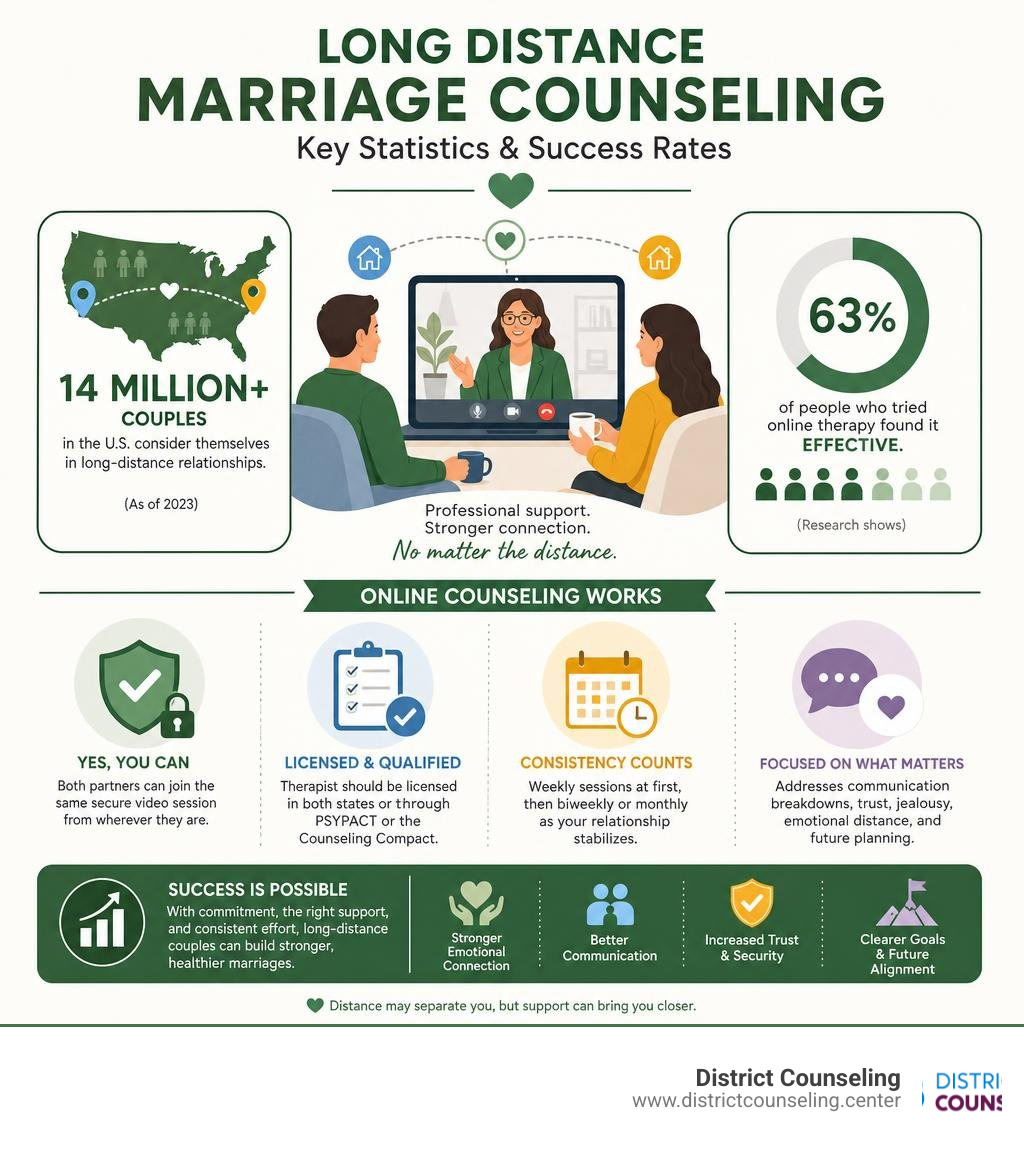
Long distance marriage counseling is professional couples therapy delivered online, helping married partners maintain emotional connection, resolve conflict, and strengthen their relationship while living apart.
Quick answers for couples considering long distance therapy:
| Question | Answer |
|---|---|
| Can we do therapy from different locations? | Yes — both partners join the same secure video session from wherever they are |
| Do we need a therapist licensed in both our states? | Yes, or a therapist licensed through PSYPACT or the Counseling Compact |
| Is online therapy as effective as in-person? | Research says yes — 63% of people who tried online therapy found it effective |
| How often should we attend sessions? | Weekly at first, then biweekly or monthly as the relationship stabilizes |
| What issues does it address? | Communication breakdowns, trust, jealousy, emotional distance, and future planning |
As of 2023, more than 14 million couples in the United States consider themselves in long-distance relationships. That’s millions of marriages navigating time zones, work schedules, and the quiet weight of sleeping alone — night after night.
Distance doesn’t have to mean disconnection. But it does take deliberate effort. Small misunderstandings grow fast when you can’t read a partner’s face or hear their tone of voice. One partner waits all night for a reply. The other had no idea anything was wrong. These moments add up.
That’s exactly where professional support makes a real difference.
I’m Francisco Ortiz, a Licensed Professional Counselor-Supervisor with extensive experience providing counseling and psychotherapy to couples and families navigating complex relationship challenges, including long distance marriage counseling. My clinical background spans individual, couples, and family therapy, giving me a grounded perspective on what actually helps partners stay connected across distance.
Glossary for long distance marriage counseling:
Understanding the Challenges of Living Apart
Living in a long-distance marriage is a unique psychological landscape. In many ways, it is a masterclass in independence, but it can also feel like a slow-burning test of endurance. When we work with couples in our Texas counseling offices — from the bustling energy of Houston to the quiet suburbs of Cypress and Katy — we find that physical separation rarely changes what couples fight about, but it vastly changes how they experience those conflicts.
Physical separation introduces a heavy layer of daily loneliness. When you come home after a long, draining day at work, the silence of an empty house can feel deafening. Over time, this physical isolation can mutate into a deep emotional disconnect. You might stop sharing the small details of your day — the funny thing your coworker said, the minor annoyance at the grocery store, or how much you missed them during lunch.
When you stop sharing these micro-moments, you slowly drift into separate realities. You begin to feel more like roommates with a shared bank account than romantic partners. This is why improving communication with your spouse is the absolute lifeline of any long-distance relationship. Without deliberate, intentional bridges of communication, the distance between your hearts will eventually mirror the distance between your zip codes.
Communication Barriers and Missing Nonverbal Cues
In a standard, geographically close marriage, up to 90% of our communication is nonverbal. We read the slight slump of our partner’s shoulders, the soft sigh they let out while washing dishes, or the warm crinkle around their eyes when they look up from their phone.
Digital communication strips all of this away.
When your primary connection is via text message, phone calls, or FaceTime, you lose those critical nonverbal cues. A short, three-word text like “I am busy” can be read in a dozen different ways depending on your current mood. If you are already feeling lonely or insecure, you might read that text as cold, dismissive, or angry. In reality, your spouse might just be rushing into a meeting.
This lack of context creates a breeding ground for massive misunderstandings. Minor disagreements that could have been resolved in five minutes with a quick hug or a warm tone of voice instead escalate into multi-day cold wars. In long distance marriage counseling, we teach partners how to actively fill in these digital gaps through active listening and explicit emotional modeling, ensuring that tone of voice and intent are never left to assumptions.
Trust, Jealousy, and Attachment Anxiety
Distance has a way of acting like a magnifying glass for our deepest insecurities. If you have an anxious attachment style, physical separation can trigger intense waves of attachment anxiety. When your partner doesn’t reply to a message for several hours, your brain might automatically jump to the worst-case scenario.
This insecurity often manifests as jealousy or a hyper-vigilant need for control. You might find yourself checking their location, analyzing their social media activity, or feeling a pang of resentment when they go out with friends.
To combat this, couples must establish radical transparency and clear, mutually agreed-upon boundaries. Trust is not a passive state of mind; it is an active practice of consistency and reassurance. By learning tips to build trust in a relationship, partners can create a solid emotional safety net. When you consistently show up when you say you will, respect established boundaries, and offer proactive reassurance, you soothe your partner’s nervous system and make the physical miles feel far less threatening.
The Unique Benefits of Long Distance Marriage Counseling
Many couples wonder if virtual therapy can actually match the impact of sitting on a comfortable couch in a therapist’s office. The short answer is: absolutely. In fact, for couples living apart, teletherapy is often far more effective than trying to schedule traditional in-person sessions around frantic travel schedules.
Online couples counseling offers unparalleled accessibility and convenience. Instead of waiting weeks for a joint visit, or forcing one partner to fly across the country just to attend a therapy session, both partners can log in from their respective locations. Whether you are living in Austin and your spouse is working in Fort Worth, or one of you is stationed halfway across the world, you can access high-quality, specialized care.
Furthermore, virtual therapy ensures equal participation. When both partners join from their own screens, there is a natural balance of power. No one is “invading” the other’s physical space, and neither partner has the “home-field advantage” of driving to a local clinic they are already familiar with. This balanced dynamic is highly conducive to deep, honest work. To understand how this fits into the broader picture of therapeutic care, check out the ultimate guide to relationship therapy.
Overcoming Time Zones and Demanding Work Schedules
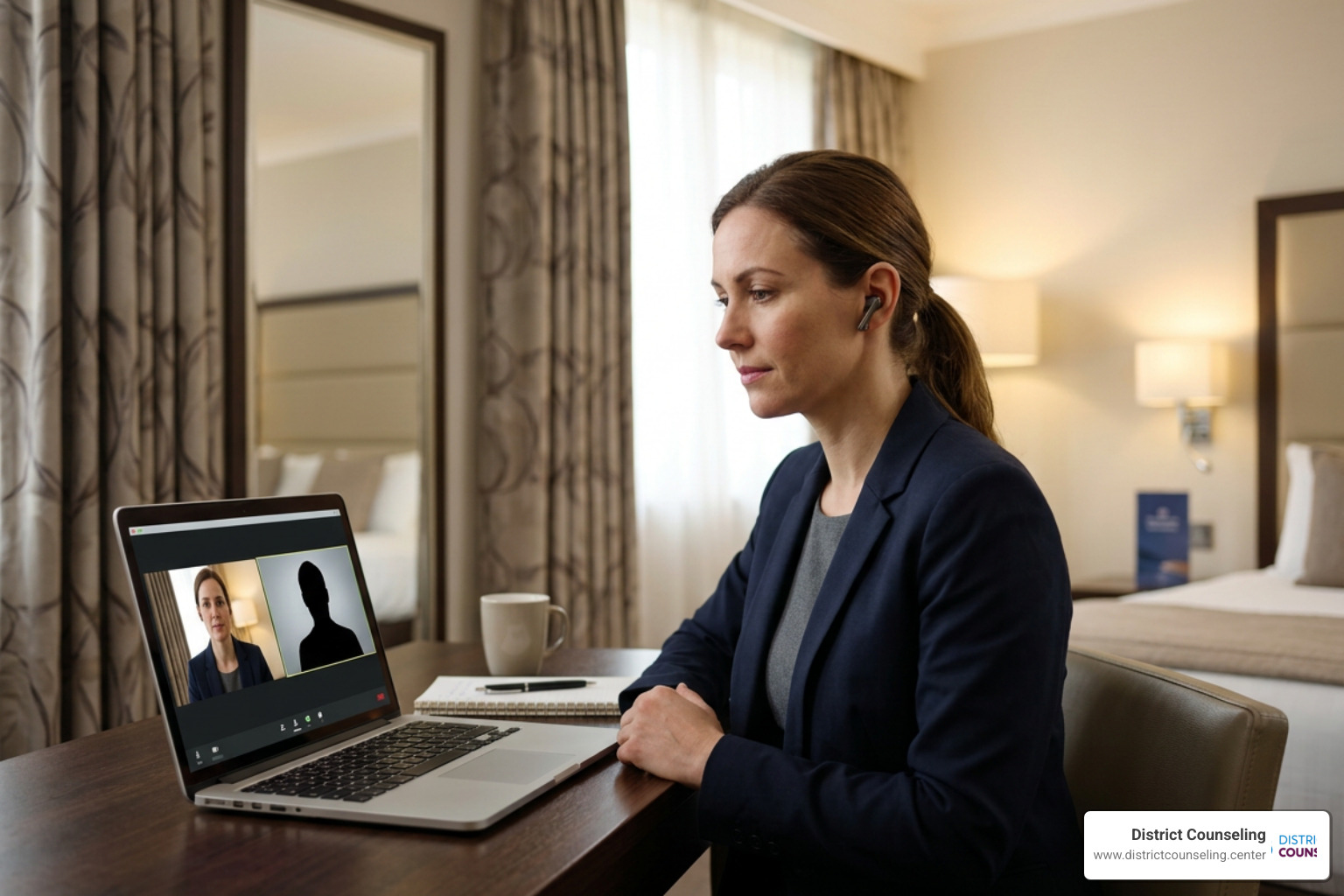
One of the greatest logistical hurdles for long-distance couples is simply finding a time to talk. If one partner is managing a high-stress corporate job in Houston’s CityCentre, while the other is traveling constantly for business, synchronizing schedules can feel like an Olympic sport.
Online therapy offers the scheduling flexibility that modern, busy professionals desperately need. Because sessions are held virtually, traveling partners can join from hotel rooms, airport lounges, or even a quiet parked car at a rest stop.
This flexibility prevents your relationship progress from stalling. In traditional therapy, a business trip usually means canceling your session, which breaks your therapeutic momentum. With virtual counseling, the work continues seamlessly. Consistency is what creates lasting behavioral change; keeping your weekly or biweekly appointments—no matter where you are in the world—ensures that you keep moving forward together.
Rebuilding Trust and Emotional Intimacy Across Borders
When you are separated by borders or long domestic distances, physical intimacy is temporarily off the table. This means your emotional intimacy must carry the entire weight of the marriage.
To thrive, partners must cultivate emotional independence and self-trust. A healthy long-distance marriage does not consist of two codependent people waiting by the phone; it consists of two psychologically independent individuals who choose to share their lives.
Through specialized virtual counseling, we help couples transition from shallow, logistical check-ins (“Did you pay the electric bill?”) to deep, meaningful digital intimacy. This involves learning how to share your inner world, your fears, and your dreams through structured exercises. For a deeper dive into this cross-border dynamic, Rhoda Bangerter’s guide on Long Distance Relationships: How to (Re)Build Intimacy Across Borders offers incredible, practical insights on maintaining closeness when you rarely share the same physical space.
Evidence-Based Techniques Used in Virtual Therapy
In our practice, we don’t just ask “how does that make you feel?” and hope for the best. We utilize structured, science-backed therapeutic modalities that have been specifically adapted for online spaces. These evidence-based techniques include Cognitive Behavioral Therapy (CBT) to challenge negative thought loops, Narrative Therapy to rewrite the “story” of your separation, and Systemic Therapy to look at the broader patterns of your relationship. You can explore these and other approaches in our guide all about marital counseling options.
The Gottman Method and Emotionally Focused Therapy
Two of the most powerful frameworks we use in long distance marriage counseling are the Gottman Method and Emotionally Focused Therapy (EFT).
- The Gottman Method: Developed by Drs. John and Julie Gottman, this approach focuses on building a “Sound Relationship House.” We teach couples how to identify and defeat the “Four Horsemen of the Apocalypse” (Criticism, Contempt, Defensiveness, and Stonewallling) which can be incredibly destructive in digital communication. For more on this, read about the Gottman Four Horsemen and How to Defeat Them.
- Emotionally Focused Therapy (EFT): This is an attachment-based therapy that focuses on creating emotional safety. In a long-distance marriage, attachment panic can set in easily. EFT helps partners understand their underlying emotional needs and express them vulnerably, rather than reacting with anger or withdrawal. If you want to find a professional trained in these deep methods, you can read our tips on decoding the Gottman Method.
Practical Communication Exercises and Connection Rituals
To bridge the physical gap between sessions, we equip couples with highly practical communication exercises:
- Reflective Listening: Before you respond to your partner, you must repeat back what you heard them say to ensure accuracy. This simple step prevents countless digital misunderstandings.
- Emotional Labeling: Because your partner can’t see your body language, you must explicitly label your emotions. Instead of just sounding quiet, say: “I am feeling very tired and a little overwhelmed by work tonight, but I am so glad to hear your voice.”
- Connection Rituals: We help couples design structured, shared virtual activities. This goes far beyond standard FaceTime calls. It might include watching a movie simultaneously, playing an online game together, or sharing a virtual meal. For creative ideas on how to build these habits, check out our guide on beyond date night connection ideas.
Navigating Logistics and Licensing Across State Lines
While online therapy is incredibly convenient, it does come with strict legal and ethical guidelines. In the United States, mental health professionals are bound by state licensing laws. Generally, a therapist must be licensed in the state where the client is physically located at the time of the session.
If you and your spouse live in different states, this can complicate things. Fortunately, the mental health landscape has evolved rapidly. Many states now participate in interstate compacts like PSYPACT (for psychologists) or the Counseling Compact (for licensed professional counselors), which allow credentialed therapists to practice across state lines.
Additionally, all virtual sessions must be conducted on secure, HIPAA-compliant video platforms to protect your privacy. Standard consumer apps like FaceTime or Zoom are often not secure enough for clinical therapy.
Choosing a Therapist Licensed in Both Partners’ States
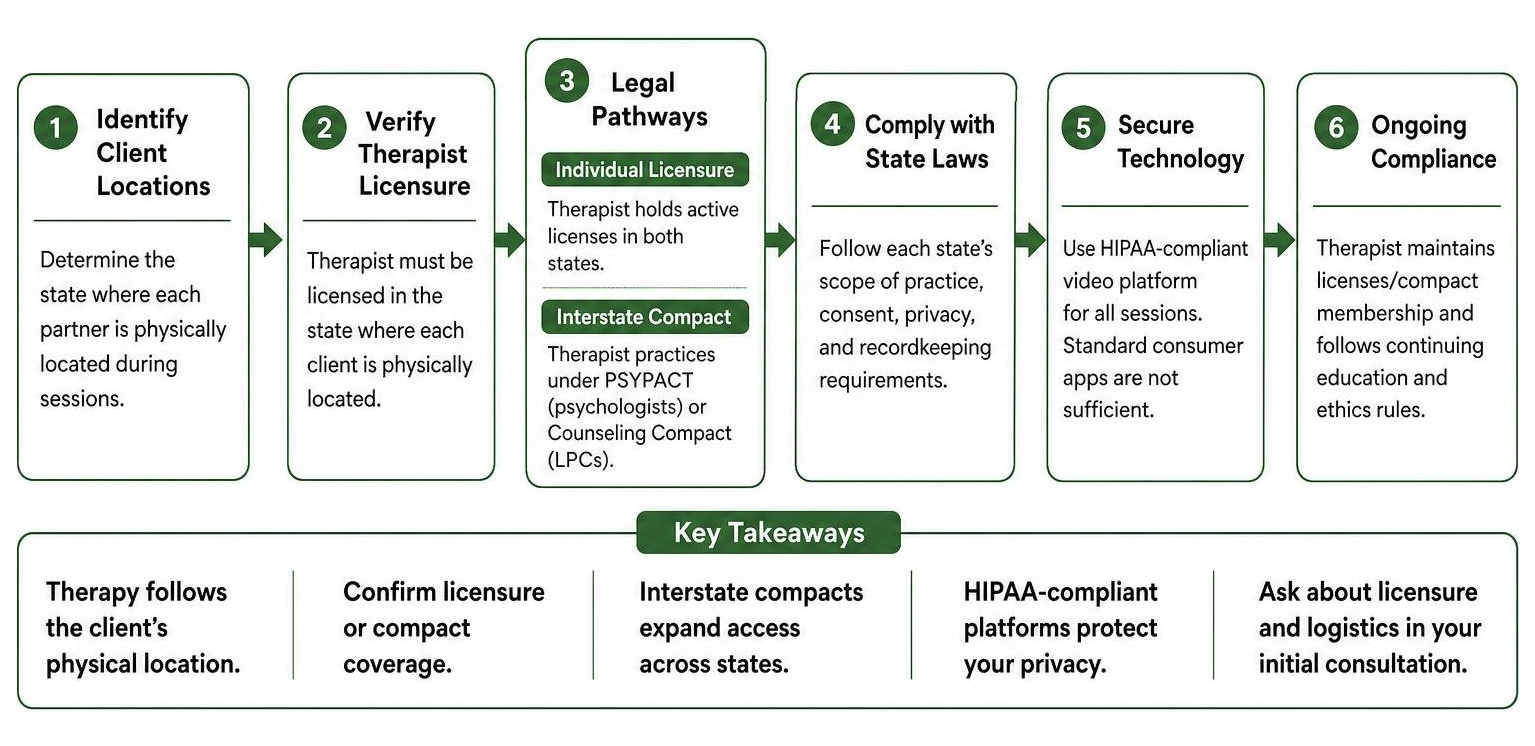
When searching for a long-distance relationship counselor, your first logistical step should always be verifying state licensure.
You must find a practitioner who holds active licenses in both of your home states, or whose credentials fall under an active interstate compact. During your initial consultation, ask direct questions about their licensing, their experience with interstate couples, and how they handle time zone differences.
Ensuring these legal guidelines are met protects both you and your therapist, giving you a safe, stable foundation to do the heavy emotional work of healing your marriage.
When to Seek Long Distance Marriage Counseling
It is a common myth that couples should only go to therapy when they are on the brink of divorce. In reality, therapy is highly effective as a preventative tool.
You should consider seeking professional support if you notice signs of chronic loneliness, emotional stagnation, or unresolved conflicts that loop continuously without resolution. If you find yourself holding back your true feelings because you “don’t want to ruin the limited time you have together,” that is a major red flag. For a detailed breakdown of these warning signs, read our article on when to seek couples counseling.
Preparing for the Transition to Cohabitation
The ultimate goal of most long-distance marriages is to eventually live in the same place. However, many couples are shocked to find that reuniting can be incredibly difficult.
After years of managing your own schedule, your own space, and your own daily routines, suddenly sharing a home can trigger intense power struggles. You have both grown and changed during your time apart. You are not simply resuming your old marriage; you are building a brand-new one.
This transition requires a delicate balance of healthy interdependence. You must learn how to make space for each other without losing the personal growth and independence you cultivated while living apart. To understand the foundations of what keeps love strong during these massive life transitions, read about what makes love last.
Relearning Companionship and Renegotiating Personal Space
Relearning companionship after decades or even months of living apart is a profound emotional recalibration. It often triggers a quiet identity crisis and what therapists call “micro-griefs” — the subtle mourning of your lost solitude and total autonomy.
Suddenly, you have to consult another person on dinner plans, grocery budgets, and weekend schedules. You might even face classic, humorous-yet-frustrating “thermostat battles” (where one partner is used to a freezing cold room and the other prefers a warm haven).
These adjustments require deep patience, open communication, and a willingness to renegotiate your space. For a beautiful, real-world look at this complex transition, read the personal essay on Long-Distance Marriage: Learning To Coexist After 33 Years, which highlights how one couple successfully navigated the emotional waves of cohabitating again after decades of living apart.
What to Expect in Your First Long Distance Marriage Counseling Session
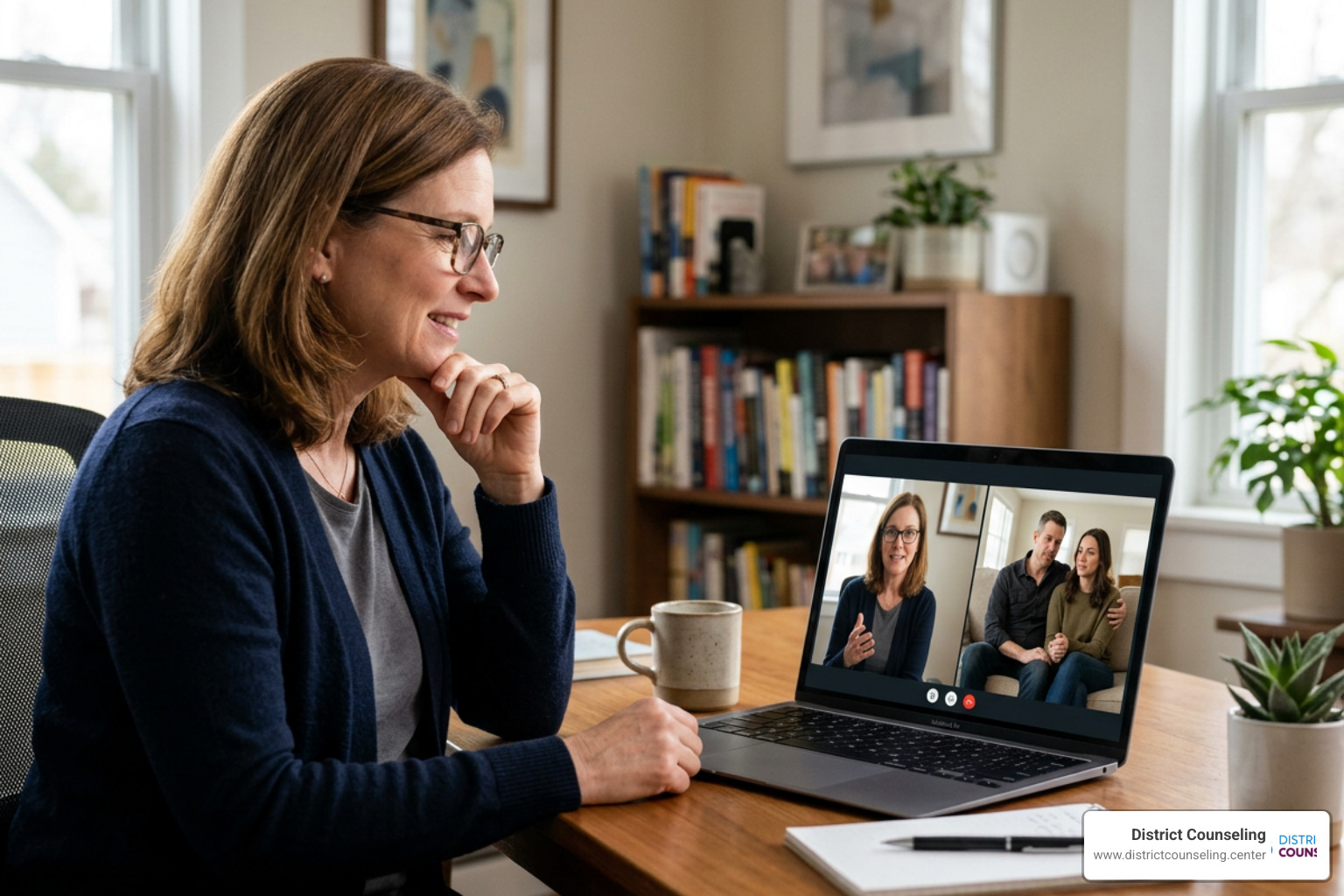
Your first session is primarily about building safety and gathering information.
The therapist will guide you through a comprehensive intake process, exploring your relationship history, the story of how you met, and the specific challenges of your current long-distance setup.
You will work together to set clear, realistic goals for your therapy. You will also establish the ground rules for your virtual sessions, ensuring that both partners have a private, quiet space with a stable internet connection to participate fully.
Frequently Asked Questions about Long-Distance Therapy
Can couples therapy work if we live in different states or countries?
Yes. Thanks to secure, HIPAA-compliant video platforms, virtual sessions can easily bridge the geographical gap. As long as your therapist meets the necessary licensing requirements for your respective locations, you can receive high-quality, coordinated care from anywhere in the world.
How effective is online couples therapy compared to in-person sessions?
Clinical research shows that online couples therapy is just as effective as traditional, in-person sessions. A 2023 study found that 63% of people who tried online therapy found it highly effective. The format allows for greater consistency, keeps therapeutic momentum going during business travel, and helps couples build practical digital communication skills that they can immediately apply to their daily lives.
What practical tools can we use between sessions to stay connected?
We highly recommend utilizing shared digital spaces to maintain your connection between sessions. This can include:
- Shared digital calendars to track visits, flights, and virtual date nights.
- Relationship apps designed for couples to share daily prompts and gratitude lists.
- Asynchronous journaling, where you both contribute to a shared digital document.
- Simple, daily check-in rituals, such as sending a voice note every morning or a text before bed.
Conclusion
Distance is undeniably hard on a marriage, but it does not have to be the end of your story. With the right tools, intentional effort, and professional support, you can transform this period of physical separation into a powerful season of emotional growth and resilience.
At District Counseling, we offer compassionate alignment to what matters most to you. Whether you are navigating a long-distance arrangement from Houston, Cypress, Katy, or any of our other Texas locations, our team of dedicated professionals is here to help you bridge the gap.
If you are ready to strengthen your connection and build a resilient, lasting marriage, explore our professional relationship and marital counseling services today. Let’s make your love go the distance, together.
Visited 7 times, 1 visit(s) today
Similar Posts

Adalid Blandin
September 9, 2026
A Comprehensive Guide to Effective Relationship Counseling Options
A Comprehensive Guide to Effective Relationship Counseling Options – Learn about relationship counseling...

Francisco Ortiz
September 7, 2026
First Couples Counseling Session: A Guide to Your First Hour on the Couch
Learn what happens in your first couples counseling session, from intake to ground rules, and how to prepare for a successful start....

Adalid Blandin
September 4, 2026
Spotting the Signs and Finding Help for Emotional Abuse
Recognize emotional abuse signs and connect with a relationship emotional abuse therapist for healing and support....

Francisco Ortiz
September 2, 2026
Riding Out the Storm: The Four Horsemen of Couples Therapy and Their Antidotes
Learn how the four horsemen couples therapy framework identifies destructive conflict patterns and provides proven antidotes to strengthen your relationship....

Francisco Ortiz
August 31, 2026
Premarital Counseling Online: Prep for Marriage from Your Couch
Prepare for marriage with premarital counseling online from your couch. Build skills, save on licenses, and strengthen your future today....

Francisco Ortiz
August 28, 2026
Licensed Telehealth Therapy Providers in Texas: A Quick Start Guide
Find licensed telehealth therapy Texas providers with this guide to legal rules, insurance parity, and clinical best practices....

Francisco Ortiz
August 26, 2026
The Intimacy Fix: What to Expect from Couples Sex Counselling
Learn how a relationship counsellor sex specialist helps couples rebuild intimacy, desire, and trust through evidence-based therapy....

Francisco Ortiz
August 24, 2026
Before the Nikah: Navigating Islamic Premarital Counseling
Discover how premarital counseling Islam builds a sacred, lasting union through faith-based modules, therapy, and practical guidance before your Nikah....

Francisco Ortiz
August 21, 2026
The Ultimate Guide to West Lake Hills Family Counseling and Keeping the Peace
The Ultimate Guide to West Lake Hills Family Counseling and Keeping the Peace – Learn about west lake hills family counseling...

Francisco Ortiz
August 19, 2026
How Relationship Therapy for Couples Can Save Your Sanity
Discover how relationship therapy for couples can restore connection, resolve conflict, and rebuild trust with evidence-based guidance....


