
Why an Emotional Support Animal Might Be the Mental Health Support You’ve Been Missing
An emotional support animal — often called an ESA — is an animal that provides comfort and companionship to someone living with a mental health condition like anxiety, depression, PTSD, or other emotional disabilities.
Here’s what you need to know at a glance:
- What it is: Any domesticated animal (dog, cat, rabbit, bird, etc.) whose presence helps ease the symptoms of a qualifying mental health condition
- Legal protection: ESAs are protected under the Fair Housing Act (FHA) — meaning landlords generally cannot charge pet deposits or enforce no-pet policies against them
- What it is NOT: An ESA is not a service animal and does not have public access rights under the Americans with Disabilities Act (ADA)
- What you need: A letter from a licensed mental health professional — not an online certificate or paid registry
- Air travel: As of January 2021, airlines are no longer required to accommodate ESAs — they are treated as regular pets
Many people first hear about ESAs when a landlord enforces a no-pet policy — or when anxiety or depression makes daily life feel unmanageable and they’re looking for support between therapy sessions. If that sounds familiar, you’re not alone.
The research backs this up. A 2020 survey of nearly 6,000 people found that almost 90% described their companion animals as a major source of support during the COVID-19 pandemic. A separate international survey of 298 ESA dog owners found that every single one reported an improved quality of life.
But navigating the rules around ESAs can be confusing — and the internet is full of scams.
I’m Francisco Ortiz, a Licensed Professional Counselor-Supervisor and Certified Forensic Mental Health Evaluator with experience in mental health assessment and psychotherapy for individuals managing mood disorders and trauma — conditions that frequently qualify someone for an emotional support animal. In this guide, I’ll walk you through exactly what an ESA is, how to qualify, and how to get legitimate documentation that actually holds up.
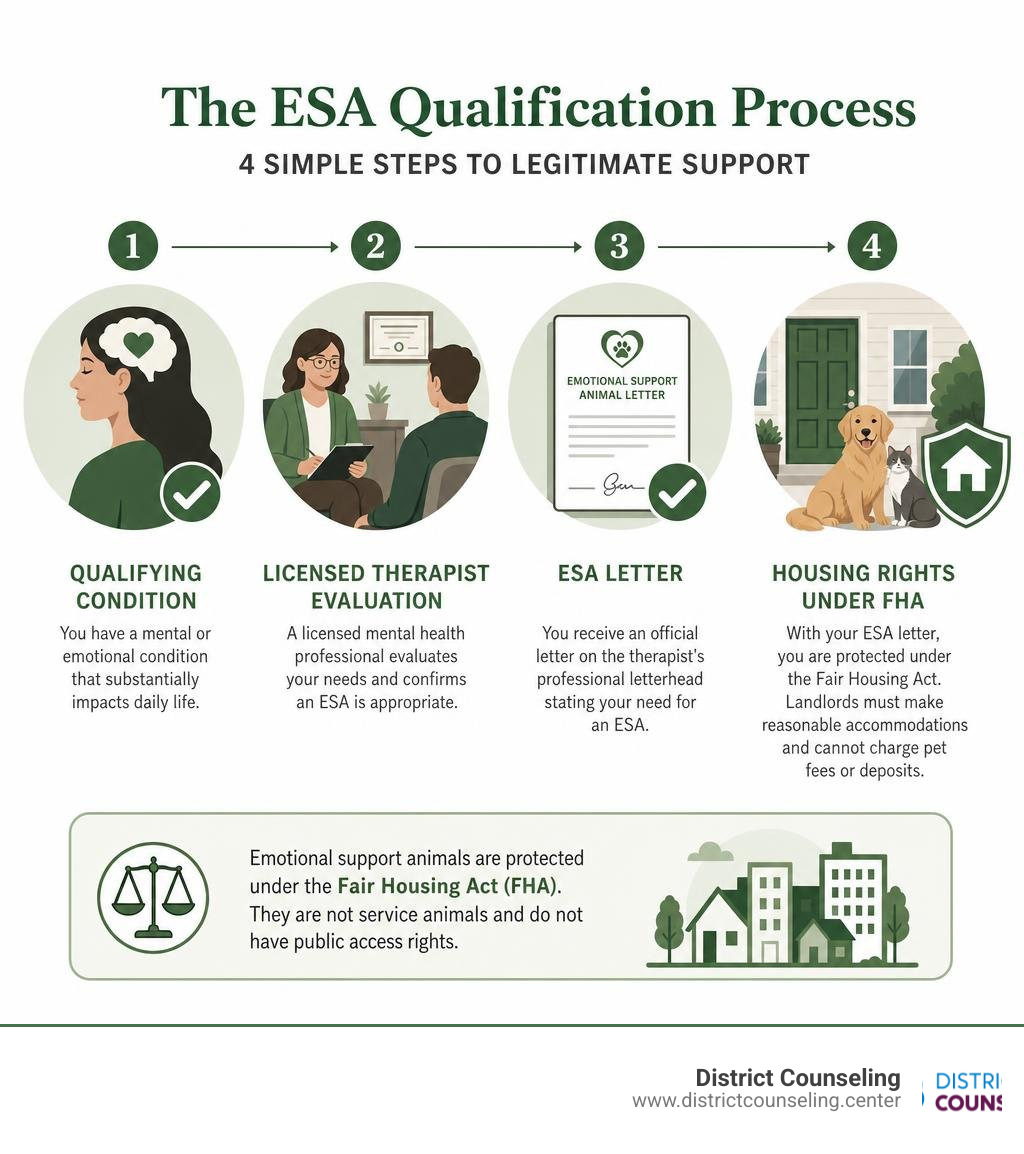
What is an Emotional Support Animal and How Does It Differ From a Service Dog?
To understand your rights, you must first understand the legal distinction between an emotional support animal, a service dog, and a psychiatric service dog (PSD).
Under federal law, the key difference comes down to task training and public access.
A service animal is defined by the Americans with Disabilities Act (ADA) as a dog (or in rare cases, a miniature horse) that is individually trained to do work or perform specific tasks for the benefit of an individual with a physical, sensory, psychiatric, intellectual, or other mental disability. Because they are trained to mitigate their handler’s disability through active tasks, service dogs are granted full public access rights.
An emotional support animal, on the other hand, does not require any specialized task training. The therapeutic benefit they provide comes from their presence, companionship, and the unconditional positive regard they offer. Because they do not perform trained tasks, they do not have public access rights under the ADA.
A third category is the Psychiatric Service Dog (PSD). Unlike a general ESA, a PSD is trained to perform specific actions to help someone with a psychiatric condition—such as waking a handler from a PTSD nightmare, buffering the handler in crowded spaces, or deep pressure therapy during a panic attack. Because PSDs are task-trained, they are legally recognized as service dogs under the ADA.
For a detailed breakdown of these differences, you can consult the Service Animals and Emotional Support Animals | ADA National Network guide.
Comparison Table: ESAs vs. Service Dogs vs. Psychiatric Service Dogs
| Feature | Emotional Support Animal (ESA) | Service Dog | Psychiatric Service Dog (PSD) |
|---|---|---|---|
| Species Allowed | Any common domesticated animal (dogs, cats, rabbits, birds, etc.) | Dogs (and miniature horses) | Dogs only |
| Task Training Required? | No | Yes | Yes |
| Primary Legal Benefit | Comfort and symptom mitigation through presence | Performs specific physical or mental tasks | Performs specific psychiatric/mental tasks |
| Public Access Rights? | No | Yes | Yes |
| Housing Protections? | Yes (Under the Fair Housing Act) | Yes (Under the Fair Housing Act) | Yes (Under the Fair Housing Act) |
| Air Travel Rights? | No (Treated as standard pets since 2021) | Yes (Fly free in cabin under ACAA) | Yes (Fly free in cabin under ACAA) |
While animal-assisted therapy can take many forms, including therapeutic visits by certified therapy dogs to hospitals or schools, an Emotional support animal is designated specifically for a single individual with a diagnosed mental health condition to help them navigate daily life within their home.
Legal Protections and Housing Rights Under the Fair Housing Act

The primary legal shield for an emotional support animal is the federal Fair Housing Act (FHA), which is overseen by the Department of Housing and Urban Development (HUD).
Under the FHA, housing providers are required to provide “reasonable accommodations” for individuals with disabilities. This means that even if an apartment complex, condominium, or rental home has a strict “no pets” policy, they must make an exception for a verified ESA.
Here are the core rules that landlords must follow under HUD guidelines:
- No Pet Deposits or Pet Rent: Landlords cannot charge you extra fees, pet deposits, or monthly pet rent for your ESA. Because they are legally classified as assistance animals rather than pets, standard pet fees do not apply.
- No Breed or Weight Restrictions: A housing provider cannot deny your accommodation request simply because your ESA is a certain breed (such as a Pit Bull or German Shepherd) or exceeds a specific weight limit. Landlords must perform an individualized assessment of the specific animal’s behavior rather than applying blanket breed bans.
- Equal Opportunity Housing: Tenants with ESAs must have equal access to all common areas of the housing complex that other residents are allowed to use.
However, landlords do have rights. A housing provider can deny an ESA accommodation request if:
- The specific animal poses a direct threat to the health or safety of others that cannot be reduced by another reasonable accommodation.
- The animal would cause substantial physical damage to the property of others.
- The request places an undue financial or administrative burden on the housing provider.
For more information on housing rules, you can read the What Is an Emotional Support Animal? | ConsumerAffairs® guide. If you live in the Katy area and need to request an accommodation, we can help you with a professional Katy Emotional Support Animal Evaluation – District Counseling .
Rules for an Emotional Support Animal in Air Travel, Workplaces, and Public Places
One of the most common points of confusion involves where you can legally bring your ESA. Because ESAs do not have the same public access rights as service dogs, their protections in public spaces are highly limited.
Air Travel
Historically, the Air Carrier Access Act (ACAA) allowed ESAs to fly in the cabin of commercial aircraft free of charge. However, following a Department of Transportation (DOT) rule change that took effect in January 2021, airlines are no longer required to recognize emotional support animals. Today, almost all major airlines treat ESAs as standard pets. If you wish to travel with your ESA, they must meet the airline’s standard pet policies, fit in an approved under-seat carrier, and you must pay the associated pet travel fee. Only trained service dogs and psychiatric service dogs (PSDs) retain the right to fly in-cabin without charge.
Workplaces
The ADA does not automatically grant employees the right to bring an ESA to work. However, under Title I of the ADA, you can request to bring your ESA to work as a “reasonable accommodation” for a disability. Your employer is required to consider the request, but they can deny it if having the animal in the workplace causes an undue hardship or a safety hazard to other employees.
Public Places
ESAs do not have the right to enter restaurants, grocery stores, shopping malls, or hotels that have “no pets” policies. While some business owners may choose to be pet-friendly, they are legally permitted to ask you to leave if you attempt to bring an ESA inside.
State-Specific Regulations and the Truth About Online Registries
As the popularity of emotional support animals has grown, so has the market for fraudulent ESA services. It is critical to understand that there is no such thing as an official federal or state ESA registry.
Many online companies charge $50 to $100 to “register” your dog or cat in a database and send you a certificate, vest, or ID tag. Under HUD and FHA guidelines, these registrations are completely worthless. Landlords are fully within their rights to reject any “certificate” or “registration card” purchased from an online registry site. The only document that carries legal weight is a signed ESA letter from a licensed mental health professional who has evaluated your mental health.
Furthermore, states have increasingly cracked down on ESA fraud. For example, California implemented a law requiring a clinician to have a continuous professional relationship with a client for at least 30 days before issuing an ESA letter.
Here in Texas, the law takes assistance animal integrity seriously. Under Texas Human Resources Code Sec. 121.006, it is a misdemeanor offense to misrepresent an animal as a trained service or assistance animal if it is not. This makes obtaining a legitimate, clinically backed evaluation more important than ever.
How to Get a Legitimate Emotional Support Animal Letter

To secure a legitimate ESA letter that complies with HUD guidelines and Texas state regulations, you must go through a proper clinical evaluation.
A valid ESA letter must meet the following criteria:
- Written by a Licensed Professional: The letter must be written and signed by a licensed healthcare professional, such as a licensed professional counselor (LPC), licensed clinical social worker (LCSW), licensed marriage and family therapist (LMFT), psychologist, or psychiatrist.
- State Licensure: The clinician must be actively licensed in the state where you reside.
- Professional Letterhead: The document must be on the clinician’s official letterhead and include their license type, license number, issue date, and contact information.
- Establishment of Need: The letter must confirm that you have a diagnosed mental health condition recognized in the DSM-5 and explain how the presence of the animal mitigates at least one symptom of that condition.
If you are located in the Cypress area, you can schedule an Emotional Support Animal Evaluation Cypress, TX with our team to ensure your documentation is fully compliant and clinically sound.
Qualifying Mental Health Conditions for an Emotional Support Animal
Not everyone qualifies for an ESA. To meet the legal definition of having a disability under the Fair Housing Act, your mental health condition must substantially limit one or more major life activities (such as sleeping, working, socializing, or caring for yourself).
Some of the most common DSM-5 conditions that qualify for an ESA include:
- Generalized Anxiety Disorder (GAD): Chronic, overwhelming worry that interferes with daily tasks.
- Major Depressive Disorder (MDD): Severe depressive episodes where a companion animal provides motivation and emotional grounding.
- Post-Traumatic Stress Disorder (PTSD): Where an animal’s presence offers a sense of safety and reduces hypervigilance.
- Social Anxiety Disorder: Where an animal helps ease isolation and provides comfort in social transitions.
- Panic Disorder: Where petting an animal can physically lower heart rates and interrupt panic spirals.
If you are struggling with any of these conditions and live in the Sugar Land area, you can book an Emotional Support Animal Evaluation with one of our compassionate Texas-licensed clinicians.
Frequently Asked Questions About Emotional Support Animals
Navigating the rules around ESAs can raise a lot of questions. Here are the answers to the most common queries we receive at our Texas clinics.
Do emotional support animals need to wear a vest or be registered?
No. Under federal housing laws, there is no requirement for an ESA to wear a vest, tag, or special harness. While some owners choose to use vests to signal to neighbors that their animal is an assistance animal, it is entirely optional. As mentioned earlier, online registries are a myth; a signed letter from a licensed professional is the only legal proof required.
Can a landlord deny my ESA letter?
In most cases, no, provided your letter is legitimate and from a licensed clinician practicing in your state. However, a landlord can deny your request if the animal is destructive, aggressive, poses a direct threat to other tenants, or if the accommodation would cause an extreme financial or administrative burden on the property owner.
How long is an ESA letter valid?
While federal law does not explicitly state an expiration date for housing letters, most landlords and property managers follow a standard 12-month guideline. They will typically request an ESA letter that is dated within the last year to ensure your clinical need is current. Annual renewals through a brief clinical assessment are standard practice.
Conclusion
An emotional support animal can be a life-changing addition to your mental health treatment plan, offering steady comfort and relief during difficult times. However, ensuring you navigate the legal landscape correctly is essential to protecting your housing rights and avoiding common online scams.
At District Counseling, we provide sincere, authentic, and compassionate mental health services across Texas. Whether you are looking for ongoing psychotherapy, specialized trauma care, or a professional evaluation for an ESA, we are here to support you. We offer professional assessments at all of our physical and telehealth locations, including:
- Sugar Land ESA Evaluation
- Katy ESA Evaluation
- Cypress ESA Evaluation
- Spring ESA Evaluation
- Spring Branch ESA Evaluation
- Copperfield ESA Evaluation
- Missouri City ESA Evaluation
- Tomball ESA Evaluation
- Pearland ESA Evaluation
- Tree House ESA Evaluation
If you are ready to take the next step toward qualifying for an ESA with a legitimate, clinically backed evaluation, Schedule an Emotional Support Animal Evaluation with us today.
Visited 5 times, 1 visit(s) today
Similar Posts

Adalid Blandin
September 28, 2026
Missouri City and Houston Couples Therapy 101
Back-to-School Mental Health: Tips for a Smooth Transition – Discover practical tips to ease back-to-school anxiety for kids, teens, and parents. Build healthy routines, manage stress, and foster emotional… …...

Adalid Blandin
September 25, 2026
How to find authentic therapy for emotional exhaustion in Houston
Find emotional exhaustion therapy Houston that helps professionals and caregivers move from burnout to renewed energy and balance....

Francisco Ortiz
September 23, 2026
A Practical Guide to Finding Licensed Telehealth Counselors in Texas
Find licensed telehealth counseling in Texas with this guide to legal standards, privacy, insurance, and best practices for virtual care....

Adalid Blandin
September 21, 2026
All About Psychiatric Weight Loss Options and Treatments
Explore psychiatric weight loss options, including medications, therapy, and bariatric support for holistic wellness....

Francisco Ortiz
September 18, 2026
No Traffic, No Waiting Rooms: Your Guide to Telehealth Counseling in Texas
Learn the rules, rights, and benefits of telehealth counseling in Texas with this complete guide to virtual therapy....

Adalid Blandin
September 16, 2026
Why Your Mitochondria Might Be Depressed
Explore metabolic mental health to boost brain energy, ease mood disorders, and support recovery through mitochondria-focused strategies....

Adalid Blandin
September 14, 2026
The Definitive Guide to Life Coaching
Discover how life coaching can help you achieve goals, gain clarity, and create lasting change in 2026....

Adalid Blandin
September 11, 2026
The Ultimate Guide to Identifying Emotional Abuse in Relationships
The Ultimate Guide to Identifying Emotional Abuse in Relationships – Learn about emotional abuse relationship...

Adalid Blandin
September 9, 2026
A Comprehensive Guide to Effective Relationship Counseling Options
A Comprehensive Guide to Effective Relationship Counseling Options – Learn about relationship counseling...

Francisco Ortiz
September 7, 2026
First Couples Counseling Session: A Guide to Your First Hour on the Couch
Learn what happens in your first couples counseling session, from intake to ground rules, and how to prepare for a successful start....


