
What Adults Should Know Before Getting Tested for ADHD
Getting tested for ADHD as an adult is more common — and more important — than most people realize. An estimated 15.5 million adults in the U.S. had a current ADHD diagnosis in 2023, yet the majority of adults with ADHD still go unidentified, often spending years wondering why focus, organization, or follow-through feel so much harder than they should.
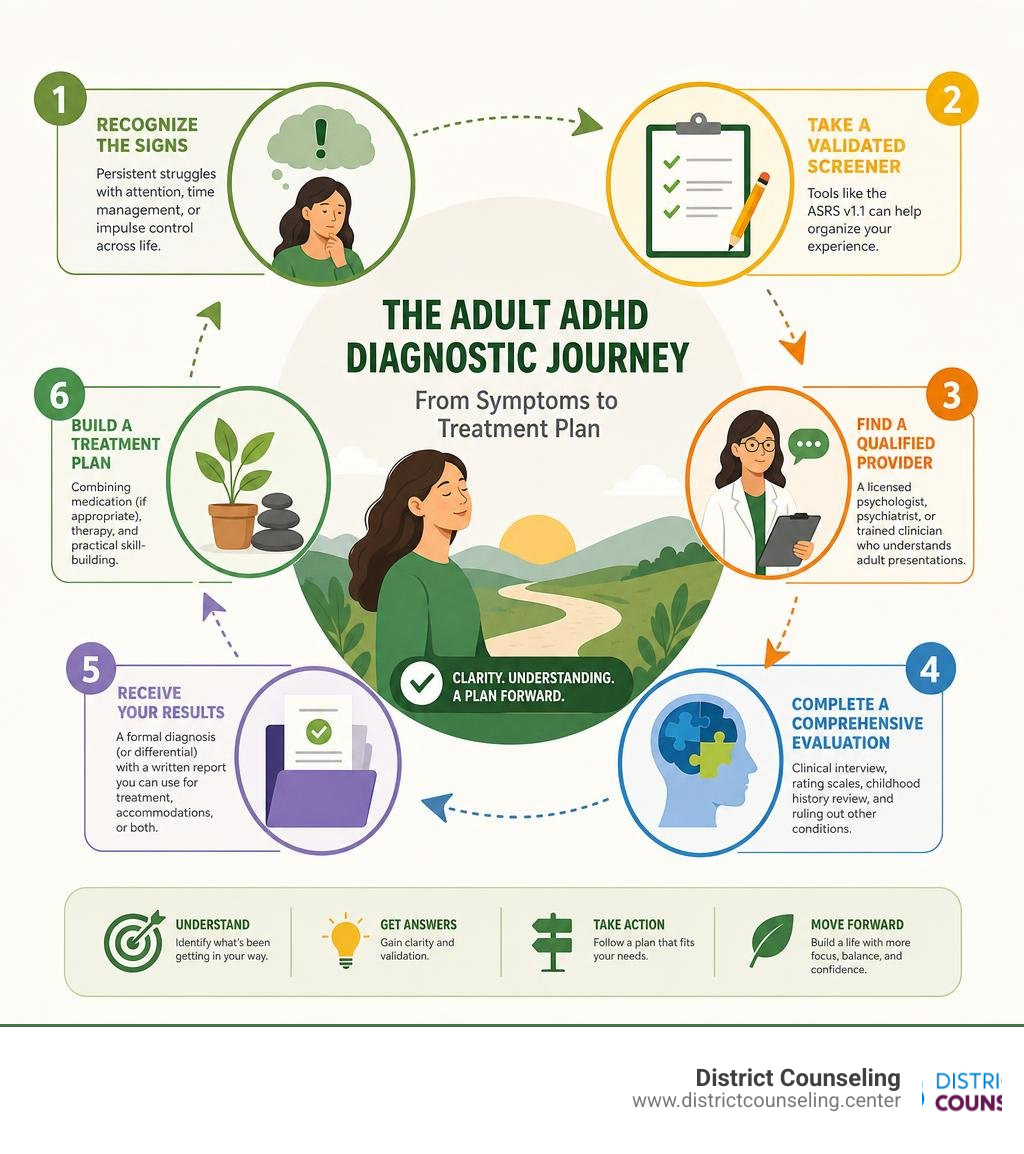
Here’s what the adult ADHD testing process looks like at a glance:
- Recognize the signs — persistent struggles with attention, time management, or impulse control across multiple areas of life
- Take a validated screener — tools like the ASRS v1.1 can help organize your experience before a formal evaluation
- Find a qualified provider — a licensed psychologist, psychiatrist, or trained clinician who understands adult presentations
- Complete a comprehensive evaluation — includes a clinical interview, standardized rating scales, childhood history review, and ruling out other conditions
- Receive your results — a formal diagnosis (or differential) with a written report you can use for treatment, accommodations, or both
- Build a treatment plan — combining medication (if appropriate), therapy, and practical skill-building
Many adults reach their 30s, 40s, or even later before anyone connects the dots. They were often told they were bright but unfocused, or they were quietly diagnosed with anxiety or depression while the underlying ADHD went unaddressed. The relief of finally having an explanation can be profound — but getting there requires understanding what the process actually involves.
I’m Francisco Ortiz, a Licensed Professional Counselor-Supervisor and Certified Forensic Mental Health Evaluator with deep experience in psychological assessment and mental health evaluation — including guiding adults through the process of getting tested for ADHD. In the sections ahead, I’ll walk you through everything you need to know to pursue an evaluation with confidence.
Relevant articles related to getting tested for adhd as an adult:
Understanding Adult ADHD: Why Late Diagnoses Happen

Why do so many of us make it deep into adulthood before even considering that our brains might process the world differently? Historically, ADHD was viewed strictly as a childhood behavioral disorder, characterized by the stereotypical “hyperactive young boy” who couldn’t sit still in a classroom. If you weren’t physically bouncing off the walls or disrupting class in the 1990s or 2000s, you simply weren’t on the diagnostic radar.
Today, we know that ADHD is a highly heritable, lifelong neurodevelopmental condition. It affects roughly 4.4% of U.S. adults, but the vast majority of these individuals live with their symptoms without ever identifying the true source of their struggles.
When adults with undiagnosed ADHD have high cognitive abilities or grow up in highly structured, supportive environments, they often manage to compensate for their deficits. They use sheer willpower, extreme organization systems, or high-stress deadlines to force themselves to focus. But when they transition to less structured environments—such as leaving home for college, starting a demanding career, or managing a household and children—their beautifully constructed coping mechanisms begin to crumble under the weight of adult executive demands.
Common daily struggles that prompt adults to seek an evaluation include:
- Chronic underachievement: Feeling like you are working twice as hard as your peers just to stay afloat, yet consistently failing to live up to your potential.
- Executive dysfunction: Staring at a simple task, like paying a bill or sending an email, and feeling physically paralyzed and unable to start.
- Time blindness: Consistently misjudging how long tasks will take, leading to chronic lateness or missed deadlines.
- Project abandonment: Buying all the supplies for a new hobby, hyperfocusing on it for a week, and then losing interest completely, leaving unfinished projects scattered throughout your life.
- Conversational drifting: Zoning out during meetings or personal conversations, constantly needing people to repeat themselves.
The Reality of Getting Tested for ADHD as an Adult
When we look at getting tested for ADHD as an adult, the diagnostic rules change slightly compared to childhood. In clinical practice, we utilize the DSM-5 (Diagnostic and Statistical Manual of Mental Health Disorders) criteria, which require adults (individuals aged 17 and older) to demonstrate at least five persistent symptoms of inattention and/or hyperactivity-impulsivity. These symptoms must have been present for at least six months, occur across two or more major life settings (such as both work and home), and cause significant impairment.
Importantly, the DSM-5 dictates that several symptoms must have been present prior to age 12. This is because ADHD is a developmental condition; it doesn’t suddenly appear out of thin air at age 30. During an evaluation, we must establish a clear, historical thread of these symptoms extending back into your youth. For more foundational details on how adult ADHD behaves over the lifespan, you can read the resource on ADHD in Adults: 4 Things to Know – National Institute of Mental Health (NIMH).
How ADHD Presents Differently in Women and High-Masking Individuals
One of the most significant reasons for late-stage diagnosis is “masking.” Masking is the exhausting process of consciously concealing your symptoms, mimicking neurotypical behaviors, and overcompensating to fit into social or professional expectations.
In women and high-masking individuals, ADHD symptoms are frequently internalized rather than externalized. Instead of physical hyperactivity, you might experience a restless, constantly racing mind. Instead of acting out, you might become hyper-organized, developing rigid routines to prevent yourself from losing items or making mistakes.
Furthermore, many high-masking adults deliberately leverage anxiety to get things done. Because your brain’s dopamine pathways make it incredibly difficult to initiate tasks based on importance alone, you might wait until the absolute last minute, using the panic of an impending deadline to force your brain into a state of hyperfocus. Over time, this constant reliance on survival-mode adrenaline leads to severe burnout, chronic fatigue, and physical exhaustion.
This internal presentation explains why so many women are misdiagnosed with generalized anxiety disorder or major depressive disorder before their ADHD is recognized. In fact, research indicates that up to 85% of items on standard anxiety and depression screening tools overlap with common ADHD symptoms in women. To understand these unique gendered patterns and how to navigate them, check out this guide on How to get an ADHD diagnosis as a woman.
The Step-by-Step Process of Getting Tested for ADHD as an Adult
If you suspect your brain works a bit differently, taking the leap to get evaluated can feel overwhelming. Fortunately, the process is highly structured and designed to give you clarity, not stress.
A thorough, professional evaluation is not a single, rushed checklist completed in a ten-minute doctor’s visit. True clinical accuracy requires a multi-step process that looks at your past, your present, and how your brain functions in real-time. For an easy-to-follow, practical breakdown of this journey, we recommend reviewing How to Get Tested for ADHD in 7 Simple Steps.
Preparing for Your Adult ADHD Evaluation
Before you walk into your evaluation appointment, a little preparation can go a long way. Because we need to establish that your symptoms have been present since childhood, gathering historical “clues” is incredibly helpful.
If possible, try to locate and bring:
- Childhood report cards: Look for teacher comments like “bright but disorganized,” “does not work to potential,” “talks too much,” or “easily distracted.”
- Prior evaluations: Any previous psychological, academic, or speech therapy testing reports.
- Collateral information: If you are comfortable, ask a spouse, partner, parent, or close friend to share their observations. Because adults with ADHD often have memory gaps or have masked their struggles for so long, having a loved one complete a quick observer rating scale provides invaluable context.
- Personal notes: Write down specific, real-world examples of how your struggles impact your work, relationships, and daily tasks so you don’t forget them during the interview.
For more detailed strategies on gathering records and preparing your historical documentation, you can refer to the guide on the Diagnosis of ADHD in Adults – CHADD.
What to Expect During the Clinical Testing and Assessment
A comprehensive clinical evaluation typically takes between one and three hours, depending on the complexity of your presentation. It generally consists of three core components:
- The Diagnostic Interview: A deep dive into your developmental, medical, academic, and psychiatric history. We will discuss your current struggles, how you manage daily responsibilities, and your family history (as ADHD is highly genetic).
- Standardized Rating Scales: You (and ideally a close informant) will complete scientifically validated questionnaires that compare your symptom frequency and severity against age- and gender-normed data.
- Objective Cognitive Testing: At our clinics, we often utilize objective, computerized continuous performance tests (such as the FDA-cleared QBTest).
During a computerized test, you will complete a simple task on a screen for about 15 to 20 minutes while an infrared camera tracks your micro-movements. This test measures your attention, impulsivity, and physical activity levels objectively, comparing your results against a massive database of peers of the same age and gender. It provides numerical, graphical data that helps us see exactly how your brain processes attention. To learn more about how these specialized tests work, explore Everything You Need to Know About an Adult ADHD Symptoms Test.
Distinguishing ADHD From Its Common Mimics

One of the most critical reasons to seek a professional evaluation rather than relying on self-diagnosis is that many other mental health and medical conditions can mimic ADHD. If you treat anxiety-induced inattention with ADHD stimulants, you might actually make your anxiety worse. A precise differential diagnosis is essential.
More than two-thirds of adults with ADHD have at least one co-existing condition, which further complicates the clinical picture. For example, adults with ADHD are nearly three times more likely to experience depression. Additionally, sleep problems affect up to 70% of adults with ADHD, often presenting as delayed sleep phase syndrome (being a natural “night owl” who struggles to wind down before 2:00 AM).
To help you visualize how these symptoms overlap and differ, review the comparison table below:
| Symptom / Pattern | ADHD | Generalized Anxiety | Depressive Disorders | Primary Sleep Disorders |
|---|---|---|---|---|
| Source of Inattention | Mind wanders naturally; unaware of distraction until after it happens; may feel happy while distracted. | Mind is consumed by specific worries, fears, or future scenarios; highly aware of the passage of time. | Mental fog, low energy, lack of motivation, and feelings of worthlessness make focusing feel impossible. | Physical fatigue and sleep deprivation impair the brain’s cognitive processing speed. |
| Onset of Symptoms | Lifelong, neurodevelopmental; symptoms always trace back to childhood (before age 12). | Can develop at any point in life; often fluctuates based on life stressors. | Typically episodic; focus issues improve when the depressive episode lifts. | Often correlates with changes in schedule, sleep hygiene, or physical health issues. |
| Hyperactivity / Restlessness | Internalized mental restlessness; constant racing thoughts; physical fidgeting. | Physical tension, muscle tightness, and a feeling of being “on edge” driven by fear. | Psychomotor agitation (restlessness) or retardation (slowing down), accompanied by low mood. | Restlessness driven by physical exhaustion or conditions like Restless Legs Syndrome. |
| Impact of Deadlines | High-pressure deadlines create urgency, often triggering hyperfocus to finish tasks. | High-pressure deadlines increase panic, often leading to complete avoidance or freezing. | Deadlines feel overwhelming and pointless due to a lack of energy or feelings of hopelessness. | Deadlines are missed due to physical exhaustion, oversleeping, or severe cognitive fatigue. |
To delve deeper into the neurological nuances of differentiating ADHD from its clinical mimics, you can read the professional analysis in Do I Have ADHD? Diagnosis of ADHD in Adulthood and Its Mimics in the Neurology Clinic | Neurology Clinical Practice.
The Role of Online Screeners in Getting Tested for ADHD as an Adult
With the rise of social media, online ADHD self-tests and screening tools have become incredibly popular. Screeners like the 18-question Adult ADHD Self-Report Scale (ASRS v1.1)—originally developed by the World Health Organization—are highly valuable starting points. They help you organize your thoughts, identify patterns, and decide whether it’s worth booking a professional appointment.
However, online screeners are not diagnostic instruments. They cannot rule out co-occurring conditions, they do not measure childhood onset, and they cannot account for masking. Relying solely on a brief internet quiz for self-diagnosis can lead to misidentifying your struggles and pursuing ineffective treatments. Think of online screeners as a compass pointing you in the right direction, rather than the map itself. For a detailed breakdown of which online tools are scientifically validated, check out ADHD Symptoms Test: A Comparison of Top Online Screeners.
Life After Diagnosis: Treatment, Support, and Emotional Impact
Receiving an ADHD diagnosis as an adult is often a profoundly emotional experience. For many, the primary feeling is overwhelming validation and relief. You realize that you aren’t “lazy,” “stupid,” or “broken”—your brain is simply wired differently.
At the same time, it is entirely normal to experience a period of grief. You may mourn the life you could have lived if you had received support sooner. You might feel anger at teachers, parents, or previous doctors who missed the signs. This emotional journey is a natural part of integrating your diagnosis into your identity.
Beyond the emotional relief, a formal diagnosis acts as a protective shield. It allows you to access legal workplace accommodations under the Americans with Disabilities Act (ADA)—such as requesting a quiet workspace, utilizing noise-canceling headphones, or receiving written instructions rather than verbal ones.
Multimodal Treatment: Medication, Therapy, and Coaching
The most effective approach to managing adult ADHD is “multimodal,” meaning it combines several different strategies tailored to your unique life.
- Medication: Medical treatments include stimulants (which increase dopamine and norepinephrine in the prefrontal cortex) and non-stimulants. Unlike many psychiatric medications that take weeks to work, stimulants can show noticeable effectiveness within minutes to hours. However, medication is a personal choice, and finding the right dosage requires working closely with a medical professional.
- Cognitive Behavioral Therapy (CBT): CBT for ADHD doesn’t try to change who you are; instead, it helps you identify and reframe negative thought patterns (like “I’m always late, so why bother trying?”) and manage the emotional dysregulation that often accompanies the condition.
- Executive Function Coaching: While therapy heals the emotional wounds, coaching builds the practical scaffolding. A coach helps you design customized, non-neurotypical systems for time management, organization, and task initiation.
To explore how these treatments are integrated into personalized care plans, you can review the resources from the Adult ADHD: Symptoms, Diagnosis & Treatment – Cleveland Clinic and read about local, tailored interventions at ADHD Treatment and Interventions at The Tree House.
Frequently Asked Questions about Adult ADHD Testing
Evaluating your brain’s processing style comes with plenty of practical questions. Here are the answers to the most common concerns we hear from adults in our Texas clinics.
How much does an adult ADHD evaluation cost?
The cost of an adult ADHD evaluation can vary widely depending on the depth of the testing and whether you use insurance. A basic screening might be relatively inexpensive, while a comprehensive neuropsychological evaluation—which provides the gold-standard documentation required for workplace or academic accommodations—can range from several hundred to over a thousand dollars out-of-pocket.
Many insurance plans cover a portion of diagnostic testing, but coverage varies significantly. We always recommend calling your insurance provider beforehand to ask about your specific mental health testing benefits. For a transparent, stress-free breakdown of what to expect financially, check out Breaking Down the Average Cost of ADHD Testing Without Losing Your Mind.
Can I get tested for ADHD and Autism at the same time?
Yes, absolutely. The co-occurrence of ADHD and Autism Spectrum Disorder (ASD)—often referred to in neurodivergent communities as “AuDHD”—is incredibly common. Historically, the DSM-4 actually prohibited clinicians from diagnosing both conditions in the same person. Fortunately, the DSM-5 removed this restriction, recognizing that many individuals carry traits of both.
A dual evaluation is highly beneficial because the two conditions can sometimes mask or conflict with one another. For example, your autistic side may crave rigid routine and predictability, while your ADHD side constantly seeks novelty, chaos, and stimulation. Evaluating both simultaneously ensures you get a complete, accurate picture of your cognitive profile. To learn more about our dual testing options in Texas, read about ADHD Evaluation for Children, Teens and Adults in Texas.
Is telehealth testing as accurate as in-person testing?
Yes. When conducted by licensed psychologists or trained clinical specialists using standardized, validated assessment tools, virtual ADHD evaluations are just as clinically valid as in-person testing.
Telehealth has made getting tested for ADHD as an adult incredibly accessible, allowing you to complete your clinical interviews and rating scales from the comfort and privacy of your own home. However, certain objective computerized tests (like the physical motion-tracking portions of some continuous performance tests) may still require a brief in-office visit. For a deep dive into the international clinical consensus supporting adult evaluations, you can review the Updated European Consensus Statement on diagnosis and treatment of adult ADHD.
Conclusion
Your brain isn’t broken—it might just process the world on a slightly different frequency. Pursuing an ADHD evaluation isn’t about pathologizing your personality or finding a “cure” for who you are. It is about gathering the objective data you need to understand your strengths, accommodate your struggles, and stop blaming yourself for challenges that are neurobiological in origin.
At District Counseling, we provide compassionate, authentic, and highly thorough psychological evaluations tailored to the unique lives of adults in Texas. Whether you are navigating the corporate ladder in Houston, managing a busy household in Fort Worth, studying in Austin, or balancing life in Cypress, Katy, Sugar Land, or Pearland, our team is here to walk alongside you with warmth and clinical expertise.
If you are ready to stop wondering and start understanding, we invite you to take the next step. Contact us today to Schedule an ADHD Evaluation and let us help you bring clarity to how your amazing brain works.
Visited 21 times, 1 visit(s) today
Similar Posts

Francisco Ortiz
September 7, 2026
First Couples Counseling Session: A Guide to Your First Hour on the Couch
Learn what happens in your first couples counseling session, from intake to ground rules, and how to prepare for a successful start....

Adalid Blandin
September 4, 2026
Spotting the Signs and Finding Help for Emotional Abuse
Recognize emotional abuse signs and connect with a relationship emotional abuse therapist for healing and support....

Francisco Ortiz
September 2, 2026
Riding Out the Storm: The Four Horsemen of Couples Therapy and Their Antidotes
Learn how the four horsemen couples therapy framework identifies destructive conflict patterns and provides proven antidotes to strengthen your relationship....

Francisco Ortiz
August 31, 2026
Premarital Counseling Online: Prep for Marriage from Your Couch
Prepare for marriage with premarital counseling online from your couch. Build skills, save on licenses, and strengthen your future today....

Francisco Ortiz
August 28, 2026
Licensed Telehealth Therapy Providers in Texas: A Quick Start Guide
Find licensed telehealth therapy Texas providers with this guide to legal rules, insurance parity, and clinical best practices....

Francisco Ortiz
August 26, 2026
The Intimacy Fix: What to Expect from Couples Sex Counselling
Learn how a relationship counsellor sex specialist helps couples rebuild intimacy, desire, and trust through evidence-based therapy....

Francisco Ortiz
August 24, 2026
Before the Nikah: Navigating Islamic Premarital Counseling
Discover how premarital counseling Islam builds a sacred, lasting union through faith-based modules, therapy, and practical guidance before your Nikah....

Francisco Ortiz
August 21, 2026
The Ultimate Guide to West Lake Hills Family Counseling and Keeping the Peace
The Ultimate Guide to West Lake Hills Family Counseling and Keeping the Peace – Learn about west lake hills family counseling...

Francisco Ortiz
August 19, 2026
How Relationship Therapy for Couples Can Save Your Sanity
Discover how relationship therapy for couples can restore connection, resolve conflict, and rebuild trust with evidence-based guidance....

Francisco Ortiz
August 17, 2026
Ready to Wed: What to Expect in Christian Premarital Counseling
Discover what to expect in premarital counseling Christian couples trust for a strong, faith-based marriage foundation....


