
What Is an Adult ADHD Symptoms Test — and Do You Need One?
An adult ADHD symptoms test is a structured self-report tool that helps you identify whether your patterns of inattention, impulsivity, or restlessness align with known ADHD symptoms — and whether it’s worth talking to a professional.
Here’s a quick snapshot of what you need to know:
| Question | Quick Answer |
|---|---|
| What is the most common adult ADHD test? | The WHO Adult ADHD Self-Report Scale (ASRS v1.1) |
| Can it diagnose ADHD? | No — it screens for symptoms, not diagnoses |
| How many symptoms are needed for an adult diagnosis? | At least 5 persistent symptoms (DSM-5, ages 17+) |
| How long have symptoms been present? | Must be present for at least 6 months |
| Who should you see after a professional screen? | A licensed mental health professional or psychiatrist |
ADHD affects an estimated 4.4% of U.S. adults — yet many go undiagnosed for years, often struggling with disorganization, missed deadlines, strained relationships, and the quiet frustration of not understanding why things feel so hard.
It’s not a character flaw. It’s a neurodevelopmental condition that affects executive function — and it’s very treatable once identified.
I’m Francisco Ortiz, a Licensed Professional Counselor-Supervisor and Certified Forensic Mental Health Evaluator with experience in psychological assessments, including the use of validated screening tools like the adult ADHD symptoms test covered throughout this guide. My clinical and forensic background gives me a unique perspective on both the diagnostic process and the real-world impact ADHD has on adults in professional and family settings.
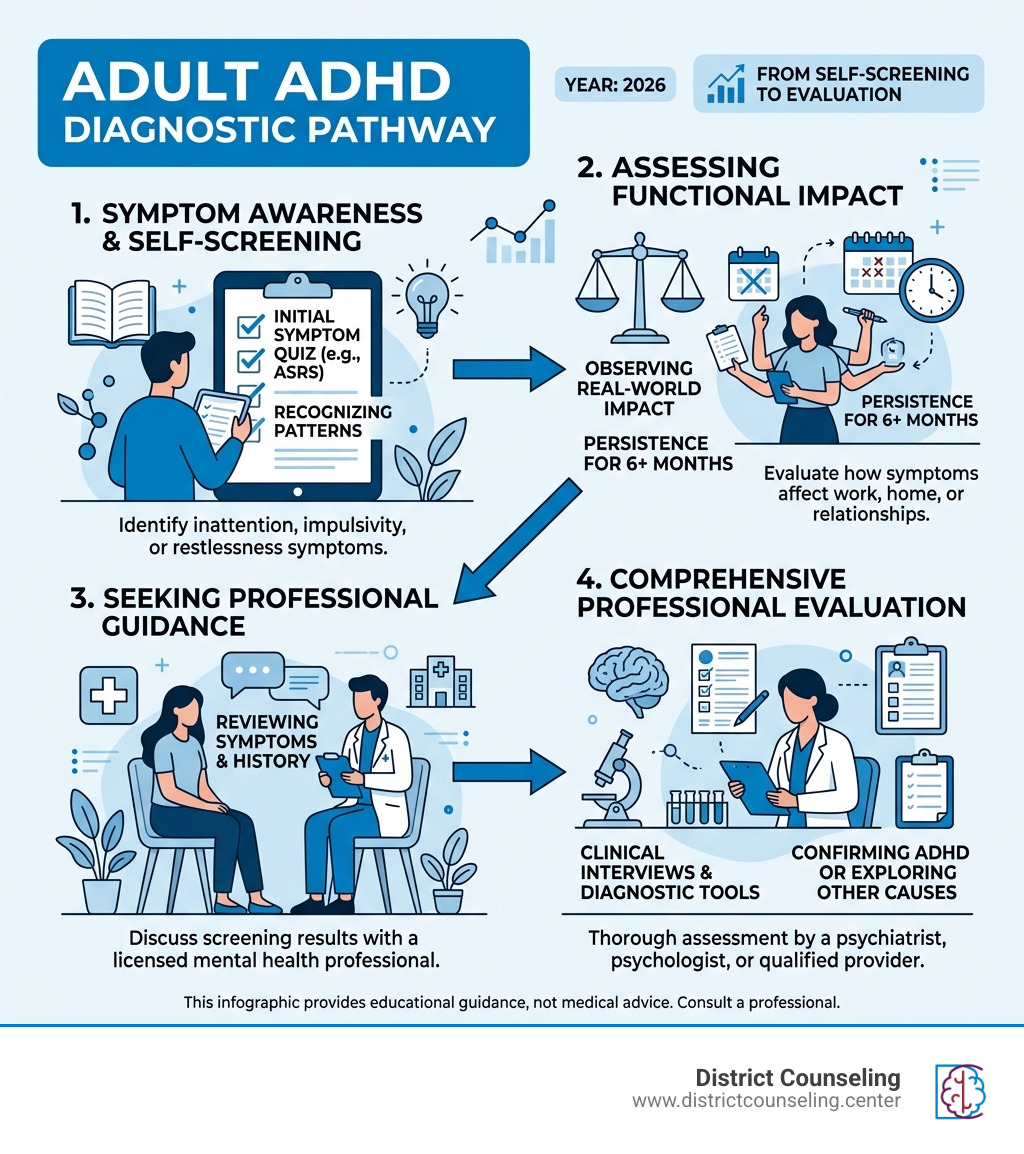
Why an Adult ADHD Symptoms Test is the First Step
Self-awareness is the catalyst for change. For many of our clients in Houston and across Texas, taking an adult ADHD symptoms test is the first time they realize their “personality quirks”—like losing keys, interrupting others, or being chronically late—are actually clinical symptoms.
In 2026, we are seeing a significant trend toward adults seeking clarity after years of feeling “lazy” or “unfocused.” A screening tool provides a standardized way to measure functional impairment. If you find yourself constantly overwhelmed by daily tasks, an ADHD Symptom Test for Adults – ADDitude can help you determine if your struggles meet the clinical threshold for further investigation. It moves the conversation from vague frustration to actionable data.
Understanding the Adult ADHD Self-Report Scale (ASRS v1.1)

The “gold standard” for initial screening is the Adult ADHD Self-Report Scale (ASRS v1.1). Developed by the World Health Organization (WHO) and researchers at Harvard Medical School, this tool was specifically designed to catch ADHD symptoms in adults, which often look different than the “bouncing off the walls” stereotype seen in children.
The ASRS v1.1 is an 18-item scale that asks you to rate the frequency of specific behaviors over the past 6 months. This timeframe is crucial because ADHD is a persistent condition; we aren’t looking for a “bad week” at work, but rather a long-term pattern of behavior. At District Counseling, we often use these insights as a starting point for a more comprehensive ADHD psychological evaluation to ensure we have the full picture of your mental health.
The Difference Between Part A and Part B
The ASRS v1.1 is divided into two sections, each serving a distinct purpose:
- Part A (The Screener): This consists of the first six questions. Research has shown these six items are the most predictive of ADHD in adults. If you score highly in the shaded boxes of Part A, there is a strong statistical likelihood that you have ADHD.
- Part B (Symptom Depth): The remaining 12 questions provide additional detail about your symptom profile. While Part A tells us if you might have it, Part B helps us understand how it manifests—whether you struggle more with organization, memory, or physical restlessness.
Both sections use a frequency scale: Never, Rarely, Sometimes, Often, and Very Often. In adult ADHD, “Often” and “Very Often” are the red flags we look for most closely.
How ADHD Symptoms Manifest in Adults vs. Children
One of the biggest hurdles to diagnosis is the misconception that ADHD always involves physical hyperactivity. While a child might run around the classroom, an adult with ADHD often experiences internal restlessness. You might feel like you have an “internal motor” that won’t shut off, or a constant need to fidget during long meetings.
In adults, symptoms often shift toward:
- Executive Dysfunction: Difficulty starting or finishing boring tasks.
- Emotional Dysregulation: Feeling easily frustrated or overwhelmed by small setbacks.
- Relationship Impact: Partners may feel ignored because the adult with ADHD “tunes out” during conversations.
Tools like the Copeland Symptom Checklist.pdf) highlight these workplace and relationship struggles, showing how ADHD evolves from academic trouble in childhood to professional hurdles in adulthood.
Core Symptoms and DSM-5 Criteria for Adult ADHD
To receive a formal diagnosis, a person must meet the criteria outlined in the DSM-5 (Diagnostic and Statistical Manual of Mental Disorders). For adults and adolescents aged 17 and older, the threshold is five or more persistent symptoms in either the inattentive or hyperactive-impulsive categories.
| Symptom Category | Key Adult Manifestations |
|---|---|
| Inattentive | Careless errors, difficulty sustaining focus, appearing not to listen, poor follow-through, chronic disorganization, avoiding mental effort, losing phones/wallets, easily distracted, forgetful in daily activities. |
| Hyperactive-Impulsive | Fidgeting with hands/feet, leaving seat in meetings, feeling restless, unable to engage in quiet hobbies, “on the go,” talking excessively, blurting out answers, difficulty waiting in line, interrupting others. |
If you suspect you lean more toward the “daydreamer” side, you might want to take a specific Inattentive ADHD test for adults to see if your symptoms align with that subtype.
Identifying Inattentive ADHD in Adults
Inattentive ADHD (formerly known as ADD) is frequently missed because it isn’t “disruptive” to others. You aren’t making noise; you’re just quietly struggling to keep your life together. You might make careless mistakes on boring reports, lose your keys three times a week, or find that your mind wanders the moment someone starts giving you directions. This “mental fog” can be just as debilitating as physical hyperactivity.
Recognizing Hyperactive-Impulsive ADHD in Adults
In adulthood, hyperactivity is less about climbing furniture and more about verbal impulsivity and internal tension. Do you find yourself finishing people’s sentences because they aren’t talking fast enough? Do you make impulsive purchases or quit jobs on a whim? These are the adult versions of the impulsivity seen in children.
How to Score and Interpret Your Adult ADHD Symptoms Test

When you look at an adult ADHD symptoms test like the ASRS, you’ll notice shaded boxes. If your checkmarks fall into those shaded areas frequently, it indicates that your symptoms are occurring at a clinically significant level.
However, scoring high doesn’t automatically mean you have ADHD. It means you have ADHD-like symptoms. The “why” behind those symptoms is what we determine during a professional evaluation. For our neighbors in North Texas, we provide specialized ADHD evaluations in Fort Worth to help parse out these results and provide a clear path forward.
Reliability of an Adult ADHD Symptoms Test vs. Clinical Evaluation
Self-report tests are wonderful for raising red flags, but they have limitations. We all have “off” days where we feel distracted. A professional clinical evaluation goes deeper by incorporating:
- Objective Data: Tests like the QBTest (a computerized continuous performance test) use motion tracking to measure hyperactivity and impulsivity objectively.
- Clinical Interviews: We look at your history from childhood to now.
- Observer Reports: Sometimes, seeing how a spouse or parent views your behavior provides a more rounded scientific perspective on ASRS results.
Conditions That Mimic ADHD Symptoms
This is the most critical part of the process. Many conditions look exactly like ADHD on the surface. If we don’t rule these out, we might treat the wrong thing:
- Anxiety & Depression: Chronic worry or low mood can destroy your ability to concentrate.
- Sleep Disorders: Sleep apnea or chronic insomnia can cause “brain fog” that mimics inattention.
- PTSD: Hypervigilance can look like distractibility.
- Autism: There is a high co-occurrence between ADHD and Autism, but they require different support strategies.
- Thyroid Issues: Physical health imbalances can affect energy and focus.
Next Steps: From Screening to Personalized Treatment
If your adult ADHD symptoms test suggests a high likelihood of ADHD, don’t panic. In fact, most of our clients feel a sense of immense relief. They finally have a name for their struggle.
The next step is to meet with a healthcare professional who can confirm the diagnosis and discuss a treatment plan. At District Counseling, we serve areas from Cypress to Sugar Land, providing a compassionate environment to explore these results. Whether it’s through traditional talk therapy or innovative options like neurofeedback therapy for ADHD, we focus on what matters most to your specific life goals.
Accommodations and Treatment Options in 2026
The landscape of ADHD treatment in 2026 is more personalized than ever. It’s no longer just “take a pill and hope for the best.” A multimodal approach typically works best:
- Workplace Accommodations: Simple changes like noise-canceling headphones, written instructions instead of verbal ones, or flexible “focus hours” can be life-changing.
- CBT (Cognitive Behavioral Therapy): This helps you build “scaffolding” for your brain—strategies for time management, organization, and managing the “shame” that often comes with a late diagnosis.
- Medication: Stimulants (like Adderall or Ritalin) and non-stimulants remain effective tools for many, helping to balance the dopamine levels in the prefrontal cortex.
- Lifestyle Interventions: High-protein diets, regular vigorous exercise, and strict sleep hygiene are foundational for managing ADHD symptoms.
Frequently Asked Questions about Adult ADHD
Can an online ADHD test provide a formal diagnosis?
No. An online adult ADHD symptoms test is a screening tool, not a diagnostic one. A formal diagnosis requires a licensed professional (like a psychologist or psychiatrist) to review your medical history, rule out other conditions, and conduct a clinical interview. Think of the online test as the “check engine light”—it tells you something needs attention, but you still need a mechanic to look under the hood.
Are ADHD test results different for women?
Yes, frequently. Women are masters of masking—using extreme effort to appear “normal” while struggling internally. Because women are often socialized to be organized and polite, their ADHD may manifest as internalizing symptoms like chronic anxiety, exhaustion, or being “hyper-talkative” rather than physically disruptive. Hormonal shifts (like pregnancy or menopause) can also significantly impact symptom severity.
What should I do if my test results indicate a high likelihood of ADHD?
Start by gathering your history. Look for old report cards or talk to your parents about your behavior as a child. Then, schedule an appointment with a specialist. Bring your test results with you to the appointment to help guide the conversation. You aren’t looking for a “label”; you’re looking for a key to unlock a more functional version of your life.
Conclusion
Taking an adult ADHD symptoms test is an act of self-compassion. It is the moment you stop blaming yourself for “not trying hard enough” and start understanding how your unique brain is wired. Whether you are in Houston, Katy, The Woodlands, or anywhere else in the great state of Texas, you don’t have to navigate this journey alone.
At District Counseling, we provide the sincere, authentic, and compassionate care you need to move from “struggling to get by” to “thriving with ADHD.”
Ready to get the clarity you deserve? Schedule your professional ADHD evaluation today and let’s start building a plan that works for your brain.
Visited 38 times, 1 visit(s) today
Similar Posts

Adalid Blandin
September 4, 2026
Spotting the Signs and Finding Help for Emotional Abuse
Recognize emotional abuse signs and connect with a relationship emotional abuse therapist for healing and support....

Francisco Ortiz
September 2, 2026
Riding Out the Storm: The Four Horsemen of Couples Therapy and Their Antidotes
Learn how the four horsemen couples therapy framework identifies destructive conflict patterns and provides proven antidotes to strengthen your relationship....

Francisco Ortiz
August 31, 2026
Premarital Counseling Online: Prep for Marriage from Your Couch
Prepare for marriage with premarital counseling online from your couch. Build skills, save on licenses, and strengthen your future today....

Francisco Ortiz
August 28, 2026
Licensed Telehealth Therapy Providers in Texas: A Quick Start Guide
Find licensed telehealth therapy Texas providers with this guide to legal rules, insurance parity, and clinical best practices....

Francisco Ortiz
August 26, 2026
The Intimacy Fix: What to Expect from Couples Sex Counselling
Learn how a relationship counsellor sex specialist helps couples rebuild intimacy, desire, and trust through evidence-based therapy....

Francisco Ortiz
August 24, 2026
Before the Nikah: Navigating Islamic Premarital Counseling
Discover how premarital counseling Islam builds a sacred, lasting union through faith-based modules, therapy, and practical guidance before your Nikah....

Francisco Ortiz
August 21, 2026
The Ultimate Guide to West Lake Hills Family Counseling and Keeping the Peace
The Ultimate Guide to West Lake Hills Family Counseling and Keeping the Peace – Learn about west lake hills family counseling...

Francisco Ortiz
August 19, 2026
How Relationship Therapy for Couples Can Save Your Sanity
Discover how relationship therapy for couples can restore connection, resolve conflict, and rebuild trust with evidence-based guidance....

Francisco Ortiz
August 17, 2026
Ready to Wed: What to Expect in Christian Premarital Counseling
Discover what to expect in premarital counseling Christian couples trust for a strong, faith-based marriage foundation....

Francisco Ortiz
August 14, 2026
Space City Love: Navigating Gottman Method Couples Therapy in Houston
Discover how Gottman Method couples therapy in Houston helps partners rebuild intimacy, manage conflict, and strengthen their bond with expert guidance....


