
What an ADHD Evaluation for Late Bloomers Actually Tells You
If you’ve been wondering whether an ADHD evaluation for late bloomers is worth pursuing, here’s the short answer: yes — and the research backs it up.
Quick overview: What to know about late-identified ADHD
| Question | Answer |
|---|---|
| Can adults be diagnosed with ADHD for the first time? | Yes. Many adults have ADHD that was missed in childhood. |
| Does ADHD appear out of nowhere in adulthood? | Rarely. Traits were usually present early but went unrecognized. |
| How common is late-identified ADHD? | Studies suggest up to 67–90% of adults meeting ADHD criteria had no childhood diagnosis. |
| What triggers recognition in adulthood? | Loss of structure, major life transitions, burnout, or hormonal shifts. |
| What does a proper evaluation involve? | Clinical interview, developmental history, standardized tools, and ruling out other conditions. |
For most of their lives, many adults quietly assumed they were just lazy, disorganized, or not trying hard enough. They built workarounds. They pushed through. And then — often in their 30s, 40s, or even later — something collapsed. The deadlines piled up. The coping strategies stopped working. And for the first time, a professional suggested ADHD might explain everything.
This experience is far more common than most people realize.
Landmark studies like the Dunedin cohort found that 90% of adults meeting ADHD criteria at age 38 had no childhood diagnosis. The E-Risk study found a similar pattern, with roughly 67% of adults meeting ADHD criteria at 18 showing no full diagnosis at any of four childhood assessments. These aren’t outliers — they represent a real and well-documented gap between when ADHD is present and when it finally gets identified.
The cost of that gap is real: years of self-blame, missed opportunities, burnout, and mental health struggles that might have been addressed much sooner.
I’m Francisco Ortiz, a Licensed Professional Counselor-Supervisor and Certified Forensic Mental Health Evaluator with experience in psychological assessment and evaluation — including navigating the clinical complexities of ADHD evaluation for late bloomers who were overlooked by earlier diagnostic systems. My background in forensic case formulation and lifespan mental health assessment shapes how I approach each adult evaluation with both rigor and compassion.
The Science of Late-Onset ADHD: Do We Really Outgrow It?
Historically, clinical wisdom treated ADHD as a pediatric disorder—something a child would eventually “grow out of” by the time they reached high school graduation. However, modern psychiatric research has completely turned this assumption on its head.

In the landmark Dunedin study, researchers discovered that a staggering 90% of adults meeting ADHD criteria at age 38 did not meet criteria for ADHD at any of their childhood assessments (completed at ages 11, 13, and 15). Similarly, the Environmental Risk (E-Risk) Longitudinal Twin Study found that 67.5% of individuals meeting DSM-5 ADHD criteria at age 18 did not meet full diagnostic criteria for ADHD at any of the four childhood assessments conducted at ages 5, 7, 10, and 12.
These findings are further mirrored internationally. In the 1993 Pelotas Birth Cohort in Brazil, 84.6% of individuals with ADHD at ages 18 and 19 did not meet criteria at their age 11 assessment. This body of evidence raises a fundamental scientific question: Does late-onset ADHD exist as a distinct, newly emerging biological entity, or are we simply getting better at identifying “late bloomers” whose early struggles were masked by intelligence, supportive family structures, or high-effort coping mechanisms?
To explore this debate in depth, clinicians and researchers frequently point to the Annual Research Review: Does late‐onset attention‐deficit/hyperactivity disorder exist? – Asherson – 2019 – Journal of Child Psychology and Psychiatry – Wiley Online Library, which notes that while “true” adult-onset ADHD (developing entirely in adulthood without any childhood precursors) remains highly controversial, the clinical reality of late-identified ADHD is undeniable. Many individuals experience a delayed emergence of impairing symptoms because their environments did not challenge their executive functioning capacities until adulthood.
Who Qualifies for the ADHD Evaluation Late Bloomers Receive?
When we talk about an adhd evaluation late bloomers can benefit from, we are looking at individuals who may not have fit the classic profile of a hyperactive, disruptive child in elementary school.
Longitudinal data shows that only about 15% of children diagnosed with ADHD continue to meet full, strict diagnostic criteria by age 25, yet approximately 65% continue to experience subthreshold symptoms that cause real-world impairment in adulthood. This means that a vast majority of adult “late bloomers” are navigating life with a brain that struggles with self-regulation, even if they do not display overt hyperactivity.
Unfortunately, retrospective recall bias is a major hurdle in adult assessments. Adults are notoriously unreliable at remembering exactly when their focus or organizational issues began during childhood. Prospective longitudinal studies—which follow individuals in real-time from childhood to adulthood—show that many adults who self-report that their symptoms started after age 12 actually had subtle, unrecognized difficulties much earlier.
If you find yourself constantly struggling with task initiation, chronic disorganization, and mental fatigue despite having a track record of academic or professional success, you can learn more about why your adult brain might need an ADHD evaluation to understand how these subtle childhood patterns may still be impacting you today.
The DSM-5 Age of Onset Dilemma
The Diagnostic and Statistical Manual of Mental Disorders, Fifth Edition (DSM-5), requires that “several inattentive or hyperactive-impulsive symptoms were present prior to age 12.” While this was an improvement from the DSM-IV’s strict age-7 cutoff, it still presents a significant diagnostic hurdle for late bloomers.
For many high-achieving individuals, symptoms were technically present before age 12 but were entirely subthreshold or successfully masked. A child with a high IQ and an organized, supportive home environment may easily maintain straight A’s and good behavior throughout elementary school. However, when they move away to college, start a demanding career, or have children of their own, the external scaffolding disappears.
A comprehensive clinical perspective on this phenomenon can be found in the Late-Onset ADHD Reconsidered With Comprehensive Repeated Assessments Between Ages 10 and 25 | American Journal of Psychiatry, which highlights that many “late-onset” cases are actually late-identified. Their underlying neurodevelopmental traits were always there, but they only crossed the threshold into clinical impairment when life’s cognitive load exceeded their brain’s natural coping capacity.
Why an ADHD Evaluation Late Bloomers Seek is Life-Changing
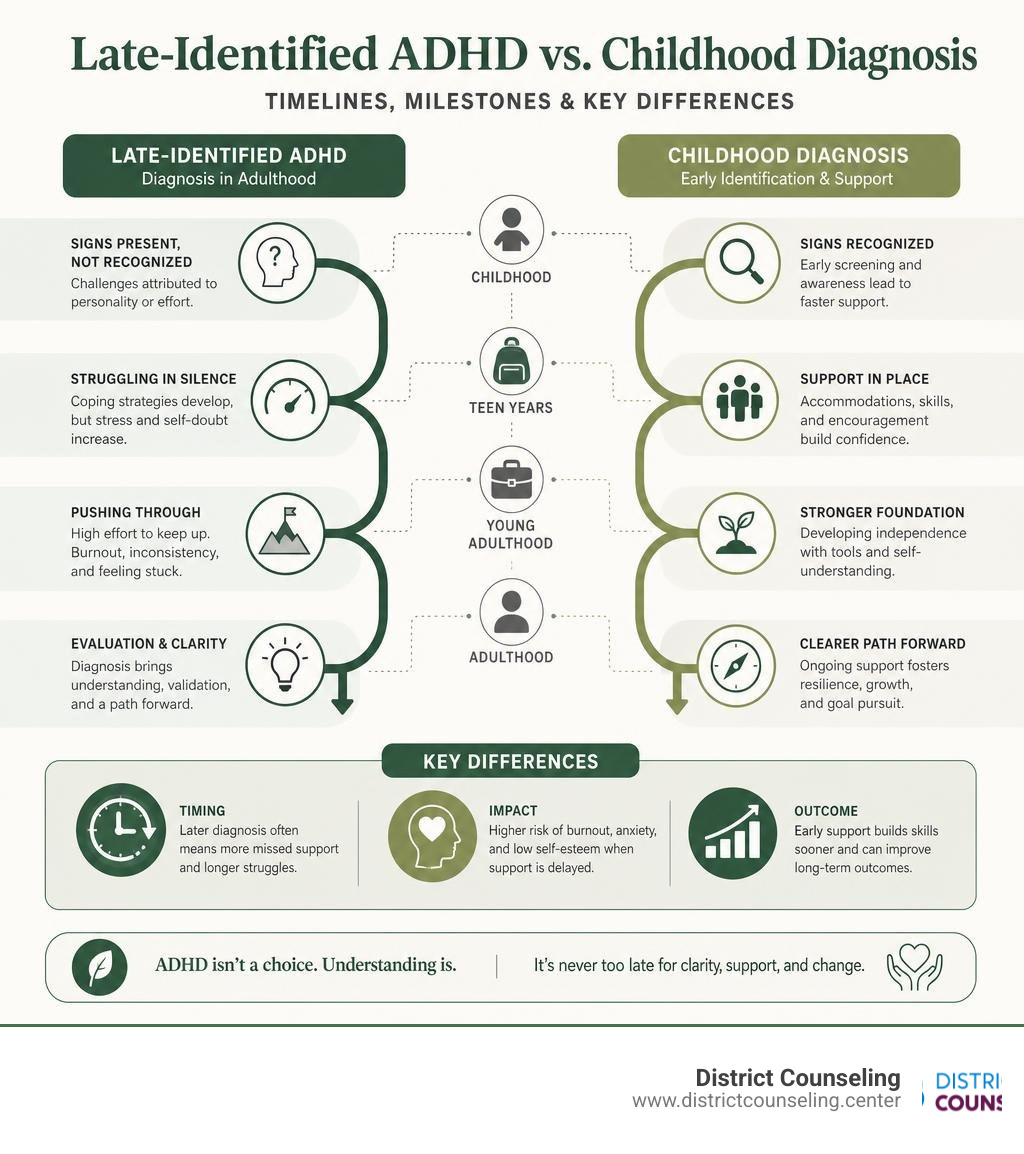
Receiving a formal diagnosis as an adult is often described as an emotional turning point. It shifts the internal narrative from “I am fundamentally flawed and lazy” to “My brain is wired differently, and I need different tools.”
| Feature | Early-Onset ADHD (Childhood Identified) | Late-Onset / Late-Identified ADHD (Late Bloomer) |
|---|---|---|
| Primary Presentation | Often hyperactive-impulsive or combined type. | Dominantly inattentive presentation; internal restlessness. |
| Academic History | Early academic struggles, behavioral notes, or tutoring. | Often high-achieving early on; “smart but disorganized” or “daydreamer.” |
| Masking & Camouflage | Low to moderate; symptoms are externally obvious. | High; intense effort spent pretending to have everything under control. |
| Primary Comorbidities | Conduct issues, learning disabilities. | Anxiety, depression, chronic burnout, fibromyalgia. |
| Brain Maturity Delay | Visible 3-to-5-year delay in prefrontal cortex development. | Similar developmental delay, but masked by high cognitive reserve. |
This developmental delay is a core neurobiological reality of ADHD. Research shows that children and adolescents with ADHD experience a 3-to-5-year delay in the maturation of the prefrontal cortex—the brain region responsible for executive functions like planning, working memory, emotional regulation, and impulse control. For a late bloomer, this means that even if they are chronologically 30, their executive functioning system may still struggle with self-regulation in ways that resemble a much younger individual.
If you are ready to stop guessing and want to seek professional clarity, we have mapped out exactly how to get tested for ADHD in 7 simple steps to make the process as straightforward and stress-free as possible.
What to Expect During the ADHD Evaluation Late Bloomers Undergo
A proper, neuroaffirming adult ADHD evaluation is not a quick 10-minute online checklist. Because adult ADHD is highly nuanced, a comprehensive evaluation requires a multi-step, stepped diagnostic procedure:
- Clinical Interview: A deep-dive conversation with a licensed clinician to explore your current struggles, occupational history, relationship patterns, and daily functioning.
- Developmental History: Looking backward to find evidence of childhood traits. This may involve reviewing old report cards (looking for comments like “highly capable but doesn’t pay attention”) or gathering collateral information from a parent, sibling, or long-term partner.
- Standardized Assessment Tools: Utilizing validated rating scales to compare your symptom frequency and severity against adult norms.
- Differential Diagnosis: Carefully ruling out or identifying co-occurring conditions like anxiety, depression, or trauma.
To demystify this process further, you can read our comprehensive guide on everything you need to know about an adult ADHD symptoms test to understand what to look for in a quality clinical assessment.
Distinguishing ADHD from Mimicking Conditions
One of the most critical reasons to seek a professional evaluation rather than relying solely on social media self-diagnosis is the complexity of differential diagnosis. Many conditions can mimic or exacerbate executive dysfunction:
- Substance Use: Heavy substance use can significantly impair attention and memory. In clinical studies, a large percentage of adults who initially screened positive for late-onset ADHD were excluded because their symptoms occurred exclusively in the context of heavy substance use.
- Sleep Apnea & Sleep Disorders: Chronic sleep deprivation directly damages prefrontal cortex functioning, causing severe brain fog and focus issues.
- Thyroid Dysfunction: Hypothyroidism or hyperthyroidism can cause profound fatigue, memory lapses, and mood swings.
- Trauma & PTSD: A nervous system stuck in a chronic fight-or-flight state struggles to register new information, plan ahead, or maintain focus.
- Anxiety & Depression: Overwhelming worry or depressive rumination consumes precious working memory, making it look like a primary attention deficit.
At District Counseling, we provide thorough ADHD Evaluation for Children, Teens and Adults in Texas across our many local offices—including Houston, Katy, Fort Worth, Austin, and Sugar Land—to ensure that we get to the root of your symptoms and rule out these mimicking conditions.
Why ADHD Symptoms Suddenly Emerge in Adulthood
If ADHD is a neurodevelopmental condition present from birth, why does it feel like it suddenly appeared in your 30s or 40s?

The answer lies in the balance between environmental demands and coping capacity. As a child, your life was highly structured. Parents woke you up, teachers gave you daily deadlines, and your schedule was mapped out for you.
When you enter adulthood, that external scaffolding vanishes. Suddenly, you are responsible for managing a career, paying taxes, maintaining a household, nurturing relationships, and perhaps raising children. If you have a high IQ, you may have been able to compensate for your executive functioning deficits through sheer intellectual effort. But eventually, the cognitive load becomes too heavy, and the masking strategies collapse under the weight of adult responsibilities.
For women, this collapse is often triggered by hormonal fluctuations. Estrogen plays a vital role in modulating dopamine—the neurotransmitter responsible for focus, motivation, and reward signaling. During perimenopause and menopause, estrogen levels drop dramatically, which can severely unmask or worsen lifelong ADHD symptoms. You can read more about how these unique challenges and cognitive strengths manifest in our guide on ADHD Late Bloomers: Thrive Beyond Expectations.
Gender Differences and the Masking Phenomenon
For decades, ADHD was primarily diagnosed in hyperactive school-age boys. Girls, who are more likely to present with the inattentive type, were frequently overlooked. Instead of acting out, girls with undiagnosed ADHD are often socialized to mask their symptoms through hyper-vigilance, perfectionism, and people-pleasing.
They don’t throw papers or run around the classroom; instead, they quiet their internal restlessness by daydreaming, over-preparing, or working twice as hard as their peers to achieve the same results. This intense internal pressure often leads to severe anxiety, depression, and chronic fatigue. The emotional and physical toll of this masking is beautifully articulated in The Journey to Diagnosis for Adult Women with ADHD and Autism, which highlights how adult women are finally reclaiming their narratives after decades of being misdiagnosed with primary mood disorders.
Gaps in Lifespan Research and Older Adulthood
While our understanding of ADHD in young adults has grown significantly, major gaps remain regarding how ADHD manifests in middle and older adulthood.
As we age, natural cognitive decline can intersect with ADHD traits, making it difficult to distinguish between age-related memory issues and lifelong executive function deficits. Furthermore, older adults face unique challenges, such as navigating retirement (which removes daily occupational structure) or managing complex medical regimens. Lifespan research is actively working to understand how polygenic risk factors and cumulative lifetime stress impact the brain health of older neurodivergent adults.
The Hidden Cost of Masking and Delayed Diagnosis
Going undiagnosed for decades is not a victimless delay. The psychological toll of masking is immense. When you spend every day pretending to have it all together while internally drowning, you live in a state of chronic nervous system activation.
This chronic stress often culminates in:
- Severe Burnout: A state of physical and mental exhaustion that doesn’t improve with simple rest.
- Secondary Physical Conditions: Emerging research suggests a strong link between the chronic stress of undiagnosed ADHD and physical conditions like fibromyalgia, chronic fatigue syndrome, and gut issues.
- Rejection Sensitive Dysphoria (RSD): An intense, overwhelming emotional pain triggered by the real or perceived perception of rejection, teasing, or criticism.
If you are currently feeling empty, overwhelmed, and unable to keep up with daily tasks, it is crucial to learn how to recover from ADHD burnout without losing your mind so you can begin healing your nervous system.
The Emotional Journey of Relief and Grief
When late bloomers finally receive their diagnosis, they typically experience two distinct waves of emotion: relief and grief.
First comes the relief—the profound validation that they are not broken, lazy, or stupid. They finally have a scientific explanation for why simple tasks felt monumentally difficult.
But closely following that relief is a period of grief. Late-diagnosed adults often mourn the life they could have lived if they had received support sooner. They grieve the academic struggles, the failed relationships, the financial “ADHD taxes” paid in late fees, and the decades spent hating themselves for things they couldn’t control. Processing this grief with a neuroaffirming therapist is a crucial step in rebuilding a compassionate, accurate self-narrative.
Frequently Asked Questions about Late-Onset ADHD
Can you actually develop ADHD for the first time as an adult?
Strictly speaking, no. ADHD is a neurodevelopmental condition, meaning the underlying neurological wiring is present from birth. However, you can absolutely experience impairing ADHD symptoms for the first time as an adult when your environmental demands finally outpace your coping mechanisms. To explore this distinction further, you can read more on the research surrounding can you develop ADHD as an adult? to understand how late-identified traits differ from other cognitive issues.
Why was my ADHD missed when I was a child?
Your ADHD was likely missed because you did not fit the outdated stereotype of a hyperactive child. If you had the inattentive type, possessed a high IQ that allowed you to cruise through school, or had a highly structured home life that managed your time for you, your struggles remained internal. Additionally, diagnostic gender biases historically meant that girls and quiet, daydreaming boys were rarely referred for evaluations.
What are the best treatment approaches for late-diagnosed adults?
The gold standard for adult ADHD treatment is a multimodal approach:
- Education & Self-Compassion: Understanding how your brain works and letting go of historical shame.
- Behavioral Strategies & Accommodations: Implementing external structures like body doubling, visual timers, and digital organization systems.
- Cognitive Behavioral Therapy (CBT): Specifically adapted for ADHD to address executive dysfunction, emotional regulation, and masking burnout.
- Medication: Working with a medical professional to explore stimulant or non-stimulant options, which help regulate dopamine and norepinephrine levels.
Conclusion
Waiting for an ADHD evaluation carries a heavy, hidden cost—one measured in years of unnecessary struggle, self-doubt, and exhaustion. If you are tired of wondering why life feels harder for you than it seems to be for everyone else, taking the step to get evaluated is an act of profound self-advocacy.
At District Counseling, we believe in sincere, authentic, and compassionate alignment with what matters most to you. We provide comprehensive psychological testing and neuroaffirming therapy across our many convenient Texas locations—including Houston, Katy, Fort Worth, Austin, Sugar Land, Cypress, Tomball, Spring, and Pearland.
Let us help you find the answers, the tools, and the self-compassion you deserve. Schedule an ADHD evaluation today and take the first step toward reclaiming your story.
Visited 20 times, 1 visit(s) today
Similar Posts

Adalid Blandin
September 28, 2026
Missouri City and Houston Couples Therapy 101
Explore relationship counseling in Houston options, from couples therapy to intensives, with costs, insurance, and therapist tips for Missouri City families....

Adalid Blandin
September 25, 2026
How to find authentic therapy for emotional exhaustion in Houston
Find emotional exhaustion therapy Houston that helps professionals and caregivers move from burnout to renewed energy and balance....

Francisco Ortiz
September 23, 2026
A Practical Guide to Finding Licensed Telehealth Counselors in Texas
Find licensed telehealth counseling in Texas with this guide to legal standards, privacy, insurance, and best practices for virtual care....

Adalid Blandin
September 21, 2026
All About Psychiatric Weight Loss Options and Treatments
Explore psychiatric weight loss options, including medications, therapy, and bariatric support for holistic wellness....

Francisco Ortiz
September 18, 2026
No Traffic, No Waiting Rooms: Your Guide to Telehealth Counseling in Texas
Learn the rules, rights, and benefits of telehealth counseling in Texas with this complete guide to virtual therapy....

Adalid Blandin
September 16, 2026
Why Your Mitochondria Might Be Depressed
Explore metabolic mental health to boost brain energy, ease mood disorders, and support recovery through mitochondria-focused strategies....

Adalid Blandin
September 14, 2026
The Definitive Guide to Life Coaching
Discover how life coaching can help you achieve goals, gain clarity, and create lasting change in 2026....

Adalid Blandin
September 11, 2026
The Ultimate Guide to Identifying Emotional Abuse in Relationships
The Ultimate Guide to Identifying Emotional Abuse in Relationships – Learn about emotional abuse relationship...

Adalid Blandin
September 9, 2026
A Comprehensive Guide to Effective Relationship Counseling Options
A Comprehensive Guide to Effective Relationship Counseling Options – Learn about relationship counseling...

Francisco Ortiz
September 7, 2026
First Couples Counseling Session: A Guide to Your First Hour on the Couch
Learn what happens in your first couples counseling session, from intake to ground rules, and how to prepare for a successful start....


