
What Tree House ESA Therapy Can Do for Your Child’s Mental Health
Tree House ESA therapy is a child-centered approach that combines emotional support animals (ESAs) with pediatric mental health care — often inside nature-inspired, treehouse-themed therapeutic environments designed to help kids feel safe, calm, and engaged.
If you’re a parent trying to understand your options quickly, here’s what you need to know:
- What it is: A therapy model that integrates ESAs (dogs, horses, and other animals) into mental health treatment for children with anxiety, autism, ADHD, trauma, and developmental disorders
- Who it’s for: Children of all ages struggling with emotional, behavioral, or developmental challenges
- Where it happens: Specialized pediatric centers and counseling practices — like District Counseling’s Tree House location in Cypress, TX
- How to start: A licensed mental health professional conducts a 30-minute ESA evaluation ($275) and can provide a same-day ESA letter
- Key benefit: Animals help children open up, regulate emotions, and build social skills in ways that traditional talk therapy sometimes cannot
For many Texas families, navigating a child’s mental health needs feels overwhelming — especially when waitlists are long and traditional therapy doesn’t seem to click. The good news is that ESA-integrated, treehouse-style care is designed specifically to meet kids where they are: through play, nature, and the unconditional presence of an animal companion.
I’m Francisco Ortiz, Licensed Professional Counselor-Supervisor and the clinical mind behind District Counseling’s Tree House ESA therapy services, with specialized training in trauma-informed care, child counseling, and forensic mental health evaluation. My work with children and families across Houston has shown me how combining therapeutic environments with animal support can unlock progress that other approaches miss.
Understanding Tree House ESA Therapy and Its Unique Design
At its core, Tree House ESA therapy blends three things children often respond to naturally:
- Safety
- Play
- Connection
Traditional therapy may rely heavily on conversation, insight, and sitting face-to-face in an office. That works well for many adults. Kids, however, often communicate through movement, imagination, sensory experiences, and relationships. An animal can become a bridge when words are hard to find.
A treehouse-inspired therapy setting adds another helpful layer. Research on pediatric, nature-themed design shows that child-friendly spaces can reduce stress and support engagement. One well-known example in pediatric design is a 54,000 square foot treehouse-themed center built around evidence-based features such as natural light, child-height viewing areas, and nature-inspired elements that invite exploration. The lesson for families is simple: environment matters.
When a counseling space feels playful instead of clinical, many children become more willing to participate. A room that feels more like discovery than diagnosis can lower defenses fast. In child therapy, that is a big deal.
At District Counseling, our Tree House approach is built around this same principle: make mental health care feel approachable, calming, and developmentally appropriate.

Key Benefits of Tree House ESA Therapy
Children do not usually say, “I need support with emotional regulation and relational safety.” They might say nothing at all. They may instead cling, withdraw, melt down, avoid eye contact, or act out. ESA-informed work helps us meet those needs more gently.
Here are some of the most important benefits:
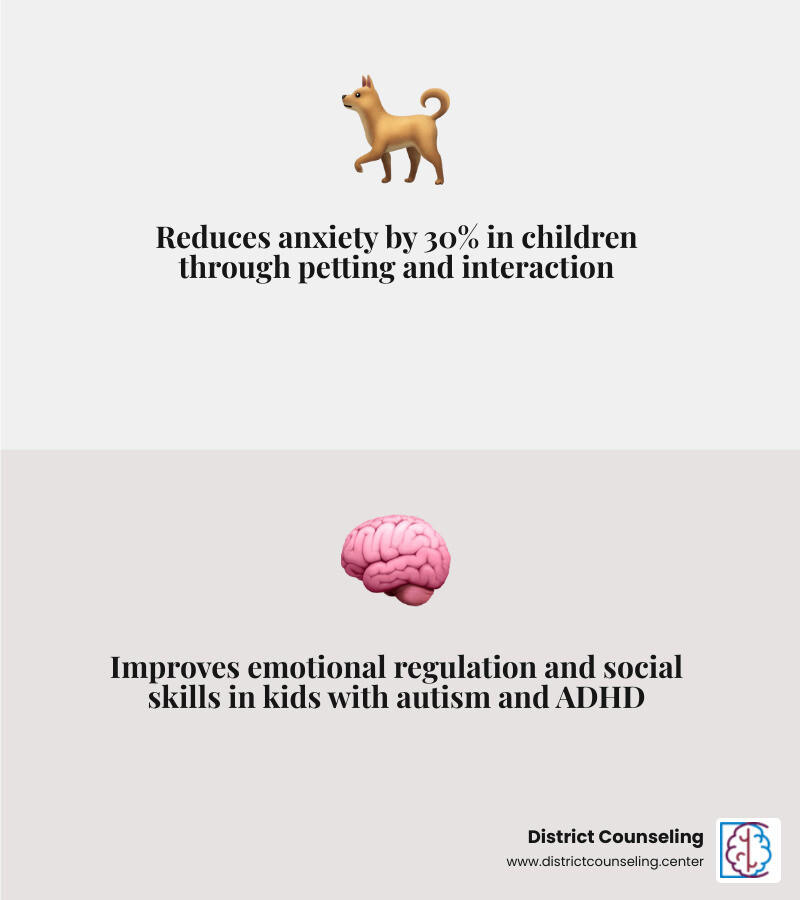
- Anxiety relief: Animals can have a grounding effect. Petting, observing, or sitting near a calm animal may help lower arousal and reduce stress.
- Emotional regulation: A child can practice breathing, waiting, gentleness, and co-regulation through interaction with an animal.
- Social skill development: Animals often create opportunities for turn-taking, eye contact, naming feelings, and practicing empathy.
- Sensory exploration: Soft fur, rhythmic movement, and predictable routines can support some children with sensory processing differences.
- Companionship: Children who feel lonely, misunderstood, or guarded may form a trusting bond with an animal before they fully trust the therapist.
Some animal-assisted models also include equine work. While not every family needs horse-based therapy, research and practice in equine-assisted mental health show that structured interaction with horses can support confidence, self-awareness, stress reduction, and relational skills.
In plain English: sometimes a wagging tail opens a door that a clipboard cannot.
Therapeutic Benefits for Autism and Developmental Disorders
Children with autism, ADHD, trauma histories, or developmental differences often benefit from therapy that is less abstract and more experiential. That is where Tree House ESA therapy can fit especially well.
For children on the autism spectrum, animals may help by:
- creating a low-pressure relational experience
- encouraging shared attention
- supporting routine and predictability
- giving children a nonjudgmental companion
- motivating communication in natural ways
For children with ADHD, animals may support work on:
- impulse control
- attention and task persistence
- body awareness
- calming transitions
- frustration tolerance
For children with broader developmental or behavioral needs, ESA-integrated care can complement services such as psychological assessment, counseling, and skills-based interventions.
If you are still figuring out what your child needs, evaluations can be an important first step. We offer autism psychological evaluations and ADHD psychological evaluations through our Tree House services to help families move from guessing to planning.
A few practical examples of how this can help:
- A child with autism may practice requesting, labeling emotions, or tolerating proximity through animal interaction.
- A child with anxiety may feel safer entering the room when an animal is part of the routine.
- A child with trauma may use the animal as a grounding anchor during difficult moments.
- A child with developmental delays may engage more readily in play-based, relational tasks when an animal is involved.
This does not mean animals replace therapy goals. They help us reach them.
Distinguishing Between ESAs, Service Dogs, and Therapy Animals
This topic confuses a lot of families, and understandably so. The terms sound similar, but they are not the same.
| Type | Main role | Special training | Public access rights | Legal recognition |
|---|---|---|---|---|
| Emotional Support Animal (ESA) | Provides emotional comfort to one person | No task-specific training required | No general public access rights | May be supported by an ESA letter in certain housing-related contexts |
| Service Dog | Performs trained tasks related to a disability | Yes, task-specific training required | Yes, broader public access rights apply | Recognized under disability law |
| Therapy Animal | Provides comfort in clinical, school, or community settings | Usually temperament-tested and program-trained | No individual public access rights like a service dog | Works as part of a program or visit setting |
Here is the easiest way to remember it:
- An ESA supports its owner emotionally.
- A service dog is trained to do disability-related tasks.
- A therapy animal helps many people in structured settings.
In Tree House ESA therapy, we may talk about ESAs for a specific child, but we also educate families on how ESA support differs from therapy-animal visits or service-dog work. This matters for expectations, school questions, housing questions, and legal clarity.
Integrating Animals into Play Therapy and ABA
Children often process their inner world through action long before they can explain it. That is why animals pair so naturally with play therapy.
In play therapy services, an animal can help us build rapport, model calm behavior, and create a felt sense of safety. Some children speak more freely while petting a dog than while making direct eye contact with an adult. Others may show us themes of care, fear, control, gentleness, or trust through how they relate to the animal in session.

Animals may be integrated into child therapy in ways such as:
- greeting rituals that make arrivals easier
- practicing boundaries and consent
- modeling gentle touch and calm movement
- using the animal to support emotion naming
- reducing defensiveness during hard conversations
- reinforcing coping skills like breathing and grounding
For some families, animal-assisted support can also complement structured behavior interventions. In broader pediatric care, children with autism may receive ABA-oriented services focused on communication, daily living skills, independence, and social behavior. In those contexts, animals can sometimes increase motivation, reinforce routines, and make skills practice feel more natural.
The key is thoughtful integration. We do not just “add an animal” and hope for the best. We use the relationship intentionally, based on your child’s developmental level, treatment goals, and sensory profile.
This can work especially well alongside services like children’s counseling, trauma counseling for children, and depression and anxiety counseling for children.
The Process of Obtaining an ESA Letter for Your Child
If your child may benefit from an ESA at home, one of the most common questions is: “How do we make it official?”
At District Counseling, the process starts with an ESA evaluation. Based on our current Tree House service information, families can expect:
- a licensed mental health professional
- a 30-minute evaluation
- a fee of $275
- possible same-day documentation when clinically appropriate
An ESA letter is a formal recommendation stating that an emotional support animal is part of a child’s mental health support plan. It is not a certificate you print from a random website at midnight while stress-eating crackers. It should come from a qualified licensed professional who evaluates the child’s needs.
A basic process usually looks like this:
- Schedule the evaluation.
- Discuss your child’s symptoms, history, and functioning.
- Review whether an animal is clinically appropriate.
- If appropriate, receive documentation.
- Use that documentation where legally relevant.
Families can also review our broader ESA letter service page and the Tree House-specific page at Emotional Support Animal Evaluation at The Tree House.
How to Qualify for Tree House ESA Therapy
Not every child needs an ESA, and not every pet automatically qualifies as therapeutic support. Clinical appropriateness matters.
In general, a child may qualify when:
- they have a mental or emotional disability or clinically significant symptoms
- the animal meaningfully helps reduce distress or improve functioning
- the recommendation is made by a licensed professional
- the family can safely and consistently care for the animal
Children who may be considered include those struggling with:
- anxiety
- depression
- trauma-related symptoms
- emotional dysregulation
- loneliness
- certain autism-related support needs
- other behavioral or emotional difficulties
Age can vary. ESA support is not limited to one narrow age bracket. What matters more is whether the animal genuinely supports the child’s emotional wellbeing and whether the family environment is a good fit.
If in-person care is difficult, families may also want to explore telehealth counseling when appropriate as part of a broader support plan.
Funding Your Child’s Care with Education Savings Accounts
This is the part where the acronym soup gets tricky: ESA can mean Emotional Support Animal, but in education policy it can also mean Education Savings Account.
They are not the same thing.
Education Savings Accounts are state-funded programs in some parts of the U.S. that may help eligible families pay for approved educational expenses. Research in this area shows that families in states with these programs often receive around $4,000 to $10,000 per student per year, and roughly half a million students receive this kind of funding annually.
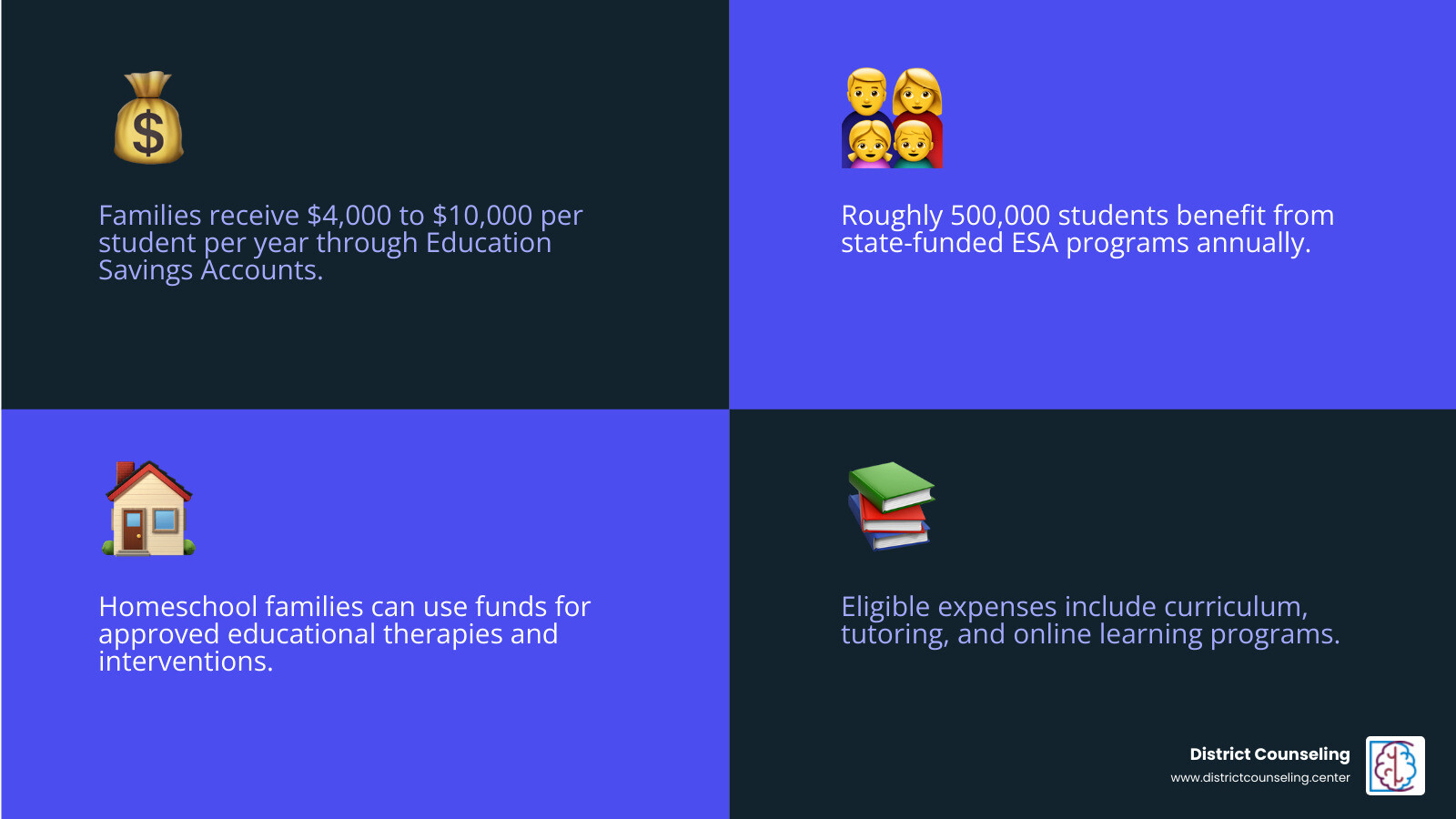
For some homeschool or alternative education families, approved ESA education funds may be used for things like:
- curriculum
- tutoring
- online learning programs
- certain special-needs educational therapies
- academic testing or support tools
Important note: this kind of funding is about education expenses, not automatically mental health treatment or ESA letters. Eligibility and approved uses depend on state rules, vendor approval, and whether a service is classified as educational versus medical or clinical.
Because rules change, Texas families should verify current program requirements before assuming therapy is covered. The safest approach is to check what is currently approved, what documentation is required, and whether a specific service is listed as eligible.
If your child needs support that overlaps home education, developmental concerns, and mental health, we recommend starting with a clear clinical plan first. From there, we can help you think through the right combination of counseling, evaluations, and family resources.
Frequently Asked Questions about Tree House ESA Therapy
What training do therapy animals undergo?
Therapy animals used in structured programs are typically screened for temperament, obedience, and comfort in public or therapeutic environments. Good programs often look for animals that can:
- follow basic commands
- remain calm around strangers
- tolerate touch from different people
- stay non-reactive to noise and movement
- handle equipment like wheelchairs, crutches, or strollers
- recover quickly from surprises
Some therapy-dog programs use behavioral checklists and annual renewals to maintain standards. Research on therapy-dog programming also shows session pricing can begin around $75 per hour for one therapy dog in some settings, though costs vary widely by program and location.
That said, an ESA is different from a therapy animal. ESAs do not need the same public-program certification because their role is emotional support for one person, usually in the home setting.
Are there state-funded options for therapy costs?
Sometimes, but not always.
State education funding programs may cover certain educational therapies for eligible students, especially in homeschool or special-needs education contexts. Families may encounter systems like marketplace purchasing platforms or reimbursement tools, but approved spending categories vary by state and by year.
Mental health counseling, psychological evaluations, and ESA-related services are not automatically covered under education funding. Families should always confirm:
- whether the program is active in Texas
- whether your child qualifies
- whether the provider or service is approved
- whether the expense is educational, clinical, or both
For Texas-based mental health services, it is often more practical to ask about private pay, insurance options where applicable, or a targeted care plan first.
How do I get started with a free consultation?
The best starting point is to contact us and discuss your child’s needs. Depending on the service, we can help you identify whether your next step should be:
- counseling
- an ESA evaluation
- an autism or ADHD evaluation
- trauma-focused therapy
- telehealth support
- a combination of services
Families often want quick clarity: “Do we need therapy, testing, or an ESA letter first?” We can help sort that out.
To learn more, visit our Tree House FAQ, explore Tree House Therapy, or review our Tree House Blog for more family guidance.
Conclusion
Tree House ESA therapy offers something many children need but cannot always ask for directly: a safe, gentle, relationship-based path into mental health care.
For children with anxiety, autism, ADHD, trauma, emotional regulation challenges, or developmental concerns, the combination of a child-friendly setting and animal support can make therapy feel less intimidating and more effective. It is not magic, but sometimes it can feel a little magical to watch a child finally relax enough to connect.
At District Counseling, we provide compassionate, evidence-informed support for children and families across our Texas communities, including Houston-area locations and our Tree House setting in Cypress. Whether your child needs counseling, trauma care, psychological evaluation, telehealth, or an ESA assessment, we are here to help you find the right next step.
You can learn more about our Tree House location or get started with ESA letters.
Visited 8 times, 1 visit(s) today
Similar Posts

Adalid Blandin
September 9, 2026
A Comprehensive Guide to Effective Relationship Counseling Options
A Comprehensive Guide to Effective Relationship Counseling Options – Learn about relationship counseling...

Francisco Ortiz
September 7, 2026
First Couples Counseling Session: A Guide to Your First Hour on the Couch
Learn what happens in your first couples counseling session, from intake to ground rules, and how to prepare for a successful start....

Adalid Blandin
September 4, 2026
Spotting the Signs and Finding Help for Emotional Abuse
Recognize emotional abuse signs and connect with a relationship emotional abuse therapist for healing and support....

Francisco Ortiz
September 2, 2026
Riding Out the Storm: The Four Horsemen of Couples Therapy and Their Antidotes
Learn how the four horsemen couples therapy framework identifies destructive conflict patterns and provides proven antidotes to strengthen your relationship....

Francisco Ortiz
August 31, 2026
Premarital Counseling Online: Prep for Marriage from Your Couch
Prepare for marriage with premarital counseling online from your couch. Build skills, save on licenses, and strengthen your future today....

Francisco Ortiz
August 28, 2026
Licensed Telehealth Therapy Providers in Texas: A Quick Start Guide
Find licensed telehealth therapy Texas providers with this guide to legal rules, insurance parity, and clinical best practices....

Francisco Ortiz
August 26, 2026
The Intimacy Fix: What to Expect from Couples Sex Counselling
Learn how a relationship counsellor sex specialist helps couples rebuild intimacy, desire, and trust through evidence-based therapy....

Francisco Ortiz
August 24, 2026
Before the Nikah: Navigating Islamic Premarital Counseling
Discover how premarital counseling Islam builds a sacred, lasting union through faith-based modules, therapy, and practical guidance before your Nikah....

Francisco Ortiz
August 21, 2026
The Ultimate Guide to West Lake Hills Family Counseling and Keeping the Peace
The Ultimate Guide to West Lake Hills Family Counseling and Keeping the Peace – Learn about west lake hills family counseling...

Francisco Ortiz
August 19, 2026
How Relationship Therapy for Couples Can Save Your Sanity
Discover how relationship therapy for couples can restore connection, resolve conflict, and rebuild trust with evidence-based guidance....


