
What EMDR therapy for trauma actually is (and why it works)
EMDR therapy for trauma is a structured, evidence-based treatment that helps your brain reprocess painful memories — so they stop controlling your life.
Here’s a quick snapshot of what it involves:
| Question | Quick Answer |
|---|---|
| What is it? | Eye Movement Desensitization and Reprocessing — a therapy that uses bilateral stimulation (eye movements, tones, or taps) to reprocess traumatic memories |
| Who is it for? | Anyone dealing with PTSD, trauma, anxiety, depression, grief, or phobias — children and adults |
| How long does it take? | 3–6 sessions for a single trauma; 8–12+ for complex trauma |
| Do I have to talk about it? | No — you think about the memory, but you don’t have to describe it in detail |
| Is it proven? | Yes — endorsed by the WHO, APA, VA, and Department of Defense |
Millions of people carry trauma quietly. It might show up as a flashback, a racing heart when you hear a certain sound, or an overwhelming feeling you can’t quite explain. Traditional talk therapy helps — but for trauma stored deep in the brain, simply talking about it often isn’t enough.
That’s where EMDR comes in.
In 1987, psychologist Francine Shapiro noticed something unexpected: moving her eyes back and forth seemed to reduce the emotional weight of distressing thoughts. That accidental observation became one of the most rigorously studied trauma treatments in the world. Today, over 100,000 clinicians use it globally, and research shows it can produce results faster than many other therapies.
I’m Francisco Ortiz, a Licensed Professional Counselor-Supervisor with extensive experience providing trauma-informed psychotherapy, including EMDR therapy for trauma, to individuals and families navigating some of life’s most difficult moments. My work spans clinical counseling, forensic mental health, and school-based services — giving me a broad perspective on how trauma shows up and how healing actually happens.
Understanding EMDR therapy for trauma
To understand why EMDR therapy for trauma is so effective, we first have to look at how the brain handles a crisis. When something terrifying happens, your brain’s natural information-processing system can become overwhelmed. Instead of the memory being filed away neatly in the past, it gets “stuck” in its raw, unprocessed form.
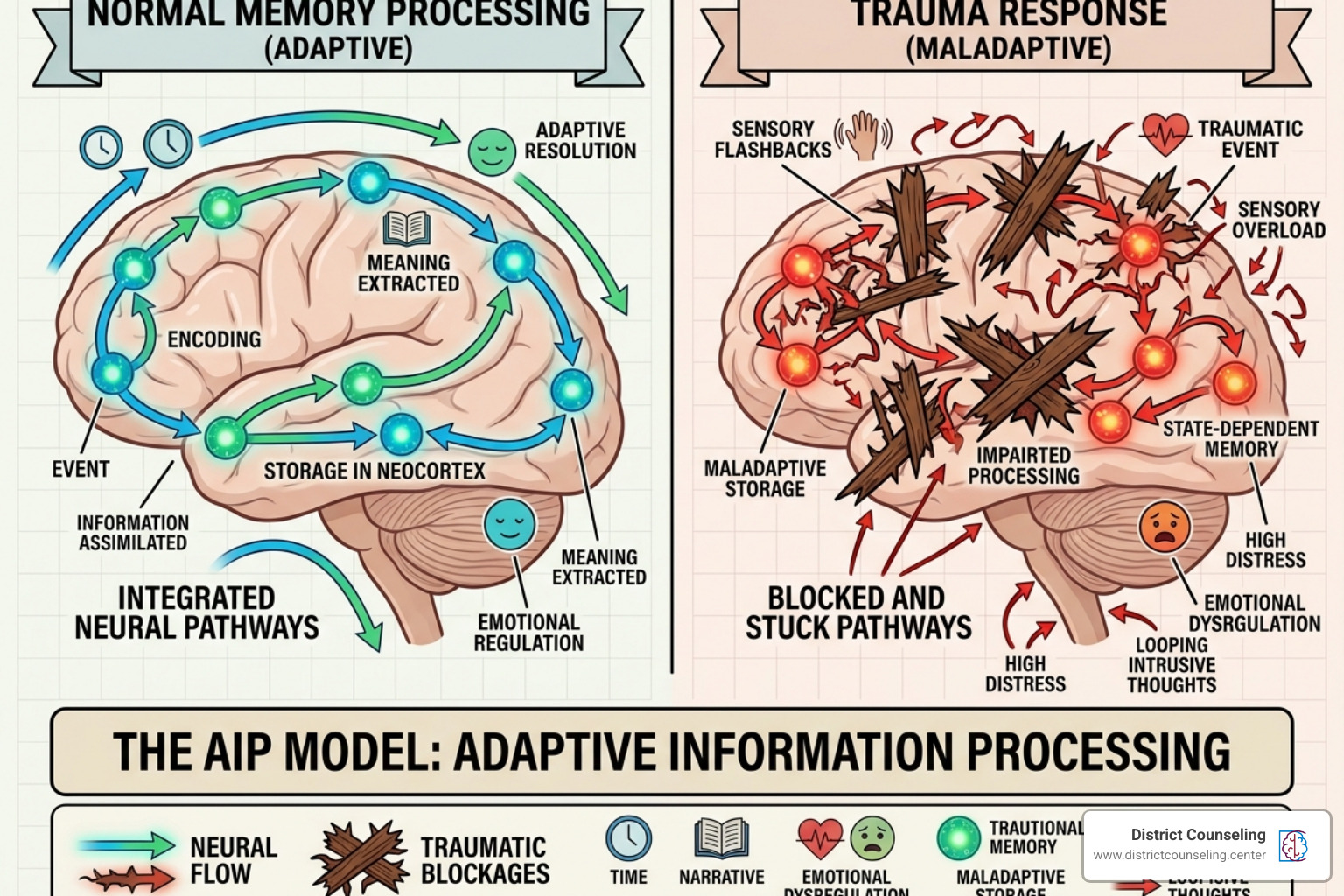
This is the core of the Adaptive Information Processing (AIP) model. Think of your brain like a physical wound. If you cut your hand, your body naturally works to close the wound. But if a foreign object — like a splinter of trauma — stays in the wound, it festers and causes pain. The AIP model suggests that trauma symptoms are simply the result of these “splinters” or unprocessed memories.
When a memory is stuck, it retains the original sights, sounds, smells, and even the physical sensations of the event. This is why a veteran might hit the ground when a car backfires, or a survivor of an accident might feel their heart race when seeing a similar car. The brain thinks the trauma is still happening. Trauma Counseling helps address these triggers, but EMDR specifically targets the storage of the memory itself. According to the American Psychological Association, EMDR reduces the vividness and emotional charge of these memories, allowing the brain to resume its natural healing process.
The history and origin of EMDR
The story of EMDR began in a park in 1987. Dr. Francine Shapiro was walking when she noticed that moving her eyes rapidly back and forth seemed to dissipate her own distressing thoughts. Intrigued, she began experimenting with this technique and developed a standardized protocol.
By 1989, the first clinical trial was published, showing remarkable success in treating PTSD. Since those early days, the therapy has evolved from a simple eye-movement technique into a comprehensive eight-phase approach. Today, it is recognized globally by organizations like the World Health Organization (WHO) and the Department of Defense. At District Counseling, we utilize EMDR Treatment because it is one of the most thoroughly researched methods for moving clients from “surviving” to “thriving.”
Who can benefit from this treatment?
While EMDR is famous for its success with veterans and combat PTSD, its reach is much broader. In April 2026, we see more people than ever seeking this therapy for “small-t” traumas — those life events that aren’t necessarily life-threatening but are deeply distressing, such as a difficult divorce, a job loss, or childhood neglect.
According to Harvard Health, EMDR is beneficial for:
- Survivors of single-incident trauma: Such as car accidents, natural disasters, or physical assaults.
- Individuals with complex trauma: Those who experienced long-term abuse or neglect during childhood.
- People struggling with phobias: Whether it’s a fear of flying or public speaking.
- Anxiety and Depression: Especially when these conditions are rooted in past negative experiences.
- First Responders and Healthcare Workers: Addressing the cumulative stress of their professions.
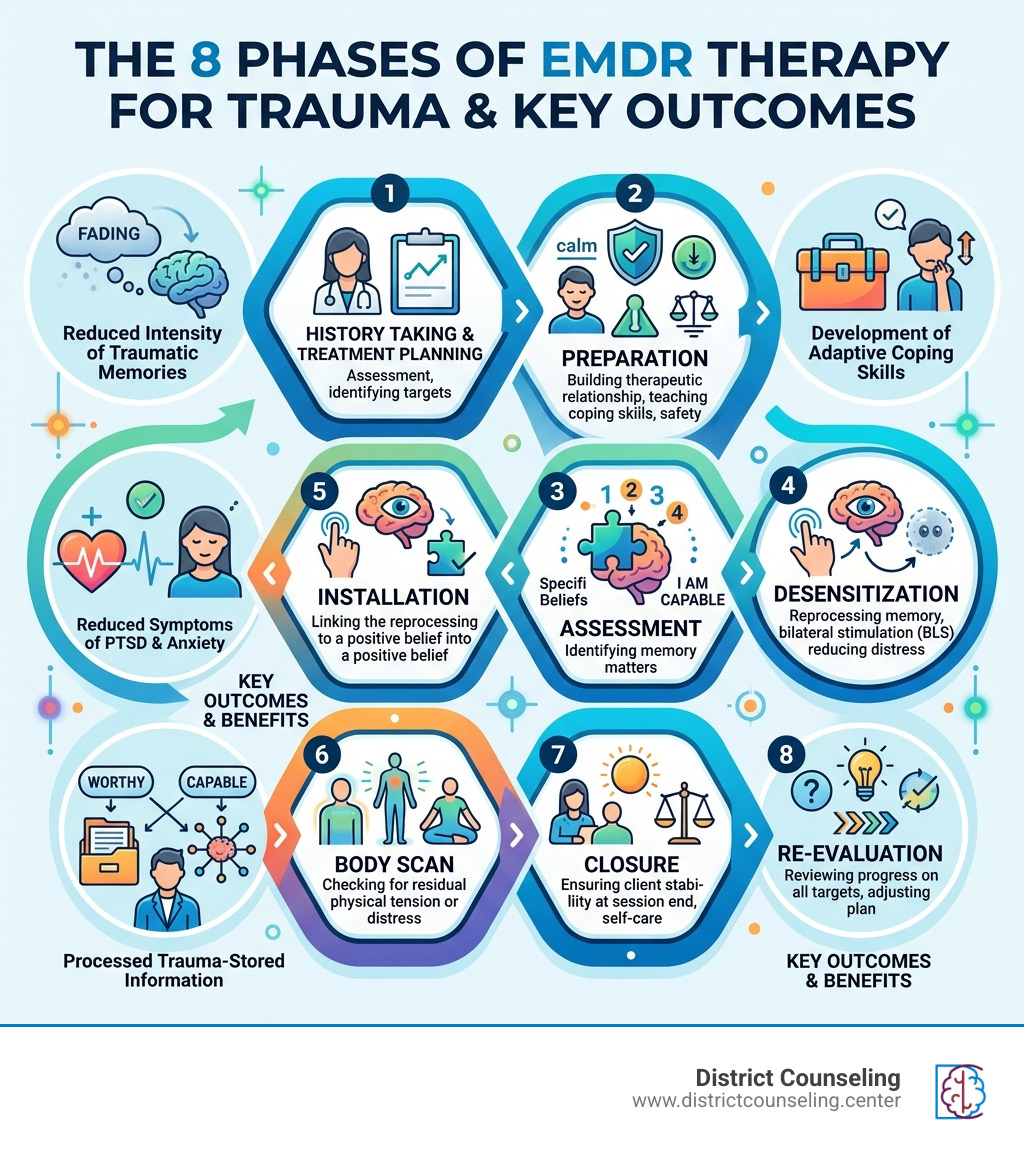
The eight phases of the EMDR process
One of the reasons EMDR therapy for trauma is so reliable is its structure. It isn’t just about moving your eyes; it is a carefully choreographed process designed to ensure your safety and success.

- History Taking: We discuss your background and identify potential “targets” (memories) for reprocessing.
- Preparation: We teach you specific “grounding” techniques to manage emotional distress. You won’t start reprocessing until you feel safe and equipped.
- Assessment: We “activate” the memory by identifying the visual image, the negative belief (e.g., “I am in danger”), and the physical sensations associated with it.
- Desensitization: This is the phase involving bilateral stimulation. We focus on the memory while your eyes follow a hand, or you listen to tones. The goal is to lower your distress.
- Installation: We strengthen a positive belief (e.g., “I am safe now”) to replace the old negative one.
- Body Scan: We check for any lingering physical tension. If your stomach still feels knotted when thinking of the event, we continue processing.
- Closure: We ensure you feel grounded and stable before you leave the session.
- Reevaluation: At the start of the next session, we check the progress made on the previously processed memory.
For our Spanish-speaking neighbors in areas like Pasadena or Missouri City, we offer Tratamiento EMDR to ensure these life-changing phases are accessible in your native language.
What to expect during EMDR therapy for trauma
If you’ve never done EMDR, the “bilateral stimulation” (BLS) part can sound a bit like science fiction. In reality, it’s quite simple. While you hold a specific memory in your mind, we provide a rhythmic stimulus that crosses the left and right sides of your body.
This can take several forms:
- Visual: Following the therapist’s fingers or a light bar with your eyes.
- Auditory: Listening to alternating tones in headphones.
- Tactile: Holding small buzzers (tappers) that vibrate in your hands or tapping on your own shoulders (the “Butterfly Hug”).
During this process, we use two key scales to track your progress. The SUD (Subjective Units of Disturbance) scale ranges from 0 to 10, where 10 is the worst distress imaginable. The VOC (Validity of Cognition) scale measures how true a positive belief feels on a scale of 1 to 7. As the Cleveland Clinic notes, the goal is to bring the SUD to 0 and the VOC to 7.
The role of bilateral stimulation in healing
Why does moving your eyes help your brain? While research is ongoing, the leading theory is that BLS creates a “dual attention” state. You have one foot in the past (the memory) and one foot firmly in the present (the tapping or eye movements).
This process is thought to mimic the natural memory-processing that happens during REM (Rapid Eye Movement) sleep. By taxing your working memory, BLS makes the traumatic image less vivid and less emotional. It helps the amygdala (the brain’s alarm system) calm down, allowing the hippocampus to file the memory away as a “past event” rather than a “present threat.” Exploring EMDR and Brainspotting reveals how these different types of stimulation can reach the deep, subcortical parts of the brain where traditional talk therapy often can’t reach.
The science of success: Effectiveness of EMDR therapy for trauma
The statistics surrounding EMDR therapy for trauma are nothing short of astounding. When mental health treatment can sometimes feel like a slow crawl, EMDR is often a sprint.
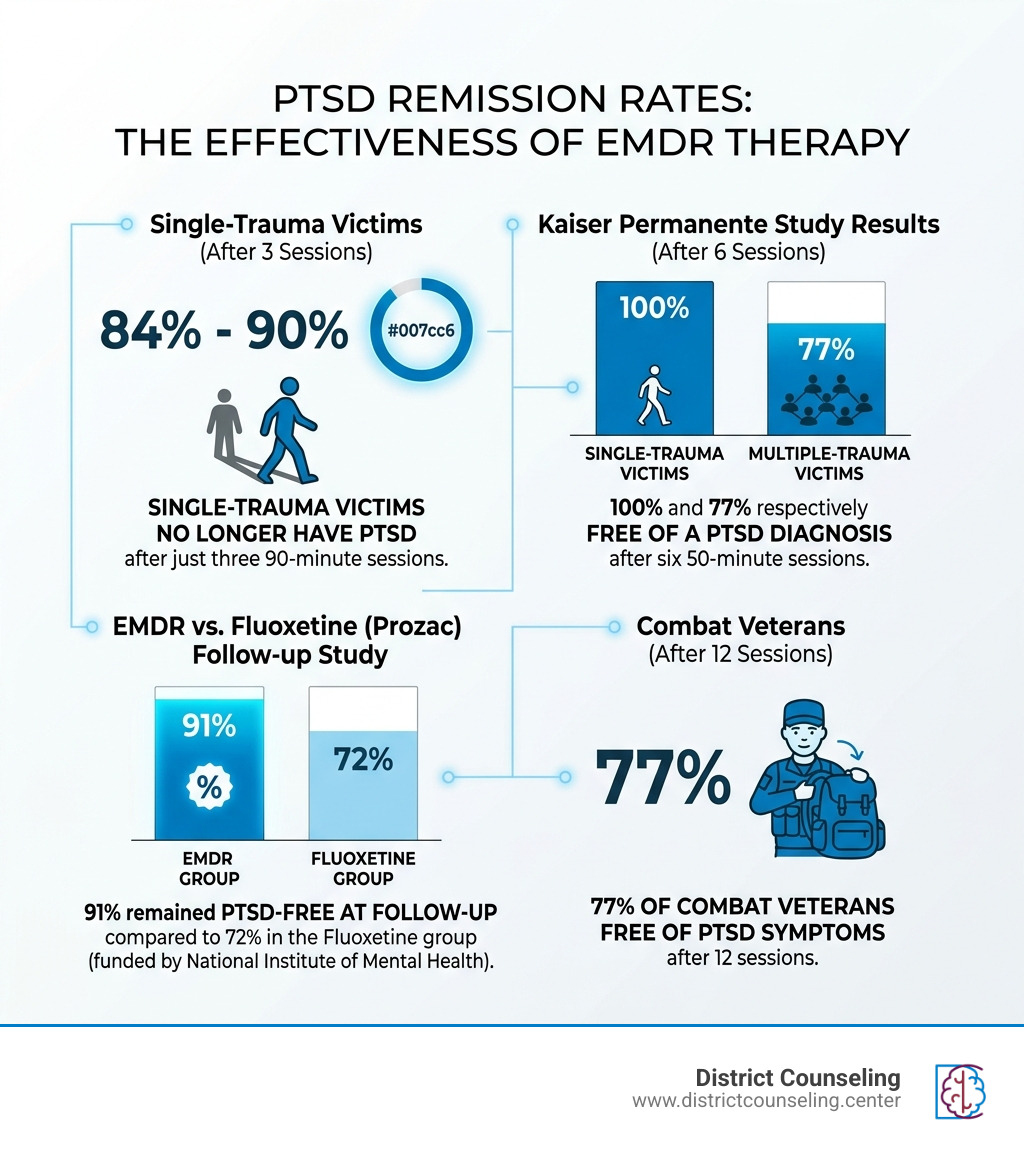
Consider these research-backed facts:
- 84% to 90% of single-trauma victims no longer have PTSD after just three 90-minute sessions.
- A Kaiser Permanente study found that 100% of single-trauma victims and 77% of multiple-trauma victims were free of a PTSD diagnosis after only six 50-minute sessions.
- In a study funded by the National Institute of Mental Health, 91% of the EMDR group remained PTSD-free at follow-up, compared to only 72% of those taking fluoxetine (Prozac).
- 77% of combat veterans were free of PTSD symptoms after 12 sessions.
With 24 randomized controlled trials supporting its use, EMDR is a heavyweight in evidence-based care. For those in Houston or Katy looking for PTSD Treatment Options, these numbers offer real, tangible hope.
Comparing EMDR to CBT and Prolonged Exposure
When choosing a therapy, many clients wonder how EMDR stacks up against Cognitive Behavioral Therapy (CBT) or Prolonged Exposure (PE). While all are effective, EMDR offers some unique advantages.
| Feature | EMDR Therapy | Trauma-Focused CBT / PE |
|---|---|---|
| Homework | Rarely required | Extensive (worksheets, exposure tasks) |
| Verbal Detail | Minimal talking about the event | Detailed verbal or written accounts |
| Mechanism | Bilateral Stimulation / AIP Model | Challenging thoughts / Habituation |
| Speed | Often faster (3-12 sessions) | Typically 12-20+ sessions |
One of the biggest draws for our clients at District Counseling is the lack of homework. In our busy Texas lives — whether you’re commuting in Houston or raising a family in The Woodlands — finding hours to do therapy homework can be a barrier. EMDR does the heavy lifting during the session. Furthermore, for those who find it too painful to speak the words of their trauma out loud, EMDR provides a way to heal without a “forced” confession. During PTSD Awareness Month, we often highlight these differences to help people choose the path that feels safest for them.
Long-term benefits and risks
The goal of EMDR isn’t just to make you feel better for a week; it’s to change your brain’s relationship with the past. Clients often report a sense of “emotional regulation” they’ve never had before. They feel more resilient and less “reactive” to the world around them.
However, like any powerful treatment, there are side effects to be aware of. Because EMDR opens up the brain’s “files,” you might experience:
- Vivid dreams: Your brain continues processing while you sleep.
- Temporary distress: You might feel a bit more emotional or tired for a day or two after a session.
- New memories: Sometimes, processing one memory brings up a related one you had forgotten.
These are actually signs that the treatment is working. For parents considering this for their little ones, Trauma Counseling for Children often uses modified EMDR protocols that are gentler and more play-based to ensure the child feels supported throughout the process.
Frequently Asked Questions about EMDR
How many sessions will I need?
This is the most common question we hear at our locations in Pearland and Sugar Land. For a “single-incident” trauma — like a one-time accident — you might see significant relief in 3 to 6 sessions. For “complex” or “developmental” trauma — things that happened repeatedly over many years — it may take 12 sessions or more. We usually recommend 60 to 90-minute blocks for reprocessing to ensure we have enough time to “open” and “close” the memory safely.
Is EMDR available in the VA?
Yes! The Department of Veterans Affairs and the Department of Defense have listed EMDR as a “best practice” for treating combat-related PTSD. It is widely available in VA settings because it works so effectively for veterans who may be tired of traditional talk therapy.
Do I have to talk about my trauma in detail?
One of the most “eye-opening” things about EMDR therapy for trauma is that you don’t have to tell us every “gory detail.” You only need to hold the image in your mind. This makes it an excellent choice for people who have jobs that require high levels of privacy or for those whose trauma is too shameful or painful to put into words. Your internal processing is what does the work; we are simply the guides.
Conclusion
Trauma has a way of making the world feel small, dangerous, and exhausting. But as we’ve seen, your brain has an incredible, innate capacity to heal if the “splinters” are removed. EMDR therapy for trauma isn’t just about looking at the past; it’s about clearing the path for a much brighter future.
At District Counseling, we are proud to serve communities across Texas — from the bustling CityCentre in Houston to the quiet streets of Tomball and the growing neighborhoods of Fort Worth. Our approach is sincere, authentic, and compassionate. We don’t just see symptoms; we see people who are ready to reclaim their lives.
If you are tired of feeling “stuck” in a memory that should have stayed in the past, we are here to help. Our team of specialists is ready to walk with you through every phase of the healing process, whether in person or through our convenient telehealth options.
Start your healing journey today and see why EMDR is the eye-opening treatment you’ve been waiting for.
Visited 11 times, 1 visit(s) today
Similar Posts

Adalid Blandin
September 4, 2026
Spotting the Signs and Finding Help for Emotional Abuse
Recognize emotional abuse signs and connect with a relationship emotional abuse therapist for healing and support....

Francisco Ortiz
September 2, 2026
Riding Out the Storm: The Four Horsemen of Couples Therapy and Their Antidotes
Learn how the four horsemen couples therapy framework identifies destructive conflict patterns and provides proven antidotes to strengthen your relationship....

Francisco Ortiz
August 31, 2026
Premarital Counseling Online: Prep for Marriage from Your Couch
Prepare for marriage with premarital counseling online from your couch. Build skills, save on licenses, and strengthen your future today....

Francisco Ortiz
August 28, 2026
Licensed Telehealth Therapy Providers in Texas: A Quick Start Guide
Find licensed telehealth therapy Texas providers with this guide to legal rules, insurance parity, and clinical best practices....

Francisco Ortiz
August 26, 2026
The Intimacy Fix: What to Expect from Couples Sex Counselling
Learn how a relationship counsellor sex specialist helps couples rebuild intimacy, desire, and trust through evidence-based therapy....

Francisco Ortiz
August 24, 2026
Before the Nikah: Navigating Islamic Premarital Counseling
Discover how premarital counseling Islam builds a sacred, lasting union through faith-based modules, therapy, and practical guidance before your Nikah....

Francisco Ortiz
August 21, 2026
The Ultimate Guide to West Lake Hills Family Counseling and Keeping the Peace
The Ultimate Guide to West Lake Hills Family Counseling and Keeping the Peace – Learn about west lake hills family counseling...

Francisco Ortiz
August 19, 2026
How Relationship Therapy for Couples Can Save Your Sanity
Discover how relationship therapy for couples can restore connection, resolve conflict, and rebuild trust with evidence-based guidance....

Francisco Ortiz
August 17, 2026
Ready to Wed: What to Expect in Christian Premarital Counseling
Discover what to expect in premarital counseling Christian couples trust for a strong, faith-based marriage foundation....

Francisco Ortiz
August 14, 2026
Space City Love: Navigating Gottman Method Couples Therapy in Houston
Discover how Gottman Method couples therapy in Houston helps partners rebuild intimacy, manage conflict, and strengthen their bond with expert guidance....


