
When Exhaustion Won’t Go Away: What You Need to Know About ADHD Therapy Burnout Relief
ADHD therapy burnout relief is the process of recovering from the deep mental, emotional, and physical exhaustion that builds when someone with ADHD has been pushing too hard for too long — and it requires more than just rest.
Here is a quick breakdown of what actually helps:
| What to Do | Why It Works |
|---|---|
| Reduce demands immediately | Stops the drain on your depleted executive system |
| Prioritize sleep and basic self-care | Restores the neurological foundation for functioning |
| Work with an ADHD-specialized therapist | Addresses shame, patterns, and coping strategies at the root |
| Practice micro-mindfulness | Regulates the nervous system without overwhelming effort |
| Set boundaries and stop overcommitting | Breaks the cycle before it restarts |
| Use external tools (planners, timers, body doubles) | Offloads cognitive work your brain can’t currently handle |
If you have ADHD, your brain works harder than most people realize. Simple tasks — managing time, filtering distractions, regulating emotions — demand significantly more mental energy than they do for neurotypical people. Over time, that extra effort adds up.
By April 2026, an estimated 15.5 million adults in the United States had received an ADHD diagnosis. About half of them were diagnosed as adults — meaning many spent years not knowing why everything felt so much harder. That kind of chronic, unrecognized strain has a name: ADHD burnout.
This is not ordinary tiredness. It is a functional collapse — a state where your brain’s executive system has simply run out of fuel. Motivation disappears. Brain fog sets in. Tasks you normally handle feel impossible. And unfortunately, the standard advice — “just rest more” or “try harder” — often makes things worse, not better.
You are not broken. Your system is overloaded.
I’m Francisco Ortiz, a Licensed Professional Counselor-Supervisor with extensive experience helping individuals navigate mood disorders, trauma, and complex mental health challenges, including ADHD therapy burnout relief. In this guide, I’ll walk you through exactly what ADHD burnout is, why it happens, and what actually works to help you recover and stay recovered.
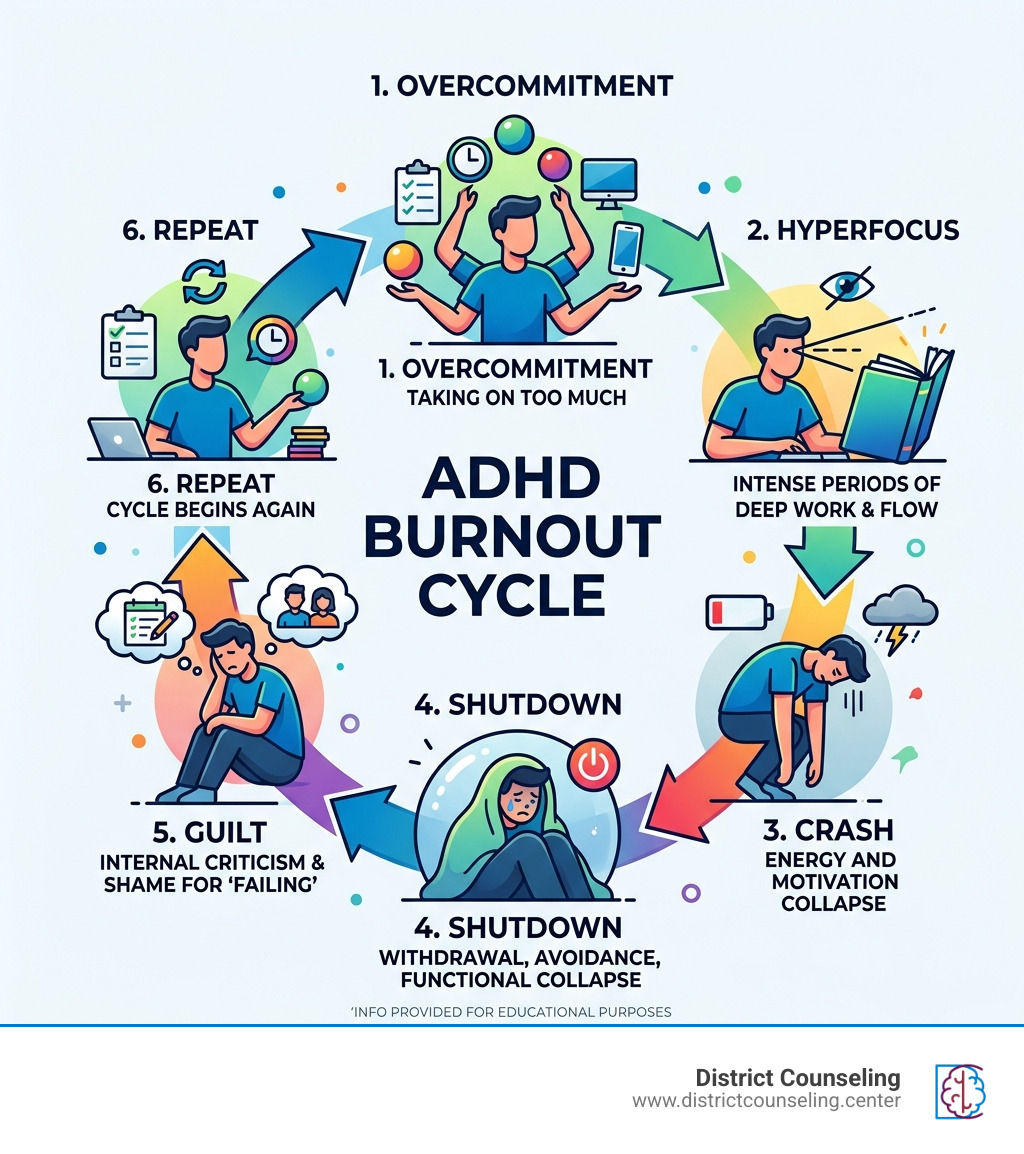
Understanding the ADHD Burnout Cycle and Symptoms
To find ADHD therapy burnout relief, we first have to recognize that this state is distinct from other mental health struggles. Many of our clients in Houston and Katy come to us thinking they are “just lazy” or “clinically depressed.” While the symptoms can overlap, the root causes are very different.
ADHD Burnout vs. Clinical Depression
It is easy to confuse the two because both involve low energy and a loss of interest in activities. However, clinical depression is often pervasive and persistent regardless of the situation. ADHD burnout is task-related and stems from chronic executive function strain. When you are burned out, you want to do the things you love, but your “brain battery” is at 0%.
| Feature | ADHD Burnout | Clinical Depression |
|---|---|---|
| Primary Cause | Chronic over-functioning and masking | Complex biological/psychological factors |
| Energy Levels | Depleted by specific cognitive demands | Consistently low across all settings |
| Motivation | High desire, low execution (task paralysis) | General loss of interest (anhedonia) |
| Response to Rest | Requires demand reduction and regulation | May persist despite lifestyle changes |
The Physical and Cognitive Toll
The symptoms of ADHD burnout are not just in your head; they are systemic. You might experience chronic physical fatigue that doesn’t go away after a long night’s sleep. Research shows that adults with ADHD are about eight times more likely to have a diagnosed sleep disorder than those without, which compounds the exhaustion.
Cognitive overload leads to “brain fog” and “task paralysis.” This is where you stare at a simple email for forty minutes, unable to type a single word. Your prefrontal cortex—the part of the brain responsible for planning and self-control—has effectively gone offline.
Masking and the 2024 Research
A 2024 study highlighted that people with ADHD report significantly higher levels of “camouflaging” or masking than neurotypical groups. Masking is the act of suppressing ADHD traits to fit into social or professional environments. It is exhausting. It’s like running a marathon while pretending you aren’t even breathing hard. This constant performance is a primary driver of the eventual crash.
If you are feeling this level of collapse, it may be time to look into ADHD evaluation services to understand how your specific brain chemistry is contributing to your stress levels. According to Psychology Today, understanding these symptoms is the first step toward effective management.
The Role of Sensory Overload in ADHD Therapy Burnout Relief
One of the most overlooked factors in burnout is sensory processing. For many with ADHD, the world is too loud, too bright, and too “fast.” This is due to issues with thalamic filtering—the brain’s ability to “tune out” irrelevant background noise or sensations.
When your brain can’t filter, every humming refrigerator, bright fluorescent light, and scratchy clothing tag is processed as a high-priority alert. This creates a state of constant overstimulation. Over time, this sensory load drains your cognitive reserves, leading to a faster burnout.

In our Texas locations, like Fort Worth and Cypress, we often see a crossover between ADHD and sensory sensitivities. If you find that environments are consistently overwhelming, you might also benefit from exploring autism testing in Fort Worth to see if a broader neurodivergent profile is at play. Using sensory grounding techniques—like weighted blankets or noise-canceling headphones—can provide immediate ADHD therapy burnout relief by lowering the “static” your brain has to process.
Why Executive Function Strain Triggers the Crash
The “crash” in ADHD burnout is often the result of dopamine dysregulation. Because the ADHD brain has lower baseline levels of dopamine, we often rely on “emergency” neurochemicals like adrenaline and cortisol to get things done. We use the “panic” of a deadline to force focus.
Common triggers for the crash include:
- Hyperfocus Cycles: Spending twelve hours on a project while forgetting to eat, drink, or sleep.
- Rejection Sensitivity Dysphoria (RSD): The intense emotional pain of perceived failure or criticism, which drives us to over-function to please others.
- Decision Fatigue: Having too many small choices to make in a day, leading to total shutdown.
- Masking Costs: The mental energy spent “acting normal” in meetings or social gatherings.
As noted by Psychology Today, these factors create a “triple effort” model: you are working on the task, working to stay focused on the task, and working to hide the fact that you are struggling. No wonder the system eventually fails.
Evidence-Based Strategies for ADHD Therapy Burnout Relief
Recovery is not about “trying harder” or “being more disciplined.” In fact, those are the very behaviors that caused the burnout. True ADHD therapy burnout relief comes from radical demand reduction and nervous system regulation.
Nervous System Regulation and Low-Demand Living
When you are in the depths of burnout, your nervous system is stuck in a sympathetic “fight or flight” state. To recover, you need to move into a parasympathetic “rest and digest” state. This requires “low-demand living.” This means canceling non-essential appointments, simplifying your meals, and lowering your expectations for productivity.

In Katy, we offer neurofeedback therapy for ADHD, which can help retrain the brain to reach these calmer states more effectively.
The Energy Accounting Method
Think of your energy like a bank account. Every task is a withdrawal, and every restorative activity is a deposit. People with ADHD often make massive withdrawals without checking the balance.
- Withdrawals: Noisy offices, long meetings, masking, complex chores.
- Deposits: Time in nature, “parallel play” (being near someone without talking), pursuing a “joy” project, and high-quality sleep.
According to the Bipolar Lives Clinical Guide, prioritizing sleep is non-negotiable. Since we face an 8x higher risk of sleep disorders, working with a clinician to stabilize your sleep-wake cycle is often the single most effective step in recovery.
How Specialized ADHD Therapy Burnout Relief Works
Standard talk therapy can sometimes feel like “one more chore” for a burned-out brain. However, specialized therapy is designed to offload the burden, not add to it.
At District Counseling, we focus on personalized ADHD treatment and interventions that address the specific mechanics of neurodivergence.
- Cognitive Behavioral Therapy (CBT) Adaptations: Instead of just looking at thoughts, we look at systems. We help you challenge the “shame” of not being productive and replace it with self-compassion.
- Emotional Regulation Skills: Since 34–70% of adults with ADHD experience significant emotional dysregulation, we teach tools to manage the “big feelings” that often lead to burnout.
- Occupational Therapy & Coaching: This focuses on the “how” of life—building routines that work with your brain rather than against it.
- Psychodynamic Support: We address the deep-seated “ADHD shame”—the feeling that you are fundamentally flawed because you can’t keep up with neurotypical standards.
Building a Sustainable Path to Long-Term Recovery
Once you have achieved some ADHD therapy burnout relief, the goal is to prevent the cycle from restarting. This requires a shift from “coping” to “sustainable living.”
The 70% Capacity Rule
Most people are taught to give 100%. For an ADHD brain, giving 100% usually means you are tapping into your emergency reserves. We recommend aiming for 70% capacity. This leaves a 30% “buffer” for the unexpected—like a late car, a sick child, or a sudden sensory overload. If you hit 70%, you are done for the day.
Workplace Accommodations and Unmasking
You don’t have to do this alone. Under the ADA, ADHD is a recognized disability, and you may be eligible for workplace accommodations. These might include:
- Flexible start/end times to accommodate sleep patterns.
- Permission to wear noise-canceling headphones.
- Written instructions rather than verbal ones to support working memory.
- “Body doubling” (working alongside someone else) to help with task initiation.
Structured but Flexible Planning
Rigid schedules are the enemy of the ADHD brain. They feel like a cage, leading to rebellion and more stress. Instead, we use “flexible structure.” This means having a list of priorities but allowing yourself to choose which one to do based on your current energy levels.
If you’re unsure where to start with these changes, an adult ADHD psychological evaluation can provide a roadmap of your specific strengths and weaknesses, making it easier to advocate for what you need.
Frequently Asked Questions about ADHD Burnout
How long does ADHD burnout typically last?
Recovery timelines vary based on how long you’ve been pushing through the “red zone.”
- Short-term burnout: If caught early, a 2-4 week “reset” with significantly reduced demands can often restore functioning.
- Chronic burnout: If you’ve been masking and over-functioning for years, deep recovery can take 6 months to a year. This isn’t a linear process; you will have good days and bad days. The key is consistent ADHD therapy burnout relief and not rushing back to your “old self.”
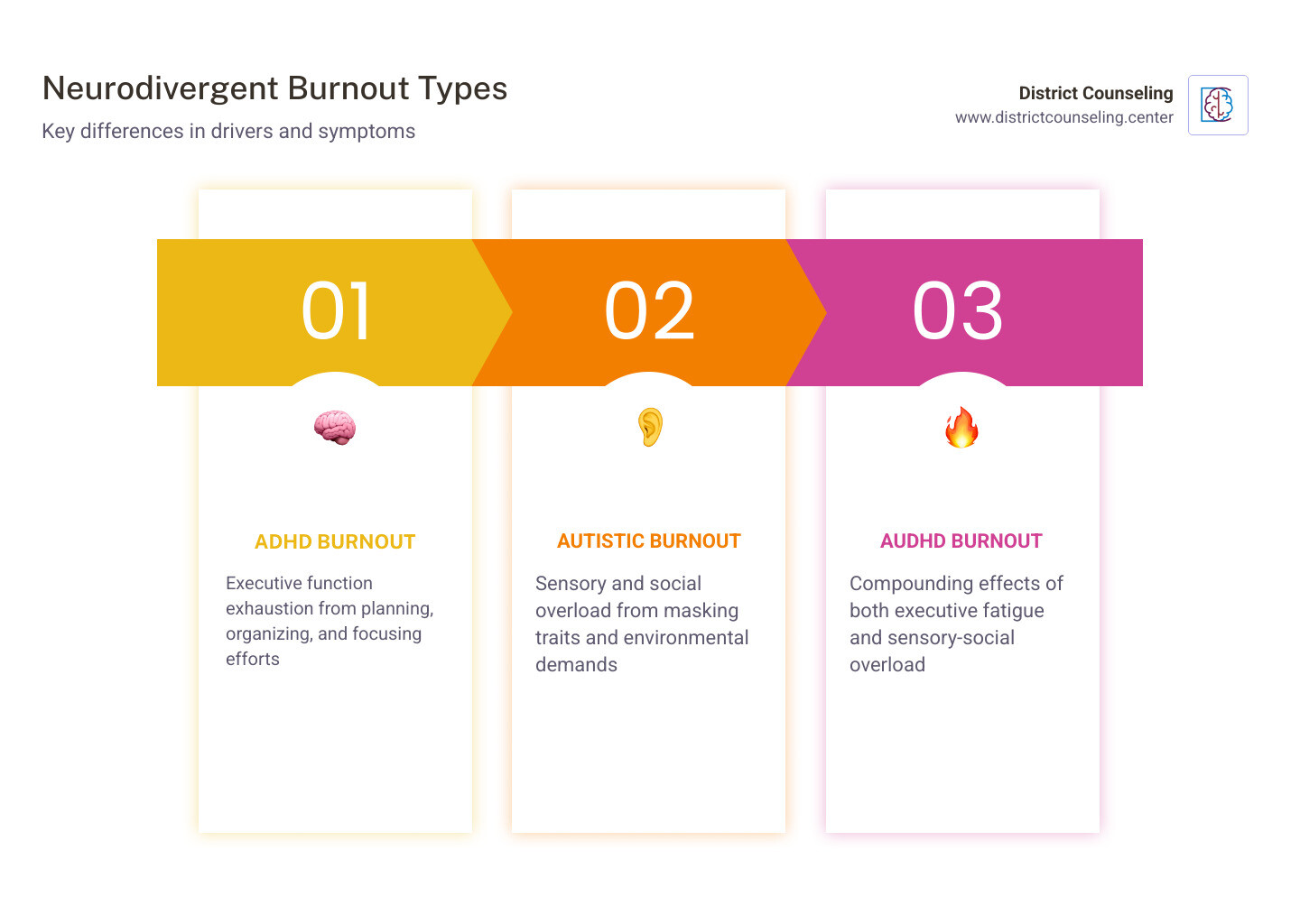
What is the difference between ADHD burnout and autistic burnout?
While they look similar, the drivers are different.
- ADHD Burnout: Primarily driven by executive function exhaustion—the “doing” part of life. It’s the fatigue of trying to organize, plan, and focus.
- Autistic Burnout: Primarily driven by sensory-social overload and the “masking” of social traits. It often involves a temporary loss of skills (like the ability to speak or handle basic chores).
Many people are “AuDHD” (both Autistic and ADHD), meaning they experience a compounding of both types.
Can medication help with burnout recovery?
Yes, but it must be managed carefully. Medication can provide the “dopamine floor” needed to engage in therapy and self-care. However, if you use medication just to “push through” the burnout, you may end up crashing harder later.
If you are in Austin, we recommend ADHD evaluations in Austin to discuss how medication adjustments might support your recovery without leading to further depletion.
Conclusion: Finding Your Way Back to You
Recovering from ADHD burnout is a journey of coming home to yourself. It’s about realizing that you don’t need to be “fixed”—you need to be supported. You deserve a life that doesn’t require you to be in a constant state of emergency.
At District Counseling, we provide sincere, authentic, and compassionate alignment to what matters most to you. Whether you are in Houston, The Woodlands, or Pearland, our team is here to help you navigate the complexities of neurodivergence with dignity.
If you’re feeling the weight of the world, ADHD therapy burnout relief is possible. You don’t have to keep running on empty. We offer specialized support across Texas, including depression and anxiety counseling tailored to the neurodivergent experience.
Reach out to us today at one of our many locations—from CityCentre to Sugar Land—and let’s start building a life that actually fits your brain.
Visited 54 times, 1 visit(s) today
Similar Posts

Francisco Ortiz
October 16, 2026
Navigating Neuropsychological Evaluations from Katy to Pasadena
Back-to-School Mental Health: Tips for a Smooth Transition – Discover practical tips to ease back-to-school anxiety for kids, teens, and parents. Build healthy routines, manage stress, and foster emotional… …...

Francisco Ortiz
October 14, 2026
How Texas caregivers can beat exhaustion with virtual therapy
Beat caregiver exhaustion therapy Texas caregivers trust—virtual sessions for stress, boundaries, and recovery. Start today....

Francisco Ortiz
October 12, 2026
Find Local Youth Counselor: How They Can Help Your Teen Thrive (52 characters)
Find a qualified youth counselor near me to help your teen thrive with evidence-based support for anxiety, trauma, and more....

Francisco Ortiz
October 9, 2026
Faith-Based Pastoral Counseling: A Comprehensive Guide
Discover how pastoral counseling integrates faith and psychology for holistic healing, grief, trauma, and marital support....

Francisco Ortiz
October 7, 2026
Houston Counseling Options: Find Local Help Nearby
Find affirming counseling in Houston for trauma, LGBTQ+ care, couples, and more. Explore local options and start your healing today....

Francisco Ortiz
October 5, 2026
Why every teacher needs a burnout therapy game plan
Why every teacher needs a burnout therapy game plan – Learn about burnout therapy for teachers...

Francisco Ortiz
October 2, 2026
Child Therapist Near Me? Here is How to Spot a Great One
Find a child therapist near me who fits your child’s needs. Learn signs, costs, and effective therapy options....

Adalid Blandin
September 30, 2026
Mental Health and Miracles: Finding Local Christian Care
Find pastoral counselling near me for faith-based emotional and spiritual support in Texas....

Adalid Blandin
September 28, 2026
Missouri City and Houston Couples Therapy 101
Explore relationship counseling in Houston options, from couples therapy to intensives, with costs, insurance, and therapist tips for Missouri City families....

Adalid Blandin
September 25, 2026
How to find authentic therapy for emotional exhaustion in Houston
Find emotional exhaustion therapy Houston that helps professionals and caregivers move from burnout to renewed energy and balance....


